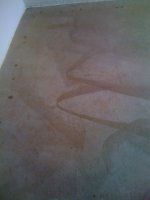
After finally completing grinding my whole garage floor down, I noticed there are spots that become damp when it rains. Since the floor obviously has water coming through it I'm thinking that my original plan of putting an epoxy floor down is not going to work. The previous owner must have done a termite treatment around the perimeter of the garage and subsequently patched the holes. I'm thinking about resorting to a stain, or if anyone has any other options they would be appreciated.


You are using an out of date browser. It may not display this or other websites correctly.
You should upgrade or use an alternative browser.
You should upgrade or use an alternative browser.
Water coming through concrete
- Thread starter cdw1982
- Start date

Wingnut65
Well-known member
Water coming up doesn't sound good. Are the damp spots right at the termite treatment holes, along the walls, in the middle, along the door with the door open (Oops, thats just me). Is the water just along the exterior wall(s) or elsewhere? Is this an attached garage, assuming probably yes or these holes would have gone outside...
A little more info and others will be able to give some ideas. Interlocking tiles are another solution if you venture that way.
jeff
A little more info and others will be able to give some ideas. Interlocking tiles are another solution if you venture that way.
jeff
Elkiebob
Well-known member
It is called hydrostatic pressure. You need to install a sump pump to relieve the pressure.
thegarageguy
Well-known member
Whats needed first is a Moisture Vapor Emissivity Reduction System) or Negative Side Moisture Vapor Barrier System before installing an epoxy flooring system.
The other alternative and preferred system in these situations is a hybrid urethane broadcast system that is poured at a 1/4 inch thick, faster turn around, resists 12 to 20 lbs of vapor emissions and much much tougher than epoxy system.
Of course both systems are pro installed and a bit pricier than your standard thin film garage flooring system.
The other alternative and preferred system in these situations is a hybrid urethane broadcast system that is poured at a 1/4 inch thick, faster turn around, resists 12 to 20 lbs of vapor emissions and much much tougher than epoxy system.
Of course both systems are pro installed and a bit pricier than your standard thin film garage flooring system.
I just bought a house with an attached 30x40 garage which I was very excited about, until after I moved in when I noticed I have moisture collecting under anything that is on the floor; seems like the whole thing, not just an isolated area. Can anything be done about this that's DIY-able, or am I stuck with a "wet" floor? The garage is older, it was probably added on in the early '90s..thanks in advance!!
I would buy a water pressure test kit (They are also called Calcium Chloride tests). This will tell you how much hydrostatic pressure you have. A good 100% solids epoxy will withstand up to 12 or so psi of hydrostatic pressure. If you need more info on this PM me.
thegarageguy
Well-known member
A good 100% solids epoxy will withstand up to 12 or so psi of hydrostatic pressure. If you need more info on this PM me.
WOW!! We use (IMO) very high end 100% solids epoxies and according to their product data sheets, all of them rate 3lbs per 24 hrs at 1000 sqft.
Please send us a link to your 100% solids product data sheet. Thanks.
csp
Well-known member
Can anything be done about this that's DIY-able, or am I stuck with a "wet" floor?
What is the drainage around the building like? Do you have downspouts that dump rainwater right next to the foundation? Is there any sort of perimeter drain?
Unless the building sits in an area with a high water table most water issues can be taken care of with proper perimeter drainage.
It may or may not be DIY, but without more info it's hard to tell.
YeOldeLancer
Member
- Joined
- Jun 9, 2010
- Messages
- 5
Hi,
I just moved into a row townhouse and my garage is below-grade. (It's like a basment) I am also experiencing water coming up from under the slab. There is no drainage around the unit (it's a rowhouse) and I can't find anything online to alleviate this. I've read numerous posts on putting a dehumidifier in the garage but I don't think that will solve the problem, only alleviate it. Also, it would be constatly running, driving up the energy bill plus it would kill the life of the dehumidifier.
Is there a way to put new flooring over it so that moisture doesn't come up? I found a post on another site that quotes from the "Ulitmate Garage Handbook" that says to put a layer of asphalt down, a moisture barrier and a layer of outdoor plywood, then to lay down tiling or whatever other flooring desired.
Here is the post:
"To answer your question let’s go back to the source that started this discussion: The Ultimate Garage Handbook:
According to the author:
Page 19:
“If you find any moisture, your flooring choices are limited. Paint is simply out of the question. Installing vinyl tile will require the construction of a sub-floor under the tile. Even carpeting is questionable since the moisture will attack the carpet backing.
Page 26, caption to photo
“If you have to put down a floor in your garage because of ground moisture migrating through the concrete here is the correct sequence: the asphalt underlay goes down first, followed by a heavy plastic sheet, ¼-inch exterior plywood goes on top of the plastic; then start with your tile.”
The photo shows a staggered view of the four layers. The first three (asphalt, plastic and plywood) are very thin. The asphalt looks to be about the thickness of a sheet of paper and the plastic is transparent -- no further specs are mentions about the thickness of the plastic. As mentioned the plywood is 1/4". Then the tile du jours"
I just moved into a row townhouse and my garage is below-grade. (It's like a basment) I am also experiencing water coming up from under the slab. There is no drainage around the unit (it's a rowhouse) and I can't find anything online to alleviate this. I've read numerous posts on putting a dehumidifier in the garage but I don't think that will solve the problem, only alleviate it. Also, it would be constatly running, driving up the energy bill plus it would kill the life of the dehumidifier.
Is there a way to put new flooring over it so that moisture doesn't come up? I found a post on another site that quotes from the "Ulitmate Garage Handbook" that says to put a layer of asphalt down, a moisture barrier and a layer of outdoor plywood, then to lay down tiling or whatever other flooring desired.
Here is the post:
"To answer your question let’s go back to the source that started this discussion: The Ultimate Garage Handbook:
According to the author:
Page 19:
“If you find any moisture, your flooring choices are limited. Paint is simply out of the question. Installing vinyl tile will require the construction of a sub-floor under the tile. Even carpeting is questionable since the moisture will attack the carpet backing.
Page 26, caption to photo
“If you have to put down a floor in your garage because of ground moisture migrating through the concrete here is the correct sequence: the asphalt underlay goes down first, followed by a heavy plastic sheet, ¼-inch exterior plywood goes on top of the plastic; then start with your tile.”
The photo shows a staggered view of the four layers. The first three (asphalt, plastic and plywood) are very thin. The asphalt looks to be about the thickness of a sheet of paper and the plastic is transparent -- no further specs are mentions about the thickness of the plastic. As mentioned the plywood is 1/4". Then the tile du jours"
YeOldeLancer
Member
- Joined
- Jun 9, 2010
- Messages
- 5
Bump anyone?
AlphaGarage
Well-known member
"Barrier-1" has a topical applied product that "will stop hydrostatic pressure, capillary action and micro silica alkali attack." The product has a 10 year performance warranty. Not a DIY product though.
(Their systems are very good at what they're designed to do, but one problem was that the treated concrete couldn't be coated, nothing they tried would adhere to it. Eventually someone tried a Wolverine BondTite epoxy on it and found that it did stick, and now Barrier-1 is offering BondTite 1503 to finish off their water proofing system.)
(Their systems are very good at what they're designed to do, but one problem was that the treated concrete couldn't be coated, nothing they tried would adhere to it. Eventually someone tried a Wolverine BondTite epoxy on it and found that it did stick, and now Barrier-1 is offering BondTite 1503 to finish off their water proofing system.)
Last edited:
WOW!! We use (IMO) very high end 100% solids epoxies and according to their product data sheets, all of them rate 3lbs per 24 hrs at 1000 sqft.
Please send us a link to your 100% solids product data sheet. Thanks.
Here is the link http://www.epoxy-coat.com/u350_pds.php
I have not looked for the hydrostatic pressure on the data sheet. If its not there, I will check with the chemist and the owner of the company, I do know I have seen the document, just have to locate it for you.
YeOldeLancer
Member
- Joined
- Jun 9, 2010
- Messages
- 5
"Barrier-1" has a topical applied product that "will stop hydrostatic pressure, capillary action and micro silica alkali attack." The product has a 10 year performance warranty. Not a DIY product though.
(Their systems are very good at what they're designed to do, but one problem was that the treated concrete couldn't be coated, nothing they tried would adhere to it. Eventually someone tried a Wolverine BondTite epoxy on it and found that it did stick, and now Barrier-1 is offering BondTite 1503 to finish off their water proofing system.)
Thanks for the info! I will look into this.

YeOldeLancer
Member
- Joined
- Jun 9, 2010
- Messages
- 5
Are their any other suggestions for DIY? It looks like Barrier-1 operates out of FL. I live in WI. 
What do you guys think about the above mentioned flooring?
Page 19:
“If you find any moisture, your flooring choices are limited. Paint is simply out of the question. Installing vinyl tile will require the construction of a sub-floor under the tile. Even carpeting is questionable since the moisture will attack the carpet backing.
Page 26, caption to photo
“If you have to put down a floor in your garage because of ground moisture migrating through the concrete here is the correct sequence: the asphalt underlay goes down first, followed by a heavy plastic sheet, ¼-inch exterior plywood goes on top of the plastic; then start with your tile.”
The photo shows a staggered view of the four layers. The first three (asphalt, plastic and plywood) are very thin. The asphalt looks to be about the thickness of a sheet of paper and the plastic is transparent -- no further specs are mentions about the thickness of the plastic. As mentioned the plywood is 1/4". Then the tile du jours"
What do you guys think about the above mentioned flooring?
Page 19:
“If you find any moisture, your flooring choices are limited. Paint is simply out of the question. Installing vinyl tile will require the construction of a sub-floor under the tile. Even carpeting is questionable since the moisture will attack the carpet backing.
Page 26, caption to photo
“If you have to put down a floor in your garage because of ground moisture migrating through the concrete here is the correct sequence: the asphalt underlay goes down first, followed by a heavy plastic sheet, ¼-inch exterior plywood goes on top of the plastic; then start with your tile.”
The photo shows a staggered view of the four layers. The first three (asphalt, plastic and plywood) are very thin. The asphalt looks to be about the thickness of a sheet of paper and the plastic is transparent -- no further specs are mentions about the thickness of the plastic. As mentioned the plywood is 1/4". Then the tile du jours"
rockchucker
Well-known member
Either or....when you are just covering up the problem, that is all you are doing. Covering up the problem. Forget the coating of the Garage Floor for now and deal with the Drainage/Hydrostatic Pressure issue first. It is like fixing a water leak with bubblegum. No matter what yo put on the floor it will fail eventually. Take the money that you are going to spend on the coating and put it towards actually fixing the problem at hand.
Proper Drainage around the perimeter of the house including Curtain Drain and catches for all Downspouts from the Gutters. Positive drain to the street or ditch.
Even a good Curtain Drain will help with Hydrostatic Pressure because it does not allow the buildup of water that causes Hydrostatic Pressure.
If the Curtain Drain does not help at all then you are going to have to either install a Sump Pump below Grade or dig a Trench around the inside of the Basement that goes to a Sump Pump.
IMO just covering an already leaking or problem area is just going to prolong the inevitable...Failure.
Just my .o2 on the matter though.
Proper Drainage around the perimeter of the house including Curtain Drain and catches for all Downspouts from the Gutters. Positive drain to the street or ditch.
Even a good Curtain Drain will help with Hydrostatic Pressure because it does not allow the buildup of water that causes Hydrostatic Pressure.
If the Curtain Drain does not help at all then you are going to have to either install a Sump Pump below Grade or dig a Trench around the inside of the Basement that goes to a Sump Pump.
IMO just covering an already leaking or problem area is just going to prolong the inevitable...Failure.
Just my .o2 on the matter though.
Motofixxer
Well-known member
- Joined
- Oct 10, 2009
- Messages
- 695
Yeah I'm thinking along the lines of a sump pit. Maybe drain tile around edges with some gravel and 1 or 2 lengths in the middle of the floor then tie them all together into the pit.
Professur
Well-known member
Water is one of the most corrosive chemicals known, and knows few boundaries. I was warned once that sealing the inside walls of a wet basement was akin to giving the water a jack hammer ... within no time, it would crumble the wall to gravel. You either need to waterproof the wet side (some form of injected membrane) or you need to dry it up. That means sump, french drain, or some other means. But it the water can get to the concrete, it will.
foss
Well-known member
Is the garage sitting in an area with a high water table ?
As several others have asked: Is the garage floor below grade? Is the gutter run-off channeled far enough away?
Are you on a slope? If you are on a slope, you may be able to use French drains to channel ground water around the garage.
Are you on a slope? If you are on a slope, you may be able to use French drains to channel ground water around the garage.
YeOldeLancer
Member
- Joined
- Jun 9, 2010
- Messages
- 5
Thanks for all the replys. We live in a rowhouse with four other homes in the row. The garage is below grade (so essentially our basement). Since it is not our property per se, we can't do anything on the common grounds (as it is the condo association's responsibility) I have not contacted the association about the problem yet (which is something I will do this week).
In any case, they will probably just throw it off as something they're not willing to deal with, since we do live in a rowhouse. So i'm looking for some way I can use to remedy the problem. The suggestions posted seem like sure fixes to any normal single family home with your own private land, but alas, will not apply to me.
In any case, they will probably just throw it off as something they're not willing to deal with, since we do live in a rowhouse. So i'm looking for some way I can use to remedy the problem. The suggestions posted seem like sure fixes to any normal single family home with your own private land, but alas, will not apply to me.
Sorry..got sidetracked with other household projects. Details: the floor is below grade, and the house is built in to a slope (back side of the garage floor is ~6' under the surface, at the front it's more like one foot. The garage has gutters which have their own underground drainage system (can't tell you where they drain to unfortunately).
So now I'm getting back on this little issue. I consulted an excavator (friend of a colleague), who quoted me $6000 to dig out french drains and spray some sort of rubbery sealant on the foundation. That's waaay way out of my budget right now, but he insisted that's the only sure way to take care of it.
This past weekend I decided to dig out a section myself at the front of the garage. I started by the front gutter drain pipe and took it down to the footer where the gutter drain pipe was sitting. The soil was, to my surprise, quite dry until I got down to the footer. It has been raining a bit lately, and it also rained quite a bit that night and to my surprise there was no water accumulation at all in the hole the next day. This has me wondering just how much good the French drain would do, and if my issue might be more along the lines of lacking a vapor barrier and moisture is just wicking up to the surface.
Now all that said, I'm noticing with all the moisture on the surface, it should be no surprise that it is quite humid in the garage...where I have all my metal tools and toys. Not good. I was thinking for a semi-inexpensive band-aid approach would be to put down poly sheeting, and then some sort of tile like Race Deck so the surface is durable. Again, this would be temporary, and I know it's not a real fix..but there are a number of advantages I can think of (such as, the nice floor being removable/reusable/resaleable unlike any sort of epoxy/sealant which may or may not work and cost almost as much, etc). What would be the negatives to doing this? Would it damage the concrete structurally somehow?
So now I'm getting back on this little issue. I consulted an excavator (friend of a colleague), who quoted me $6000 to dig out french drains and spray some sort of rubbery sealant on the foundation. That's waaay way out of my budget right now, but he insisted that's the only sure way to take care of it.
This past weekend I decided to dig out a section myself at the front of the garage. I started by the front gutter drain pipe and took it down to the footer where the gutter drain pipe was sitting. The soil was, to my surprise, quite dry until I got down to the footer. It has been raining a bit lately, and it also rained quite a bit that night and to my surprise there was no water accumulation at all in the hole the next day. This has me wondering just how much good the French drain would do, and if my issue might be more along the lines of lacking a vapor barrier and moisture is just wicking up to the surface.
Now all that said, I'm noticing with all the moisture on the surface, it should be no surprise that it is quite humid in the garage...where I have all my metal tools and toys. Not good. I was thinking for a semi-inexpensive band-aid approach would be to put down poly sheeting, and then some sort of tile like Race Deck so the surface is durable. Again, this would be temporary, and I know it's not a real fix..but there are a number of advantages I can think of (such as, the nice floor being removable/reusable/resaleable unlike any sort of epoxy/sealant which may or may not work and cost almost as much, etc). What would be the negatives to doing this? Would it damage the concrete structurally somehow?
Supercoat claims they can be installed in basements... with up to 10 lb H20/ 24 hours. (about double other epoxies it seems). They sell it at Sams.
http://www.supercoat.us/
http://www.supercoat.us/
LegacyIndustrial
ALLIANCE MEMBER
If you see water run.
Don't mess with it.
Stain your floor, seal it and move on.
There is no epoxy that can resist a good amount of hydro. pressure.
You forget that the water will take the concrete off the floor with the epoxy attached if it's bad enough.
I have seen it many times.
Don't mess with it.
Stain your floor, seal it and move on.
There is no epoxy that can resist a good amount of hydro. pressure.
You forget that the water will take the concrete off the floor with the epoxy attached if it's bad enough.
I have seen it many times.
There is no epoxy that can resist a good amount of hydro. pressure.
You forget that the water will take the concrete off the floor with the epoxy attached if it's bad enough.
I have seen it many times.
I believe this happened to my floor. It has what looks like a sealer or paint of some sort, and there are areas with a darker color covering about half of the total area...overall the floor is smooth but there are a lot of shallow pock marks in the darker area, and it's also where the floor gets visibly wet.
shermanator
New member
- Joined
- Sep 26, 2010
- Messages
- 3
What about the DryLok concrete floor paint in these cases? It's not epoxy, but wouldn't that work?
Daniel Dudley
Well-known member
- Joined
- Sep 4, 2009
- Messages
- 3,546
Bump anyone?
Google Radonseal It is made for this kind of thing. You might get out of this for a couple hundred dollars.
I wonder if this will work.
http://www.thoroproducts.com/pdf_info/INF_CMS_6.05.pdf
I can't determin if you can paint this.
http://www.thoroproducts.com/pdf_info/INF_CMS_6.05.pdf
I can't determin if you can paint this.
LegacyIndustrial
ALLIANCE MEMBER
What about the DryLok concrete floor paint in these cases? It's not epoxy, but wouldn't that work?
That's great but paint will not perform like epoxy and will be pushed off as well.
Stick to the stain, it's the future.
laparks_us
New member
- Joined
- Jul 10, 2013
- Messages
- 1
I have a similar problem with water seeping up through the concrete garage floor. I am in a side-by-side townhouse and the area has a high water table. During or after a heavy rain or wet period, I will have a 10' x 10x-ish pool of water in the center of the garage along the long seam.
I have had a basement water-proofing company out for a quote on putting in drain tile which would tie into my sump pump system. The quote was for $2300.
I bought this townhouse a year ago. The sellers did not disclose there can be water in garage. I want to go after the sellers to reimburse me for the cost of the sump system.
I have two questions:
1. Is the quote reasonable? I cannot find another experienced contractor who does this kind of work in my area.
2. How can I 'prove' to the sellers this is a pre-exisiting problem? None of my neighbors were aware of problem and no one else in the town house complex has a similar problem, although almost all of the 30 townhouses have sump pumps in their lower levels (basements). The sellers were not very friendly with the neighbors so I am not surprised that no one knows much about them or any pre-existing issues.
Thanks in advance.
I have had a basement water-proofing company out for a quote on putting in drain tile which would tie into my sump pump system. The quote was for $2300.
I bought this townhouse a year ago. The sellers did not disclose there can be water in garage. I want to go after the sellers to reimburse me for the cost of the sump system.
I have two questions:
1. Is the quote reasonable? I cannot find another experienced contractor who does this kind of work in my area.
2. How can I 'prove' to the sellers this is a pre-exisiting problem? None of my neighbors were aware of problem and no one else in the town house complex has a similar problem, although almost all of the 30 townhouses have sump pumps in their lower levels (basements). The sellers were not very friendly with the neighbors so I am not surprised that no one knows much about them or any pre-existing issues.
Thanks in advance.
pauls340
Well-known member
cdw, we just solved the exact problem you have with moisture drive caused by differential/ static head pressure, at two projects. Both floors were over 30 years old and after our grind we had water coming out of the slab. Simple fix with Vapor Lock by spggogreen.com . One was a school gym floor and the other an ice rink shower. First step is to flood floor, let water get into the slab and sprayon the Vapor Lock then wash off. The VL turns the water in the slab into CSH gel. CSH makes your concrete harder. If you're going to epoxy over it, just do a light sanding. Good Luck
nonhog
Well-known member
cdw, we just solved the exact problem you have with moisture drive caused by differential/ static head pressure, at two projects. Both floors were over 30 years old and after our grind we had water coming out of the slab. Simple fix with Vapor Lock by spggogreen.com . One was a school gym floor and the other an ice rink shower. First step is to flood floor, let water get into the slab and sprayon the Vapor Lock then wash off. The VL turns the water in the slab into CSH gel. CSH makes your concrete harder. If you're going to epoxy over it, just do a light sanding. Good Luck
Which VL product did you use? Is it DIY? Need to grind first? I looked at the
site but it was not clear to me.
More details please!
LegacyIndustrial
ALLIANCE MEMBER
Did you test to see how bad it is?
nonhog
Well-known member
Did you test to see how bad it is?
Me? If so my floor leaves puddles under plastic totes, not just a damp "stain"
I have never done any formal testing. Its for sure coming underneath.
Cardboard boxes will not last if left on the garage floor.
Should I test it? Didn't even there was a kit until this thread. Found it on one of the links.
LegacyIndustrial
ALLIANCE MEMBER
Me? If so my floor leaves puddles under plastic totes, not just a damp "stain"
I have never done any formal testing. Its for sure coming underneath.
Cardboard boxes will not last if left on the garage floor.
Should I test it? Didn't even there was a kit until this thread. Found it on one of the links.
Yes they make small kits that can tell you more or less how much water is coming up.
nonhog
Well-known member
I will do that.
Sounds interesting. Not sure what I will do with the info. Beside confirming what I already know, that I am screwed!
Sounds interesting. Not sure what I will do with the info. Beside confirming what I already know, that I am screwed!
pauls340
Well-known member
Take that information up to your local pub and add $2 and get a beer. That info is totally a waste of money and time when have that much moisture drive. You need to solve your problem if you want to make your concrete Purdy.
nonhog
Well-known member
Take that information up to your local pub and add $2 and get a beer. That info is totally a waste of money and time when have that much moisture drive. You need to solve your problem if you want to make your concrete Purdy.
$2! This is the Seattle area. Good luck!
I don't drink Bud Light. pauls340, I contacted Vapor Lock and am waiting to hear from my local rep.
In Alaska!
