I recently acquired a small used compact tractor with a front end loader. I have been doing some repairs to it and removed the tires and wheels. I found that the left rear large tire is filled with water and is very heavy, but the right rear is not filled. On the front its the opposite, the right front is filled with water but the left is not. So basically the filled ones are at opposite corners. Is this a normal thing not to fill both sides?


You are using an out of date browser. It may not display this or other websites correctly.
You should upgrade or use an alternative browser.
You should upgrade or use an alternative browser.
Water filled tractor tires
- Thread starter gregs
- Start date
Farmall450
Well-known member
No, not sure what's going on there. Were the dry 2 replaced?
Farmall450
Well-known member
Also, it's probably either calcium chloride or windshield washer fluid, so be careful.
Boilerhouse
Well-known member
Both rear tires should be filled (actually about 3/4 filled), but not the fronts, with windshield washer fluid, or plumbers antifreeze or, if you are rich, beet juice. Do not use salt (corrosive to the rims), or rad antifreeze. (toxic to animals if it leaks)
southalabama
Well-known member
I’d replace water with beet juice or calcium chloride.
Shiftless
Well-known member
Is windshield washer fluid OK for animals to drink a little bit?
Is it more poisonous than plain water mixed with the appropriate amount of methanol? Ethanol would be safe but more expensive unless you have a secret source. (Moonshine)
Is it more poisonous than plain water mixed with the appropriate amount of methanol? Ethanol would be safe but more expensive unless you have a secret source. (Moonshine)
Jeepster04
Well-known member
- Joined
- Jun 25, 2013
- Messages
- 3,112
I use RV antifreeze. Non toxic and its somewhat cheap, but I only use 15 gal or so.
Boilerhouse
Well-known member
It's probably not good for them, but they don't seem to be drawn to it like rad antifreeze, which some animals are attracted to.
Renegade1LI
Well-known member
Bring the valve to 12 o clock if you have to add air, usually if they're filled with calcium they will be tubed.
mike93lx
ALLIANCE MEMBER
How big are these front tires? Usually the engine provides front end ballast and your rear lifting is a lot less than front endThey look to be all original tires. FWIW I don't know what there filled with, I just used water in the title. I am guessing they filled the front to help compensate for lifting something heavy with the rear lift.
The engine is often not heavy enough if you do some heavy lifitng at the rear. Maybe it'll stay down, but you won't have much grip with the front wheels, can just go forward when you try to steer, and especially if there's a slight incline it'll start to tip over. Typically you can get extra steel weights up front, though water in the wheels is a great solution cause it only adds weight but does not stress the wheel bearings (if you put weights on the chassis, it's all transferring to the wheels through the wheel bearings). Or cast iron wheel weights, though they're less common nowadays than they used to be.How big are these front tires? Usually the engine provides front end ballast and your rear lifting is a lot less than front end
Check out Rimguard.
Or YouTube for Good works tractor. I think that is it.
Or YouTube for Good works tractor. I think that is it.
mike93lx
ALLIANCE MEMBER
Fair enough, but a "small compact tractor" probably won't be doing a lot of rear end heavy lifting, no?The engine is often not heavy enough if you do some heavy lifitng at the rear. Maybe it'll stay down, but you won't have much grip with the front wheels, can just go forward when you try to steer, and especially if there's a slight incline it'll start to tip over. Typically you can get extra steel weights up front, though water in the wheels is a great solution cause it only adds weight but does not stress the wheel bearings (if you put weights on the chassis, it's all transferring to the wheels through the wheel bearings). Or cast iron wheel weights, though they're less common nowadays than they used to be.
racecougar
Well-known member
No.Is windshield washer fluid OK for animals to drink a little bit?
Is it more poisonous than plain water mixed with the appropriate amount of methanol? Ethanol would be safe but more expensive unless you have a secret source. (Moonshine)
No. Typical WW fluid (not the special bug remover type) is just methanol, water, and dye. Methanol is toxic to animals.
TractorJeff
Well-known member
He states its got an FEL. There should be no reason to load the front tires as the FEL will act as the ballast.
My off the cuff guess as to why its the left rear is because backing up an incline with a loader bucket full, the left rear would spin first.
My off the cuff guess as to why its the left rear is because backing up an incline with a loader bucket full, the left rear would spin first.
I am going to let some of the liquid out of the back tire to see if I can tell what it is. I am guessing its just water. All the tires have tubes in them. As for the front I am going to try to take it out of the one. I am not planning on having anything on the back to cause a problem and its got a FEL so I can pick up some ballast if I need to. My concern on the front is just the added weight and how it affects the steering using the FEL. The tractor has power steering but I dont see any benefit for the front in what I am planning to use it for.
finn
Well-known member
I use beet juice, sold commercially as Rimguard.
It, non toxic to animals, and the specific gravity is higher tHan WW fluid, annd also not as corrosive as calcium chloride.
It, non toxic to animals, and the specific gravity is higher tHan WW fluid, annd also not as corrosive as calcium chloride.
woodscaper
Well-known member
With a loader on the front, weight goes in the back tires, none in the front tires. Even with the loaded rear tires, be very cautious when handling heavy full buckets on anything but flat ground, can get real interesting real quick. Almost every farm tractor I've been around has had loaded rear tires, it increases traction and stability considerably, with no significant mechanical issues.
mike93lx
ALLIANCE MEMBER
Filled tires plus additional ballast on the 3pt, like a barrel full of rocks, is not uncommon.And would it be best to fill the other rear tire? Is there any mechanical issues when adding additional weight to the drive?
JohnKal
Well-known member
Filled tires plus additional ballast on the 3pt, like a barrel full of rocks, is not uncommon.

That’s what I do. The rear tires are filled with something called citrastar.
mike93lx
ALLIANCE MEMBER
Nice rig! I'd be happy to destroy my yard with that tractor
That’s what I do. The rear tires are filled with something called citrastar.


I've posted this before. I have always used antifreeze, animal won't get it unless the tire breaks. Don't put water in tire if you are using a tubeless tire to keep rim from corroding. 1/2 gallon of antifreeze probably will be enough for your small tractor. To fill tire: Get a device probably from a dealer or maybe from a parts store. I have only bought 0ne and don't remember. Put device on end of garden hose. Jack wheel up, remove valve core from tire. Use small hose and small funnel to pour antifreeze into tire(jack tire up and turn valve stem to bottom of tire.) Carefully pour antifreeze into tire. Its better to lower tire until flat and as you pour antifreeze into tire slowly jack up tire. As the flat tire expands it will create a vacuum which will help **** in the antifreeze. Rotate wheel until valve stem is at the top. Put valve stem back in tire. Attach device with hose attached to valve stem. Turn on water. The device has a pushbutton valve on the side which you use to release air pressure. When tire is filled you will see water coming out. cut off water, remove device, lower wheel to ground, check for desired tire pressure. Hope this helps. You could also get an electric drill powered pump but I have had no experience with them.
KEH
KEH
BruceMc
Well-known member
One downside to filling a compact tractor tire is you don't gain that much due to it's small size and short wheelbase, but removing and replacing the tire becomes exponentially that much harder. Rigging up some ballast on the rear may be a better option. In the summer my backhoe provides plenty of ballast for the loader and forks, and in the winter the backhoe gets replaced with the 3 pt hitch. Lots of alternatives to rig up weight if I'm not already carrying the rear plow.
What about using denatured alcohol and water? It's usually a lot cheaper cause it isn't taxed the same way.
Still, water is quite heavy and filling the tires gets that weight as low as possible. Hanging it anywhere else also raises your centre of gravity.One downside to filling a compact tractor tire is you don't gain that much due to it's small size and short wheelbase, but removing and replacing the tire becomes exponentially that much harder. Rigging up some ballast on the rear may be a better option. In the summer my backhoe provides plenty of ballast for the loader and forks, and in the winter the backhoe gets replaced with the 3 pt hitch. Lots of alternatives to rig up weight if I'm not already carrying the rear plow.
Bring the valve to 12 o clock if you have to add air, usually if they're filled with calcium they will be tubed.
Yup, always rotate mine to 12:00 to add or check air pressure. If you’re checking air, give a shot of air to the valve stem first to blow the liquid out of the stem. Otherwise it goes into your air gauge, and some gauges don’t like that.
BruceMc
Well-known member
While that's true, all I'm saying is there's a tradeoff. You can find fill charts that will give you a pretty good idea of how much ballasting you gain with what size tire. For instance, I have a Kubota BX25 with 26x12.0-12 tires, good for about 10 gallons. Depending on what you fill it with, I could gain maybe 95 pounds per tire. That helps, but not a lot, and anytime I had to pull a tire off and put it back on I'd be handling something like 135 lbs. instead of 40 lbs. Now when I'm using the FEL I can lift the rear tires off the ground if I don't have weight on the rear. But since the fulcrum is the front tires, I gain a lot more leverage off the 3 pt hitch with a lot less weight, and I can keep that weight an inch off the ground if need be.Still, water is quite heavy and filling the tires gets that weight as low as possible. Hanging it anywhere else also raises your centre of gravity.
Tire Ballast Filling Guide - EnviroTech Services
As the general contractor, we first create the highest level of trust and integrity with our clients. We value our role in the success of your project.
 envirotechservices.com
For the smaller tires, I always found it easier to lay the wheel on its side, break the bead and pour the washer fluid in the side. Fill it all the way full to get as much weight as you can, then air it up to seat the bead.
It's a little more work to remove and replace the wheel, but a lot faster and easier than messing with the little filler tool in the valve stem.
Now a days I just drop the smaller tires (12 inch wheels or smaller) off at the tire shop and have them foam filled. Heavier, and no more flats to mess with. When it's time for new tires on the rear of my compact tractor I might go with the foam there but for now I've got the ethanol mix and wheel weights and plenty of years of tread left.
It's a little more work to remove and replace the wheel, but a lot faster and easier than messing with the little filler tool in the valve stem.
Now a days I just drop the smaller tires (12 inch wheels or smaller) off at the tire shop and have them foam filled. Heavier, and no more flats to mess with. When it's time for new tires on the rear of my compact tractor I might go with the foam there but for now I've got the ethanol mix and wheel weights and plenty of years of tread left.
HenryAZ
MEMBER EMERITUS
I did not want to fill my rear tires, so I made this rear ballast, with 800lbs of concrete in it (plus 4" tubes for tools). My FEL has approximately 750lbs of lift capacity at its pivot, so anything I can lift with the FEL is counter-weighted.
Last edited:
These Kubotas are so nice, I really need something like that (but around 55hp and same diameter tires). Currently got a 90hp Lamborghini that's way too much tractor for me (but I do have a Lambo registered to my name ).
Some previous owner fitted a big metal bar to the front of my trusty ol' Fendt. Single cylinder air cooled 14hp diesel, generally drinks less than 1l/hour, so about 0.2 gallon/hour.
I need to make some nicer brackets for it.
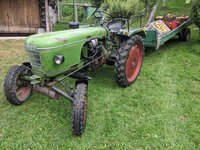
).Some previous owner fitted a big metal bar to the front of my trusty ol' Fendt. Single cylinder air cooled 14hp diesel, generally drinks less than 1l/hour, so about 0.2 gallon/hour.
I need to make some nicer brackets for it.
Unless there is some special reason, I would want both tires filled.And would it be best to fill the other rear tire? Is there any mechanical issues when adding additional weight to the drive?
jblnut
ALLIANCE MEMBER
Quick note here that I haven't read yet .... Don't use water if you're in a cold area of the world ... Water freezes and will cause big issues in your tires.
We do not have ballast in any tires on the farm. Adding cast/steel wheel weights is our preferred method. They can be removed if needed, are still part of the wheel assembly and will not rot anything out from the inside and no environmental damage if they fall off. You can usually add more iron weight than you can put in the tire anyway. Iron weight is also easier to add/remove.
To each their own though. Add what you need to to stay safe !!
We do not have ballast in any tires on the farm. Adding cast/steel wheel weights is our preferred method. They can be removed if needed, are still part of the wheel assembly and will not rot anything out from the inside and no environmental damage if they fall off. You can usually add more iron weight than you can put in the tire anyway. Iron weight is also easier to add/remove.
To each their own though. Add what you need to to stay safe !!
gtae07
Well-known member
Wow... I'd never heard of filling tires with ballast before...
RPH
Well-known member
Two reasons liquid ballast it used. One, the weight. Two, the weight is low in the tire right where it contacts the ground. Putting the weight right where it’s needed the most.
John Deere chart showing weight gains for different tires. My DB 1210 Carrie’s about 3000 pounds across both rear tires.
John Deere chart showing weight gains for different tires. My DB 1210 Carrie’s about 3000 pounds across both rear tires.
Attachments
kj_mustang
Well-known member
My best guess as to why the opposite front/rear tires were filled is it is a 4 wheel drive tractor. My tractor is 4 wheel drive too but really isn't as most small tractors don't have front differential lock. It may not have a rear differential lock pedal either. I have had mine spinning opposite front and rear tires before.
Mainiac Mat
Well-known member
It's called "loading" the tires. As stated, 3/4 full is the norm. Both rear tires should be filled. Filling the front tires is not as common. You need to set up a pump/vent rig to get this done and there are lots of YouTube videos that can show you how to do it.
If you are in an area that sees freezing temps, you need to use a liquid with a low freezing temp. Ideally, you want to use a heavy liquid so you get more ballast weight per gallon filled. Common options include:
If you are in an area that sees freezing temps, you need to use a liquid with a low freezing temp. Ideally, you want to use a heavy liquid so you get more ballast weight per gallon filled. Common options include:
- CaCl used to be the standard, and it's 1.4X the weight of water, but can (will?) cause major corrosion issues if you leak even a small amount.
- Windshield washer fluid is readily available, and relatively inexpensive. But it weighs less than water (~.8X) so you you get less bang for your buck.
- Mixing anti-freeze is another readily available option, but if you leak even a small amount, you risk poisoning your animals, as mammals are very attracted to it and it is deadly poisonous.
- Beat Juice is widely considered the best option as it is 1.6X heavier than water, doesn't freeze, and isn't toxic (though I hear it will stain your white shirts). The problem is that it's not available at Walmart. You have to go to a tire store that services commercial vehicles (trucks and tractors) to get it. There are a couple brand names out there... Rim Guard is one. It's very viscous (similar to molasses), and you'll probably have to have it filled by the same dealer.
Zeke
Well-known member
Isn't beet juice basically Evapo-Rust?