Gunfixr
Well-known member
I think this will be the first thread i've started here, lol.
Going to be replacing the existing electric water heater. I've helped friends by doing this, so it isn't my first rodeo, but I have something a bit different here.
Current heater is 13yr old whirlpool. It is in a sort of "closet" off the utility room. There is a crawlspace underneath. It is not in a pan, but directly on the floor. The electric line comes up out of the floor, and there is a newer line that comes off the heater, and in midair, they are spliced together with wire nuts and tape. Two white pex lines come up through the floor and connect straight to the input and outputs of the heater, via what appears to be something like a compression fitting, a nut that is just tightened down. The t/P valve has a pex line that goes down the side and through the floor.
I plan to change the wiring setup by mounting a Junction box on the wall next to the heater, running the feeder line into it, and running a line from the heater into the Junction box for the connection. It will have a lid mounted.
I plan to add a pan underneath the new heater.
The new heater is the same size as the old, I already have purchased it. I have purchased the new unit in accordance with the circuit (20 amp, with awg 12, new unit is 4500kw elements).
So, my questions:
Is running pex directly to the heater's in and out hookups acceptable? I was under the impression that some sort of insulator section was required (i've always worked on units involving copper or steel piping).
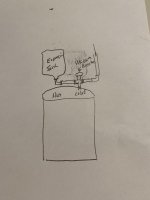
When installing the pan, can I use a t-fitting off the pan, and end the t/P valve line into the top of it, using one line through the floor, or would it be better to end the t/P valve line inside the pan?
Going to be replacing the existing electric water heater. I've helped friends by doing this, so it isn't my first rodeo, but I have something a bit different here.
Current heater is 13yr old whirlpool. It is in a sort of "closet" off the utility room. There is a crawlspace underneath. It is not in a pan, but directly on the floor. The electric line comes up out of the floor, and there is a newer line that comes off the heater, and in midair, they are spliced together with wire nuts and tape. Two white pex lines come up through the floor and connect straight to the input and outputs of the heater, via what appears to be something like a compression fitting, a nut that is just tightened down. The t/P valve has a pex line that goes down the side and through the floor.
I plan to change the wiring setup by mounting a Junction box on the wall next to the heater, running the feeder line into it, and running a line from the heater into the Junction box for the connection. It will have a lid mounted.
I plan to add a pan underneath the new heater.
The new heater is the same size as the old, I already have purchased it. I have purchased the new unit in accordance with the circuit (20 amp, with awg 12, new unit is 4500kw elements).
So, my questions:
Is running pex directly to the heater's in and out hookups acceptable? I was under the impression that some sort of insulator section was required (i've always worked on units involving copper or steel piping).
When installing the pan, can I use a t-fitting off the pan, and end the t/P valve line into the top of it, using one line through the floor, or would it be better to end the t/P valve line inside the pan?