To avoid these ads, REGISTER NOW!

Water In Conduit

hammlm

Well-known member
Joined
Jun 21, 2005
Messages
676
Location
SE PA
I plan to install a conduit between the basement of my house and my shed. The shed is elevated from the house. (see pic)

Now -- given that all PVC conduit installations leak, or somehow or the other get filled with water, what is my best bet to avoid water being pushed up the pipe, and through the LB into my basement?

Should I drill some small holes on the bottom of the LB before installing so that the water drips out there?

I have thought about plugging the pipe with duct seal on the inlet to the LB, but that seems sketchy.

Are there other better (newer) ideas?

Thoughts? Thanks in advance.
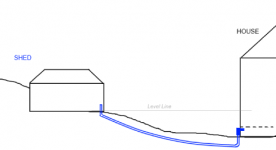
 

Attachments

  • SMLSHD.png
    SMLSHD.png
    9.4 KB · Views: 119
To avoid these ads, REGISTER NOW!

Aceman

Well-known member
Joined
Jan 28, 2007
Messages
2,513
Location
Eastern Oregon
They make this specifically for that, but I've never used it:

http://www.polywater.com/ductseal.html

I probably wouldn't even try to seal the conduit myself unless a customer specifically asked for it. I would just drill a couple 1/8" holes in the LB like you mentioned. Honestly, I would drill the holes EVEN if the conduit was sealed just to have a little insurance in case some water does get in there.
 
OP
H

hammlm

Well-known member
Joined
Jun 21, 2005
Messages
676
Location
SE PA
Thanks all. Rookie - thats a great question. I don't know but i should consider that. Sparky - then what??? Piipe from the splice box to the LB? Will that solve the effect of gravity pushng down when the sealed splice box fils up? Just asking, not trying to argue.

Aceman - i have seen it and know someone who used it (but i didn't see it yet). Im afraid if i want to pull a switchleg or whatever through later. Don't love the idea of breaking the pipe to run another wire or two. Thoughts?

Thanks to all. Good ideas.
 

awdblazer

Well-known member
Joined
Oct 17, 2011
Messages
1,100
Location
winnipeg, manitoba, canada
They make this specifically for that, but I've never used it:

http://www.polywater.com/ductseal.html

I probably wouldn't even try to seal the conduit myself unless a customer specifically asked for it. I would just drill a couple 1/8" holes in the LB like you mentioned. Honestly, I would drill the holes EVEN if the conduit was sealed just to have a little insurance in case some water does get in there.

you ever priced that stuff out? pretty expensive for expanding foam
 

theoldwizard1

Well-known member
Joined
Feb 22, 2011
Messages
43,142
Location
SE MI
Should I drill some small holes on the bottom of the LB before installing so that the water drips out there?
If you have weepin tile installed around the exterior of the house running to a sump pump, that is what I would do.

Where the conduit makes the corner to come up to the LB, dig down to the weeping tile. Make sure that it is installed correctly with a sock and back filled with gravel. line your pit with landscape cloth down to below the weeping tile. Back fill with more gravel up to and over where the conduit starts to come up. Fold cloth in before back filling with top soil.

Are there other better (newer) ideas?

This may be a case where direct burial cable is better, but you still need a "sweep" to run down from the LB to under the ground. Use a Schedule 80 sweep.
 

Gooch

Well-known member
Joined
May 30, 2009
Messages
676
Location
Petersberg, IA
I've never had conduit fill with water above grade, so just make sure you penetrate the buildings above grade and you'll be fine.
 
OP
H

hammlm

Well-known member
Joined
Jun 21, 2005
Messages
676
Location
SE PA
We had water pouring out of a conduit near the top of a power pole on a street near the bottom of a hill. Good news is that the wire doesnt care.

That is good news for a pole-mounted stub up.

My basement cares!

I am leaning towards:

(1) Drilling weep holes in the LB, and plugging the top of the LB (where it exits the conduit body and goes into the houes) with duct seal -- mosty for insects, etc.)

(2) Using Direct-Bury wire and just sleeving the conduit on at each end for building entry. I prefer conduit for future proof, but this is still in the running.
 

Eriehunter

Well-known member
Joined
Mar 14, 2014
Messages
189
I would seal the conduit where it enters the house with expanding foam from the outside. I would also drill a weep hole at the bottom of the LB, probably in the back above where the conduit enters the LB. The foam would make good insulation as well as a barrier if the water comes up that high, but it probably won't.
 

malibu101

Well-known member
Joined
Jul 1, 2005
Messages
3,908
Location
Walnutport PA
We did a pipe install at work from an inground box on top of a hill, down the hill, and through the foundation into the building. During heavy rains water would come in through the conduit due to the Quazite (brand name) box getting water into it and the conduit acting as a drain.
We ultimately cut the conduit outside of the building and routed it up to a weatherproof box above grade on the outside of the building and from the box back underground through the foundation as it was.
We drilled 2 small holes in the bottom of the box for water to escape. It works perfect.
Yeah, yeah, even 2 small holes on the bottom probably mean the box is no longer weatherproof but it works and is safe as far as we're concerned.
 
To avoid these ads, REGISTER NOW!

ctgoodman

Well-known member
Joined
Mar 1, 2010
Messages
315
Location
Salisbury, NC
I've worked in and around buried conduits for the past 15 years. I haven't seen many conduits that have not had water get in them. No matter what you put in to they and stop it, it will somehow manage to expel itself at the lowest point. I've bulled up raised floors in server rooms that look like a small pond.
 

larry4406

Well-known member
Joined
Jan 27, 2006
Messages
19,211
Location
Northern Virginia
Why can't you run say 2" conduit from the shed to the house and turn up at the house with 2"

Then use a 3" LB at the house and a 3" riser at the house which telescopes over the 2". This creates an annular gap that any water runs out of, yet your cable is still conduit protected.

If you run 3" from the shed, then the house would be 4".
 

Mustang51js

Well-known member
Joined
Jan 24, 2014
Messages
1,734
Location
Haskell nj
Why can't you run say 2" conduit from the shed to the house and turn up at the house with 2"

Then use a 3" LB at the house and a 3" riser at the house which telescopes over the 2". This creates an annular gap that any water runs out of, yet your cable is still conduit protected.

If you run 3" from the shed, then the house would be 4".

You can't do that legally because your suppose to have a solid connection, but would work if he did it that way. I would just stub up the house a couple feet and then elbow in. I can't see the water being that bad. If you get the pipe up higher than the shed pipe if possible will stop the water from going up that high.
 

malibu101

Well-known member
Joined
Jul 1, 2005
Messages
3,908
Location
Walnutport PA
Why can't you run say 2" conduit from the shed to the house and turn up at the house with 2"

Then use a 3" LB at the house and a 3" riser at the house which telescopes over the 2". This creates an annular gap that any water runs out of, yet your cable is still conduit protected.

If you run 3" from the shed, then the house would be 4".

Maybe the fit of a PVC expansion fitting is a loose enough fit to allow water out? Don't know never used one or looked at one real close.

Link to an example of an expansion fitting- http://0323c7c.netsolhost.com/docs/Conduit expansion fittings.pdf
 

Mustang51js

Well-known member
Joined
Jan 24, 2014
Messages
1,734
Location
Haskell nj
Those have a rubber o-ring inside so it won't let water out. If you really think you will get a lot of water in the pipe then use a t fitting coming up, continue the pipe up and in, then out of the side of the t use a elbow and have it face down.your still going to have bug issues since it's an open pipe.
 

LS6 Tommy

Well-known member
Joined
Dec 27, 2013
Messages
26,162
Location
Northern NJ
We had water pouring out of a conduit near the top of a power pole on a street near the botttom of a hill. Good news is that the wire doesnt care.

Give it some time. I can't even COUNT the number of circuits I've had to replace over the years from water in the conduit...

Tommy
 

Kevin C

Well-known member
Joined
Aug 4, 2011
Messages
1,653
Location
Portland OR
My thought.... My plumbing doesn't leak, how hard is it to put together conduit joints that are water tight? Planning for problems is good but I'm not sure I would worry all that much (assuming your the one fitting and glueing the joints).

My guess is that the leaks others have seen are from poorly fit joints that got dirt in them when they went together.

Even completely leak tight, you will still get water from condensation, but it should occur slowly enough that its not a problem ( no deluge of water pouring in during a hard rain). That it would ( reduced to a really low level) stop if you blocked any air circulation into the conduit.

Flame away... :)
 

Mustang51js

Well-known member
Joined
Jan 24, 2014
Messages
1,734
Location
Haskell nj
My thought.... My plumbing doesn't leak, how hard is it to put together conduit joints that are water tight? Planning for problems is good but I'm not sure I would worry all that much (assuming your the one fitting and glueing the joints).

My guess is that the leaks others have seen are from poorly fit joints that got dirt in them when they went together.

Even completely leak tight, you will still get water from condensation, but it should occur slowly enough that its not a problem ( no deluge of water pouring in during a hard rain). That it would ( reduced to a really low level) stop if you blocked any air circulation into the conduit.

Flame away... :)

How long has the pipes been in, and have you pulled new wires in or out since installed. It's rare to get water pouring out of the pipe but almost every pipe I've seen that's been underground for a year or more has some water in it.
 

Kevin54

MEMBER EMERITUS
Joined
Jan 12, 2005
Messages
29,341
Location
Urbana, Ohio
When we used to get horrific downpours, I couldn't figure out how water was getting into my garage. Try as I might, I couldn't find a leak outside UNTIL I was doing some drywall work and had to cut out a section underneath my breaker panel. The LB box was filling with water. I know where it was starting but couldn't fix it as the electrical conduit it buried quite a way down under a sidewalk, but it crossed over a drain tile from our gutters going to the pond. The drain tile is closed off now, and I haven't had a problem since.
 

tmunsch

Well-known member
Joined
Nov 10, 2013
Messages
49
Location
Baytown, Texas
We ultimately cut the conduit outside of the building and routed it up to a weatherproof box above grade on the outside of the building and from the box back underground through the foundation as it was.
We drilled 2 small holes in the bottom of the box for water to escape. It works perfect.
Yeah, yeah, even 2 small holes on the bottom probably mean the box is no longer weatherproof but it works and is safe as far as we're concerned.

This is the best solution, the water will only fill the conduit (if at all) and run out of the box, You can come out of the side of the box up towards the top, so the water can't over fill the box and get into the conduit going to your basement. We use low point drains and vents all the time...

T,
 
To avoid these ads, REGISTER NOW!
Top Bottom