To avoid these ads, REGISTER NOW!

Water Line Trench, Big Problems

Mattilac

Well-known member
Joined
Jan 19, 2013
Messages
212
Houston, we have a problem.

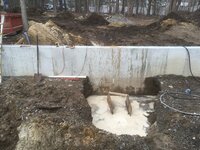
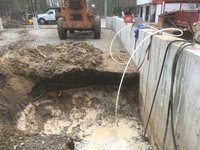
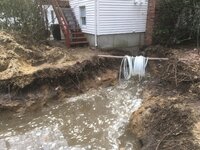
I dug a 100' long 5' deep trench to run a water line (3/4" PEX) from house to new garage. Plan is to go under both foundations' footing. Problem is the trench just rapidly fills up with ground water. Apparently the water table is only like 1' below ground level - insane.

I've been trying to keep it pumped out (I have a gas-powered 3" pump which is up to the task), but because the soil here is all clay/sand, the bottom of the trench is just all mud.

I'm not sure how to deal with this amount of mud. I get down in the trench with waders on and it's like getting locked into concrete. Can't do or see anything in there. I can't dry it out because the ground water keeps oozing in from the sides of the trench. And of course the sides of the trench are starting to collapse into the trench (even though I dug the top out wider in hopes to avoid this), creating even more mud, and reducing the depth that I originally dug to. I can't even feel the foundation footing anymore with all the mud in there now. I tried to build a makeshift dam to keep the mud from sliding down the sides into the way, but I'm just having no luck.

How do the pros deal with this?
IMG_2201.JPG


IMG_2200.JPG


IMG_2198.JPG
 
Last edited:
To avoid these ads, REGISTER NOW!
OP
M

Mattilac

Well-known member
Joined
Jan 19, 2013
Messages
212
I have a 400 GPM trash pump (Wacker PT3A) that works great until it hits the mud at the bottom.
 

nadogail

Well-known member
Joined
Jan 23, 2009
Messages
31,933
Location
Coronado, CA
Just as the pipe keeps the supposedly clean water in the pipe, it will keep the muddy water out of the pipe.

If you are not going to be inspected for trench depth, why not just back fill the trench after you drop the pipe in place?
 

lynnbilodeau

Well-known member
Joined
Jun 4, 2013
Messages
813
Location
Oklahoma
If you want to bring that water table down, you will need to trench downhill from that trench, and install drainage tubes. I had a problem with a high water table inside my shop and ran 280 foot of perforated pipe that all connected downhill to a 4 inch pipe. I was fortunate that I had a place to terminate the four inch pipe. Finally dried it out enough so we could concrete. There is much more to the story, but that is how I would deal with your river.
 
OP
M

Mattilac

Well-known member
Joined
Jan 19, 2013
Messages
212
Shove the line down in the mud and cover it up?

How did you pour the footing?

That's the plan in the trench itself, but how to get under the footings at each end is the question.

Last fall when we excavated for the foundation, the ground water level was just under the 4' depth required for the footing. Got lucky then I guess.
 

Spud McGee

Well-known member
Joined
Apr 11, 2022
Messages
405
That's the plan in the trench itself, but how to get under the footings at each end is the question.

Last fall when we excavated for the foundation, the ground water level was just under the 4' depth required for the footing. Got lucky then I guess.
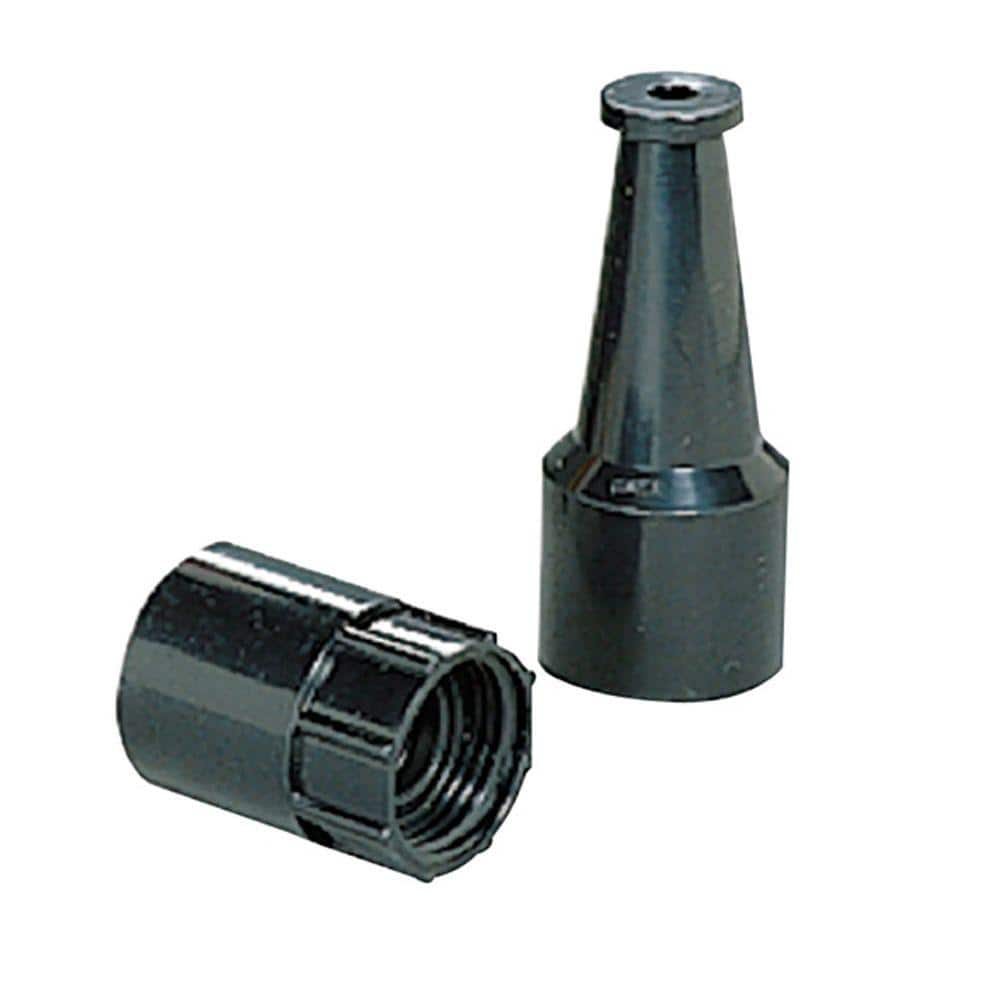
I'd get one of those $5 kits that let you attach a hose and a jet to a piece of PVC. They are used for digging under driveways and whatnot for sprinkler systems. Get your trench as close as you dare to your house, then use the PVC+hose+jet to tunnel. under the foundation.

I used one of these to go through a bunch of GA clay and it worked well.

From the way you describe it, it sounds like it could possibly be easier to go under your house with the PVC and use it to tunnel back towards your existing trench.
 

Monza Harry

Well-known member
Joined
Dec 29, 2018
Messages
1,433
Location
Windsor ON
When I decided to run hydro (electric power) to the garage I needed 2/3 of the length of the house on the driveway side, of course heat is also required as I am/I've turned into a big wuss, so that required 2/3 the length of the house on the other side and the entire width of the house! So we'll add water, and that needs a place to go, so a sewar is needed and it is even deeper than the water (@ ~ 5') at the end. My soil is sand with some clay and lots of river rock (and the requisite buried treasure [garbage, concrete, etc.]) So every night after work after having a machine do the initial dig I would spend 2-3 hrs. digging out the cave-ins, then get maybe an hour (sometimes plus) to work on the conduit, water & the sewer piping, and the gas line. So I feel your pain, oh it seemed to rain every third day just because "Jesus Loves Us". So I'll suggest in addition to the pumps a squirrel cage fan or 3 may help. [Start them early in the day]. I just persevered for about a month and a half (+/- IIRC) Wth lots of help (mostly my 2 brothers). Since this was all dug up, seemed a prudent time to waterproof the basement, this was poured from inside without an exterior form so I had to add concrete to water proof. Then it of course required a drainage tile as well. So that summer I told anybody coming by, to look for the house with the "moat". So other than the fan suggestion I'm just here for moral support from the been there done that club. My trench ended up at about 150' all told. Definetly feeling your pain! Harry
 

jack stand

Well-known member
Joined
Feb 29, 2012
Messages
3,325
Location
Lakes Region Maine
If you didn't find much rocks while digging, I'd say just throw the pipe in between the 2 buildings leaving as small or short of a ditch as possible and backfill the middle. For entering the building's... where are you climate wise? Do you have to deal with much of a frost depth?
I'd also have on hand those super sealing *kits (going through the concrete walls) so that you can keep the water out of the buildings and basement.
Pumping as small of a hole/ditch as possible at the building's may be easier to pump out.
* I don't remember what they're called but remember a friend, who happened to be a poured wall contractor describe it as several pieces. I've never had this trouble and ordinarily "hydraulic cement" would normally be used, but what if it doesn't? I can't imagine digging that out of the wall without damaging the pipe and then having to excavate again.
Good luck with this one. 👍
 

jblnut

ALLIANCE MEMBER
Joined
Jan 17, 2015
Messages
6,988
Location
In the Middle of MN
Where are you located ?

If you don't need to be that deep for any other reason I'd agree with others and just push it into the muck and backfill.

As far as getting the water out without the mud plugging up your pump you need to make some sort of sump. Picture a 55gal barrel with holes in the sides to act as a big filter with a solid base. Set the pump in there up on a rock or something else heavy and let it do it's thing. Look up dewatering on YouTube for more ideas ....


Also can't believe someone hasn't mentioned putting at least one more line/pipe in for future internet or what knows what ? This is the Overkill Journal after all lol
 

Drill Sergeant Arc

Well-known member
Joined
Jan 7, 2017
Messages
486
Location
Ore-gun
I don’t know if this will help you but when I ran water from the house to the shop I dug down to the required depth several feet from the foundation which I knew was 18 to 24 inches deep. I used a old piece of the smaller diameter chainlink fence top rail that was 1-1/4 diameter or there about and maybe 8 or so feet long.

I put a very minor radius in the pipe by putting it under the back bumper of the PU and lifting the pipe a tiny bit and moving it a little and lifting a tiny bit again and repeating this until I had the desired very gradual radius I wanted. It should look like something between a subtle “J” shape and a snow ski but the radius was tighter to start with and gradually decreased to almost the other end. And this shape is dependent on the depth of the foundation and how deep you are starting at.

I laid the pipe on it’s side on a piece of plate steel sitting on concrete and hammered the end flat then trimmed the corners off.

This is the tricky part of this idea. You are roughly judging the position of the point where you are starting at outside of the foundation in relation to a point several feet inside the foundation where you want this pipe to come up out of the ground at roughly a 45 degree angle. And these two points match the radius you now have in that pipe and it’s center point of the radius will be below the foundation footing.

So, I placed that flattened end of the pipe at the bottom of the trench end and positioned it so that the pointed end was at the trajectory I wanted it to go and started driving it in with a hand sledge, guiding it as I drove it in. When I started driving it I was standing and reaching up to hit the pipe end and when I finished the pipe was at grade and almost horizontal. And it came up under the house several feet on the other side of the foundation.

I cut the flattened end off under the house and the other end at the base of the trench and then slid the waterline through it.
 

rancherbill

Well-known member
Joined
Oct 18, 2007
Messages
5,334
Location
Foothills County, Alberta, Canada
Put the pipe in and fill it in.

You don't need a trench all open unless you are having an inspection. We had a water problem and and the inspector just wanted to see pics with something to show the depth. A garden shovel was fine. Stood the shovel up in the trench took a pic and filled it in.

For the small area where you are going into the house a samll pump will keep it dry enough to do the work quickly.
 
To avoid these ads, REGISTER NOW!

NUTTSGT

Super Moderator
Staff member
Joined
Sep 14, 2009
Messages
50,901
Location
Northern Central Ohio
I'm going to guess you will need to fill that PEX with water and cap the ends other wise it's going to float if you try to bury/fill in the trench with water in it. You might even need to add a bit of weight to hold it down.


A water table like that, you must have a crawl space instead of a basement? Is it damp ?
 

Viper98912

Well-known member
Joined
Oct 20, 2012
Messages
1,124
Location
GA
I'd get one of those $5 kits that let you attach a hose and a jet to a piece of PVC. They are used for digging under driveways and whatnot for sprinkler systems. Get your trench as close as you dare to your house, then use the PVC+hose+jet to tunnel. under the foundation.

I used one of these to go through a bunch of GA clay and it worked well.

From the way you describe it, it sounds like it could possibly be easier to go under your house with the PVC and use it to tunnel back towards your existing trench.
WHAT? THEY SELL THIS THING? I've had to do so many under-sidewalk projects the long and hard way (spade and fingers). Thanks for the tip.
 

chris142

Well-known member
Joined
Dec 19, 2011
Messages
6,533
Location
apple valley,ca
Will the water go down in summer. We have the opposite problem in my area. Ground is rock hard and my well that's 288 ft deep struggles to produce 2 gpm.
 

ycgoat

Well-known member
Joined
Mar 28, 2020
Messages
971
Location
S.E. Va
Once upon a time when I worked installing duct banks and manholes here in swampy coastal Va. We would
Starting on one end pump out water dig a hole and bury the screened pump hose in the hole surrounded by gravel
clean out the mud and replace with gravel
Do this for 20’+ and install your pipes on boards or something to raise it off the gravel.
Plug the pipe ends and back fill
Repeat In increments of the pipe length you can get done in 1 day
 

409425hp

Well-known member
Joined
Dec 7, 2020
Messages
173
Location
Nh
Pretty simple you need bigger or more pumps
When you are pumping work your way down a foot to a time,tie your hose up and lower it as the water drops.If you just throw it all the way to the bottom it is just going to plug with mud.Use a five gallon bucket and drill holes or slot the sides,put the suction lines inside the bucket to keep the screen from plugging.If you can get some 3/4 crushed stone that will help when you get down to the last foot.
You have to get the water out to properly backfill under your footings,which really should be backfilled with flow fill concrete,but you can use stone if that’s not feasible.
Good luck you’ll get it
 

CraigStu

Well-known member
Joined
May 22, 2014
Messages
4,023
Location
Blacksburg, Va
I would back up from the plan. You see where the water goes on it's own w/ a very graphic display. You really want to go under the footers w/ a water table like this? Not me. I'd run the pipe out through the wall above ground, a 90deg fitting, and then down the foundation to below frost depth and another 90 deg. Do that at both house and garage and put heat tape around it for the winter. You could also run it through maybe 3 inch pvc to help w/ insulating it.
 

Spud McGee

Well-known member
Joined
Apr 11, 2022
Messages
405
WHAT? THEY SELL THIS THING? I've had to do so many under-sidewalk projects the long and hard way (spade and fingers). Thanks for the tip.
Yep. You used to have to go down the PVC fitting aisle and piece everything together. These guys started selling a simple kit where you just add your own length of PVC.

Some of what I learned from used them is first, give your glue plenty of time to dry. If you rush it, you can shoot your tip off and get it stuck in your hole. Second, you can be pretty rough with the thing. If it gets to a point and stops, like it found a rock, you can let it sit there a minute and try to blast out enough dirt to move the rock, or you can use it as a battering ram and knock the rock out of the way.

There are plenty of videos on youtube showing the principal in action, even if its not this specific product.
 

Bill Bowman

Well-known member
Joined
Mar 28, 2007
Messages
3,146
Location
Metro Chicago
I'd probably just slip the pex through a cinder block, drop it in trench, repeat along the trench and fill it in. Several cinder blocks will do the trick.
 

mcbane

Well-known member
Joined
Jul 23, 2017
Messages
794
Location
California
Must be rough to live in the tropics. While the trench is open maybe plant some coconut and banana trees. As has been suggested, use cinder blocks to weigh down empty PEX if that will help to keep the waterline further away from the tropical heat. Nothing worse than trying to get a glass of cold water and finding it is 100F.
 

BombShelter

Well-known member
Joined
Nov 16, 2015
Messages
543
Location
State of Hockey
I've seen different ways, up here one of them is to have dozens of dewatering pumps around the build area, they work until everything is built and dry then the contractors move the equipment to another wet job site.

Contractors will also use bentonite, filling in trenches to stablize them and keep the walls from collapsing. Regardless of what you do I'd use bentonite at both foundations for future water issues before backfilling the trench (if that is even possible).

Up here when they replace old lead water pipes (5+ feet down) with new plastic, after the trenches have been backfilled, groundwater follows the new pipes into the basement, of course the city denies any fault on the newly wet basements.
 

Natty Bumppo

Well-known member
Joined
Dec 8, 2019
Messages
368
Location
Savoy, MA
You picked just about the worst time to dig a 4' trench in New England. I know it doesn't help your problem. But if you can wait until the water table drops you'll be in a much, much better position to install that PEX properly. The water table is generally always high in late winter and spring, and typically drops throughout the summer.
 
Last edited:
OP
M

Mattilac

Well-known member
Joined
Jan 19, 2013
Messages
212
Where in the world are you working,do you really need water that bad in the shop?
Massachusetts, and whether I really need water or not, at this point I might as well see the job through...

A water table like that, you must have a crawl space instead of a basement? Is it damp ?
No crawl space or basement. Both the house and detached garage are slab on grade with frost wall foundation.
 
OP
M

Mattilac

Well-known member
Joined
Jan 19, 2013
Messages
212
I finally managed to get the PEX installed under both the garage and house footings. It took three days and I was swimming in mud the entire time. Not fun at all. The water jetting method ended up being the ticket to get under the footings, but I had to do it blind, feeling around in the mud to determine where I was.

But at least that's done with now, and I have one continuous line running from inside the house to inside the garage. I secured the line to the bottom of the trench by simply walking on it, pushing it down into the mud. It's at least 4' down everywhere, so I'm happy about that.

Now the question is, how do I properly backfill this trench? There is at least a foot deep of pure mud along the whole bottom of the trench. And I can't get all the water out, even with all the filters and screens I'm running on the four different pumps I have. So it's a couple inches of water on top of a foot of mud I'm dealing with.

I'm afraid that if I just push all the excavated soil back in, it's not going to settle properly, like what happened here: https://www.garagejournal.com/forum/threads/the-heck-is-going-on-here.513514/

In fact, I already did a little test; I shoveled some clay back into a section of the trench and tried tamping it down, but it's still super jello-y just like in the link above.

Please advise...
 
Last edited:
OP
M

Mattilac

Well-known member
Joined
Jan 19, 2013
Messages
212
A few current pics (w/ installed PEX):

Inside house:
IMG_2226.JPG

Exiting house (mostly buried in the mud):
IMG_2234.JPG

Coming up inside garage foundation:
IMG_2238.JPG
 
Last edited:

tarmy

Well-known member
Joined
May 28, 2014
Messages
4,670
Location
Nor Cal
I would slide a piece of schedule 40 PVC or similar over that pex and under those concrete foundations to protect that pex from floating up and rubbing on the conc and potentially failing.

Anything you use in that trench will settle and move that line around. Plan on it drying out and needing to recompact it when it does. You could bed that pipe in sand to protect it a bit and place fill on top of that.
 

ycgoat

Well-known member
Joined
Mar 28, 2020
Messages
971
Location
S.E. Va
Now that the pex is in the mud, the only options I know of to dry jt out are to use an additive like line to the soil before you back fill, then ince you have a decent base back fill using a descent fill
 

bluedog225

Well-known member
Joined
Jan 31, 2012
Messages
3,275
Location
Texas
My vote would be a pvc sleeve, as much as you can manage to protect the pex, then Polyiso would help with freezing and keep it down. Then gravel? Or dump redimix dry a few inches thick? Dunno

What a mess. Props for getting it done.
 
To avoid these ads, REGISTER NOW!
Top Bottom