myredracer
Well-known member
I am just about to set up the piping and air "treatment" for my home shop. Have a 60 gallon upright, 3-cylinder, 1-stage compressor rated at 18.5 cfm at 90 psi. Not sure if it really does put out 18.5 cfm but it will keep my die grinder running continuously at 90 psi (on testing). I am going to have two drops, one for air tools and the other for clean air for blasting, painting, etc. Not sure if I will get a plasma cutter.
Trying to figure out what filters and how to dry the air has been rather confusing and the internet has not yielded any really good recommendations (at least to me).
I am going to build a condenser using 3/4" copper pipe to remove some of the moisture. Will be around 30' or maybe more. I have some lengths of 3/4" left over so makes sense to use it. The rest of the piping runs would be 1/2" copper.
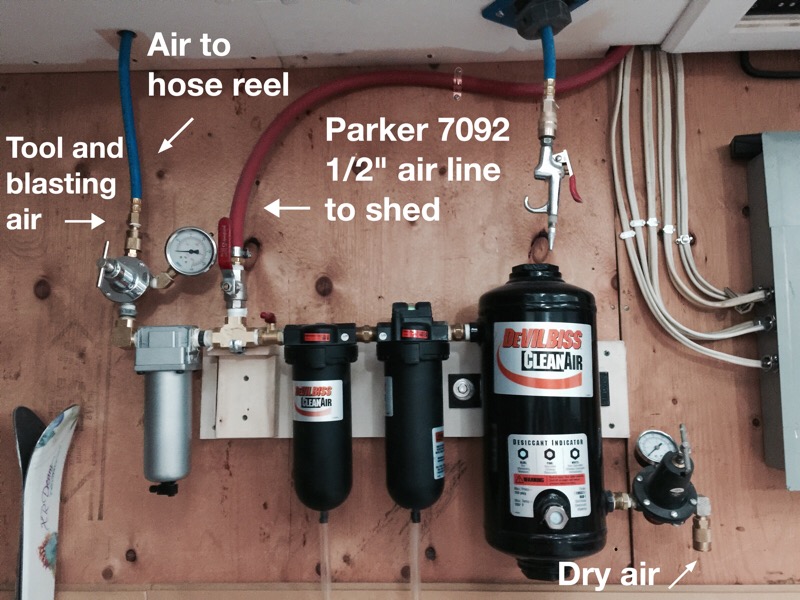
For dry/clean air I was thinking of first an IR water separator with 5 micron filter as in the 1st pic.
The next filter is the confusing one for me. I was thinking of either a Motor Guard CO4515 coalescing filter or their M-60 or maybe even the MC-100. The coalescing filter only removes oil though and is that vapor and/or droplets? Does it remove anything else? The M-60 removes oil vapor but not oil droplets. The MC-100 removes oil, silicone and organic vapor plus VOCs. Is the MC-100 simply the best choice? (Doesn't cost much more anyway.)
The last thing in the line would be a dessicant bead dryer like in the 2nd pic which is a Princess Auto item. It's 30" tall and 2" dia. Do these things work good enough for a home shop? It bought it 10+ years ago and used it once. It's rusty inside - clean with wire brush and then use rust converter?
Would this be okay for a home shop? Should I install a separate regulator for blasting versus painting or just adjust a single one as needed? Same question I guess for air tools and blow gun?
For air tools, I would use an "air control unit". I have a no-name brand one that is identical to the Sharpe 880A in 3rd pic. I may or may not use an automatic oiler that I already have.
My compressor does not seem to have an air dump valve and I would like to add an automatic electric one. Would this go at the pressure switch location?
I am otherwise okay on the piping layout.
Thanks!


Trying to figure out what filters and how to dry the air has been rather confusing and the internet has not yielded any really good recommendations (at least to me).
I am going to build a condenser using 3/4" copper pipe to remove some of the moisture. Will be around 30' or maybe more. I have some lengths of 3/4" left over so makes sense to use it. The rest of the piping runs would be 1/2" copper.
For dry/clean air I was thinking of first an IR water separator with 5 micron filter as in the 1st pic.
The next filter is the confusing one for me. I was thinking of either a Motor Guard CO4515 coalescing filter or their M-60 or maybe even the MC-100. The coalescing filter only removes oil though and is that vapor and/or droplets? Does it remove anything else? The M-60 removes oil vapor but not oil droplets. The MC-100 removes oil, silicone and organic vapor plus VOCs. Is the MC-100 simply the best choice? (Doesn't cost much more anyway.)
The last thing in the line would be a dessicant bead dryer like in the 2nd pic which is a Princess Auto item. It's 30" tall and 2" dia. Do these things work good enough for a home shop? It bought it 10+ years ago and used it once. It's rusty inside - clean with wire brush and then use rust converter?
Would this be okay for a home shop? Should I install a separate regulator for blasting versus painting or just adjust a single one as needed? Same question I guess for air tools and blow gun?
For air tools, I would use an "air control unit". I have a no-name brand one that is identical to the Sharpe 880A in 3rd pic. I may or may not use an automatic oiler that I already have.
My compressor does not seem to have an air dump valve and I would like to add an automatic electric one. Would this go at the pressure switch location?
I am otherwise okay on the piping layout.
Thanks!