To avoid these ads, REGISTER NOW!

Water, sink, no entry to septic

Whiskeymike

Well-known member
Joined
Oct 31, 2013
Messages
775
Location
Austin, TX
I have a detached 30x40 shop. It currently has no plumbing inside, but I do have a garden hose pipe outside the building. I'm considering splitting that off, running water inside to an old laundry sink. But I have no where to exit the waste. I could run it back outside and dump into grass, but should this be done in any special way? Like mimicking a tiny drain field? Or should I filter the outbound?

I considered connecting it to a 55 gallon drum, but then I don't know what I would do with that.

Also, my main focus is water for washing hands, getting water for projects, etc.. So I'm not expecting a lot of waste or toxic things. If I dump it into the ground, what guidelines are there for soap or products that can be used safely without turning my yard into a toxic graveyard?
 
To avoid these ads, REGISTER NOW!

Falcon67

Well-known member
Joined
Jun 11, 2009
Messages
18,371
Location
Merkel, TX
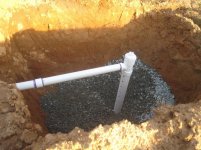
When we lived in the sticks I routed the output from the washing machine to the garden to keep it out of the septic. Worked quite well. Wash with something like Dawn and just feed it out on the ground. It's bio-friendly. Alternately, you could dig a 35~55 gallon sized hole (wide/deep), plumb a perf pipe into the middle and fill that with gravel.
 

Vegaman_Dan

Well-known member
Joined
Jun 1, 2012
Messages
2,453
Location
Pacific, WA
A French drain or 'dry well' can work. It may not be to code in your area though.

Digging a hole and dropping in an oil drum with the top cut off and filled with concrete debris, gravel, etc, works well. You can plumb in a drain to a surface connection / cleanout that you attach your sink drain to. Backfill with dirt and you've got a solid drain that will last a long time.

I've been tempted to do similar, but I don't have room for a sink in the garage.
 

Kevin54

MEMBER EMERITUS
Joined
Jan 12, 2005
Messages
29,341
Location
Urbana, Ohio
I have a detached 30x40 shop. It currently has no plumbing inside, but I do have a garden hose pipe outside the building. I'm considering splitting that off, running water inside to an old laundry sink. But I have no where to exit the waste. I could run it back outside and dump into grass, but should this be done in any special way? Like mimicking a tiny drain field? Or should I filter the outbound?

I considered connecting it to a 55 gallon drum, but then I don't know what I would do with that.

Also, my main focus is water for washing hands, getting water for projects, etc.. So I'm not expecting a lot of waste or toxic things. If I dump it into the ground, what guidelines are there for soap or products that can be used safely without turning my yard into a toxic graveyard?

A lot of questions for a first post. Where are you located (state) and that will determine some answers. Does it get below freezing in your area, do you plan on having heat in the garage if it does, how far away is your septic, what is your property layout like, and probably a few other questions could be asked also. :dunno:
 
OP
W

Whiskeymike

Well-known member
Joined
Oct 31, 2013
Messages
775
Location
Austin, TX
Thanks for the comments. I'll research a French drain and similar. That sounds pretty straight forward.

A lot of questions for a first post. Where are you located (state) and that will determine some answers. Does it get below freezing in your area, do you plan on having heat in the garage if it does, how far away is your septic, what is your property layout like, and probably a few other questions could be asked also. :dunno:

I'm outside Austin, TX. It does get below freezing, but it's seldom. The shop is heated/cooled. Land is 6+ acres with septic tank about 50 yards away.
 

HoosierMark

Well-known member
Joined
Jan 31, 2013
Messages
1,443
Location
Southeast IN
Why not do it the simple way. Run a solid pipe out away from the building x distance then dig a simple small trench say 1 foot square and put a perferated pipe in it surrounded by gravel. Maybe 5 foot long. Make it virtually level so the water drains evenly thru it and cover it with dirt. Think about how much water you will actually drain, probably not much. You can add more pipe if you get a wet spot.
 

911mike

Well-known member
Joined
May 22, 2010
Messages
494
Location
michigan
When I built the barn I buried 4" PVC pipes in all 4 corners of the building to carry the water from the gutters. The pipes are each 100'+ long and end into a hill so the water drains down the hill. I just tee'd into one of those for my sink. Works great.
 

Slackerzinc

Well-known member
Joined
Feb 27, 2012
Messages
596
Location
.
I used a 55gal plastic drum, cut the top off it and drilled a series of holes along the cut edge. The drum was flipped upside down and buried so that the open side was down. It works great for my urinal and wash sink, also being plastic I don't have to worry about it rusting and collapsing.

 
Last edited:
To avoid these ads, REGISTER NOW!

John in OH

Well-known member
Joined
Jun 2, 2007
Messages
2,444
Location
SE Ohio & Eastern Virginia
First of all, Kevin is correct. You need to check out your local building codes to see what is permitted in your area.

That aside, I had a similar situation. I had water to my detached shop, but no access to the septic system. I wanted only to be able to wash my hands and rinse off stuff in a shop sink, no bathroom facility or other foul effluent, just soapy water.

My solution was to dig a drywell about 4'x 4' x 5' deep about 30' from the shop. In this pit I installed a vertical 4" PVC distribution pipe drilled with about 100, 1/2" dia. holes and an open bottom end. Placed the pipe in the center of the pit and filled the surrounding space with #57 gravel, covered the gravel with tar paper and covered that with 1' of dirt. The drywell is connected to the shop sink stub-up via 2-1/2" PVC drain pipe.

IMG_7482 (768x1024).jpg IMG_7481 (1024x768).jpg IMG_7484 (1024x768).jpg IMG_7489 (1024x768).jpg

The general soil in the area is pretty sandy so this drywell has worked great, so far.
 

Kevin54

MEMBER EMERITUS
Joined
Jan 12, 2005
Messages
29,341
Location
Urbana, Ohio
First of all, Kevin is correct. You need to check out your local building codes to see what is permitted in your area.

That aside, I had a similar situation. I had water to my detached shop, but no access to the septic system. I wanted only to be able to wash my hands and rinse off stuff in a shop sink, no bathroom facility or other foul effluent, just soapy water.

My solution was to dig a drywell about 4'x 4' x 5' deep about 30' from the shop. In this pit I installed a vertical 4" PVC distribution pipe drilled with about 100, 1/2" dia. holes and an open bottom end. Placed the pipe in the center of the pit and filled the surrounding space with #57 gravel, covered the gravel with tar paper and covered that with 1' of dirt. The drywell is connected to the shop sink stub-up via 2-1/2" PVC drain pipe.

IMG_7482 (768x1024).jpg IMG_7481 (1024x768).jpg IMG_7484 (1024x768).jpg IMG_7489 (1024x768).jpg

The general soil in the area is pretty sandy so this drywell has worked great, so far.

John.....I like that idea and just may have to do that myself. I have a well that is rather close and could easily run water to the garage.

It's not going to happen this year, but I have another alternative too. I have a 6' overhang on the house side of my garage. My septic tank needs to have a baffle put in/repaired. We do use the overhang to sit under in the summer, but if I could enclose it in, I could put in a 6' wide bathroom. My septic tank would be maybe 20' away from it if that far. I did speak with the septic tank guy the last time he cleaned it and asked him that if I tied in to the septic with another bathroom, would I have enough fall. He stated that I did and that actually the tank is buried deeper than most. Where my outlet to the tank is, it is roughly 5' down :wtf:

Around here they build houses kind of odd. With having clay, they use the soil as forms, meaning they won't use, or don't have to use form boards. They will lay out where the footers are going to go on the ground, then dig a trench all around, then put in their rebar and concrete. After that sets for a few days, they will then take the sod out of the middle. Then they will have the block layer, or wall guys either put up block walls or forms for poured walls. then build a wall about 4' high. At this point the foundation walls are all up then they start building. When done, they will excavate the ground and bring it up around the foundation.

I've seen it done many a time in our county but it is the only county I've ever saw it done that way.
 

59 wagon man

Well-known member
Joined
Oct 25, 2010
Messages
1,589
Location
hollywood fla
infiltrator drainfield panels can be used look kinda like an oil drum cut in half the longway. one of them with the 2 ends needed run $50 - $100 .probably last a lifetime
 
Last edited:

Thumper68

Well-known member
Joined
May 16, 2013
Messages
5,134
Location
Duluth MN
I had a similar issue when I built the shop, here is the solution I came up with and it was passed by our local sepitic guy.

Cut the center out of a old steel rim 15" works fine, place on top of a plastic 55 gal drum and draw a line about 1 inch inside the rim and cut out.

install 2 flanges on the side of the drum near the top for entrance and exit pipes.

Bury the drum deep enough for the drum and rim to be flush with the ground.

For the inlet you can use pvc pipe for the exit use 1 1/2" abs irrigation tube connected to a sump pump once the plumbing is done form up around the rim and pour concrete for a lid I use 1/8th inch diamond plate.


The gray pvc pipe is for the elec for the pump.


This is the only pic I have of the last one I did for my sisters trailer.

Run the abs to a "T" in the septic feed line.

The one on the shop has been in use year round in MN for 7 years and the one for my parents cabin has been in seasonal use for 5.
 

bczygan

Well-known member
Joined
Nov 4, 2009
Messages
22,002
Location
DETROIT! Arsenal of Scrappers
Aside from code issues, the first thing to do, if you aren't tying to a septic or sewer system, is to see what your subsurface soil is like. Dig a hole, located well away from any well, and deep enough to get to the sub surface soil. Fill it with a measured amount of water and time how long it takes to be absorbed.

This gives you a benchmark.

Frozen ground and times when it rains a lot will reduce your capacity, so design the pit with extra capacity. Cover it so rain is shed away from it, and slope the ground above it away.

In freezing areas put the drain below freezing and use part of the line as a distribution line by using perforated material. Don't forget a sock to keep it clear.
 

Kayak22

New member
Joined
Aug 18, 2019
Messages
1
Location
Umatilla, FL
One issue that comes to mind is proper distance frm the existing water well. In my county,Lake County, FL, it would need to be 75 feet. This is the code requirement, but allso the safety requirement to assure that ground watere is properly filted by the sand/soil before it reaches the well.
 
To avoid these ads, REGISTER NOW!
Top Bottom