To avoid these ads, REGISTER NOW!

Water Supply???

karoc

Well-known member
Joined
Dec 19, 2017
Messages
1,998
Location
Hemphill Tx
Guys I was wondering what are my choices for getting water from meter to my house? Normally I would just run either 3/4 or 1” PVC pipe. But where it comes up from ground and into house, want something little more ridgid. So is choice still galvanized pipe to enter home above ground? Looking for options
 
To avoid these ads, REGISTER NOW!

dcg9381

Well-known member
Joined
Jun 20, 2018
Messages
11,709
Location
Austin, TX
I run a 2" PVC water line from our "supply" (tanked) about 250' to the house. Reason for that is length of the run, so I need a larger pipe.

For supply to the house our plumber used 2 x 1" PEX lines. Dual feed.

I'd hesitate to use anything rigid above ground in N. Texas. It's going to freeze (eventually). Both PVC and galvanized pipe are going to be "intolerant" to freeze. PEX is intolerant to UV, but I've never had a freeze failure.
 
OP
K

karoc

Well-known member
Joined
Dec 19, 2017
Messages
1,998
Location
Hemphill Tx
PEX is better but I was wanting to put hose bib on supply to drain and for hose to do little watering. After watching couple YouTube I see that the galvanized pipe is no longer used.
 

AC-WC

Well-known member
Joined
Jan 22, 2023
Messages
767
Location
NE, Indiana
Personally I would never add galvanized to any water supply. Eventually, it will rust internally and reduce to a pin hole size for water flow. It can also rust through and get pinholes and leak. My house when built had all galvanized pipe for water. I had the crummiest water pressure and several pin hole leaks. Replaced with PVC or pex and never looked back.
 

larry4406

Well-known member
Joined
Jan 27, 2006
Messages
19,151
Location
Northern Virginia
New construction here in northern VA and MD we run black poly. Typically 1-1.25” size based on run from meter to house (plumber decides).

I’m not a plumber. Some poly is NPT size and others are IPS. If I recall, the IPS uses a more expensive compression fitting at the barbs/threaded ends which are not as readily available here.

Sleeve it thru your footings and slab. I like using 2” pvc sleeve thru the slab and hold the sleeve above the slab 2-3 inches. Later you can install a Fernco to seal the poly to the sleeve for radon.

Be mindful of any frost depth requirements in your area.

EDIT

Maybe its CTS (copper tube size) not IPS as @Baumeister says in Post 12... See, I told you I am not a plumber!
 
Last edited:

Crazyjake8493

Well-known member
Joined
Sep 26, 2014
Messages
3,953
Location
Upstate NY
Personally I would never add galvanized to any water supply. Eventually, it will rust internally and reduce to a pin hole size for water flow. It can also rust through and get pinholes and leak. My house when built had all galvanized pipe for water. I had the crummiest water pressure and several pin hole leaks. Replaced with PVC or pex and never looked back.
100% true. We had a bunch of galvanized here and it started leaking last winter so I replaced it all with PEX. I'll see if I have any pictures I took of the galvanized pipe. There were sections of the 1/2" pipe you couldn't fit a pencil through. Not to mention the pink/red rust stains in our toilet and shower.
 

Beerhippie

Well-known member
Joined
Oct 13, 2023
Messages
9,716
Location
Far NE Oregon
Never, ever even consider galvy pipe for new construction! There are so many causes of galvanic corrosion and all of them attack galvanized pipe. As soon as the zinc coating is gone, the rest of the pipe starts going.

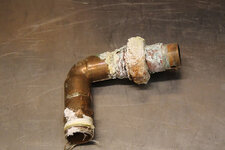
Copper is great--it's expensive and takes time and expertise to run--but if you have any galvy anywhere in the system it will destroy the galvy even faster. Dielectric unions are a myth (as is using brass fittings) as all plumbing is eventually connected through grounds.

PEX is great, but, as mentioned above, keep it out of even indirect sunlight. I certainly don't mean you have to run PEX at night and have it buried before dawn. I run exposed PEX in the brewery, but am careful to keep it where direct or nearly direct sunlight from windows doesn't hit it. Yet to have any fail. PEX is highly resistant to freeze damage (if you get the right kind), but keep in mind that the metal fittings are not!

A hose bib takes a beating. If used as a hose bib and not just a drain, it needs to be mounted securely--not just hung from PEX. If you're installing a whole-house drain--a very wise choice--be sure to slope all lines to drain back to it. We used an exterior hose bib on all our new or remodel work as it drains the water to the outside. But I live where sub-zero winters are the norm, not the exception. It's common practice here to shut off and drain the house if taking a winter vacation--even just a few weeks. Just one of the ways you can tell the old hands from the newcomers.
 
Last edited:

Ilikeike

ALLIANCE MEMBER
Joined
Jan 8, 2015
Messages
2,452
Location
Northern Ca.
Maybe it's a reginal thing,

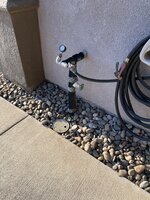
Pretty much every house new and old in most of Ca. have PVC from the meter to the house, then it adapts to Galv coming up with a shut off valve and then enters the house and goes to PEX. so maybe 3' of galv pipe.
Need something pretty stout on the outside. you could stand on this 3/4" pipe.
IMG_5962.jpg
 

Baumeister

Member
Joined
Apr 24, 2021
Messages
9
Location
MO
I used the black poly in a roll, for my water supply from the main, to inside the house. CTS (copper tube size) has much better fittings for underground, than IPS, which is barbed fittings. CTS uses a stainless insert in the poly to hold shape, and a solid brass clamp on the pipe, over the insert. Other end on the fitting is brass pipe thread. Good to go underground. Here we go through the foundation, below frost line.
 
To avoid these ads, REGISTER NOW!

flat350

Well-known member
Joined
Jan 1, 2009
Messages
1,006
Location
illinois
Dielectric unions are a myth (as is using brass fittings) as all plumbing is eventually connected through grounds
With a dielectric union on a water heater, exactly where is the direct metal to metal connection that would allow current flow ?
 

Bert_

Well-known member
Joined
Dec 24, 2016
Messages
9,716
Location
NW Iowa
Being from the Midwest I can't imagine a water line coming up OUTSIDE a building.

Even with the warmer temperatures I wonder why you would just bring it up inside for physical protection and from the sun if you're using plastic.
 

Beerhippie

Well-known member
Joined
Oct 13, 2023
Messages
9,716
Location
Far NE Oregon
With a dielectric union on a water heater, exactly where is the direct metal to metal connection that would allow current flow ?
Look at the electrical connections. If it has a ground wire (it does) and it's grounded to the heater (it is), it's electrically bonded to pretty much every piece of metal in the house.
 

housewolf

Well-known member
Joined
Feb 3, 2021
Messages
1,144
Location
East Texas
Just food for thought, if your slab isn’t placed yet. You could run a (copper or pex) loop to an interior wall and have a valve inside an access panel to shut the house off if needed. You could even run it inside a PVC sleeve (I didn’t) if it made you more comfortable. FWIW; I didn’t put any hose bibs on my house either, so no domestic water on outside walls. I have a separate underground loop for yard hydrants including one at the shop I can hook an air hose to for blowing it dry. I’m pretty sure I can reach anywhere on my (acre) lot with a 50’ hose.

If the slab is in place, keep the amount of exposed (pex) pipe to a minimum and insulate in while you’re installing it. Consider putting a jacket over the insulation.

When we have a hard freeze, I don’t even think about my plumbing. Family, friends, & neighbors usually keep me busy.
 
Last edited:

bb29510

Well-known member
Joined
Dec 27, 2022
Messages
1,216
mine is 1 inch pvc sch 40, its 23 years old, buried 18 inches
 

nadogail

Well-known member
Joined
Jan 23, 2009
Messages
31,938
Location
Coronado, CA
Mine is a half inch copper line, it has proven to be Adequate.

The builder ran it from the house to the detached two car garage that is my shop.
 

flat350

Well-known member
Joined
Jan 1, 2009
Messages
1,006
Location
illinois
Look at the electrical connections. If it has a ground wire (it does) and it's grounded to the heater (it is), it's electrically bonded to pretty much every piece of metal in the house.
Look at a dielectric fitting the rubber washer and plastic sleeve prevent any metal to metal contact between the 3 pieces, thus stopping any current flow through the fitting.
 

Beerhippie

Well-known member
Joined
Oct 13, 2023
Messages
9,716
Location
Far NE Oregon
But the ground wire connects them. Surely you have other things around the house that are connected to both electrical and plumbing that also have ground wires.

Even if the water heater were the only grounded plumbing appliance in the house, the pipe is still, literally, grounded where it goes underground.

Any electrical connection between dissimilar metals will lead to galvanic corrosion.

Put your Ohmmeter across the two sides of the dielectric union--you might be surprised.

OTOH, if you have to use a union, dielectric are the way to go. I hate machined brass unions with a passion.

Because:

53615291650_6346433fd3_b.jpg
 

PoorUB

Well-known member
Joined
Mar 29, 2021
Messages
11,626
Location
Fargo, ND
Guys I was wondering what are my choices for getting water from meter to my house? Normally I would just run either 3/4 or 1” PVC pipe. But where it comes up from ground and into house, want something little more ridgid. So is choice still galvanized pipe to enter home above ground? Looking for options
New house, slab on grade? I would bury it, use PEX and come in under the slab. I would not use PVC. If you want an outside shut off, put it in a pit with a cover, or a curb stop. Existing house? I have seen guys dig under the footing and bore down through the concrete to run the pipe into the house., then back fill.

I would avoid galvanized like the plague. Brass or stainless if you want threaded pipe.
 
To avoid these ads, REGISTER NOW!
Top Bottom