To avoid these ads, REGISTER NOW!

Water4Gas

To avoid these ads, REGISTER NOW!

goodfellow

Well-known member
Joined
Dec 17, 2006
Messages
2,288
Location
NoVA
Can't cheat the laws of physics -- no matter how much hype they throw at it.
 
OP
R

rinny_tin_tin

Well-known member
Joined
Dec 20, 2008
Messages
636
Location
Northern Virginia
It's not worth the effort. The basic problem all these sorts of schemes seem to overlook is that it takes more energy to create the hydrogen than what you get out of it.

Wait a minute - and I must admit - when I first heard about this tek, I thought the same thing - bunk. However, at the urging of a chemist colleague, I read the product documents and the tests performed by accredited third party testing institutions. Moreover, the tek is not something that new and has been applied in some other important arenas. Again - they use low power electrolysis to "crack" H2O into Oxygen and Hydrogen - the Hydrogen is then fed into the air intake to mix with the intake air to boost combustion of regular fuel (gas, diesel, etc.)

Is this really bunk?
 

Cholleman

Well-known member
Joined
Jan 19, 2009
Messages
55
Is this really bunk?

absolutely without a doubt. if you throw physics out the window for a moment and just think in terms of money, do you really think that major auto manufacturers wouldn't have slapped this bad boy on all their rides over the last year or so? somehow, they overlooked this modern marvel of efficient engineering and billy bob in the sticks discovered it all by his lonesome? of course not, because it doesn't work. may i direct you to this link for your viewing pleasure:

http://www.cracked.com/article_16484_6-retarded-gas-saving-schemes-people-are-actually-trying.html

i love this part in particular:

The Water4Gas kit includes a book, some parts that look like they're stolen from your mom's kitchen and a theory that violates a bunch of scientific laws and creates some new ones along the way. Check out the above picture of the kit you can buy from these guys. We've seen the "Electrolyzer" and "Vaporizer" before. Except they were holding mayonnaise and pickles the last time we checked. At least they admitted that the spoon was just a spoon though.

It must be noted that the mayonnaise jar is new for 2008, which shows how the technology is improving every year.


If you can't trust "Ozzie Freedom," who can you trust?

What's it supposed to do?
The kit and instruction book are supposed to show you how you can improve your gas mileage by converting water into an amazing new fuel. According to the website, this fuel gives you "the atomic power of Hydrogen" which means their pickle jar will do what science previously thought required a power plant. Wow! We bet this makes the engineers at Toyota feel like a bunch of assholes!

Ozzie Freedom's device will supposedly cause each gallon of water to expand into "1883 gallons of combustible gas!!!" (exclamation marks from original site, along with the dubious use of gallons to measure a gas). This gas is something they like to call HHO (also known as "Brown's Gas") although sometimes on the site they like to just say it produces hydrogen.


Adding to all this confusion is that despite the fact that you get 1,883 gallons of this gas that they claim is three times more potent than gasoline, you can only look forward to your mileage uh ... doubling. Possibly.

What will it really do?
Besides set you back a couple hundred bucks for the book and parts if you buy it from them (less if you like eating pickles and mayonnaise), nothing. And that's good because if it did manufacture a highly-combustible gas, you sure as hell wouldn't want to start injecting it into your engine without a whole lot of other modifications. It's the same reason you don't want to fill your tank with gunpowder, on the basis that one explodey substance is as good as another.

Unfortunately, what they're trying to do violates a few laws of physics. In reality, it has to take more energy to split water molecules than you get back by doing it. When you hear car companies talk about making cars that run on hydrogen, they're talking about using enormous amounts of electricity from power plants to produce the hydrogen. In other words, to do what Water4Gas is claiming, you'd need a car battery so powerful that you could just run your whole car off it.

This one seems particularly popular among the conspiracy theorists on the net, since the whole premise of Water4Gas is that they're using "forgotten" patents on technology that was apparently "suppressed" by the evil oil companies.

So how were the oil companies able to stop General Motors and Honda from using it, but couldn't take down this one dude's website? That's why they call him Ozzie Freedom, baby!
 
Last edited:

tdkkart

Well-known member
Joined
Jun 17, 2006
Messages
6,887
Location
Eastern Iowa
You can make Hydrogen from water at home with a very similar setup, albiet much larger and using much more electricity, and still producing very little useable fuel, at least not all at once.
You sure as hell can't do it under the hood in a mayo jar using a 12V battery, at least not in enough quantity to actually do anything.

I wish I could find the article, years ago there was an old guy around here(Iowa) that was making hydrogen fuel for his truck. Had a huge vat in a shed, powered by a wind generator, and some sort of collection system that he gathered up and stored the hyrogen with. Been years ago, so it's hard to say where I even saw it at.

It can be done, but so can running your car off of golf cart batteries, and you can make your own ethanol too, but none of these can be done economically on a small or large scale. If they could we'd be seeing it.
 
OP
R

rinny_tin_tin

Well-known member
Joined
Dec 20, 2008
Messages
636
Location
Northern Virginia
You can make Hydrogen from water at home with a very similar setup, albiet much larger and using much more electricity, and still producing very little useable fuel, at least not all at once.
You sure as hell can't do it under the hood in a mayo jar using a 12V battery, at least not in enough quantity to actually do anything.

I wish I could find the article, years ago there was an old guy around here(Iowa) that was making hydrogen fuel for his truck. Had a huge vat in a shed, powered by a wind generator, and some sort of collection system that he gathered up and stored the hyrogen with. Been years ago, so it's hard to say where I even saw it at.

It can be done, but so can running your car off of golf cart batteries, and you can make your own ethanol too, but none of these can be done economically on a small or large scale. If they could we'd be seeing it.

Well........when I was a kid, we used to generate Hydrogen using ordinary batteries and pop bottles like done in this video

http://www.wonderhowto.com/how-to/video/how-to-perform-electrolysis-78347/

however, we later graduated to using Ammonium Hydroxide and Aluminum et al as it was more productive .....but -- it does not take extraordinary means to generate Hydrogen - and the Water4Gas scheme is plausible in theory as a means to produce Hydrogen - however, if this is sufficient Hydrogen to make a difference is another story. I don't see where the concept violates the law of physics. What law? Conservation of Energy?

Brown's gas etc is an established process involving Hydrogen - so I'm not yet persuaded that the tek won't work.
 

GreenRodder

Member
Joined
Mar 16, 2008
Messages
14
Location
Canada
You could always convert your car to run off propane then substitute the propane for methane.... There's always a lot of methane around ;)

I've also seen and heard of people running their diesel engines off fry oil. You know, the old used french fry oil at fast food joints. Apparently all you have to do is filter it and add a small amount of thinning agent. Some guys in colder climates also install heating elements in their fuel cells or... in this case, fat cells, to keep the oil from thickening up. Search for it on you tube!
 

RPH

Well-known member
Joined
Dec 17, 2006
Messages
4,190
Location
Michigan Thumb
They utilize 2 different high frequency conveters to run a pair of capacitors in the generation cylinder. Frequency is variable by the gas pedal movement. 12 vdc can be stepped up quite a bit by these converters. One runs at 280 kHz and the other at 28 kHz.
 

Stuart in MN

Well-known member
Joined
Sep 8, 2005
Messages
23,006
Location
Minneapolis
Certainly, you can generate hydrogen with this setup but the point is that it will take more energy to produce the small amount you'll get, compared what you'll gain by putting it into your engine.
 
OP
R

rinny_tin_tin

Well-known member
Joined
Dec 20, 2008
Messages
636
Location
Northern Virginia
Certainly, you can generate hydrogen with this setup but the point is that it will take more energy to produce the small amount you'll get, compared what you'll gain by putting it into your engine.


Seems this is the stickler on the topic: If I recall correctly ---

12 VDC at 125 mA = 1.5W was the input energy for a duration of about 3 minutes produced sufficient Hydrogen to fill the upturned bottle and produced a heck of a large explosion when ignited, and in one case - ruptured the plastic bottle. Now - I can't say at this point what the output energy was- however, on its face, it seems much more than 1.5 W.

I don't think its disputed that H2 introduced into the combustion air results in better/cleaner combustion.
 

GreenRodder

Member
Joined
Mar 16, 2008
Messages
14
Location
Canada
I don't think its disputed that H2 introduced into the combustion air results in better/cleaner combustion.

True, but I think that if you were to add hydrogen to the combustion air then the resulting explosion would be greater then needed. You would have to set the injectors to allow for less fuel to not cause engine failure. In my mind it would be the equivalent of running lean?
 

rocketman

Well-known member
Joined
Jul 16, 2008
Messages
263
Location
Chicagoland
Brown's Gas generation ideas have been around for decades actually. Many different names, applications and iterations.

It's ALL bunk.

Actually I use "Beans4Gas." GREAT and proven method of methane production. Creates a nice blue flame! :thumbup:
 
OP
R

rinny_tin_tin

Well-known member
Joined
Dec 20, 2008
Messages
636
Location
Northern Virginia
They utilize 2 different high frequency conveters to run a pair of capacitors in the generation cylinder. Frequency is variable by the gas pedal movement. 12 vdc can be stepped up quite a bit by these converters. One runs at 280 kHz and the other at 28 kHz.

Most cogent and intelligent post and I almost glossed over it! Thanx...Tell me, whats the function of the converters - why is it necessary? A switcher to permit step up voltage? Does the higher voltage generate more H2 O2?

It would - wouldn't it!

:beer:
 
To avoid these ads, REGISTER NOW!

RPH

Well-known member
Joined
Dec 17, 2006
Messages
4,190
Location
Michigan Thumb
One converter is used to supply the current for the capacitor plates in the water which starts the breakdown of the molecules. The other converter charges a winding around a torrid coil this faciltates the final break down into parahydrogen.
 

ddawg16

Well-known member
Joined
Jul 11, 2008
Messages
21,005
Location
S. California
Mythbusters did a show recently where they tested that unit along with other quack devices......it did not produce enough h2 to even start the engine......

FYI.....a majority of the hydrogen we use here is actually produced from natural gas.......

To give you a relative idea....if we extract the hydrogen from natural gas to power cars....we loose about 40% of the potential energy of the natural gas if we were to just burn it directly in the car.

But if you really want to improve your MPG....I have a set of magnets that will align the atoms in your fuel for better burning....and if you add acitone to it....hey....200mpg is possible.....
 

Leitnin

Active member
Joined
Mar 11, 2008
Messages
31
In regard to the 12v at .125A = 1.5W statement

watts are a measure of power, which are equivalent to ENERGY PER TIME.

thus 1.5W = 1.5 joules PER second.

Thus 1.5W for 3 minutes = 270 Joules of energy.

put into terms we might use commonly is about 200 ft-lbs of force. That can crack a bottle.

and we CAN say that the energy output by conservation of energy is less than 270 Joules.

There is just no way to output more power, than you input. Not even the same amount. 1st and 2nd laws of thermodynamics.
 
OP
R

rinny_tin_tin

Well-known member
Joined
Dec 20, 2008
Messages
636
Location
Northern Virginia
In regard to the 12v at .125A = 1.5W statement

watts are a measure of power, which are equivalent to ENERGY PER TIME.

thus 1.5W = 1.5 joules PER second.

Thus 1.5W for 3 minutes = 270 Joules of energy.

put into terms we might use commonly is about 200 ft-lbs of force. That can crack a bottle.

and we CAN say that the energy output by conservation of energy is less than 270 Joules.

There is just no way to output more power, than you input. Not even the same amount. 1st and 2nd laws of thermodynamics.

........and if I light a match to a stick of dynamite - what about that input/output relationship? - How valid is your application of Thermo Laws in this case?:lol_hitti
 

nissan_crawler

Well-known member
Joined
Jan 12, 2008
Messages
9,638
Location
Wichita, KS
pure bunk. :rolleyes: I'm pretty sure that theory was dispelled in seventh grade science.

Did you hear you don't have to pay taxes, will never be arrested for it?

Oh, you can buy houses for $1 all day long, too.
 

ddawg16

Well-known member
Joined
Jul 11, 2008
Messages
21,005
Location
S. California
pure bunk. :rolleyes: I'm pretty sure that theory was dispelled in seventh grade science.

Did you hear you don't have to pay taxes, will never be arrested for it?

Oh, you can buy houses for $1 all day long, too.

And don't forget that the oil companies bought the rights to the 100 MPG carborator......
 

Leitnin

Active member
Joined
Mar 11, 2008
Messages
31
........and if I light a match to a stick of dynamite - what about that input/output relationship? - How valid is your application of Thermo Laws in this case?:lol_hitti


The same law's apply. If you were to take the elements of dynamite including nitroglycerin (C3H5N3O9) and try to create them from their final components, which like most combustion reactions the byproducts are mainly CO2 and H2O.

To compare the scenario to that of the water4gas situation, you would be attempting to create dynamite from carbon dioxide and water and a few other byproducts.

This would take more energy than would be reclaimed from the combustion. Due to the same laws of thermodynamics and energy conservation.
 
OP
R

rinny_tin_tin

Well-known member
Joined
Dec 20, 2008
Messages
636
Location
Northern Virginia
The same law's apply. If you were to take the elements of dynamite including nitroglycerin (C3H5N3O9) and try to create them from their final components, which like most combustion reactions the byproducts are mainly CO2 and H2O.

To compare the scenario to that of the water4gas situation, you would be attempting to create dynamite from carbon dioxide and water and a few other byproducts.

This would take more energy than would be reclaimed from the combustion. Due to the same laws of thermodynamics and energy conservation.

Sorry - although Thermo Laws are indeed valid, you mis apply - lets change the scenario for a sec and say that the subject was some other gift of nature - say Oil, for instance. Sure, if you want to consider the energy input required to produce the oil, the primary consumer dinosaurs, and the resulting decomposition, then you can apply the Thermo Laws and show input=output ..but we don;t. Instead, the Oil companies drill, collect, refine, distill, ship, distribute and you buy and fill your car and drive off. Electrolysis does indeed crack H2O with relatively low energy input. Checking with colleagues who are more versed on the topic: The W4Gas product is viable and does indeed work. Someone mentioned here that this product was dispelled on myth busters (I assume the TV show wit the two clowns) and that they were unable to generate sufficient gas to start an engine. Well...its not intended to be the primary fuel ...only a supplement - ergo, need to go back to 7th grade and get rid of the TV :lol_hitti
 
OP
R

rinny_tin_tin

Well-known member
Joined
Dec 20, 2008
Messages
636
Location
Northern Virginia
pure bunk. :rolleyes: I'm pretty sure that theory was dispelled in seventh grade science.

Did you hear you don't have to pay taxes, will never be arrested for it?

Oh, you can buy houses for $1 all day long, too.


And this is coming from the guy that thought it was perfectly fine to toss Ethylene Glycol waste in the public sewer. Did they teach that to you in the 7th grade?:lol_hitti
 

Leitnin

Active member
Joined
Mar 11, 2008
Messages
31
It seems to me it is you who mis-apply.

Refining oil for combustion producing a byproduct of H20 and other gases is not the same as electrolysis.

Electrolysis:

2H2O(l) → 2H2(g) + O2(g)

and then through combustion

2H2(g) + O2(g) → 2H2O(l)

the same reaction in two directions can-not yield net energy.

If this worked...we wouldn't need power plants. We would 'crack' one water molecule, and then combust it, and the energy that came out would be more than enough to crack it again AND send out in a power grid. This would be repeated and since this better than perpetual motion machine worked, we would have a source of infinite energy.

The problem with the water4gas is that both ends of the process you have water.

Oil combusted into water and other gases releases energy. but chemically combining them back into OIL would take even more.


On the other hand, if you were to use a bicycle generator or even coal or nuclear power to crack the water, and then combusted it in the car, you may be able to lower the cost of running the car, but only if the cost of the coal energy or nuclear energy is cheaper than gas (which it tends to be).


There is no way this can produce energy in a closed system however, I.E. car cracks the H2O and then car recombines the H2O(combustion).


If I'm really wrong somewhere, tell your colleagues to get on that better than perpetual motion machine....They'll make billions.
 

Leitnin

Active member
Joined
Mar 11, 2008
Messages
31
and I may be no expert, but in many municipalities I believe the proper procedure for ethylene glycol disposal in the public waste system as it is designed to treat it from the water safely.
 

nissan_crawler

Well-known member
Joined
Jan 12, 2008
Messages
9,638
Location
Wichita, KS
And this is coming from the guy that thought it was perfectly fine to toss Ethylene Glycol waste in the public sewer. Did they teach that to you in the 7th grade?:lol_hitti

and I may be no expert, but in many municipalities I believe the proper procedure for ethylene glycol disposal in the public waste system as it is designed to treat it from the water safely.

I proved that to him with about 10 examples, he insists he knows better than the water treatment plants and their experts.
 
OP
R

rinny_tin_tin

Well-known member
Joined
Dec 20, 2008
Messages
636
Location
Northern Virginia
It seems to me it is you who mis-apply.

Refining oil for combustion producing a byproduct of H20 and other gases is not the same as electrolysis.

Electrolysis:

2H2O(l) → 2H2(g) + O2(g)

and then through combustion

2H2(g) + O2(g) → 2H2O(l)

the same reaction in two directions can-not yield net energy.

If this worked...we wouldn't need power plants. We would 'crack' one water molecule, and then combust it, and the energy that came out would be more than enough to crack it again AND send out in a power grid. This would be repeated and since this better than perpetual motion machine worked, we would have a source of infinite energy.

The problem with the water4gas is that both ends of the process you have water.

Oil combusted into water and other gases releases energy. but chemically combining them back into OIL would take even more.


On the other hand, if you were to use a bicycle generator or even coal or nuclear power to crack the water, and then combusted it in the car, you may be able to lower the cost of running the car, but only if the cost of the coal energy or nuclear energy is cheaper than gas (which it tends to be).


There is no way this can produce energy in a closed system however, I.E. car cracks the H2O and then car recombines the H2O(combustion).


If I'm really wrong somewhere, tell your colleagues to get on that better than perpetual motion machine....They'll make billions.

Yes - you are really wrong somewhere, and your bleat of *perpetual motion* demonstrates where a little bit of knowledge is a dangerous thing. Fact is, the system works.
 
OP
R

rinny_tin_tin

Well-known member
Joined
Dec 20, 2008
Messages
636
Location
Northern Virginia
I proved that to him with about 10 examples, he insists he knows better than the water treatment plants and their experts.

You didn't prove anything to me with your poor selected examples. Fact is, for every poor *example* you can find that says there *may* be no harm from small amounts accessing the sewer system, you will find 20 accredited examples that says not to do it. Go tell your neighbors that you dump waste anti freeze into the sewers and also report yourself to your municipality and get a written response from them and post it here. Fact is - you are wrong, you know it so stop doing it. :lol_hitti
 

Leitnin

Active member
Joined
Mar 11, 2008
Messages
31
"Yes - you are really wrong somewhere, and your bleat of *perpetual motion* demonstrates where a little bit of knowledge is a dangerous thing. Fact is, the system works."


At this point you have come to argue with science by saying "you are wrong" and offering no alternative. Where am I wrong?

Simply put, how can you go from water to h2 and o2 and then back to water and get energy out of the system?
 

-B-

Well-known member
Joined
Feb 4, 2009
Messages
1,567
Location
Northshore of Boston
Not bunk it is real science but the way it is packed and sold is bunk. Unfortunately the systems only create a minimal amount enough to make a small influence on fuel economy. If larger amounts could be generated easily under the hood it most certainly would be used by major manufacturers.
 

Leitnin

Active member
Joined
Mar 11, 2008
Messages
31
Not bunk it is real science but the way it is packed and sold is bunk. Unfortunately the systems only create a minimal amount enough to make a small influence on fuel economy. If larger amounts could be generated easily under the hood it most certainly would be used by major manufacturers.

Again, even this is questionable. No one will argue that it does not create hydrogen...but you are using gasoline to provide the electricity that is used to create the hydrogen...

It is not physically possible to "win" in this situation. You can even get out the same energy you put it in.


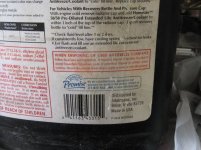
Also, from a random jug of coolant in the garage. How can they say this..."If permitted, dispose in sanitary sewer systems"
 

Attachments

  • IMG_1573.jpg
    IMG_1573.jpg
    84.5 KB · Views: 8

nissan_crawler

Well-known member
Joined
Jan 12, 2008
Messages
9,638
Location
Wichita, KS
You didn't prove anything to me with your poor selected examples. Fact is, for every poor *example* you can find that says there *may* be no harm from small amounts accessing the sewer system, you will find 20 accredited examples that says not to do it. Go tell your neighbors that you dump waste anti freeze into the sewers and also report yourself to your municipality and get a written response from them and post it here. Fact is - you are wrong, you know it so stop doing it. :lol_hitti

First off, I have never done it, so it's hard to stop. You also know this, so quit insisting that I do.

Second, how are the examples "poorly selected"? They show it is indeed legal to dump it, depending on the treatment plant. Here's the old post, since you insist on denying it.

It seems to depend on the municipality.

Many sites say no, but these say yes:

Purdue says household amounts ok: http://www.purdue.edu/envirosoft/housewaste/house/antifrze.htm

Missouri says yes if it goes to public works: http://www.dnr.mo.gov/pubs/pub114.pdf

Oregon says yes, depending on they type of treatment plant: http://www.deq.state.or.us/lq/pubs/factsheets/hw/UsedAntifreeze.pdf

Ok in lincoln, NE: http://www.lincoln.ne.gov/city/health/environ/pollu/antifrez.htm

Tennessee says yes, depending on plant: http://www.state.tn.us/environment/swm/oil/antifreeze.shtml

Ames, Iowa says yes: http://www.cityofames.org/worksweb/operations/StormSewers/StormSewerInformation.htm

Michigan says ok, with permission from sewer authority: http://www.deq.state.mi.us/documents/deq-ead-tas-antifrez.pdf

HUBbard, mn says ok, contact plant: http://www.co.hubbard.mn.us/Public%20Works/Solid%20Waste/FAQsolidwaste.pdf

Basically, it depends on the treatment plant.

Third, you are the one denying and not understanding the very basic laws of science. Who are you to be an authority, when you discredit the conservation of energy?
 
Last edited:
To avoid these ads, REGISTER NOW!
Top Bottom