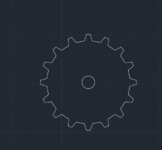
I know this has been discussed before but I can't seem to find the specific service recommendations. I have a gear that I need cut from 3/8 plate either by waterjet or laser. I know there are services that will take my dwg/dxf file and cut it and ship it back. Does anyone have a favorite service? It isn't a big part. That is a .650" bore.
My favorite Water Jet service is in my backyard. My favorite Laser Service is at our company.

Is the material ferrous or non ferrous? It will make a difference with the type of laser being used. You also haven't stated how important the tooth profile accuracy is. Looks like this will be used for a cogged belt. If so the amount of draft in the kerf might cause the belt to walk.
A CO2 Laser or Fiber Laser will not care ferrous or non-ferrous
Metal. The difference will be in which assist gases are applied, Nozzle Selection and Focal Length.
Thickness of non-Ferrous Metals require more "Heat" or in the Laser world Power. Thus our 10K Laser maximum capacity is 1 inch thick HRP&O (Ferrous), .625 Stainless and .500 Aluminum.
If the .650 center hole is important I wouldn't expect either laser or water jet to be more accurate than +/- .010 unless secondary machining operations (lathe, mill) are used. Yes some of the machines are capable of better tolerances but that's not what most shops run at unless new perishable tooling gets replaced.
Our production Lasers are spec'ed at +/-.00039 repeatability and +/-.0019 per 20 inches of travel Positioning Accuracy. The rub is depending on the Beam Quality and distortion on the sheet due to heat buildup this can vary the accuracy. Our rule of thumb is +/-.004 when looking at the process and can the Laser hold the customers expected tolerance.
There are ways around this by using a cut sequence strategy to reduce the heat soak of the sheet by working randomly around the sheet. We also can adjust cutting conditions for a specific hole or holes to hold closer tolerances. We have held +.001/-.000 on specific hole diameters in certain cases (.036-.120 thick materials). The issue is set-up time required increases and run time is increased.
You are spot on...most shops are just going to cut it. We on the other hand based on the type of work we do have to dial it in. If we were making a low volume run, Laser it and ream the hole. If we are doing thousands of them we would drive the hole size to eliminate the secondary operation of reaming saving time and money.
My personal WJ is spec'ed at +/-.001 "Table Accuracy". I have found it is pretty close and I use the rule of thumb of +/-.004 too when looking at what I am going to do. Holes become an issue. 99.9% of the hole is accurate but the start stop point can have just a little "nib" in the holes causing a Gage Pin to hold up. My work around is either undersize and ream or hit it with a round file. Lasers in my experience are more forgiving on this front.
A good Laser/WJ operator like a good Machinist will know his machine and adjust accordingly to get the expected outcome.
There's also dross, and HAZ from the laser to consider if secondary machining operations are to be done. Dross just needs some work with a file if it's aluminum. If it's ferrous (steel) the HAZ (Heat Affected Zone) can make de-burring and secondary machining difficult.
On the newer Lasers systems Dross is becoming a nonissue. Assist Gas technology and Nozzle design are a game changer in this area of Lasering. We have incorporated ABR (Advanced Burr Reduction) technology into our Laser Systems on 2 out of 3 on our automated Lasers using 2 different technologies.
Our newest Fiber Laser also uses AI (Artificial Intelligence) which helps with ABR, Speed, Gas Consumption reduction and part quality.
HAZ is an issue as long as "melting heat" is involve. It can be your best friend or worse enemy. Keep plenty of Carbide on hand when C'Sinking Lasered 4130 Holes. HAZ reduction or elimination is where the Water Jet shines.
Your drawing shows sharp internal corners, that's not going to happen with either process. Either include radii or an undercut is required, ask the company what their machine is capable of.
The Laser Beam diameter runs around .008 diameter for the most part. A Water Jet will vary based on Mixing Tube Diameter, for my Machine they offer .010, .020, .030 and .048 diameters. I run .030 so the minimum is a .015 Radii assuming the Mixing Tube is not worn.
Radii in corners are the best if you can have them. Internal or external. Just like a race car, the Laser or Water Jet have to slow down for the corners and then ramp back up to speed on the straights. You can fine tune a Laser using the cutting conditions varying the Speed, Power, Duty Cycle and Frequency. Water Jet software is less techy offering minimal tuning. I am waiting for the WJ industry to catch up to Laser Technology on the Cutting Conditions front.
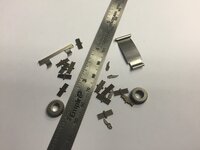
The parts in the picture were done on a CO2 Laser with one of the best Laser Set-ups in the business. Tony rans Lasers for us since 1979 at my Dad's shop he sold and started working for us 25 years ago as our Laser guru. He retired a couple of years ago and passed on what he could. Not sure if we will ever find an other Tony.
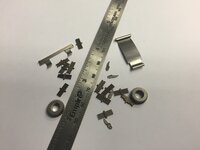
.019 diameters on .030 centers, .004 Stainless Shim Stock if I remember correctly??? We Lasered these in a 7/16 +/- square pattern and then punched them out in a round circle to make a Screen Filter for a nozzle. Med-Device application.

Not trying to nitpick, just offering some guidelines to consider as you set your expectations for the part. Laser is usually faster and a better choice for material less than 1/8 but it depends upon how powerful the laser is ($$$ machinery gets more capability). I've no experience with laser cut accuracy in 3/8 material.
Todays Fiber Lasers fly on almost any material. Again relative to thickness. Thinner doesn't always mean faster. Looking at Time Studies we have done for some reason .134 CRS cuts faster than .105 CRS??? On both our 8K and 10K Machines. Things that make you rub your chin.
The water jet will certainly cut that thickness with no trouble, speed/cost will depend upon the shop that does it. Water jet does have draft in the kerf (angle) but that will depend upon the cutting feed rate, and the consumables that are supposed to be replaced when they wear beyond a certain point.
Both the Laser will have a draft. The Laser is more forgiving thus less noticeable. The draft can be more noticeable on holes and Radii on thicker material because of the "erosion effect" where towards the bottom of the sheet the path lags behind the path at the top of the sheet shaping a hole like the upper half of a Hour Glass. Hope that makes sense.
My experience with my WJ is .0055 draft no matter the thickness up to 2.000 thick. WJ offer an option to run a Tilt-A-Jet Head which can compensate for this draft if required. Most shops I have seen run a straight head.
Both Lasers and WJ have consumables. Not sure how they compare cost wise hour per hour??? That might be a good study?
Parts wise:
Our Laser Consumables most often replaced are the Windows, Lens and Nozzles. On my Water Jet it is the Mixing Tube and Final Filters.
A Lens can cost $1500.00. A Mixing Tube $130.00.
Lenses will wear and I am not sure the average hours. That would depend on the power involved and how often we are required to change Windows.
Mixing Tubes...I had one get clogged up at 36 hours use which is uncommon. I am currently on my 2nd Mixing Tube with 151 hours showing on the pump. Final Filters run 10-15 hours. They are about $15.00 each.
Both Machines have PM Schedules that it is in you best interest to keep up with them.
Assist Products:
Laser: Liquid Nitrogen and Liquid Oxygen. We burn a lot of both. Tankers show up weekly to top off our 9000 gallon Nitrogen Tank and 6000 gallon Oxygen Tank.
Water Jet: Garnet (sand). Currently I am paying $0.42 per pound and run 14 ounces a minute cutting.
Machine Cost: $800K for a new Mitsubishi 10K Laser...$150K for an Omax 5555 WJ.
@RoninB4 I respect your posts here on GJ 100%. You have wisdom...that infinitely small point in space where knowledge meets experience.
@rslaback pm me for my email address. I'll quote your part on the Water Jet. The local guys I deal with are finding I can WJ parts cheaper than sendcutsend can laser them when they can eliminate the shipping charges. They also appreciate the turnaround I can offer when they get in a bind.
sendcutsend and oshcut are both good services. But you get what you get. Their business model eliminates the inspection overhead by design. I am not saying this is good or bad...it just is. I have a job I will be working on this week where the customer supplied the flats parts and wants me to form them. The parts came from sendcutsend. He would have had them bend the parts but the radii require for bending was out of their norm. The quality of the parts look good. I need to check them against the flat patterns to determine the accuracy.
Keep us posted on where you end up and how the parts work.