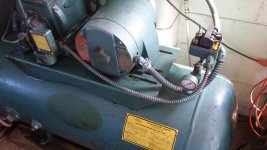
I have acquired an old (not nearly as old as me) Wayne air compresor. I believe it was made in 1965. The pump says 376-SH, ME14591, AC 4273, and the motor says 5KC184AG201C, FR184 type KC. On the tank it says Wayne compressor Head 144 shell 168 then 169490, ASME 1965. I paid 150 for it I sure it was worth that. i didn't know it was that big so i didn't take a trailer to pick it up, so we (4 guys) squeezed it into my van, I had to unload it myself. What I need to know is how to wire it up. It has a metal conduit and only a black and red wire, no ground, I'm assuming the conduit serves as a ground? Thanks.

You are using an out of date browser. It may not display this or other websites correctly.
You should upgrade or use an alternative browser.
You should upgrade or use an alternative browser.
Wayne Air compressor
- Thread starter oologahan
- Start date

Roberts210
Well-known member
Hey, oologahan, I like your MF-10. Or is it an MF-12?
Is the compressor 220? Is it 3-phase?
Is the compressor 220? Is it 3-phase?
Last edited:
Its is a MF-16 Hydrostatic, only made for 18 months and just over 3900 units produced, a third of them were exportedvoverseas. 16hp kohler K341 with three point hydraulic deck lift. They were made in West Des Moines Iowa by AMF. I also have the rear tiller and dump cart, about 900 pounds.I have three other Massey's and 18 other big GTs. Yep 220, SINGLE phase
Roberts210
Well-known member
Sorry, I just read your second post. If it's 1.5 H.P., 220VAC it will draw 10 amps on each leg, and will need appropriately sized wires and outlet.
Roberts210
Well-known member
Here's my MF-10. Original 10 h.p. Tecumseh with 5 forward speeds and one in reverse, but it has a torque amplifier that in each gear, you can increase/decrease speed while decreasing/increasing torque. No hydraulics. I got it out of an auto salvage yard in the early 1990's and have used it as a mower ever since.

PSYKO_Inc
Well-known member
That motor likely doesn't use a ground, although the conduit can be grounded. One wire goes to 120 hot, other wire goes to 120 hot on the opposite phase. That gives you 240, standard wiring for most 240 equipment.
Thank you, very much!That motor likely doesn't use a ground, although the conduit can be grounded. One wire goes to 120 hot, other wire goes to 120 hot on the opposite phase. That gives you 240, standard wiring for most 240 equipment.
Here's my MF-10. Original 10 h.p. Tecumseh with 5 forward speeds and one in reverse, but it has a torque amplifier that in each gear, you can increase/decrease speed while decreasing/increasing torque. No hydraulics. I got it out of an auto salvage yard in the early 1990's and have used it as a mower ever since.
Cool Old Massey, if you give me the serial number from the ID tag I can tell you when it was built. I have a feeling it might be a 1966 which would have had the aluminum dash and nose cone, your nose cone is gone (too bad, they are worth 175-200), but you sould be able to see the dah cowl from under the hood. The 1966 version was built by Beaver mfg, not AMF like all the others. Unless someone changed the rear end the MF-10 was originally a 4 speed. Also the term Torque Amplifier" is a registered trademark of International Harvester to describe their version of Allis Chalmers "Shuttle Shift" transmission, however, the feature on your MF-10 is a variable speed option (it used to say that on the hood decal) which uses a the same system as the John Deere 110 and 112, that increases or decreases the size of the drive pulley by squeezing the pulley sides in or out, both the IH and AC systems worked through the transaxle and not the pulley's, just FYI
Last edited:
sberry
Banned
The motor certainly needs a ground.
Roberts210
Well-known member
You'll need two hot legs and a neutral. So it was hard-wired. It has flex conduit and a black and red wire? You'll have to find the neutral somehow--trace things back until you can see (probably) a white wire. You'll have to loosen the ends of some of the flex conduit until you can find the neutral, and extend it to the end of the flex conduit where all three can be wired into a dedicated box. With only a 1.5 h.p. motor you won't have many amps on each leg. 12 ga Romex from the breaker panel into the box or wall receptacle should be fine. A dedicated 220 breaker will be needed for it. Hopefully you'll have room in the breaker panel for the new breaker. If you've never done this before find a buddy who knows how, or hire an electrician. Where in Okla are you?
Yes, my MF-10 has the variable speed option with the squeezable drive pulley. It's probably a 4 speed--it's in the barn and I'm out of town on a job, but low gear is really low. I never get mine in high gear, except for once racing my brother across the barnyard in his mower. I beat him!
Yes, my MF-10 has the variable speed option with the squeezable drive pulley. It's probably a 4 speed--it's in the barn and I'm out of town on a job, but low gear is really low. I never get mine in high gear, except for once racing my brother across the barnyard in his mower. I beat him!
Last edited:
The motor certainly needs a ground.
There is no ground wire or place for one in the junction box next to the motor, the only way I see a ground is through the metal conduit.
I took the cover off the junction box next to the motor, no white or green wire, just a black and red, no place for a white or green wire on the terminal block either. I have a dedicated 220/240 outlet and breaker for a small stick welder, that's no problem, I can wire it into that outlet as I rarely use my stick welder. I'm just perplexed by the motor only having a black and red, both hot I assume, UNLESS they wired it for 120 volts, which it is capable of. Could this be possible.You'll need two hot legs and a neutral. So it was hard-wired. It has flex conduit and a black and red wire? You'll have to find the neutral somehow--trace things back until you can see (probably) a white wire. You'll have to loosen the ends of some of the flex conduit until you can find the neutral, and extend it to the end of the flex conduit where all three can be wired into a dedicated box. With only a 1.5 h.p. motor you won't have many amps on each leg. 12 ga Romex from the breaker panel into the box or wall receptacle should be fine. A dedicated 220 breaker will be needed for it. Hopefully you'll have room in the breaker panel for the new breaker. If you've never done this before find a buddy who knows how, or hire an electrician. Where in Okla are you?
Yes, my MF-10 has the variable speed option with the squeezable drive pulley. It's probably a 4 speed--it's in the barn and I'm out of town on a job, but low gear is really low. I never get mine in high gear, except for once racing my brother across the barnyard in his mower. I beat him!
Roberts210
Well-known member
Yes, it could be possible it's wired for 110, but no electrician worth his salt would run a red lead as a neutral. Is there a piece of white tape wrapped around the end of the red lead? It sounds like you'll need someone with a good multimeter and some elec. smarts to figure it out.
If you pull the small curved covers on the motor you should be able to see some wiring diagrams which will tell you whether the motor is wired for 110 or 220, as well as the rotation if the motor is reverseable. The wires inside the motor should have tags or tape affixed to them identifying them--T1, T2, T3, T4, T5, T8, and how these are joined together and joined to the incoming hot and neutral leads will tell you the voltage and rotation of the motor.
If you pull the small curved covers on the motor you should be able to see some wiring diagrams which will tell you whether the motor is wired for 110 or 220, as well as the rotation if the motor is reverseable. The wires inside the motor should have tags or tape affixed to them identifying them--T1, T2, T3, T4, T5, T8, and how these are joined together and joined to the incoming hot and neutral leads will tell you the voltage and rotation of the motor.
Yes, it could be possible it's wired for 110, but no electrician worth his salt would run a red lead as a neutral. Is there a piece of white tape wrapped around the end of the red lead? It sounds like you'll need someone with a good multimeter and some elec. smarts to figure it out.
If you pull the small curved covers on the motor you should be able to see some wiring diagrams which will tell you whether the motor is wired for 110 or 220, as well as the rotation if the motor is reverseable. The wires inside the motor should have tags or tape affixed to them identifying them--T1, T2, T3, T4, T5, T8, and how these are joined together and joined to the incoming hot and neutral leads will tell you the voltage and rotation of the motor.
Thanks a BUNCH!

Roberts210
Well-known member
Sure thing. If there's a piece of white tape wrapped around the end of the red wire it means it IS being used as a neutral wire.
Here's a wiring diagram for a 110/220 motor.
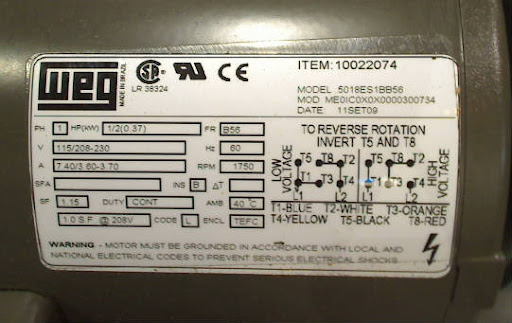
Here's a wiring diagram for a 110/220 motor.
PSYKO_Inc
Well-known member
If it's wired for 240 it doesn't use neutral just 2 hots. Safety grounds didn't become mandatory until sometime in the 60s, so if it was built before then it likely won't have a ground. You could add a ground wire, just bolt it to the motor chassis using the same gauge wire as the 2 hots. You can wire it to a plug that fits your 240 outlet, polarity doesn't matter for the hots, ground goes to the chassis, neutral left disconnected. BTW that terminal block is the pressure switch, you'll have to open the motor housing to verify that it's wired for 240.
Roberts210
Well-known member
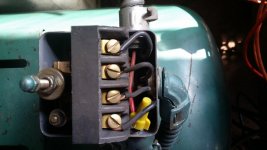
The 4 black wires that are shown in picture 1--where do they go?
Pull the little cover off the end of the motor, where the flex conduit connects to the motor. You should see the motor leads inside there and there may be a diagram on the inside of that small cover plate similar to the one above that gives the same information--it may not be on the inside of that cover plate, but the diagram as above will be on the motor somewhere. The diagram above shows the wires having different colors. Your motor is older and it may not have differently colored wires, but it will have small metal tags or pieces of white tape with the T1, T2, etc on them to identify each one. You might as well learn this stuff now.
Pull the little cover off the end of the motor, where the flex conduit connects to the motor. You should see the motor leads inside there and there may be a diagram on the inside of that small cover plate similar to the one above that gives the same information--it may not be on the inside of that cover plate, but the diagram as above will be on the motor somewhere. The diagram above shows the wires having different colors. Your motor is older and it may not have differently colored wires, but it will have small metal tags or pieces of white tape with the T1, T2, etc on them to identify each one. You might as well learn this stuff now.
If it's wired for 240 it doesn't use neutral just 2 hots. Safety grounds didn't become mandatory until sometime in the 60s, so if it was built before then it likely won't have a ground. You could add a ground wire, just bolt it to the motor chassis using the same gauge wire as the 2 hots. You can wire it to a plug that fits your 240 outlet, polarity doesn't matter for the hots, ground goes to the chassis, neutral left disconnected. BTW that terminal block is the pressure switch, you'll have to open the motor housing to verify that it's wired for 240.
Thats what I was thinking in 1965, very few things had a ground, 110/115 or 220/240. I'll open the motor and check. Thanks
Last edited:
Forgot to tell you, I live near Claremore Oklahoma, where you from in Missouri? The two middle wires come directly from the motor, the one on the bottom that ties into the red wire goes to the conduit/panel box, the black wire it connects to on the bottom goes to the reset? switch near the pump, the black wire at the top goes to the conduit/panel box, the out side two wires are where electric comes into from the conduit.The 4 black wires that are shown in picture 1--where do they go?
Pull the little cover off the end of the motor, where the flex conduit connects to the motor. You should see the motor leads inside there and there may be a diagram on the inside of that small cover plate similar to the one above that gives the same information--it may not be on the inside of that cover plate, but the diagram as above will be on the motor somewhere. The diagram above shows the wires having different colors. Your motor is older and it may not have differently colored wires, but it will have small metal tags or pieces of white tape with the T1, T2, etc on them to identify each one. You might as well learn this stuff now.
Roberts210
Well-known member
Heck, hook it up to 220 and if it explodes you did it wrong.
Just kidding, sort of. I always run ground or neutral wires just to be safe--that's why they were made code. I'm near Joplin out in the country. I'm about 100 miles from you. Isn't Claremore where Will Rogers was from?
Just kidding, sort of. I always run ground or neutral wires just to be safe--that's why they were made code. I'm near Joplin out in the country. I'm about 100 miles from you. Isn't Claremore where Will Rogers was from?
Last edited:
Heck, hook it up to 220 and if it explodes you did it wrong.
Just kidding, sort of. I always run ground or neutral wires just to be safe--that's why they were made code. I'm near Joplin out in the country. I'm about 100 miles from you. Isn't Claremore where Will Rogers was from?
Will Rogers was from Oologah, thats where I live, the museum is in Claremore though. If I attach the conduit to the panel will that serve as a ground, or should I attach a wire to the frame and that as a ground?
Roberts210
Well-known member
Ok, I am not an electrician, but I asked my old buddy who I've known since 1st Grade at St. Joseph's Grade school. He is an E.E. was an industrial electrician supervising the entire electrical dept. of a large factory. Here is what he told me: "Yes you can wire it with 2 hots--you don't need a neutral. However grounding is important, I would recommend grounding it. The motor should be grounded all the way to the distribution panel, and the wire run in the same conduit (or cable) with the hots. The motor should have a ground wire coming out of it."
Roberts210
Well-known member
He further said this to my question about whether the ground wire should be tied into the neutral buss in the dist. panel: Short answer is yes. In some cases there is a separate ground bus - different from neutral bus; but in most cases these 2 are tied together inside the panel. If you see neutrals (white) and grounds (bare) tied into the same bus, you can generally assume they are tied together. But if it looks like they're separate, tie the ground from the motor into the bus with all the bare wires.
If you do use a white wire as a ground wire, you should mark both ends - with a piece of green tape or a tag - so nobody taps into it in the future, thinking it's a neutral.
If you do use a white wire as a ground wire, you should mark both ends - with a piece of green tape or a tag - so nobody taps into it in the future, thinking it's a neutral.
Roberts210
Well-known member
And anytime you mess with things inside the distribution panel ALWAYS THROW THE MAIN BREAKER, which shuts off all power to the panel.
Ok, I am not an electrician, but I asked my old buddy who I've known since 1st Grade at St. Joseph's Grade school. He is an E.E. was an industrial electrician supervising the entire electrical dept. of a large factory. Here is what he told me: "Yes you can wire it with 2 hots--you don't need a neutral. However grounding is important, I would recommend grounding it. The motor should be grounded all the way to the distribution panel, and the wire run in the same conduit (or cable) with the hots. The motor should have a ground wire coming out of it."[/QUOTE
The motor itself has no ground wire, at least none that is identified as such, only black wires. I'll post pics of inside the motor panel soon. BTW, I did a test of plugging in just the two hots and the motor ran, seemed fine, but I would feel better knowing it was at least halfway right. I hear what your electrician friend is saying, and I know he is trying to be helpful, but most of all safe, so some information may be "code" information designed to promote safety, but on this old of equipment I do not know how relevant, or maybe redundant, some of the information is. I know he (or any electrician) might be able to make a better call on site. By the way the shop is all wired in conduit, built in 1965-1966 by a government mechanical engineer.
Last edited:
Roberts210
Well-known member
He wired both my barn and my new house and did a great job. He also ran the 4/0 main elec. line from the service entrance at my barn, underground to the house and up to the distribution panel. My brother is a code enforcement officer and even tho I am out in the country, where there is no code enforcement, he did look over the electrical installation and found it excellent in every way except he didn't like that I had the dist. panel in a closet.
I guess I'm running down a slippery slope here dealing with this old of a motor. Any knowledge person is going to advise me as to code, but I might run into problems doing that, If (they are) my grounds are running into my neutral bar, I cant really run a ground from the motor to a ground that is also a neutral. I don't see how the flex conduit that attaches to the junction box and dist. panel wont provide the ground I need. This compressor was a a City electric power plant in Kansas wired with two hots and the conduit attached to the power box since the compressor was new. Of course I don't know what type of power, panel, or grounds they were running.
oologahan,I have acquired an old (not nearly as old as me) Wayne air compresor. I believe it was made in 1965. The pump says 376-SH, ME14591, AC 4273, and the motor says 5KC184AG201C, FR184 type KC. On the tank it says Wayne compressor Head 144 shell 168 then 169490, ASME 1965. I paid 150 for it I sure it was worth that. i didn't know it was that big so i didn't take a trailer to pick it up, so we (4 guys) squeezed it into my van, I had to unload it myself. What I need to know is how to wire it up. It has a metal conduit and only a black and red wire, no ground, I'm assuming the conduit serves as a ground? Thanks.
do you still have this Wayne compressor?
If so I am in the process of restoring my vertical wayne 1964 compressor
and need a picture of complete yellow label that is on the side of this your tank.
mine was missing half of the label. you can see images of the one I,m working on.

