AndrewMarek
Active member
Hello All
To start off insulation is not something I know much about. I’ve done some reading and talking to contractors but not sure that’s been helpful.
We live in central Texas and we are in the process of taking in a 700sqft carport that is under the main roofline and converting to a new bedroom, bathroom, and office and then building a detached garage, shop, and MIL suite. All of the plans for the carport conversion were approved but the city made the comment that the ceiling/roof needed to be r38 vs the r25 that the architect spec’d and everyone bid on. In this area of the house the attic space contains the downstairs air handler and a lot of duct and about 400sqft of decking on top of the joists we use for some various storage. Ceiling joists and rafters are both 2x6s.
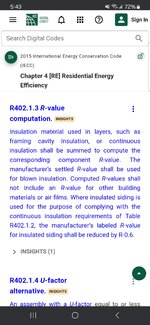
The contractors had planned to spray the roof decking with open celled foam to 5.5 inches and that really only gets me to r21 anyway. So I need to get another r17. Can we just add 5.5 of batts (r21) or blown in between the ceiling joists to get there? Do the layers of insulation need to touch? Or can they be additive in the same areas? This approach appeals to me because of the air handler and duct in this area. It should make that more efficient. Would building codes allow this?
Similarly, an alternative I was thinking about was just adding batts and/or blown in to get to r38. We would like to skip the pain in the rear of ripping up that 400sqft deck (osb) on top of the joists. Can we add batts below and blown in above it to get there? Does code allow that?
The insulation guys are basically telling me to spray foam the decking to r21 and get and “engineering study” to show the permitting authority that it’s as effective as r38.
What ever happens I’m paying more than the original bids. I’m probably looking at 1k more for the 1st 2. The engineering study is about 600. But if I’m paying I would like to at least get physical insulation.
I hope all this makes sense. Thank you for any insight you can provide.
Andy
To start off insulation is not something I know much about. I’ve done some reading and talking to contractors but not sure that’s been helpful.
We live in central Texas and we are in the process of taking in a 700sqft carport that is under the main roofline and converting to a new bedroom, bathroom, and office and then building a detached garage, shop, and MIL suite. All of the plans for the carport conversion were approved but the city made the comment that the ceiling/roof needed to be r38 vs the r25 that the architect spec’d and everyone bid on. In this area of the house the attic space contains the downstairs air handler and a lot of duct and about 400sqft of decking on top of the joists we use for some various storage. Ceiling joists and rafters are both 2x6s.
The contractors had planned to spray the roof decking with open celled foam to 5.5 inches and that really only gets me to r21 anyway. So I need to get another r17. Can we just add 5.5 of batts (r21) or blown in between the ceiling joists to get there? Do the layers of insulation need to touch? Or can they be additive in the same areas? This approach appeals to me because of the air handler and duct in this area. It should make that more efficient. Would building codes allow this?
Similarly, an alternative I was thinking about was just adding batts and/or blown in to get to r38. We would like to skip the pain in the rear of ripping up that 400sqft deck (osb) on top of the joists. Can we add batts below and blown in above it to get there? Does code allow that?
The insulation guys are basically telling me to spray foam the decking to r21 and get and “engineering study” to show the permitting authority that it’s as effective as r38.
What ever happens I’m paying more than the original bids. I’m probably looking at 1k more for the 1st 2. The engineering study is about 600. But if I’m paying I would like to at least get physical insulation.
I hope all this makes sense. Thank you for any insight you can provide.
Andy