To avoid these ads, REGISTER NOW!

Weatherproofing Nightmare (Barndo)

Bert_

Well-known member
Joined
Dec 24, 2016
Messages
9,747
Location
NW Iowa
Just for you, Bert, because you have helped me out before (thanks). The outermost fin, flush with the window frame front face, is sticking up, out and down. I'm not talking about anything under the metal siding as I can't see anything but a window frame stuck into an opening in the metal siding.

If I was totally wrong about everything said up to this point, the top of the window acts as a ledge for nests of god-knows-what. It will collect dirt and then water. Anyone can have whatever they see fit. I know what a call back looks like and I hated them. So I worked hard so as to not have to do call backs. The few call backs that I did have were 90% flush fin retro windows slapped on into an existing opening. I didn't like them then and I don't like them now. I specifically tailored my advertising to not reach tracts of stucco homes with AL windows that were allowed by the local AHD to have a new window pasted to the side of the building.

That bronze window pictured here is exactly what is sold in CA for that purpose.

IN MY OPINION ONLY: no one should have a sharp metal fin sticking out of anything. This is the vinyl equivalent of that window:

200_vinyl_features_3.jpg

This is the window I would have used. No external fin:

what-is-an-integral-nailing-fin-1.jpg

Again, a vinyl window shown as an example. After prepping the RO with flashing membrane behind that flange, I would have attached the window and added a Z-flashing above and then covered both sides and then the top with more flashing. I would have brought the moisture barrier over on top of that staggered from bottom to top. That is essentially 3 layers of waterproofing.

Metal edging trim is optional after that, but has to be done in a way so as to not send water towards the window, but divert away. Even board trim is OK but again the top board would have Z flashing. Where I don't have that much experience is having to deal with ribs. I know no building I ever would build would have anything including a light fixture sitting on top of ribs. Everything would be let in and flashed.

So that's just my opinion that worked well enough for 25 years that the majority of my business was referral.
I appreciate the conversation

I'm fairly sure he does have a window like the bottom example. Then j channel installed around it. The window and the j channel look separate to me. Again I don't really like it either but that is what 90%+ of contractors are doing. It's the same with vinyl siding.

The only really good way I have come up with is to cut across the entire panel(s) that touch the window. Then you have a horizontal seam you can flash into. You have to get longer sheets to account for overlap in the extra seams. I did it with a penetration in the roof of my garage, layered in the flashing just like shingles. I have never seen anyone else do this though.
 
Last edited:
To avoid these ads, REGISTER NOW!

cgrutt

Well-known member
Joined
Mar 4, 2016
Messages
8,307
I'm not familiar with window installation on metal buildings but that doesn't look like a nailing flange it looks like j channel to me, which as I understand it, would be the way to trim the window with metal (or vinyl for that matter) siding. There is a tab at header overlapping the vertical jam. This is fairly normal as far as I understand it. What looks unusual is the wide gap between the outside face of the J-channel and the siding. But I think that is due to the size of the ribs. Notice the siding is flush up against the J-channel at the ribs. They make a j-channel with internal section that comes back into structure (jamb channel) that would hide some of the large exposed gap on the vertical section.

How are the windows actually fastened to the structure? Is there a nailing flange under the siding or is it attached like a replacement window, screwed through side of window jamb? And there is nothing else between framing and siding, right?

The j-channel would ordinarily work but normally has additional flashing (t7thape, etc) to structure. The gap between the window and j-channel would be caulked, foamed or taped.

V6kQL.png

ETA if there is no sheathing or other water barrier under the metal siding any water that is caught by the j channel but directed under the siding will have nowhere else to go but into the structure. This would normally get caught by the sheathing and/or house wrap and still be directed outside of the structure. Not sure if there is any of this there on your building. If this is the case the only thing you will be able to do is to keep the water outside of the metal siding. Maybe some sort of urethane adhesive or seam seal on the seams? Or replace the j channel with a drip cap? Sorry just thinking outloud.
 
Last edited:

kinglake

Well-known member
Joined
Dec 12, 2011
Messages
96
Just for you, Bert, because you have helped me out before (thanks). The outermost fin, flush with the window frame front face, is sticking up, out and down. I'm not talking about anything under the metal siding as I can't see anything but a window frame stuck into an opening in the metal siding.

If I was totally wrong about everything said up to this point, the top of the window acts as a ledge for nests of god-knows-what. It will collect dirt and then water. Anyone can have whatever they see fit. I know what a call back looks like and I hated them. So I worked hard so as to not have to do call backs. The few call backs that I did have were 90% flush fin retro windows slapped on into an existing opening. I didn't like them then and I don't like them now. I specifically tailored my advertising to not reach tracts of stucco homes with AL windows that were allowed by the local AHD to have a new window pasted to the side of the building.

That bronze window pictured here is exactly what is sold in CA for that purpose.

IN MY OPINION ONLY: no one should have a sharp metal fin sticking out of anything. This is the vinyl equivalent of that window:

200_vinyl_features_3.jpg

This is the window I would have used. No external fin:

what-is-an-integral-nailing-fin-1.jpg

Again, a vinyl window shown as an example. After prepping the RO with flashing membrane behind that flange, I would have attached the window and added a Z-flashing above and then covered both sides and then the top with more flashing. I would have brought the moisture barrier over on top of that staggered from bottom to top. That is essentially 3 layers of waterproofing.

Metal edging trim is optional after that, but has to be done in a way so as to not send water towards the window, but divert away. Even board trim is OK but again the top board would have Z flashing. Where I don't have that much experience is having to deal with ribs. I know no building I ever would build would have anything including a light fixture sitting on top of ribs. Everything would be let in and flashed.

So that's just my opinion that worked well enough for 25 years that the majority of my business was referral.
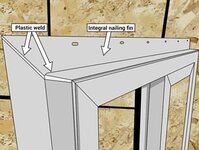
Here is the best image I can find on a quick search but you can see in this picture that there is an nailing fin/flange and the exterior trim is part of the window itself. The metal siding/r-panels are just cut to fit inside the existing trim very similar to how vinyl siding would be done.

Installing-metal-building-windows.jpg
 

Bert_

Well-known member
Joined
Dec 24, 2016
Messages
9,747
Location
NW Iowa
Here is the best image I can find on a quick search but you can see in this picture that there is an nailing fin/flange and the exterior trim is part of the window itself. The metal siding/r-panels are just cut to fit inside the existing trim very similar to how vinyl siding would be done.

Installing-metal-building-windows.jpg
Pretty accurate depiction.

It's going to keep the bulk of the water out but it's going to leak to some extent. That's not a big problem in a shop but it's why I wouldn't do it for living space
 

Walkers

Well-known member
Joined
May 17, 2021
Messages
3,912
Location
Cave Creek Az
I have fixed a handful of that type of install simply by plasma cutting a profile to mate up to your siding and building a box around the the window, screwing it to the sheet metal with tabs, and then caulking it. It seals it up well, but a true fix would require removing the windows.
 
OP
S

Slimmons

Well-known member
Joined
Sep 11, 2023
Messages
66
@cgrutt Thanks, that makes a lot of sense. As far as what they put in, the picture that @kinglake is better than any of my pictures. They basically did that, with the J trim, and then put the metal over that. There's nothing else (other than the spray foam on the inside.) I've never seen drip caps, so that's a really good option.
@Walkers Would you mind giving me a bit more detail on what you mean by plasma cutting a profile and mating it to the siding? I'm sorry, my terminology for metal buildings is definitely not what it should be by now. Are you saying you built a box for around the window, and just cut the shape of the ribs on the top/bottom so that it mated on there? I kind of like that idea, because I can make it look like whatever I want.
@Zeke Sorry if this thread has caused you any grief, I am hugely appreciative to how helpful you (and everyone else) has been. I have a lot to think about.

As for my next step, I'm going to get 100% proof on whether or not this building is leaking anywhere other than the windows. I'll update here.
 
To avoid these ads, REGISTER NOW!

Walkers

Well-known member
Joined
May 17, 2021
Messages
3,912
Location
Cave Creek Az
@Walkers Would you mind giving me a bit more detail on what you mean by plasma cutting a profile and mating it to the siding? I'm sorry, my terminology for
It simply means cutting the same zig zag that your siding has out of a piece of sheet steel. That way you can make a box around the window frame that doesn't have all the gaps that a piece of straight material would have. Consider it the same as scribing a piece of wood to fit.
 

Zeke

Well-known member
Joined
Aug 13, 2009
Messages
17,176
Location
Long Beach CA, the sewer by the sea.
I'm all confused, those window frames look like they should be somewhere further "into" the building
This what I have been thinking all along. I finally blew up the pic and looked at the details right down to the wrinkle on the top fin. Well, AL fins don't wrinkle so there is some kind of sheet metal going up and over and maybe under. You think you're confused!

The whole mess is a water trap and like I said a place for dirt, nests, and a bit of a hazard.
 

WisJim

Well-known member
Joined
Dec 20, 2010
Messages
2,283
Location
Menomonie, WI
Reading this thread makes me glad that my shop and garage has blandex sheathing and housewrap under the metal siding, and the windows are installed onto the sheathing.
 

ZRX61

Well-known member
Joined
Aug 15, 2006
Messages
28,716
Location
Solar Blight Valley, SoCal
This what I have been thinking all along. I finally blew up the pic and looked at the details right down to the wrinkle on the top fin. Well, AL fins don't wrinkle so there is some kind of sheet metal going up and over and maybe under. You think you're confused!

The whole mess is a water trap and like I said a place for dirt, nests, and a bit of a hazard.
I think the installer screwed up by mounting the windows after the metal siding was already on the building.
 

My Old Tools

Well-known member
Joined
Jun 4, 2014
Messages
5,440
Location
Hamrick Lake, TX
It's hard to tell from the pictures, but in one picture it looks like the flange that should screwed to the frame is actually outside of the siding and screwed through the siding.
 

KenC

Well-known member
Joined
Dec 20, 2009
Messages
2,590
Location
oklahoma
I just had a quick 'net course on these windows. Seems that the standard in the industry relies on caulking to seal them. Totally opposite of what I've learned in years of working with 'normal' windows. Rule was and is, never rely on caulking as it will always fail. Always, just a matter of when.

Flashing and counter-flashing is the only way that will work, forever. Unfortunately that starts before the window is installed.

Not knowing what the window configuration really looks like uninstalled, nor how installation process and sequence went makes it near impossible to make an accurate recommendation that doesn't start with, 'remove the window'.
 

clutchee

Well-known member
Joined
Feb 19, 2007
Messages
332
Location
TX- Near the Telephone
We live in a barndo, we built.

There needs to be sealer applied all way around windows where the meet the metal sides. All way around. This take gap between window which yes, sits outside, and fills gap.
 
To avoid these ads, REGISTER NOW!
Top Bottom