Remi
Well-known member
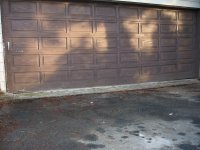
The garage door on my (new to me) house is a 18' single wood door. Unfortunetly due to many different factors (sagging concrete, listing walls and sagging door) large gaps have developed around the door and especialy at the bottom.
I live in a mild climate, but heating a garage with gaps like these would be a waste and inefective so I set about closing some of these gaps. I could have replaced the door for a new steel insulated unit but I would still need to deal with the same problems.
First I set about fixing the sag in the door. When I was installing a garage door in my old house, I noticed a section in the manual about supporting long span doors with cables. So I went about trying this with the door. After learning that U bolts are much better than eye bolts. I turned the turnbuckles to tighten up the cables and pulled up on the center of the door. It worked, but only slightly. Over all it only lifted the door about 1/2". And introduced a new problem. The panels in the door started developing cracks over time. Overall if I had to do it again I would not do it at all. So I relaxed the cables and left them in place simply to keep the door from sagging any more. I also removed one cable that was a little to close to comfort of a work area when the door swings up.
I was still left with large gaps at the ends of the door at the bottom, mostly due to sloping concrete. So I ripped of the old weather stripping. I cut a piece of 2x pressure treated wood to fit the gaps. I brad nailed them to the bottom of the door while using PL Premium. Than I installed new weather striping at the bottom. It worked out great, nice tight fit to the concrete. Plus no more leafs floating into the garage. I also added more strips on the side of the door where the garage door liner trim was listing away from the door creating a gap.
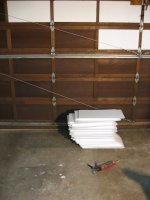
I was left with many small cracks in the thin panels of wood. So I bought 4 sheets of 3/4" rigid foam. I cut and beveled them to fit each panel on the back. I did this on the table saw. Small tip: raise the blade only far enough to clear the top of the foam (this should be done at all times anyway). If you lift it to high the side of the blade starts to collect the foam and building up a resin. Which makes the foam chatter. I tried to glue one piece using spray contact cement to glue the foam to the back of the panel. It worked but it ate away at the foam, and spraying that much foam is a unpleasant job. So I used a combination of PL premium dabs and NP1 (one part polyurathane) to go over the cracks. Holds very well and is fast.
I was still left with the long horizontal gaps between the main panels. So I bought some 3/16" and 1/4" closed cell foam. And applied it at the top of each panel so when the door closed, it squished the foam and created a tight seal. It's important to use the proper sized foam for the gaps. If the foam is to thick it could impede the closing of the door.
I'm still left with some small gaps around the perimiter of the door. The door does not stick out past the liner consistantly enough to use the closed cell foam. So I;m going to atach some weather striping that is specificly designed for this (a lip of rubber or foam that flares out)
All this work has made a big difference in the comfort level of the garage (and my wallet). When spring comes around I will fill the cracks from the outside and give the door a new coat of paint.
I live in a mild climate, but heating a garage with gaps like these would be a waste and inefective so I set about closing some of these gaps. I could have replaced the door for a new steel insulated unit but I would still need to deal with the same problems.
First I set about fixing the sag in the door. When I was installing a garage door in my old house, I noticed a section in the manual about supporting long span doors with cables. So I went about trying this with the door. After learning that U bolts are much better than eye bolts. I turned the turnbuckles to tighten up the cables and pulled up on the center of the door. It worked, but only slightly. Over all it only lifted the door about 1/2". And introduced a new problem. The panels in the door started developing cracks over time. Overall if I had to do it again I would not do it at all. So I relaxed the cables and left them in place simply to keep the door from sagging any more. I also removed one cable that was a little to close to comfort of a work area when the door swings up.
I was still left with large gaps at the ends of the door at the bottom, mostly due to sloping concrete. So I ripped of the old weather stripping. I cut a piece of 2x pressure treated wood to fit the gaps. I brad nailed them to the bottom of the door while using PL Premium. Than I installed new weather striping at the bottom. It worked out great, nice tight fit to the concrete. Plus no more leafs floating into the garage. I also added more strips on the side of the door where the garage door liner trim was listing away from the door creating a gap.
I was left with many small cracks in the thin panels of wood. So I bought 4 sheets of 3/4" rigid foam. I cut and beveled them to fit each panel on the back. I did this on the table saw. Small tip: raise the blade only far enough to clear the top of the foam (this should be done at all times anyway). If you lift it to high the side of the blade starts to collect the foam and building up a resin. Which makes the foam chatter. I tried to glue one piece using spray contact cement to glue the foam to the back of the panel. It worked but it ate away at the foam, and spraying that much foam is a unpleasant job. So I used a combination of PL premium dabs and NP1 (one part polyurathane) to go over the cracks. Holds very well and is fast.
I was still left with the long horizontal gaps between the main panels. So I bought some 3/16" and 1/4" closed cell foam. And applied it at the top of each panel so when the door closed, it squished the foam and created a tight seal. It's important to use the proper sized foam for the gaps. If the foam is to thick it could impede the closing of the door.
I'm still left with some small gaps around the perimiter of the door. The door does not stick out past the liner consistantly enough to use the closed cell foam. So I;m going to atach some weather striping that is specificly designed for this (a lip of rubber or foam that flares out)
All this work has made a big difference in the comfort level of the garage (and my wallet). When spring comes around I will fill the cracks from the outside and give the door a new coat of paint.