To avoid these ads, REGISTER NOW!

Wej-it anchors for the MaxJax

lemmy999

Well-known member
Joined
Jun 25, 2019
Messages
86
Location
TN
I was in the market for a MaxJax lift and I was looking at the anchor bolt stress analysis on the MaxJax website:

https://www.maxjaxusa.com/requirements

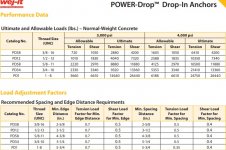
They calculate the worst case tension on each bolt (arms fully extended) to be 3,238lb and they state that in 3000psi concrete, the ultimate strength of the anchor is 12,580lb for the PD58 5/8" Wej-It.

But if you go to the Wej-it website and look up that anchor, they show that in 3000 psi concrete the ultimate tension strength for the PD58 is 8880lb and the allowable tension is 4x less at 2220lb, which is less than the 3,238lb calculated by MaxJax. I called MaxJax to ask them about this because I assumed I was missing something and all I got was the tech support guy telling me that they had lots of these installed and never had a problem.

I'm an engineer but not a civil engineer and I was hoping someone with more knowledge in this area could tell me what I'm (hopefully) getting wrong. Thanks.
 

Attachments

  • wejit.jpg
    wejit.jpg
    129.7 KB · Views: 134
To avoid these ads, REGISTER NOW!

mcbane

Well-known member
Joined
Jul 23, 2017
Messages
794
Location
California
The "calculation" on the maxjax site would get an F in engineering school. The incorrect value for the anchor ultimate strength is similarly careless.

Chances are this is the work of a web designer or marketing person and does not reflect on maxjax's engineers. In all likelihood the designers in China have never even seen the US website.
 

strutaeng

Well-known member
Joined
Dec 12, 2011
Messages
2,271
Location
Dallas, TX
lemmy999, if you are an engineer, I would recommend you download Hilti Profis software. It is widely used in industry and a basic understanding of mechanics of materials will get you rolling on it. Simpson also has a nice software, as well as Powers (Dewalt.) You know the loads, locations of G.C....you can easily calculate reactions based on geometry.

I try to avoid these threads about lifts because manufacturers don't seem to publish reactions. They just say use "this," as you have found out.

Seems scary that a F250 over your head is just held with 2 cheesy post-installed anchor bolts into 3 1/2" concrete...but that's just me.
 
OP
L

lemmy999

Well-known member
Joined
Jun 25, 2019
Messages
86
Location
TN
Thanks for the input. I don't think I could ever get under a lift like this without also having tall jackstands under it.
 

matt_i

Well-known member
Joined
Mar 14, 2008
Messages
10,728
Location
SE Michigan
Seems scary that a F250 over your head is just held with 2 cheesy post-installed anchor bolts into 3 1/2" concrete...but that's just me.

Completely agree. In the industrial world, any critical anchor is epoxied for the far far greater shear strength. Just in that "residential application" if the dust isn't blown out of the hole due to jack leg installers, the actual strength of the epoxied anchor is near zero. Which is a bigger problem than a low strength wedge anchor. So we go with the lowest common denominator.
 

c4cruiser

Well-known member
Joined
Oct 8, 2012
Messages
359
Location
Lacey WA
Thanks for the input. I don't think I could ever get under a lift like this without also having tall jackstands under it.

I've had my MaxJax in place and use it a lot. Never had any worries/concerns about getting under a car and working.

One thing I did have a concern about was that the WejIt anchors were supposed to have a minimum of a 4" thick slab so the anchors would have something to grab once they were placed in the holes. Turned out my garage floor was only 2-1/2" thick where the anchors were to be placed. :wtf:

So I wound up calling a local concrete company and had two 4'x4' sections of the floor removed and they poured a 12" thick slab in the hole and used rebar to connect the new slab to the existing floor. I also asked for a 5000 psi mix to make sure the pour was going to be strong enough.

I decided to not use the WejIt anchors as they were only 4" long. So I bought some 7" epoxy anchors. So far after 4 years of use, I have not seen any sort of problems. I use the lift for two Corvettes and they each weigh about 3400 lbs. Sometimes I will have one car up on the hoist for a week or so. I also decided to use hydraulic fluid; some people use non-synthetic ATF. Either one works and it's a good idea to check for any leaks and make sure the reservoir is full before raising a car up.
 

Mr onetwo

Well-known member
Joined
Apr 6, 2011
Messages
2,009
Location
Coastal Maine
I have had my MaxJax for several years installed with the epoxy anchors.I would recommend spending the extra coin for those anchors.Get the concrete right and you will never have to worry.I have literally installed thousands of concrete wedge anchors in my career as a mechanical contractor(retired) and they are tried and true in the right circumstance.IMHO this is not one if you plan on moving or storing the MaxJax.You need an epoxy anchor when you are torquing and un-torquing the bolts multiple times.
 

curiousB

Well-known member
Joined
Dec 15, 2011
Messages
143
Location
NW Chicago, IL
I bought longer bolts and nuts to avoid putting rotational force on the anchors. It also ensures maximum thread engagement in the anchor.

The bolts are over-length by 1-2". I thread a nut well up the bolt threads. I screw the bolt into the anchor until it bottoms out. Then I tighten nut. I use a second wrench to hold the bolt from twisting in the anchor. Much like the anchor setting procedure.
 

Attachments

  • Maxjax bolts.jpg
    Maxjax bolts.jpg
    110.9 KB · Views: 159

mike93lx

ALLIANCE MEMBER
Joined
Dec 9, 2013
Messages
37,572
Location
Richmond, VA
I bought longer bolts and nuts to avoid putting rotational force on the anchors. It also ensures maximum thread engagement in the anchor.

The bolts are over-length by 1-2". I thread a nut well up the bolt threads. I screw the bolt into the anchor until it bottoms out. Then I tighten nut. I use a second wrench to hold the bolt from twisting in the anchor. Much like the anchor setting procedure.

That's an interesting solution. Thanks for sharing
 
OP
L

lemmy999

Well-known member
Joined
Jun 25, 2019
Messages
86
Location
TN
I have had my MaxJax for several years installed with the epoxy anchors.I would recommend spending the extra coin for those anchors.Get the concrete right and you will never have to worry.I have literally installed thousands of concrete wedge anchors in my career as a mechanical contractor(retired) and they are tried and true in the right circumstance.IMHO this is not one if you plan on moving or storing the MaxJax.You need an epoxy anchor when you are torquing and un-torquing the bolts multiple times.

I have drilled several places and found my floor is about 5" thick. I wanted to go with the epoxy anchors since they are clearly much stronger, but then I started reading how the expanding anchors are a bit more idiot proof. For epoxy anchors is it as simple as just getting all of the dust out (brush the hole, blow and/or vacuum out the hole)? Or should I actually clean the inside of the hole with something?
 

strutaeng

Well-known member
Joined
Dec 12, 2011
Messages
2,271
Location
Dallas, TX
I have drilled several places and found my floor is about 5" thick. I wanted to go with the epoxy anchors since they are clearly much stronger, but then I started reading how the expanding anchors are a bit more idiot proof. For epoxy anchors is it as simple as just getting all of the dust out (brush the hole, blow and/or vacuum out the hole)? Or should I actually clean the inside of the hole with something?

Read the manufacturer's installation instructions for epoxy. All manufacturers have different procedures. Brush, blow with air compressor, psi requirements, etc...

some say 2 brush, 2 blows...some say 3 brush, 3 blows...

If you are using the Hilti SafeSet system, no cleaning!
 

nels2825

New member
Joined
Jan 10, 2019
Messages
3
Location
lakeville, MN
I installed 10 of these anchors previously, and the issue I had is that the epoxy seemed to drain out of the hole. I had drilled through the concrete slab so there was dirt at the bottom of the hole, but the epoxy still squeezed out some. I knew that it worked OK at several holes because the excess epoxy squirted out the top when the anchor was inserted. I had read about people using coffee filters at the bottom of the hole to keep it in there, any other suggestions? I was thinking of putting expanding foam in there and then re-drilling the hole through the foam. I am trying to make two more mounting points for the lift in the floor
 

mcbane

Well-known member
Joined
Jul 23, 2017
Messages
794
Location
California
I installed 10 of these anchors previously, and the issue I had is that the epoxy seemed to drain out of the hole. I had drilled through the concrete slab so there was dirt at the bottom of the hole, but the epoxy still squeezed out some. I knew that it worked OK at several holes because the excess epoxy squirted out the top when the anchor was inserted. I had read about people using coffee filters at the bottom of the hole to keep it in there, any other suggestions? I was thinking of putting expanding foam in there and then re-drilling the hole through the foam. I am trying to make two more mounting points for the lift in the floor

You probably have a void under the slab. Mix up a watery grout, like Sika 212, and pour it into the hole. Feed in as much as the hole will accept. Then re-drill and you are good to go.
 
OP
L

lemmy999

Well-known member
Joined
Jun 25, 2019
Messages
86
Location
TN
I bought longer bolts and nuts to avoid putting rotational force on the anchors. It also ensures maximum thread engagement in the anchor.

The bolts are over-length by 1-2". I thread a nut well up the bolt threads. I screw the bolt into the anchor until it bottoms out. Then I tighten nut. I use a second wrench to hold the bolt from twisting in the anchor. Much like the anchor setting procedure.

That is a good solution to prevent rotational forces on the anchors. Is there a reason you have a large washer and a smaller washer?
 
OP
L

lemmy999

Well-known member
Joined
Jun 25, 2019
Messages
86
Location
TN
I was going to try the longer bolts like curiousB did and I know that according to Dannmar and the company that makes the anchors that these are 5/8-11 bolts. However the bolt heads are stamped with 8.8 which, as far as I know, usually found on metric bolts. So I pulled out my thread gauge and the 11tpi wouldn't fit. The 13 tpi was the only one on the standard thread gauge that would fit. Then I tried my metric thread gauge and the 2mm pitch was a perfect fit. So are these bolts really M16 coarse thread bolts (M16 - 2mm)?
 

Attachments

  • 20190726_104752.jpg
    20190726_104752.jpg
    94.7 KB · Views: 51
  • 20190726_104852.jpg
    20190726_104852.jpg
    112.4 KB · Views: 32
  • 20190726_104908.jpg
    20190726_104908.jpg
    123.2 KB · Views: 47
To avoid these ads, REGISTER NOW!
OP
L

lemmy999

Well-known member
Joined
Jun 25, 2019
Messages
86
Location
TN
I continue to be amazed at the amount of errors on the Maxjax website and in their documentation. I contacted them and they said that it is indeed a M16 - 2mm coarse thread and not a 5/8-11 tpi. So is the Wej-It website wrong as well (they claim they are 5/8 -11) or is Dannmar using some Chinese alternative to the Wej-It?

I have also noticed that when installing the anchor, MaxJax says to have a space of 5/8" between the anchor and the nut before you tap it in the hole, then they say to tighten the nut 3 turns. They also mention 90 ft-lb and bringing the anchor to 1/8" below the surface of the concrete floor. I installed one anchor today and at 3 turns it is still well below the surface of the floor and it is still easy to turn. So I went close to 5 turns and it is still 1/4" below the surface of the floor.

So I started to think about the 2mm (0.079") thread pitch. In the three turns they specify, it would only pull up the anchor about 0.237". To get to 1/8" below the surface of the floor it would need to be pulled up 1/2". With a 0.079" pitch that would be 6.3 turns. I think at just under 5 turns I am getting pretty close to the 90 ft-lbs value and the anchor is expanded enough, but it is still 1/4" below the surface. To me it seems the specification should be to set the space between the anchor and nut to 1/2" instead of 5/8" and tighten about 5 turns instead of 3. Has anyone else found this to be the case?
 

PoorOwner

Well-known member
Joined
Feb 10, 2007
Messages
5,032
Location
CA
I just installed 4 5/8” wejit wedge anchors.
Instruction says 90 ft lbs or 3 turns from hand tight.

I got about 1-1.25 turns. It was fairly snug with a 15/16 wrench which had reasonable length. In my case I am only tightening a cast iron stand and don’t want to crack it. I probably got 25 ft lbs.

I don’t notice much up or down movement during tightening.

The problem following instructions. They put you at the mechanical limits of the concrete and anchor. And sometimes things can go wrong.

How many turns before feeling tight is not a good measurement. If your drilling is more sloppy it will take more turns for the wedge to expand.
 
OP
L

lemmy999

Well-known member
Joined
Jun 25, 2019
Messages
86
Location
TN
True. But for the PD58 Wejit anchors, the coarse thread is 11 tpi or 0.091" pitch. So if you thread the nut on the sacrificial bolt 5/8" above the anchor (the WejIt instructions call this the "installation space") and hammer it down, the top of the anchor will be 5/8" below the surface of the concrete. For each turn of that nut, the top of the anchor will move up exactly 0.091". So if you hammer it down 5/8" below the surface and turn it 3 turns it will only move up 0.273 or a little over a 1/4" so the top of the anchor will be well below the surface of the concrete. Or maybe I am missing something else in this installation process.

However the more I research it is obvious that Dannmar are no longer supplying Wej-It anchors. The anchors are no longer 5/8-11 bolts, and they do not say Wej-It on them anywhere. I have seen older videos of people installing their anchors from DannMar and the box says Wej-It and the anchor has Wej-It stamped on it. I have really been disappointed in this company so far. They are helpful when you call in, but the website and the documentation that comes with it gets more wrong than it does right.
 

PoorOwner

Well-known member
Joined
Feb 10, 2007
Messages
5,032
Location
CA
I looked at an installation sheet I found, and I don't see they say how much it will be below the surface after tightening.

http://www.toggler.com/wejit/powerdrop.pdf

It sounds like you drilled the hole a little large and it takes more turns to expand, however should be no harm done.
Once the wedge bites, I think you cannot go by TPI count because it will stop raising much. Just don't keep adding turns to get it to 1/8" at the surface, you may weaken the anchor.

whether it is 1/4" or 1/8" below the surface, should be a non issue. If you feel you have drilled very consistently and feel you have a repeatable procedure, then put the anchors a little less deep.

On the stud version I used, it says

W/O
Inspection
Turns
To Set 3-5

(Pass hand tight) So the turns method is rather imprecise.

If you want to be precise use a torque wrench. You need a torque wrench to put install the lift anyway.


It doesn't look like you are installing wejit anchors, it's some sort of metric-no-name anchor so these instructions should probably be disregarded.
 
Last edited:
OP
L

lemmy999

Well-known member
Joined
Jun 25, 2019
Messages
86
Location
TN
I didn't think the hole was too big because I really had to beat the sacrificial bolt pretty hard to get the anchor in the hole. I also put another 7/8" bit drill bit I had down in the hole and it was really tight and I almost could get it back out. However my harbor freight rotary hammer drill and the two Makita ones I went to Home Depot to attempt to rent had quite a bit of wobble in the chuck.

I agree that the instructions don't pertain anymore since MaxJax are no longer supplying Wej-It anchors, however the instructions, specifications and diagrams on the MaxJax website and in their supplied documents are the same as on the Wej-It page and haven't been updated since they stopped using Wej-It anchors. But even if the anchors are identical in every way except for the size of the bolt thread, that would result in a small difference in the amount of turns needed to reach a certain amount of expansion and therefore torque.

Also, the Wej-It website isn't consistent either. Here it says the installation spacing is 1/2" for the PD58 (right side of table at the bottom of page)

http://www.toggler.com/wejit/installation_power_drop.html

and here it says it is 5/8" for the PD58 (bottom of page 2)

http://www.toggler.com/wejit/powerdrop.pdf

The pdf and the installation page give different values for the PD58, but for all of other sizes the installation spacing is the same in both tables. But ultimately I guess that difference just affects the final height of the anchor once expanded properly.

I think you are right that the torque spec is really the most precise one as far as installation. Like you said, the # of turns is heavily dependent on the hole diameter. The problem is that it isn't that easy to use a torque wrench on something like this since the nut has to be tightened with a wrench and you get get a socket on it.

I was looking at my MaxJax anchors (and I assume it is similar for the Wej-It ones) and the expansion part of the anchor reaches its maximum expansion at about 0.5". To pull the expansion part of the anchor up that much would take 5.5 turns for the WeJ-It 11 tpi threads and 6.3 turns for the anchors I have.
 
Last edited:

PoorOwner

Well-known member
Joined
Feb 10, 2007
Messages
5,032
Location
CA
You can put a crow feet onto a torque wrench. Give it some torque and see where you are at.
 
OP
L

lemmy999

Well-known member
Joined
Jun 25, 2019
Messages
86
Location
TN
You can put a crow feet onto a torque wrench. Give it some torque and see where you are at.

I didn't have (and couldn't find locally) a 15/16" or 24mm crow foot. the largest one I had was 19mm So I used an 11 inch 15/16" wrench then used a 15/16 bolt, a washer and a nut to couple it to my 16" torque wrench which is 16" long. Then I set the torque wrench to 53 ft-lb which would be 90 ft-lb with the 11" extension. I was actually pretty close already. I added about 1/3 turn. But at least now I know I have them torqued properly.

I called Dannmar and they said they no longer sell Wej-It drop in anchors (even though the website still shows a picture of Wej-It anchors). I asked who made the anchors they use now and he claimed they manufacture them. Which probably means they just import them from a company that makes something similar to the Wej-It.
 

mcbane

Well-known member
Joined
Jul 23, 2017
Messages
794
Location
California
Also, the Wej-It website isn't consistent either. Here it says the installation spacing is 1/2" for the PD58 (right side of table at the bottom of page)

http://www.toggler.com/wejit/installation_power_drop.html

and here it says it is 5/8" for the PD58 (bottom of page 2)

http://www.toggler.com/wejit/powerdrop.pdf

One of those documents is a few years newer than the other and they likely just failed to remove the outdated installation instructions from the server, even though they appear to have unlinked it from the menu. Unless you are sure you bought NOS bolts from 2012, you would want to go with the current documentation. If in doubt, give them a call.
 
OP
L

lemmy999

Well-known member
Joined
Jun 25, 2019
Messages
86
Location
TN
One of those documents is a few years newer than the other and they likely just failed to remove the outdated installation instructions from the server, even though they appear to have unlinked it from the menu. Unless you are sure you bought NOS bolts from 2012, you would want to go with the current documentation. If in doubt, give them a call.

They are both available from the main Power Drop anchor page.

http://www.toggler.com/wejit/power_drop.html


If you go to that link on the "Overview" tab and look down to the "Technical Info and Certifications" section there is a link to the PDF file "View Specific Catalog Info" and it shows 5/8". Then if you click on the "installation" tab at the top, the table at the bottom of the page shows 1/2". I feel like 1/2" is likely the proper value. In the PDF file, each progressively larger anchor has an increasing installation spacing value except for the PD58. It has the same value as the larger PD34.
 

kmtischer

New member
Joined
Feb 1, 2014
Messages
1
I have to say "Well done Lemmy999". I just discovered this thread size issue myself. I have not installed my newly acquired MaxJax, but have been getting my ducks in a row. I ordered a box of 25 setscrews 5/8-11 to plug the holes when not in use. About a buck a piece. Come to find out threads don't match anchors. Looking at the box of anchors, it is a generic white box with Danmar name. Inside is a sheet with Danmar name. Part #119990, Thread size 5/8-11. Obivously company decided to save some money and went with cheaper overseas anchors. Thats their right, but they should be upfront and open about it. And include the correct documentation with it.
On a side not, when first inspecting the anchors, I noticed one of poor quality which had deep grooves on the taper of the anchor. I didn't want any issues with it so I contacted the company and they did agree to send a replacement which I haven't received yet. In the picture, you will see what I'm talking about in the anchor on the left with a good anchor on the right
 

Attachments

  • IMG_20190731_201103690.jpg
    IMG_20190731_201103690.jpg
    71.7 KB · Views: 90

mike93lx

ALLIANCE MEMBER
Joined
Dec 9, 2013
Messages
37,572
Location
Richmond, VA
I have to say "Well done Lemmy999". I just discovered this thread size issue myself. I have not installed my newly acquired MaxJax, but have been getting my ducks in a row. I ordered a box of 25 setscrews 5/8-11 to plug the holes when not in use. About a buck a piece. Come to find out threads don't match anchors. Looking at the box of anchors, it is a generic white box with Danmar name. Inside is a sheet with Danmar name. Part #119990, Thread size 5/8-11. Obivously company decided to save some money and went with cheaper overseas anchors. Thats their right, but they should be upfront and open about it. And include the correct documentation with it.
On a side not, when first inspecting the anchors, I noticed one of poor quality which had deep grooves on the taper of the anchor. I didn't want any issues with it so I contacted the company and they did agree to send a replacement which I haven't received yet. In the picture, you will see what I'm talking about in the anchor on the left with a good anchor on the right

Why would you use something of questionable quality anyway? I can't say I would ask for replacements, I would ask for them to reimburse me purchasing quality anchors
 
OP
L

lemmy999

Well-known member
Joined
Jun 25, 2019
Messages
86
Location
TN
I have to say "Well done Lemmy999". I just discovered this thread size issue myself. I have not installed my newly acquired MaxJax, but have been getting my ducks in a row. I ordered a box of 25 setscrews 5/8-11 to plug the holes when not in use. About a buck a piece. Come to find out threads don't match anchors. Looking at the box of anchors, it is a generic white box with Danmar name. Inside is a sheet with Danmar name. Part #119990, Thread size 5/8-11. Obivously company decided to save some money and went with cheaper overseas anchors. Thats their right, but they should be upfront and open about it. And include the correct documentation with it.
On a side not, when first inspecting the anchors, I noticed one of poor quality which had deep grooves on the taper of the anchor. I didn't want any issues with it so I contacted the company and they did agree to send a replacement which I haven't received yet. In the picture, you will see what I'm talking about in the anchor on the left with a good anchor on the right

I have had a few other issues as well with my M6.

1) the end cap for one of the hydraulic cylinders was almost completely unscrewed. The other was on tight. I have seen at least one other person with this issue in the MaxJax install thread.

2) The lever on the locking mechanism that is supposed to slide over the locking blocks (that are welded onto the carrier every few inches) when you disengage the locks and lower the lift had a groove in it that was allowing the locking blocks to catch on that groove and the carrier wouldn't come down. This was when there was no weight on the lift besides the carrier and the lift arms.

3) I'm now having issues with the guide blocks binding when I try to lower the lift unless the weight on the arms is perfectly balanced.

On top of that there were some documents missing in the package (they sent them out to me) and there are quite a few errors in the manual that comes with the lift.


So be sure to double and triple check everything because they seem to have quality control problems.
 

Todynot

Member
Joined
Jan 27, 2020
Messages
10
Location
NJ
Breathing some new life into this one...

Received my M6 this week and can confirm it came with real deal Wejit hardware, not poor imitation.

Referencing published Wejit performance data, each anchor is rated for 2220 lbs allowable tension in 3ksi concrete, translating to 11,100 lbs per upright column (5 anchors per). Looking at the ultimate tension rating, which is failure, this value increases 4X to 44,400 per column. If you have 4ksi concrete these values increase by another 1.5X plus. Bottom line, if installed correctly, there appears to be ample safety margin built into the design.

My lift came with the matte paint, which has been associated with cases of binding. I was told they switched back to gloss paint to resolve this, but mine slipped through. They are sending me replacement columns without drama.

Wanted to provide my initial impressions, which are positive.
 

matt_i

Well-known member
Joined
Mar 14, 2008
Messages
10,728
Location
SE Michigan
Im surprised nobody has mentioned the moment-loading (misbalance) of the column(s).

Ever single anchor in the base is under a different tension because of the linear centerline distance from the edge of the foot where the column is trying to roll over. Simply multiplying (number of anchors) * (working max tension) gets you how resistant the column is to being lifted off the concrete by a 30T Grove mobile crane, but that failure mode is sort of remote. The unbalanced loading of the column trying to flip it over in one direction or other is a much more likely scenario, and that means one has to sum moments.

Throwing out some rough numbers. A 1000 lb unbalanced load 48" out from the base-edge is 4000 ft-lbs, if the anchor on the base is 1ft out from the edge its going to experience a 4000 lb upward load. Which under some circumstances is going to fail. Thankfully there are other anchors working to assist and my 48" could be out of the range of the lift arms. But nobody wants to run right on the ragged edge as your company would be out of business in short order due to the lawsuits from the fails.

My guess on the large range between "working" and "ultimate" is that the working is a reliable figure that accounts for the varied classes of installation [we read about wedge anchors every week on GJ], whereas the ultimate is where the anchor was perfectly set and the concrete failed instead....
 

Todynot

Member
Joined
Jan 27, 2020
Messages
10
Location
NJ
^^^ Dannmar runs this calculation based on only the three outer anchors and with both arms fully extended (48") straight away from the column (never going to happen in real usage). Under this scenario there is considerable safety margin according to their math, again, based on only three anchors (five are present).
 

mbrock

Member
Joined
Jan 6, 2017
Messages
15
I installed 10 of these anchors previously, and the issue I had is that the epoxy seemed to drain out of the hole. I had drilled through the concrete slab so there was dirt at the bottom of the hole, but the epoxy still squeezed out some. I knew that it worked OK at several holes because the excess epoxy squirted out the top when the anchor was inserted. I had read about people using coffee filters at the bottom of the hole to keep it in there, any other suggestions? I was thinking of putting expanding foam in there and then re-drilling the hole through the foam. I am trying to make two more mounting points for the lift in the floor
I'm sure you solved this by now, but for anyone reading with the same question these are a great solution that I used to keep the epoxy from going all the way through. https://www.whitecap.com/Simpson-St...nchoring-Screen-Tube-27318/#ETS626-137ETS626/

Simpson Strong-Tie 5/8 x 6" 60 M Anchoring Screen Tube
Mfg#: ETS626 | SKU#: 137ETS626
Simpson Strong-Tie
$4.89 each
 
To avoid these ads, REGISTER NOW!
Top Bottom