I had some ideas on your problem and took them to our CWI (certified weld inspector) to discuss. He confirmed what I was thinking.
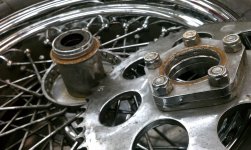
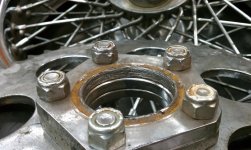
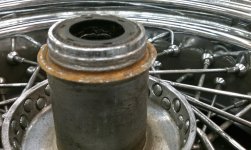
The rust indicates that the failure occured at least some amount of time before it came apart. The CWI agreed and noted the gouging / scratching that appears to have taken place in the press-fit joint. It looks like it had spun and marred it all up. My guess is that it was shifting / spinning over some span of time after the failure, and eventually worked out enough to fail.
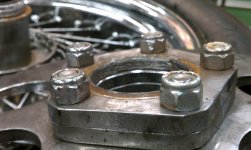
But why did it fail in the first place? From what we see, there is plenty of penetration here. What is amazing to me is that it appears that both base metals and the filler metal mixed up in a nice bead which seems to penetrate about 1/8" into the base metal on the sprocket flange. You can't tell how deep into the hub but it didn't release from the hub so its less of an issue. Then the entire portion of mixed base metal and filler metal broke loose of the sprocket flange base metal. It broke loose very cleanly. This is notable because if it would have taken out chunks of one base metal or the other, then you would have to assume at least some areas had fusion strong enough to overstress the base metal (or even the filler...).
Instead, it looks like a boundry layer between the mixed metals and the flange metal was maintained, even though the flange metal melted and mixed with the filler & hub base. He thought it might have occurred due to welding on a previously chromed part without grinding or machining the chrome away prior to welding. While this is a possibility, I found it unlikely as it appears that the weld bead's exposed face had the same finish as the hub, which I assume to be chrome (though very dirty...). I think it is a incompatability between the filler metal and the sprocket flange material. The flange could be some kind of hardened steel or alloy which required a special filler metal, or a high strength filler metal was used which caused residual stresses larger than the strength of the base metal. Even mixing with chrome, creating a weaker alloy or a chrystalline layer could be the culprit.
I think however, is that it is a heat affected zone crack, due to the inclusion of hydrogen, a sensitive material used for the sprocket flange, and high risidual stresses. (moisture, a non readily welded metal for the flanges, and a high strength metal for the filler).
You might check out the section on heat affected zone cracking in this pdf about weld cracks.
http://content.lincolnelectric.com/pdfs/knowledge/articles/content/weldcracking.pdf
Crack forms, then propogates along the HAZ due to cyclical loading (stress changes with every turn of the wheel). Eventually cracks through, and then rusts, while the pressed joint is all thats holding it together, it gradually (gradual enough to allow rusting completely) spins itself loose enough to come apart. Maybe under very fast take offs the hub spun a quarter turn at a time....or a twentieth.
Its hard to say exactly what happened but I believe this to be feasible.