To avoid these ads, REGISTER NOW!

Welder fuse panel requirements

jives

Well-known member
Joined
Jan 4, 2013
Messages
2,811
Location
Central NY
I am pondering the need for another welder beyond my Forney flux core. I can anticipate needing to weld steel plate from 1/4 to up to 1/2". I think stick welding is my best bet, and can get a used tombstone or equivalent for less than $200. I am not sure that such welders are compatible with my electrical service. I have 240V on a 30A breaker available, but it seems some of these 200+ amp welders require a 50A breaker.

What should I be looking for in a welder that can work with a 30A breaker, but still weld up to 1/2" plate?
 
To avoid these ads, REGISTER NOW!

mike93lx

ALLIANCE MEMBER
Joined
Dec 9, 2013
Messages
37,805
Location
Richmond, VA
I am pondering the need for another welder beyond my Forney flux core. I can anticipate needing to weld steel plate from 1/4 to up to 1/2". I think stick welding is my best bet, and can get a used tombstone or equivalent for less than $200. I am not sure that such welders are compatible with my electrical service. I have 240V on a 30A breaker available, but it seems some of these 200+ amp welders require a 50A breaker.

What should I be looking for in a welder that can work with a 30A breaker, but still weld up to 1/2" plate?
An inverter welder, not a transformer like a tombstone.

One of the new super light and compact units
 

rooster59

Well-known member
Joined
Nov 16, 2014
Messages
970
Location
Land of the Pines
1/2 plate is a lot of beveling, multiple passes, lots of rod. I'm not strong enough to lift much 1/2", 3/8" is plenty, 1/4" more better.

This is from Lincoln:

Lincoln Tombstone Welder

Input Power and Grounding Connections
Before starting the installation, check with the power company to be
sure your power supply is adequate for the voltage, amperes, phase
and frequency specified on the welder nameplate. Also, be sure the
planned installation will meet the United States National Electrical
Code and local code requirements. This welder may be operated
from a single phase line or from one phase of a two or three phase
line.
All models designed to operate on less than 250 volt input lines are
shipped with the input cable connected to the welder.
Place the welder so there is free circulation of air in through the
louvers in the back and sides of the case and out of the bottom on
all four sides. Mount a NEMA Type 6-50R receptacle in a suitable
location. Be sure it can be reached by the plug on the input cable
attached to the welder.
Using the following instructions, have a qualified electrician connect
this receptacle (NEMA 6-50R Type) to the power lines at the fuse
box. Three #10 or larger copper wires are required if conduit is
used. For long cable runs over 100'(31m), #8 or larger wire in
conduit will be needed to prevent excessive voltage drops. Fuse the
two hot lines with 50 ampere super lag type fuses as shown in the
following diagram. The center contact in the receptacle is for the
grounding connection. A green wire in the input cable connects this
contact to the frame of the welder. This insures proper grounding of
the welder frame when the welder plug is inserted into the
receptacle. If a separate disconnect switch is used, it should have
two poles for the two hot lines and both should be fused for 50
amperes
 
Last edited:
OP
J

jives

Well-known member
Joined
Jan 4, 2013
Messages
2,811
Location
Central NY
Okay, so as to not have to rewire my garage with heavier gauge wire and a 50A breaker/fuse, some sort of inverter arc welder may be the ticket. But as racecougar indicates, can I still get there on a 30A circuit?
 

NUTTSGT

Super Moderator
Staff member
Joined
Sep 14, 2009
Messages
51,071
Location
Northern Central Ohio
Okay, so as to not have to rewire my garage with heavier gauge wire and a 50A breaker/fuse, some sort of inverter arc welder may be the ticket. But as racecougar indicates, can I still get there on a 30A circuit?
Try checking out Arccaptain.

There's a few YouTubers that have used them, that are actual welders/fab shops... not just "influencers."


If you check out his channel, he's got a few videos on this welder.

 
OP
J

jives

Well-known member
Joined
Jan 4, 2013
Messages
2,811
Location
Central NY
Try checking out Arccaptain.

There's a few YouTubers that have used them, that are actual welders/fab shops... not just "influencers."

I actually watched this vid a while ago when I first started thinking about a new welder. Glad to have the endorsement!
 

u2slow

Well-known member
Joined
Nov 20, 2011
Messages
3,610
Location
BC
Every machine has an an amperage and duty cycle rating. Use that info together with your Code book to size the circuit.

Further to that, the machine's user manual will have a guideline for circuit sizing.
 

racecougar

Well-known member
Joined
Jan 26, 2021
Messages
5,168
Location
Missouri
Try checking out Arccaptain.

There's a few YouTubers that have used them, that are actual welders/fab shops... not just "influencers."


If you check out his channel, he's got a few videos on this welder.

It looks like a useful setup, but it's only rated at 205A with a 35.6A input. The OP needs more output with less input than that.
 
OP
J

jives

Well-known member
Joined
Jan 4, 2013
Messages
2,811
Location
Central NY
So, what am I planning on building . . . good question. This has more to do with not being limited in the future, but offhand I cannot think of 1/2". I do have far off plans to modify/repair an old hay wagon running gear to make a shepherd's hut, such as repairing the rocking bolsters. Don't need 1/2' capabilities, but at least 3/8" angle and plate.
 

LopezBart

Well-known member
Joined
Oct 13, 2023
Messages
2,561
Location
Lopez Island, WA
Note that the "tombstone" welders are rated at 225 amps output... but one can weld quite happily at 150 amps output using 1/8" rod (likely a bit less would be better). Yes, multiple passes will be need for 1/2" material, but this gives one a chance to weld in different locations to reduce distortion. This should work at 30 amps 240 input in my experience; you may need to drop the welding current to 130 amps or so. If you have problems popping the breaker, you'll need to upgrade, but I think you'll get away with it.
 

Model A Fan

Well-known member
Joined
Dec 1, 2011
Messages
1,223
Location
NW Washington
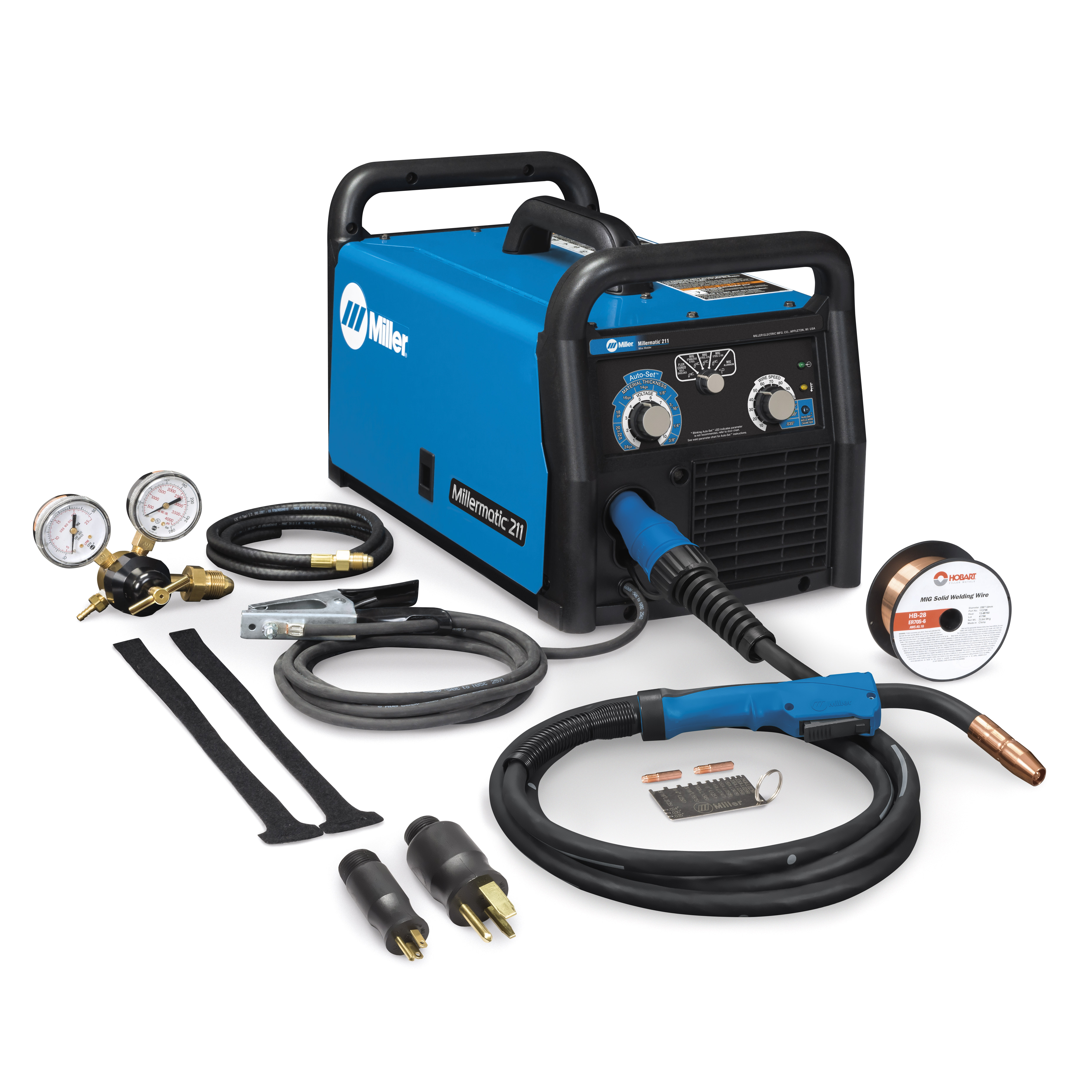
Not to hijack the thread entirely, but I have a Miller 211 and I'm wondering what amperage main breaker should I be looking at? I am having an electrician run new wire from the house main to the garage for a new sub-panel. What gauge wire should I be looking to get run from my main panel to sub-panel?

I'd like to future-proof the garage for lighting and new runs of outlets.
 
Last edited:
To avoid these ads, REGISTER NOW!

racecougar

Well-known member
Joined
Jan 26, 2021
Messages
5,168
Location
Missouri
So, what am I planning on building . . . good question. This has more to do with not being limited in the future, but offhand I cannot think of 1/2". I do have far off plans to modify/repair an old hay wagon running gear to make a shepherd's hut, such as repairing the rocking bolsters. Don't need 1/2' capabilities, but at least 3/8" angle and plate.
If you're not welding 1/2", or if the 1/2" you're welding doesn't need to be as strong as unadulterated 1/2", then yes, you can get by with 30A input. If you're truly concerned about not being limited in the future, you need a 50A circuit.
 

LopezBart

Well-known member
Joined
Oct 13, 2023
Messages
2,561
Location
Lopez Island, WA
Not to hijack the thread entirely, but I have a Miller 211 and I'm wondering what amperage main breaker should I be looking at? I am having an electrician run new wire from the house main to the garage for a new sub-panel. What gauge wire should I be looking to get run from my main panel to sub-panel?


In the questions section, a Miller rep recommends a 30A 240V circuit.

Keep in mind you may want more power for something else in addition (air compressor?). You need to size things such that all devices that start automatically are powered plus your welder or other high draw tool.
 

rooster59

Well-known member
Joined
Nov 16, 2014
Messages
970
Location
Land of the Pines
Okay, so as to not have to rewire my garage with heavier gauge wire and a 50A breaker/fuse, some sort of inverter arc welder may be the ticket. But as racecougar indicates, can I still get there on a 30A circuit?

For an intermittent welder like most stick welders, you can get by with a smaller wire with a 50 amp breaker. Like 10g with 50A breaker. I think it's in the code somewhere, read the details from Lincoln in my earlier post.
 

mike93lx

ALLIANCE MEMBER
Joined
Dec 9, 2013
Messages
37,805
Location
Richmond, VA
For an intermittent welder like most stick welders, you can get by with a smaller wire with a 50 amp breaker. Like 10g with 50A breaker. I think it's in the code somewhere, read the details from Lincoln in my earlier post.
Its based on duty cycle, not welding process.

Most welder people run at home can actually be wired on 12 and for many, 14.
 

finn

Well-known member
Joined
Mar 27, 2005
Messages
16,326
Location
The UP, God's country

In the questions section, a Miller rep recommends a 30A 240V circuit.

Keep in mind you may want more power for something else in addition (air compressor?). You need to size things such that all devices that start automatically are powered plus your welder or other high draw tool.
Prior to 2016, the Millermatic 211 was a transformer machine. They’re long gone redesigned it in 2016 to an inverter power supply.

Not sure, but the earlier version would logically require a larger breaker than the inverter machines being sold today.

That’s one reason I passed on almost new 211 last summer. It was a transformer machine, and I wanted flexibility to move it around, so power draw and weight were working against me.
 

theoldwizard1

Well-known member
Joined
Feb 22, 2011
Messages
43,237
Location
SE MI
Every machine has an an amperage and duty cycle rating. Use that info together with your Code book to size the circuit.
You have to watch that duty cycle ! Even top quality inverter welders will stop if you exceed their duty cycle.
 
Last edited:

Bert_

Well-known member
Joined
Dec 24, 2016
Messages
9,765
Location
NW Iowa
It looks like a useful setup, but it's only rated at 205A with a 35.6A input. The OP needs more output with less input than that.
Duty cycle is probably low enough at 205A output you would never trip a 30A.

A 30A breaker will hold 36A for a long time. Probably at least an hour.
 

Bert_

Well-known member
Joined
Dec 24, 2016
Messages
9,765
Location
NW Iowa
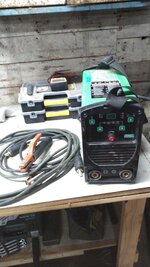
I got this everlast 200A inverter a couple years ago. I looked for a reasonably priced used transformer machine for a while and honestly I'm kind of glad I never found one. This machine is so portable and convenient. Can pretty much weld anywhere.

KIMG2504.JPG
 

Steve_P

Well-known member
Joined
Sep 15, 2010
Messages
5,185
I have a 40+ year old Miller 240V stick welder, and the max draw is listed as something like 48A. I'd assume a Lincoln "tombstone" would be similar. That outlet has a 50A breaker and 6ga wire even though I really only use a Lincoln MIG on it that probably doesn't need 30A
 

seber

Well-known member
Joined
May 31, 2016
Messages
4,203
Location
Deep East Tx.
There is a lot of confusion about inverter vs transformer efficiency. Transformers are at least 90% efficient. Usually much better. Inverters will not run on noticeably less current for a given output.
 

Bert_

Well-known member
Joined
Dec 24, 2016
Messages
9,765
Location
NW Iowa
There is a lot of confusion about inverter vs transformer efficiency. Transformers are at least 90% efficient. Usually much better. Inverters will not run on noticeably less current for a given output.
Transformers have high efficiency but power factor is another thing to consider.
 

theoldwizard1

Well-known member
Joined
Feb 22, 2011
Messages
43,237
Location
SE MI
There is a lot of confusion about inverter vs transformer efficiency. Transformers are at least 90% efficient. Usually much better. Inverters will not run on noticeably less current for a given output.
Got any documented proof ?
 

racecougar

Well-known member
Joined
Jan 26, 2021
Messages
5,168
Location
Missouri
Duty cycle is probably low enough at 205A output you would never trip a 30A.

A 30A breaker will hold 36A for a long time. Probably at least an hour.
Likely so, but my point was that the OP needs more like 250A output and he's limited to a 30A input, which just doesn't compute.
 

LopezBart

Well-known member
Joined
Oct 13, 2023
Messages
2,561
Location
Lopez Island, WA
If welding thick material downhand, one would normally choose a larger diameter rod to save passes if welding commercially. However, if welding out of position, smaller rods will carry a smaller puddle, which makes overhead welding a lot easier (and safer). Most people won't have a full range of welding rods in the home shop, and certainly won't have the monster welders (or three phase power) needed to run 5/16+ rod.

Other than increasing welding and grinding time, there's nothing wrong with welding multiple passes with smaller rods - it's what one does when welding 1" plate, after all. A rod like 7018 that releases the flux easily makes inter-pass cleanup a snap.

From https://weldguru.com/welding-rod-sizes/
1741231938128.png
 

Jack Ryan

Well-known member
Joined
Jun 2, 2022
Messages
340
Location
Adelaide, South Australia
Likely so, but my point was that the OP needs more like 250A output and he's limited to a 30A input, which just doesn't compute.

Taking an ESAB Rebel 285 (single phase) as an example.

GMAW - 260A @ 40% duty cycle (230V)

Imax = 43A

Ieff = 27.2A

Those specifications say you can weld at 260A on a 30A circuit without tripping the breaker - so long as you adhere to the 40% duty cycle.

Ieff is the effective mains current and defines the required supply circuit. If you are actually running 260A, you won't be running much else at the same time from the same circuit.

Jack
 

seber

Well-known member
Joined
May 31, 2016
Messages
4,203
Location
Deep East Tx.
Transformers have high efficiency but power factor is another thing to consider.
This is true and older welders could be even less than 75% efficient, but modern welders have power correction and are seldom worse than 95% efficient.
 

Jack Ryan

Well-known member
Joined
Jun 2, 2022
Messages
340
Location
Adelaide, South Australia
There is a lot of confusion about inverter vs transformer efficiency. Transformers are at least 90% efficient. Usually much better. Inverters will not run on noticeably less current for a given output.
Some transformers are efficient, but many welding transformers are not. Welding transformers have significant flux leakage giving the well know "droop" output characteristic.

Welding transformers have a poor efficiency and a poor power factor. Even with basic power factor correction, the power factor is only reasonable at a specified load.

Jack
 

Jack Ryan

Well-known member
Joined
Jun 2, 2022
Messages
340
Location
Adelaide, South Australia
This is true and older welders could be even less than 75% efficient, but modern welders have power correction and are seldom worse than 95% efficient.
Power efficiency is the ratio of output (welding) power to input (mains) power. Strictly speaking, this is independent of power factor. Most machines have an efficiency rating, and a power factor.

Jack
 
OP
J

jives

Well-known member
Joined
Jan 4, 2013
Messages
2,811
Location
Central NY
Thanks for the lessons, folks. The trick now is patience waiting to see what pops up on CL or FBM.
 
To avoid these ads, REGISTER NOW!
Top Bottom