I'm curious the method and joint design you've used to weld 1/2" steel with a 125 amp flux core welder.
125 amps will weld 1/2" steel, but it is typically done with 7018 stick electrodes and multiple passes on a groove joint.
The reason I bring it up is aluminum doesn't weld like steel, and if you try to weld thicker aluminum with an undersized machine, you're going to have a bad time. 1/4" aluminum takes more heat to weld properly than you think.
The machine to get really depends on the kind of work you want to do with it. If you plan to weld mostly sheet metal, some light angle, maybe some occasional thicker bracketry, maybe TIG is best. TIG really shines on bead aesthetics and delicate work too, like radiator repairs, pontoon boat fixes, fuel cells, or buildup work on stuff like aluminum heads. A tig welder is also incredibly useful on stainless and delicate steel work too. Don't count that out. A 200 amp machine like a Lincoln Squarewave TIG 200 is a great machine for a home shop with a budget.
If you see yourself mostly doing heavier structural shapes, fixing trailers, making larger weldments, or if just speed and simplicity is your jam, go with a MIG with a spool gun. In your shoes I'd recommend a 200 amp MIG machine with a spool gun. If you can spring for one with pulse, you'll thank me later. TIG is the absolute best for thinner, delicate work, but really is slow and takes a lot of heat to work well on thicker aluminum, and you really want to get a watercooled torch at that point. A spool gun can be frustrating to use sometimes, but they're fast, easy to use, and can weld some decent thickness on a smallish size machine. They are also less money than a full tig rig. I'm partial to Miller machines, but HTP makes a really nice small MIG for aluminum, as does Lincoln. I personally don't care for ESAB due to local dealer support and general corporate shenanigans on their part, but they make a decent machine for home shop guys. I personally have a Millermatic 255 for my home shop machine, and it is an outstanding machine for the money, albeit at the top of your budget.
In the end, they are both good to have, but I understand only having the space/time/justification/ budget for one, and ultimately it is what works for you that matters.
Just some examples of what I'm talking about, from my shop. We do a lot of specialty welding and machine work, so we see a large variety.
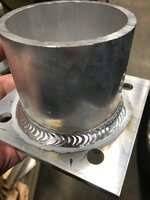
This bracket was welded with a TIG machine, a Syncrowave 350, running around 280 amps with 75% argon 25% helium gas blend. I had just enough heat to get the toes to wet in properly and keep up with the positioner. Aluminum likes to be welded hot and fast. Dwell too long and you end up just heat soaking the part and damaging the temper or heat treat, and it also takes forever.

This bracket looks a lot like the first one, but this was done with a MIG machine, running "profile pulse". It took HALF the time as the TIG bracket and looks ALMOST as good. Granted, this MIG machine is not a home shop machine (Invision 450), but you could get similar results with a decent smaller machine if it was setup properly and you had some practice. We had to make hundreds of these, so we were trying to get the price down for the customer and keep the bead aesthetics up as well as the quality. In the end, pulsed MIG was the way to go for sure.
I run these fuel cells we make on a 200 amp TIG machine, a Miller Dynasty 200.
Plenty of amps for the outside corner welds, but it really could use another 10-20 amps for the thick side of the mounting brackets and filler neck. I get enough heat for the thicker section by sequencing the welds properly on the tabs so they get hot while welding the thinner sections thereby preheating the bracket. The filler neck I preheat with a propane torch. These 1/4" brackets welded to .090" sheet in a lap/fillet weld is the upper limit of a 200 amp machine, at least in my experience. I would want a 280 amp or 350 amp machine if I had to do any real quantity of these.


Hopefully this helps.

