To avoid these ads, REGISTER NOW!

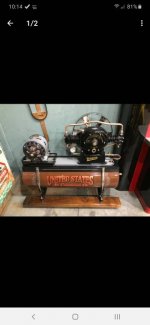
Welding a Century-Old Air Compressor Tank...?

OP
M

MDchanic

Well-known member
Joined
Dec 2, 2017
Messages
68
Location
Hudson Valley, NY
To be fair, you didn't ask for responses from "Qualified" people...

True enough, Tommy, but I wasn't criticizing others for responding, just trying to limit unnecessary posts that we all have to wade through.

We've all had the pleasure of reading threads consisting of post after post from people who have "heard" or "read" that something is this way or that way, and, to be completely honest, I can hear and read just fine, so such helpful contributions as warning me that exploding tanks are dangerous is just background noise that I have to screen out. We all read through these threads looking for the few posts by people with actual experience in the area, of one form or another, and it doesn't seem wrong to allude to this at the outset.

I was hoping I might find someone who has worked with or studied riveted tanks, who could discuss the actual historical construction and repair techniques, operating stresses, failure modes, etc., but my impression is that if there's anyone like that out there, they're not easy to find.

Have a great night!

- Eric
 
To avoid these ads, REGISTER NOW!
OP
M

MDchanic

Well-known member
Joined
Dec 2, 2017
Messages
68
Location
Hudson Valley, NY
You couldn't pay my boss enough to put our ASME stamp on it. I don't think his insurance company would like it.
We could make a new one, no problem...

Which was pretty much what I had figured from the beginning, but, you know, figuring and finding out with some degree of confidence are two different things.

Seems I can get a new tank made to my specifications for about a grand, so, who knows, maybe one day I'll do that. As for now, though, I've got other projects that are more pressing (such as installing my new Mohawk lift...).

Thank you for the input!

- Eric
 

firebirdparts

Well-known member
Joined
Jun 8, 2016
Messages
10,653
Location
Kingsport, TN
My best friend in the whole world is chairman of the state boiler code board and also the company's main decider of who can and can't fix a vessel. I think we could fix that. We do in fact have a lot of equipment that old of much more exotic construction. I'll bet a competent person would be looking at cutting a strip out of the bottom, though.

that said, we have extremely well-trained people that take care of this stuff. The metallurgy would concern any reasonable person, but we can measure that directly. With technology of today, measuring the base metal thickness is also easy. Internal inspection is pretty easy. We would not be above cutting it in two, inspecting the interior, then closing it back up.

With 100 year old locomotives they put a lot of faith in the hydro results. It's pretty safe to hydro something. If it's gonna break, you break it then.
 
OP
M

MDchanic

Well-known member
Joined
Dec 2, 2017
Messages
68
Location
Hudson Valley, NY
I think we could fix that. We do in fact have a lot of equipment that old of much more exotic construction.

See, that is what I was interested in hearing about.

I'm not about to ask Joe Blow down the street to weld it, but I would expect that qualified people do exist, if only because there is old equipment still in operation, and someone has to keep it going.

Now, FireBird, I'm NOT asking you to fix it, to tell me how to fix it, or to give me an estimate on fixing it, but if you know anything about this, I am curious about what you or your friend thinks:
If you look at the leaking picture, you can see that water is spraying out in a flat line along the final segment of the riveted seam, about 1" away from the drain plug.
This is a small tank, 14" x 48", and that drain plug is 1/4" NPT.
The test pressure was 250psi - I ran it up to 250, shut the valve, and saw the gauge dropping, so I took a look, and took this picture with the pressure at about 225psi.

I would assume that when you do restoration work, the first thing you do is ultrasonic testing of the metal thickness. Obviously, if the metal is sound, a good welder could replace an entire portion (presumably the bottom, encompassing both the thinnest part where there's been rust, as well as the riveted part, which seems to be a failure point), and visually clean and inspect the inside at the same time.

To someone who does not do this, this all sounds extremely involved, and therefore expensive, probably at least as expensive as having a new tank custom made, but if it were less, and the person doing it was qualified, I might actually consider it.

Flame suit on! :flamethro:

- Eric
 

kwb

Well-known member
Joined
May 1, 2009
Messages
1,776
Location
PNW
Well OP I will give it to you for being persistent:headscrat

If you would read what you just wrote -
this all sounds extremely involved, and therefore expensive, probably at least as expensive as having a new tank custom made,
You would realize why it is that everyone said to not bother.

Yes the technology exists to do what you want to do (repair)... matter of fact it has existed for decades.

I am sure that somewhere there is John Doe Welding that will do this for cash in a dark alley and he will never let you see his face or license number. If you want a reputable source for this - you will pay an insane price to fix something that other than being yours and old has no sentimental value.

Anything can be repaired, just not everything can be repaired economically.
 

American Locomotive

Well-known member
Joined
Jan 8, 2017
Messages
11,000
Location
Rhode Island
OP, you sort of got the same answers already in your other thread about this compressor, no? Yes it's possible to fix the tank, but it's going to be extremely expensive to get someone to do it, and to put their "stamp" on it.

A 100 gallon propane tank is dirt cheap and approximately the right size, and could probably be easily modified/made to look original.

However I thought ZRX61's idea was absolutely genius. You can get 10-15 gallon air tanks that would fit right inside, and it'd be trivial to get the connections to (include the water drain) to the "outer" tank. Plus, it'd give you a chance to see what the inside of the tank actually looks like.
 

Glemon

Well-known member
Joined
Aug 29, 2020
Messages
2,173
Location
NE
I was hoping I might find someone who has worked with or studied riveted tanks, who could discuss the actual historical construction and repair techniques, operating stresses, failure modes, etc., but my impression is that if there's anyone like that out there, they're not easy to find.

Have a great night

- Eric

Of course you can't find anybody, the ones who tried it all got blowed up!

Sincerely, The Peanut Gallery
 

My Old Tools

Well-known member
Joined
Jun 4, 2014
Messages
5,443
Location
Hamrick Lake, TX
First, let me say that is one cool compressor. I would love to have it. Around here (oil country) we have a ton of certified tank and pipeline welders, and more than a few tank building shops. Plenty of places x-ray welds and perform eddy current corrosion detection and other non-destructive analysis. Look around and you'll find the right place that will want to get that old piece of history going again.
 

Robert Haas

Well-known member
Joined
Sep 30, 2010
Messages
1,749
Boiler tank repair companies exist. They see these designs daily. The rule of thumb is flaky rust at seams near rivets is red tagged. (Non operative/non-repairable)

Of course the OP does not want to hear that. He has already come up with the answer he wants and is just waiting for somebody to back him up.

If the tank is that rotten, can only imagine what the rest of the plumbing/mechanical looks like.
 
OP
M

MDchanic

Well-known member
Joined
Dec 2, 2017
Messages
68
Location
Hudson Valley, NY
... flaky rust at seams near rivets is red tagged.
There is no flaky rust at the seam or the rivets.


Of course the OP does not want to hear that.
Because, much like his wife, you can read his mind and know what he's thinking.
Even if you're wrong.


... can only imagine what the rest of the plumbing/mechanical looks like.
Cylinders clean with no scoring, rust, or ridges, pistons shiny, bearings shiny with no play or signs of wear.
In case you were wondering... But you knew what I was thinking anyway.

- Eric
 
OP
M

MDchanic

Well-known member
Joined
Dec 2, 2017
Messages
68
Location
Hudson Valley, NY
I've killed nuns before. I will kill them again.

attachment.php


- Eric
 

gorilla

Well-known member
Joined
Dec 13, 2007
Messages
1,654
You seem unwilling to spend $1,000.00 for a new tank. Shop time for that kind of work is going to be about $100.00/hour. Do you think that thing can be repaired in less that 10 hours?
 
To avoid these ads, REGISTER NOW!

brownbagg

Well-known member
Joined
Mar 20, 2006
Messages
5,208
get you a cut off pile and weld two end on it, a pile is about 1/2 to 3/4 thick
 

imjustdave

Well-known member
Joined
Apr 9, 2014
Messages
204
Location
Sumner WA
ROI on a fix for this to all about keeping the nostalgia of the compressor, financial correctness, performance to make air for a shop or something else isn't the goal here.
Sure a shop could make an almost identical tank maybe even exact copy but it wouldn't be 100 years old original. 95% of the reply here are all financial based if that was the case OP can go to HD and pick up another and be done. Not saying the bottom isn't all rusted out junk and it all paper thing and will never hold air again could be the case but none of us have actually looked either.

How many steam locomotives are repaired? how many make any financial sense ... basically none, past keeping a cool old piece of history alive.

OP keep looking you will find someone that will understand and see the value in your goals.
 

Viper98912

Well-known member
Joined
Oct 20, 2012
Messages
1,131
Location
GA
I was going to ask "so how much did ya pay for that hunkajunk?"

But then saw you posted $200 for the compressor.

In the end, this is a casual place for guys-n-gals to get together and have discussions. No need to get offended at the drive-by comments, as most of them are from people genuinely looking to give advice, whether it's high technical advice or just plain "common sense" advice. We're all here to be internet family and enjoy each others' company.
 

Robert Haas

Well-known member
Joined
Sep 30, 2010
Messages
1,749
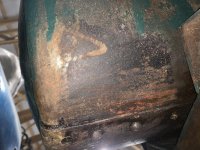
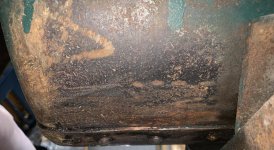
If the outside surface of this compressor has the amount of rust shown at the failure point, what might the interior (The part that has never been painted nor kept dry) look like?
attachment.php
 
OP
M

MDchanic

Well-known member
Joined
Dec 2, 2017
Messages
68
Location
Hudson Valley, NY
You sir, are not honest

Au contraire.

The underside has surface rust, presumably because the previous owner only repainted the top.

Unfortunately, I did not take this photo with the intention of capturing every detail of the bottom of the tank — I lay down on my back quickly to catch the water spray before it bled down and stopped.

If you look closely, you can see the 1/4" drain plug, which is immediately adjacent to the seam, and then to its right you can see a straight vertical ridge, which is the end of one edge of the seam.

You can see the line of rivets going into the background, in between the two main jets of the leak.

The edge of the seam that you can see just before the leak is not perfectly smooth, but it is intact, and only surface-rusted.

But, if I do come across someone who repairs antique tanks, I will ask that person to have a look at it and trust his or her judgement.

- Eric
 
OP
M

MDchanic

Well-known member
Joined
Dec 2, 2017
Messages
68
Location
Hudson Valley, NY
Or you could do what Don did. It is static now.
Pic borrowed from the big party garage.

Don did a fantastic job, but it's not my style.

In general, my stuff looks well used, but works, or is in pieces, and "I'll get to it one day..."

If it isn't working, or on some reasonable road to being fixed, I won't keep it.

- Eric
 

Chris_Hamilton

Well-known member
Joined
Dec 2, 2012
Messages
1,023
Try contacting Kent White of TMTechnologies. He would be able to give you some answers.
https://www.tinmantech.com/contact-us/

Or look for a boilermaker in your area. Preferably an older guy with years of experience in the trade. They could tell you pretty quickly if a repair is viable. Although I don't think you will like their answer.:)

A proper repair will cost you far more than you are probably willing to spend though. They made those tanks by rolling the center with probably a six inch overlap and then riveting it together, then oxy-fuel welding the end caps on.
Another thing to consider if one tries to weld the leak is what will the heat from the weld do to the seam? Are those nearly century old rivets still holding tight enough to deal with the expansion that will occur with the heat required to weld that joint/area?

Don't be offended but I think you are nuts, wanting to repair this and put it into service. Would be much better to pay a qualified boilermaker to make a replica of the tank using modern construction techniques
 
To avoid these ads, REGISTER NOW!
Top Bottom