To avoid these ads, REGISTER NOW!

Welding aluminium for first time ever and its popping like tiny firecracker

handyman2020

Well-known member
Joined
Sep 22, 2019
Messages
222
Location
Toronto
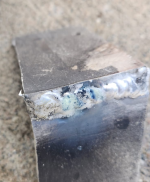
Used Blue Demon ER5356 alumininum to weld below but it turned green and got onto tig rod head and made a blob 120A AC TIG settings @120VAC


Settings (AC TIG, 2T Mode, Green Electrode):
  • Mode: AC TIG
  • Trigger: 2T
  • Pulse: YES
  • Waveform: SQUARE (not pyramid/triangle)
  • T PRE (Pre-flow): 1.0 sec
  • LS (Start Current): 40 Amps
  • T UP (Up-slope): 1.0 sec
  • LP (Peak Current): 120A @ 120vAC
  • tdown (Down-slope): 3.0 sec
  • LF (Crater Current): 40 Amps
  • T POST (Post-flow): 7.0 sec
  • AC Frequency (Hz): 70–90 Hz
  • AC Balance (Clean Width): 30–35%
  • Gas: 100% Argon @ 19 L/min
  • Tungsten Size: 3.2mm (1/8") Green (Pure)
  • Filler Rod: ER5356
  • Cleaning: Acetone + stainless steel brush

1781042300837.png


1781042315082.png

1781042328486.png


1781042342094.png
 
To avoid these ads, REGISTER NOW!
OP
H

handyman2020

Well-known member
Joined
Sep 22, 2019
Messages
222
Location
Toronto
why its not looking like youtubers showing how to weld ? like really clean and cool ?

:(
 
Last edited:

PCustoms

Well-known member
Joined
Jul 23, 2011
Messages
22,798
Location
VT
Edit: what series is your base metal?

What does your tungsten look like?
 

e015475

Well-known member
Joined
Jul 24, 2012
Messages
643
Location
Show Low and Mesa Arizona
I'm no expert but I stayed in a Holiday Inn last night...........

You should have about an amp for every .001 of material thickness, and from the pics it looks about 1/4", so your amps are way too low. Bet that took you a while to weld. That bead should be going down like **** through a goose and look like a stack of coins.

19 l/min of argon seems awfully high. Must be awfully turbulent unless you have one of those cups that's about the size of an espresso cup. At that argon flow you could be blowing the puddle around

Turn the pulse off - that is for thin sheet metal and you're making it really hard on yourself. Go back to basic settings and tweek from there

Not all aluminum alloys are weldable - do you know what you have? Any chance the popping you're hearing is the metal cracking (ie 2024 aluminum maybe)? Is the filler rod compatable with the alloy you're trying to weld?

Those non-aluminum colors are contaminates. Sand the oxide coating of with fresh sandpaper till you're down to bare unoxidized metal, then clean the HAZ with acetone. Clean your filler rod with sandpaper too, then with acetone - it makes a difference
 

PCustoms

Well-known member
Joined
Jul 23, 2011
Messages
22,798
Location
VT
From OP previous weld issues thread (SS exhaust)

1781053697114.jpeg


I keep thinking back to trying to weld 1/4" AL on 120v, alloy, and cleanliness
 

txvwnut

Well-known member
Joined
Jan 1, 2015
Messages
7,620
Location
Bedford, Texas
Turn off pulse, get rid of the pure tungsten and switch to either Lathanated or LaYZr. LaYZr is my preferred but honestly I can't tell a difference between the two. I use 3/32" for damn near every thickness of metal I weld. For amp settings you want one amp per thou of thickness and I add ten percent for aluminum. Looking at your picture that aluminum is dirty, really dirty. With aluminum you have to clean it, then clean it again. It also helps to run the torch over it at just enough pedal to cook out any impurities before getting on with running a bead.

If you are surfing Youtube for advice look up Welding Tips and Tricks and The Fabrication Series. Both of those give great tips and learning aids for Tig welding.
 
OP
H

handyman2020

Well-known member
Joined
Sep 22, 2019
Messages
222
Location
Toronto
I'm no expert but I stayed in a Holiday Inn last night...........

You should have about an amp for every .001 of material thickness, and from the pics it looks about 1/4", so your amps are way too low. Bet that took you a while to weld. That bead should be going down like **** through a goose and look like a stack of coins.

19 l/min of argon seems awfully high. Must be awfully turbulent unless you have one of those cups that's about the size of an espresso cup. At that argon flow you could be blowing the puddle around

Turn the pulse off - that is for thin sheet metal and you're making it really hard on yourself. Go back to basic settings and tweek from there

Not all aluminum alloys are weldable - do you know what you have? Any chance the popping you're hearing is the metal cracking (ie 2024 aluminum maybe)? Is the filler rod compatable with the alloy you're trying to weld?

Those non-aluminum colors are contaminates. Sand the oxide coating of with fresh sandpaper till you're down to bare unoxidized metal, then clean the HAZ with acetone. Clean your filler rod with sandpaper too, then with acetone - it makes a difference

I have no idea what the aluminium metal was, I found it in my metal junk where it was sitting for years

and my welder can only do 120A @ 120VAC

i totally forgot to turn off pulse :( but somehow managed to weld the L angles above.
 
OP
H

handyman2020

Well-known member
Joined
Sep 22, 2019
Messages
222
Location
Toronto
can anyone tell me if these welds are going to hold, I did melt the aluminium and weld it, its not just surface weld? I will be putting these L angles I made under a tools cart
 

Hohn

Well-known member
Joined
Aug 25, 2016
Messages
2,642
Location
Diesel Central, Indiana
can anyone tell me if these welds are going to hold, I did melt the aluminium and weld it, its not just surface weld? I will be putting these L angles I made under a tools cart
I can tell you it's almost certain not to hold.
Aluminum has poor fatigue life to begin with, and since you've conveniently peppered in countless crack initiation locations, a failure is a statistical certainty if subjected to any kind of cyclic loading.
 
To avoid these ads, REGISTER NOW!

Hohn

Well-known member
Joined
Aug 25, 2016
Messages
2,642
Location
Diesel Central, Indiana
I have no idea what the aluminium metal was, I found it in my metal junk where it was sitting for years

and my welder can only do 120A @ 120VAC

i totally forgot to turn off pulse :( but somehow managed to weld the L angles above.
It's debatable just how welded they are.

You don't weld aluminum by starting with material straight off the junk pile and not cleaning it.
WIre brush it clean. Preferably with a stainless bristle brush over brass and DEFINITELY not plain carbon steel bristle.

After a thorough wire brush for cleaning, hit it with acetone. Let it flash off after wiping down.

Then position your parts to weld 45 degrees uphill. That often helps with weak machines because it preheats the material ahead a bit.

Preheat is also your friend since aluminum ***** heat from the puddle like mad when its thicker like your pieces. Get the material to 200F or so and it will weld much nicer.

Also, the soot tracking almost certainly means a gas coverage issue. You shouldn't have any soot in a 100% argon coverage zone. Are you using shielding gas? Did you open the tank valve? Is your gas solenoid cycling? Is there a gas obstruction in your lead?

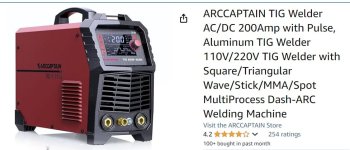
ArcCaptain is budget basement Amazon machine, so you have to assume some things may not be as they should be. Once sorted out, they can work well enough, but it's common to have to be the final stage of quality control. Just as it is with Everlast or Primeweld or other priminent lower-budget machines.
 

dr_clyde

Well-known member
Joined
Jan 7, 2009
Messages
6,443
Location
Holland, MI
That aluminum is very dirty, likely coated.

All the soot, smoke and other funky colors are from the aluminum burning off those contaminants and messing with your shielding.

Grind the metal clean to bare material with a fiber disc or flap wheel and that will help considerably.

Run 2% lanthanated tungsten and throw the pure tungsten in the scrap. It’s not meant for inverters. I recommend 3/32” diameter for general work, 1/8” for thicker stuff like 1/4” aluminum.

I’d be running a #5 or #6 cup, 25-30 CFH on my gas. Pure argon.

You want as much amperage as that little machine will give you, likely 200. It may not be enough without a little preheat.

Adjust your balance to give you just enough cleaning action to make a clean puddle and go from there. I’d start with 70% EN and see if that works.
 

john.k

Well-known member
Joined
Jun 4, 2024
Messages
1,078
Air movement aka draughts are often the cause of T I G problems
 

dr_clyde

Well-known member
Joined
Jan 7, 2009
Messages
6,443
Location
Holland, MI
You guys are hearing hoofbeats and thinking zebras instead of horses.

His metal is VERY dirty. That will cause all of the issues shown in that puddle.

If he still has shielding issues on bright, clean, new metal, then you can start looking for hose leaks.

When troubleshooting a problem, you adjust one variable at a time. The metal being filthy is problem #1. Fix that and then try it again CHANGING NOTHING ELSE. Then, if a problem persists, move on down the line of issues until the problem goes away.
 

Hohn

Well-known member
Joined
Aug 25, 2016
Messages
2,642
Location
Diesel Central, Indiana
You guys are hearing hoofbeats and thinking zebras instead of horses.

His metal is VERY dirty. That will cause all of the issues shown in that puddle.

If he still has shielding issues on bright, clean, new metal, then you can start looking for hose leaks.

When troubleshooting a problem, you adjust one variable at a time. The metal being filthy is problem #1. Fix that and then try it again CHANGING NOTHING ELSE. Then, if a problem persists, move on down the line of issues until the problem goes away.
Exactly right. I think it's because of the stupefying disbelief that someone would try to TIG metal that filthy.
 

john.k

Well-known member
Joined
Jun 4, 2024
Messages
1,078
OP claims weld zone was cleaned in #1 ...dirty metal already suggested at #3 and denied .....I once had a big diesel engine sump welded by a ''top professional'' he ignored suggestions it was magnesium ,and welded with aluminium filler .....then claimed it was '''dirty metal''
 

Old Man Roger

Well-known member
Joined
Apr 6, 2017
Messages
17,531
Location
Palm Coast Florida
OP claims weld zone was cleaned in #1 ...dirty metal already suggested at #3 and denied .....I once had a big diesel engine sump welded by a ''top professional'' he ignored suggestions it was magnesium ,and welded with aluminium filler .....then claimed it was '''dirty metal''
The pictures suggest it wasn’t clean enough. A couple passes with a wire brush and some acetone isn’t the same as taking it down to new bare metal and acetone.
Welding magnesium with aluminum would usually cause a fireworks display that would make it impossible to continue, ask me how I know.lol :scared: 🎇
 

dr_clyde

Well-known member
Joined
Jan 7, 2009
Messages
6,443
Location
Holland, MI
OP claims weld zone was cleaned in #1 ...dirty metal already suggested at #3 and denied .....I once had a big diesel engine sump welded by a ''top professional'' he ignored suggestions it was magnesium ,and welded with aluminium filler .....then claimed it was '''dirty metal''
Look at those pictures again.

There is no evidence of a grinder/sander being used. Barely any scratch marks from a wire brush.

This is random bits of aluminum, highly, highly unlikely it is mag. And yeah, mag welds like dirty aluminum, but this IS dirty aluminum.

It's black and grey! Aluminum should be bright silver!
 
  • Like
Reactions: K13

dr_clyde

Well-known member
Joined
Jan 7, 2009
Messages
6,443
Location
Holland, MI
Could be an aluminum alloy that isn't weldable.
Un-weldable aluminum alloys puddle clean, they just crack immediately.

If it is a die cast part, it can contain large amounts of zinc, which will pop and spit, which could be a thing, but heavy contamination from whatever is coating that part will do that too.

It looks like a piece of sheet/plate that was cut from something with a cutoff wheel. I doubt it's a casting, but we don't have enough pics to go on.
 

rlitman

Well-known member
Joined
Oct 18, 2010
Messages
24,599
Location
Long Island
I have no idea what the aluminium metal was, I found it in my metal junk where it was sitting for years...
<sigh> There are cast aluminum alloys that could in theory be weldable, but internal porosity makes them unweldable with any level of preparation. There are the typical unweldable aluminum alloys that will always crack on a weld. And there are the alloys with magnesium that will burn and spit at you.

That aluminum is very dirty, likely coated.

All the soot, smoke and other funky colors are from the aluminum burning off those contaminants and messing with your shielding.

Grind the metal clean to bare material with a fiber disc or flap wheel and that will help considerably...
It isn't obvious to me what the exact problem the OP is having, but I completely agree with you in that IF the metal is a weldable alloy, we'll never find out until the OP fixes the basics. Because an anodized or clear coated surface, no matter how "clean" it may seem to someone uninitiated in aluminum welding can give this result.

However, when the story the dimes are telling me is that the OP dipped his tungsten and kept going with a contaminated tungsten. Having a uncontaminated tungsten is just as important as having uncontaminated base metal. Also, I don't think the issue here has anything to do with a "green" pure tunsten, even though green tungsten is the "wrong" choice.
 

dr_clyde

Well-known member
Joined
Jan 7, 2009
Messages
6,443
Location
Holland, MI
<sigh> There are cast aluminum alloys that could in theory be weldable, but internal porosity makes them unweldable with any level of preparation. There are the typical unweldable aluminum alloys that will always crack on a weld. And there are the alloys with magnesium that will burn and spit at you.


It isn't obvious to me what the exact problem the OP is having, but I completely agree with you in that IF the metal is a weldable alloy, we'll never find out until the OP fixes the basics. Because an anodized or clear coated surface, no matter how "clean" it may seem to someone uninitiated in aluminum welding can give this result.

However, when the story the dimes are telling me is that the OP dipped his tungsten and kept going with a contaminated tungsten. Having a uncontaminated tungsten is just as important as having uncontaminated base metal. Also, I don't think the issue here has anything to do with a "green" pure tunsten, even though green tungsten is the "wrong" choice.
Pure tungsten won't run correctly on an inverter. It would stutter and have an unstable arc.

If you don't have the knowledge that pure tungsten was meant for transformer rectifier machines and attempted to use it on an inverter you might not know that causes problems with the arc.

But I do agree that looks like it could be contaminated tungsten soot. That's the thing, that look could be caused by a lot of factors. I've seen welds like that caused by the wrong gas, nasty base metal, heavily contaminated tungsten, leaks in the hose, the list goes on.
 

rlitman

Well-known member
Joined
Oct 18, 2010
Messages
24,599
Location
Long Island
Pure tungsten won't run correctly on an inverter. It would stutter and have an unstable arc...
To unpack this, for those who don't understand what this means, additives (I'm a fan of lanthanated) are mixed in with the tungsten in the rod to improve the arc initiation, as well as hold back tip melting. On DC, you only initiate the arc once. On AC, with an old-school transformer machine, the arc gets extinguished and restarted every half cycle (when the voltage crosses zero). In order to have a stable AC arc with a transformer, the machine needs to overlay a continuous HF arc starting signal.

On an inverter with AC, the voltage rises and falls (crosses zero) so quickly that there is no time for the arc to extinguish, so AC inverters do not use continuous HF. But the catch is that depending on the circuitry of your machine, pure tungsten without the assistance of the additives to keep the arc going with each zero crossing can lead to stuttering. Pulse can make that issue even worse.

Back to the OP and cleaning. When it comes to aluminum, cleaning doesn't just mean cleaning where the weld bead is being laid down. It means cleaning out to the end of the HAZ (heat affected zone) and beyond, and we should clearly see an etched zone (in this cleaned region) around the weld caused by the cleaning action of the electrode-positive half cycle. We don't see any of that.
 

Dagny

Well-known member
Joined
Jul 25, 2014
Messages
2,990
Location
Northern Wi.
Get some new 1/8 in sheet about 100 dollars worth. Follow above advice. Then weld away. It will keep getting better as you practice.
 
To avoid these ads, REGISTER NOW!
Top Bottom