To avoid these ads, REGISTER NOW!

Welding Aluminum

glentre

Well-known member
Joined
May 21, 2016
Messages
909
Location
Gloucester, Virginia
I have two alum lift ramps with badly bent tabs where they fit into the ramps. See photo. One has a hairline crack at the bend. Question is, can these bent pieces be bent back in a straight line with the angle of the ramp or will they break off when I try? Also, can they be re-welded where the tabs have broken away from the underside of the ramp?

I have a Mig/TIG, wire/stick welder but have never welded aluminum. Is this something a novice welder like me should try or should it be left to the pros?

Would appreciate advice.

Glen
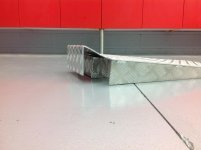
 

Attachments

  • image.jpg
    image.jpg
    130.8 KB · Views: 213
To avoid these ads, REGISTER NOW!

rsanter

Well-known member
Joined
Dec 22, 2007
Messages
18,487
Location
visalia ca
Yes they can be went back
Yes they may stress crack a little more
Yes they can be welded with a TIG or a MIG with spoolgun
 

MrSurly

Well-known member
Joined
Jan 15, 2014
Messages
1,671
Location
East Texas
Not addressing the welding, but the bending.
1.) It WILL crack, likely breaking altogether if you bend it back without annealing.
2.) annealing is touchy because the temp at which aluminum softens is *really close* to the temperature at which it falls apart.
3.) Here's an old 'trick of the trade' for doing this without ruining the metal:
Using an Acetylene torch with cutting tip or the largest brazing tip you have handy, light the torch withOUT adding oxygen in order to create a carborizing flame (making soot). Use the torch to "paint" the aluminum where it needs to be annealed so that there is a heavy soot covering that area. This only takes a second or two. Now, adjust the torch (add oxygen) to create a proper blue flame.
Use the torch now to heat the area where it needs to be annealed. You'll find that as the aluminum heats up, at a certain temp, the soot will fall off! move the torch to make the soot fall off the area needed, but don't continue heating any spot once the soot is gone. If you stay in that spot for a second or two after, the metal will sag and fall out.
4.) let it cool.
5.) once it's cooled you'll find that you can bend it easily. Shape it as needed and let it sit.
6.) after a day or so it will regain its previous hardness.
7.) If you need its hardness restored *now*, put it in the freezer for an hour.
 

6768rogues

Banned
Joined
Nov 28, 2007
Messages
4,524
Location
Western NY
When bent, the material becomes work hardened. That makes it hard to bend back at the same place it bent. That is why often when trying to bend something back it bends in a different place from where it bent the first time. If you put it on something that provides adequate support and hammer it back, you can make it bend back where you want it to bend. I so seldom have a need to weld aluminum that I outsource the work. I weld steel, but have not had a need to buy the added equipment to weld aluminum.
 

malibu101

Well-known member
Joined
Jul 1, 2005
Messages
3,908
Location
Walnutport PA
Not addressing the welding, but the bending.
1.) It WILL crack, likely breaking altogether if you bend it back without annealing.
2.) annealing is touchy because the temp at which aluminum softens is *really close* to the temperature at which it falls apart.
3.) Here's an old 'trick of the trade' for doing this without ruining the metal:
Using an Acetylene torch with cutting tip or the largest brazing tip you have handy, light the torch withOUT adding oxygen in order to create a carborizing flame (making soot). Use the torch to "paint" the aluminum where it needs to be annealed so that there is a heavy soot covering that area. This only takes a second or two. Now, adjust the torch (add oxygen) to create a proper blue flame.
Use the torch now to heat the area where it needs to be annealed. You'll find that as the aluminum heats up, at a certain temp, the soot will fall off! move the torch to make the soot fall off the area needed, but don't continue heating any spot once the soot is gone. If you stay in that spot for a second or two after, the metal will sag and fall out.
4.) let it cool.
5.) once it's cooled you'll find that you can bend it easily. Shape it as needed and let it sit.
6.) after a day or so it will regain its previous hardness.
7.) If you need its hardness restored *now*, put it in the freezer for an hour.
I don't know much about aluminum welding but I've heard of the soot trick.

What I wonder is step 4-7.
Once the metal has cooled to ambient air temperature- How does time (a day or so)?
Or what I consider a reasonable temperature 0° (in the freezer) change the metallurgy of the aluminum? Where I live aluminum can often see subzero temperatures during the winter.
 

MrSurly

Well-known member
Joined
Jan 15, 2014
Messages
1,671
Location
East Texas
I wish I had a metallurgical answer but what I do have is anecdotal evidence that it does in fact work exactly as described... the “why” part is up to someone else to explain.

My understanding is that the hardness of the aluminum is it’s ‘normal state’; annealing it does not cause a permanent change, only a temporary change and that a property of the material is that it will return to its normal state... whether you want it to or not. Resuming a normal temp starts the process, freezing it (cooling it faster) simply accelerates the normalization.
Whether making it *even colder* changes it further, I dunno.

I’m certain that it’s a thoroughly studied topic, especially in regards to aviation and aerospace applications.


Sent from my iPhone using Tapatalk
 
Last edited:

n20junkie

Well-known member
Joined
Aug 22, 2010
Messages
538
Location
Grand Island, NY
We keep aircraft rivets in the freezer to keep them from hardening. Commonly called ice box rivets. You pull and install, minutes later they are starting to harden.

Without knowing the grade of aluminum, any heat treating advice is best guess.

We have sheets of “O” material,mor annealed that keeps forever at that state. T3 and T6 are common heat treated for stiffness that keep forever as well.

Heat treating aluminum is funky stuff compared to steels.
 
Last edited:

joe_padavano

Well-known member
Joined
Feb 26, 2011
Messages
1,788
Location
Northern VA
My understanding is that the hardness of the aluminum is it’s ‘normal state’; annealing it does not cause a permanent change, only a temporary change and that a property of the material is that it will return to its normal state...

Your understanding is flat wrong. I am an aerospace engineer and I have to deal with aluminum, heat treating, and annealing. Once you anneal aluminum, it is annealed, period. It does NOT magically return to the heat treated state unless you go through a heat treating process. This is the fundamental problem with welding heat treated aluminum. The heat affected zone anneals the metal locally, which causes lower strength at the welds. In the aerospace world, critical structural parts that are welded need to be totally annealed and re-heat treated to maintain the original strength, or else they need to be designed to accommodate the reduced strength in the HAZ.
 
To avoid these ads, REGISTER NOW!

MrSurly

Well-known member
Joined
Jan 15, 2014
Messages
1,671
Location
East Texas
Your understanding is flat wrong. I am an aerospace engineer and I have to deal with aluminum.


You won’t get any argument from me; the reason I stated that “I don’t know”
Is because, I don’t actually know.

Apparently (based on Google) there are literally hundreds of aluminum alloys. *Some* apparently have “temp related self-hardening” characteristics.
I don’t have any idea what alloy(s) I’ve done a similar process to, I can only tell you that it did what it did.
The key is that it (recently, *it* was diamond-plate 1/8”) became soft enough to form around a 1” pipe and then later became too hard to “unbend” without annealing again.
Anecdotal, and unknown material specs.
I also have *no idea* what it’s hardness was before and after. Did it return fully to its previous hardness? I sure doubt it.
The hands-on experience was that I could not bend it..... and...
then I could.... then, after a bit, I could not.
That’s not scientific...... but it ain’t like it never happened.
236e49942065b03003eb61421bd37a2e.jpg


Sent from my iPhone using Tapatalk
 
Last edited:
OP
G

glentre

Well-known member
Joined
May 21, 2016
Messages
909
Location
Gloucester, Virginia
Wow! Sounds like bending aluminum and welding it is a rather complicated issue, one an inexperienced guy like me should not attempt to do. Also, did not know you need pure Argon gas to weld and I don't have any. Should have done my research first.

Reading all the suggestions and advice, I guess I'll take the ramps to a shop that has the proper capability to straighten them out and re-weld them.

Again, this forum has educated me and this time, probably prevented me from getting into trouble attempting the fix the ramps myself. Thanks to all.

Glen
 

MrSurly

Well-known member
Joined
Jan 15, 2014
Messages
1,671
Location
East Texas
Glen, I have never welded aluminum, I have only bent it and bolted it for basic ornamental uses. If I needed some *critical* work done on ramps or structural applications, I would absolutely get it done professionally


Sent from my iPhone using Tapatalk
 

dogdog

Well-known member
Joined
Nov 15, 2011
Messages
12,711
Not addressing the welding, but the bending.
1.) It WILL crack, likely breaking altogether if you bend it back without annealing.
2.) annealing is touchy because the temp at which aluminum softens is *really close* to the temperature at which it falls apart.
3.) Here's an old 'trick of the trade' for doing this without ruining the metal:
Using an Acetylene torch with cutting tip or the largest brazing tip you have handy, light the torch withOUT adding oxygen in order to create a carborizing flame (making soot). Use the torch to "paint" the aluminum where it needs to be annealed so that there is a heavy soot covering that area. This only takes a second or two. Now, adjust the torch (add oxygen) to create a proper blue flame.
Use the torch now to heat the area where it needs to be annealed. You'll find that as the aluminum heats up, at a certain temp, the soot will fall off! move the torch to make the soot fall off the area needed, but don't continue heating any spot once the soot is gone. If you stay in that spot for a second or two after, the metal will sag and fall out.
4.) let it cool.
5.) once it's cooled you'll find that you can bend it easily. Shape it as needed and let it sit.
6.) after a day or so it will regain its previous hardness.
7.) If you need its hardness restored *now*, put it in the freezer for an hour.

while most consumer Aluminum are 6061 base... still different series of tempers for that 6061...

I just remember these tidbits ...

Not all aluminum are weldable...
Not all aluminum are heat treatable.
Not all aluminum are heat treated the same way.
 

rsanter

Well-known member
Joined
Dec 22, 2007
Messages
18,487
Location
visalia ca
You won’t get any argument from me; the reason I stated that “I don’t know”
Is because, I don’t actually know.

Apparently (based on Google) there are literally hundreds of aluminum alloys. *Some* apparently have “temp related self-hardening” characteristics.
I don’t have any idea what alloy(s) I’ve done a similar process to, I can only tell you that it did what it did.
The key is that it (recently, *it* was diamond-plate 1/8”) became soft enough to form around a 1” pipe and then later became too hard to “unbend” without annealing again.
Anecdotal, and unknown material specs.
I also have *no idea* what it’s hardness was before and after. Did it return fully to its previous hardness? I sure doubt it.
The hands-on experience was that I could not bend it..... and...
then I could.... then, after a bit, I could not.
That’s not scientific...... but it ain’t like it never happened.
236e49942065b03003eb61421bd37a2e.jpg


Sent from my iPhone using Tapatalk

When you anneal aluminum or any other metal it stays that way until some action such as Work hardening or heat treating alters that state.
It is very common when forming aluminum that you work harden it to the point that it no longer wants to move or will run the risk of cracking. You then anneal it or anneal it again and you can begin shaping it again.
A metal former thT is making a car body outmof aluminum may have to anneal an area many times in the process of shaping that panel
 

NUTTSGT

Super Moderator
Staff member
Joined
Sep 14, 2009
Messages
50,852
Location
Northern Central Ohio
Wow! Sounds like bending aluminum and welding it is a rather complicated issue, one an inexperienced guy like me should not attempt to do. Also, did not know you need pure Argon gas to weld and I don't have any. Should have done my research first.

Reading all the suggestions and advice, I guess I'll take the ramps to a shop that has the proper capability to straighten them out and re-weld them.

Again, this forum has educated me and this time, probably prevented me from getting into trouble attempting the fix the ramps myself. Thanks to all.

Glen

With the information that has risen to the top with this thread, I going to move it to the Fabrication and Techniques section. I'm sure others will chime in and more can learn from all this information.
 
To avoid these ads, REGISTER NOW!
Top Bottom