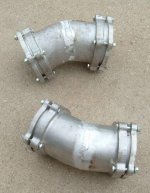
Short answer : It depends.
Slightly longer answer : It depends on what the original aluminum alloy is as to whether it is even weldable or not (some alloys are weldable, some are weldable with varying degrees of difficulty, and some are not really weldable at all).
Choice of the 'correct' filler (electrode, rod, wire, whatever) depends on the parent material alloy and the service/environmental conditions. Sometimes, the answer is
NOT the 'usual' main two aluminum welding alloys of 5356 or 4043.
Next, you really do have to clean the metal you want to weld.
http://www.millerwelds.com/pdf/spec_sheets/MillerAluminumbrochure.pdf
Sometimes, you can 'get away with' a little less cleaning if doing something like using SMAW (aka stick) on some non-critical welds on plain mild steel using say 6010 or 6011 electrodes. Those electrodes and that process (SMAW) have a flux coating that can 'tolerate' a certain amount of 'crud' (non-metal) and still usually make acceptable welds (given at leat some skill from the operator).
GTAW (aka TIG) on aluminum? You
HAVE to be welding clean bare metal.
Or else doing such 'tricks' as (trying to make) a welding pass, getting the heat from that welding pass to try and 'remove' or float/trap some of the 'crud' in the weld bead, grind out the (now crappy) attempted weld bead, and repeating the process until you actually do get a 'good' weld bead.
Remember, you
ALWAYS are welding
metal. (ignoring if you were trying to weld plastic, but that's a whole 'nuther ball o' bees wax).
Anything that is
not metal (such as rust, aluminum oxides, paint, oil, grease, water, tape, plastic, dried concrete, Jimmy Hoffa, mustard from lunch, etc, etc, etc)
W-I-L-L interfere to varying degrees with making a weld. Some welding process 'tolerate' a bit of non-metal (SMAW with the aformentioned 6010/6011 electrodes) and some will not really accept any amount of non-metal when making or trying to make the weld.
Next, a repair should take into account the 'why' of how the piece in question broke in the first place. Sometimes, the answer to a 'repair' is to just weld it back together and sometimes other things have to be 'fixed' as well.
Preheat on aluminum is usually not recommended to be over 200F, and interpass temps should usually be limited to less than 250F max.
So, the answer is : It depends.

More specific answer: Welding 1/4 - 3/8 inch thick aluminum is going to push the power output of a 211-class machine pretty hard (although the MM211 is 'rated' for up to 3/8 inch thick aluminum, per the 'spec' sheet and sales brochure). But that is going to be at a rather short duty-cycle (approx 1.5-2 minutes welding time and then ~8 minutes of 'take a break and let the machine cool off' time).
In addition, out-of-position welding (any position other than "flat") using spray-transfer mode (what most aluminum GMAW is done in) will be darn difficult due to the puddle fluidity. Pulse-spray GMAW is usually recommended for out-of-position aluminum GMAW.
Per the manual, MM211 MVP on 240V input power, using the Spoolmate 100 spoolgun, 0.035 solid aluminum 4043 wire (iffy for welding cast aluminum alloys, sometimes that filler alloy is OK, and sometimes not. 4047 may or may not be a 'better' filler, as it has ~2x the silicon and thus may better match the casting alloy 'recipe'. Or maybe not, since I have not idea what your aluminum piece is made of. ) Pure argon shielding gas at ~40-50 cfh, set controls to 10/85 (voltage/ WFS). For the 1/4 inch thick sections, the suggested settings for the manual are 7/75 (again using 0.035 solid 4043 aluminum filler nad pure argon shielding gas).
The 211-class and 'smaller' machines are typically only going to be able to use 4043 wire, based on the machine's voltage-vs-amperage characteristics. They do
NOT typically have the correct voltage-vs-amperage characteristics to run anything other than 4043 filler, so don't even think about trying to use 5356 filler (takes a higher arc voltage for the amperage to run that filler compared to 4043, and the 'smaller' machines just weren't designed to produce those voltage-vs-amperage parameters).
Me? I'd go more for a 250-class machine (or bigger) or a similar power level GTAW machine. Probably 4047 filler (cast aluminum is usually relatively high in silicon, so the 4047 is -usually- a closer match). Clean the molds carefully and well, and still expect to go back and completely grind out at least some of the welds (if not all of them) and redo them until good welds are achieved. Then the owner still has to go and hire a tool-and-die type to remachine (grind and polish as applicable) any 'critical' mold surfaces to match the existing mold surface.
Does your business insurance cover you if you somehow botch those ~$20k molds? You touch it, you are 'It', liabilty wise. Just something else to ponder.
So again I say, the answer is : It depends.
YMMV.