
You are using an out of date browser. It may not display this or other websites correctly.
You should upgrade or use an alternative browser.
You should upgrade or use an alternative browser.
Welding cast iron?
- Thread starter clewis38
- Start date
rsanter
Well-known member
I mig weld it.
I clean the area and sometimes V the crack (depends on thickness)
I preheat the area with a torch, then mig weld, then post heat to relive the stress.
Then let cool slowly
I clean the area and sometimes V the crack (depends on thickness)
I preheat the area with a torch, then mig weld, then post heat to relive the stress.
Then let cool slowly
Packard V8
Well-known member
X2 - the must in welding cast iron is to get and keep it HOT, not just warm, weld, wrap in insulation and let it cool overnight.
jack vines
jack vines
NI-99 is what it is used. Lots of videos on YouTube. Stick or Tig, don’t think I have seen MiG spools. eBay is about $45 a lb cheapest so far from that weld queen guy. Used to be $25 10 years ago or before 2019.
Drill to drop crack
Vgroove
Pre heat and post heat
Peen after welding
Er309 some say it also works for cast steel might not work for grey iron. Spark test chart would give you hints on what your cast irons are.

Almost all popular welding YouTube guys have a videos on these.
It used to be popular to use ER309 for guys that welds turbo exhaust manifolds for custom waste gate and stuff.
Drill to drop crack
Vgroove
Pre heat and post heat
Peen after welding
Er309 some say it also works for cast steel might not work for grey iron. Spark test chart would give you hints on what your cast irons are.
ERNI99 3/32" Nickel 99 1 lb Tube Welding Rods Blue Demon | eBay
MIG welding of cast iron. This wire is extensively. Welding Current. Welding Positions. ERNi-Cl (Nickel Alloy 99) is used for TIG and. high nickel content, the welds are readily. used to repair gray iron castings.
www.ebay.com
Almost all popular welding YouTube guys have a videos on these.
It used to be popular to use ER309 for guys that welds turbo exhaust manifolds for custom waste gate and stuff.
Last edited:
mark-NJ
Well-known member
TIG braze it with SilBronz
rooster59
Well-known member
strutaeng
Well-known member
Very difficult to weld apparently.
Grinding to clean and create a groove, pre-heat with those colored wax crayons, special welding rod, peening, post-heat and insulating blanket to keep warm as long as possible. That's the procedure I did on an axle welding of the pumpkin to axle tubes. It wasn't too pretty, but weld profile looked decent and didn't get any cracking or porosity.
Tig is probably a better welding process but I don't have that capability. I don't know about using mig, didn't think you could do cast iron with mig?
Grinding to clean and create a groove, pre-heat with those colored wax crayons, special welding rod, peening, post-heat and insulating blanket to keep warm as long as possible. That's the procedure I did on an axle welding of the pumpkin to axle tubes. It wasn't too pretty, but weld profile looked decent and didn't get any cracking or porosity.
Tig is probably a better welding process but I don't have that capability. I don't know about using mig, didn't think you could do cast iron with mig?
Dagny
Well-known member
braze
danielbuck
Well-known member
- Joined
- Apr 15, 2014
- Messages
- 933
I've mig welded, preheat a bit with a torch, and cool it slowly. Not sure if either of those are absolutely necessary, but it's what was recommended to me and I've done it that way every time without fail.
PugetDude
ALLIANCE MEMBER
I was taught the recommended procedure is, Grind bevel, Clean Preheat, Stainless rod, cool slowly in sand if the part is small enough; wrap in insulation if it's too big.
In practice, I usually just use preheat with a few quick MIG hot tacks, grind them off and then weld the entire joint with MIG.
I'm not welding anything critical; haven't had anything fail yet.
In practice, I usually just use preheat with a few quick MIG hot tacks, grind them off and then weld the entire joint with MIG.
I'm not welding anything critical; haven't had anything fail yet.
zmotorsports
ALLIANCE MEMBER
I've done quite a bit of cast iron welding over the years and results vary depending a lot on the actual quality of the casting itself.
In early years I used NI-99 TIG rod with pretty good success as long as the part is adequately pre-heated and allowed to slowly cool. Wrapping in insulation works pretty good for a makeshift setup.
I have also used ER-309 but mainly prefer that for dissimilar metals. Lately I've been using some ERCuSi (silicon bronze) TIG brazing rod made by Blue Demon and have had excellent results. I recently repaired an old radiator end casting from a 1940's Farmall tractor in my projects thread and it turned out pretty good and is back in service successfully.
In early years I used NI-99 TIG rod with pretty good success as long as the part is adequately pre-heated and allowed to slowly cool. Wrapping in insulation works pretty good for a makeshift setup.
I have also used ER-309 but mainly prefer that for dissimilar metals. Lately I've been using some ERCuSi (silicon bronze) TIG brazing rod made by Blue Demon and have had excellent results. I recently repaired an old radiator end casting from a 1940's Farmall tractor in my projects thread and it turned out pretty good and is back in service successfully.
BD1
Well-known member
I used Nickle stick rod for the repairs I did. It was cheaper to buy some stick and I've used stick a lot. It depends on what your working on, material thickness, and how much room you have to work with. A sick rod can fit almost anywhere. Maybe post a picture of what you're working on.
gahrajmahal
Well-known member
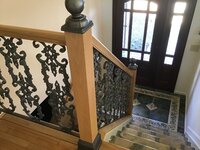
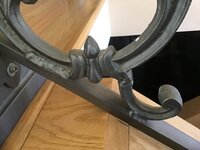
I welded this cast iron railing with my Lincoln tombstone welder. I purchased the stick welding rods from the railing supplier. I didn’t preheat the components or heat to cool down when I made these. I have used those stick weld rods to repair some exhaust manifolds on my aviator car. I did pre-heat that because it was old and dirty and not new. It worked fine and was no more difficult than welding anything else.
Used to stick weld, now do the same thing with the MIG using standard wire. Seems to work well so far.I mig weld it.
I clean the area and sometimes V the crack (depends on thickness)
I preheat the area with a torch, then mig weld, then post heat to relive the stress.
Then let cool slowly
GaryM909
Well-known member
Years ago I had to weld some cast iron pumps. Buttered on a first pass with 309 and finished with a nickle rod.
I can't remember what the preheat was but it cooled in a box of Zonolite.
A couple month later I had to braze a couple more. I used a #6 rosebud and fed 3 flux coated 3/16 brazing rods a time. Again back in the Zonolite.
I can't remember what the preheat was but it cooled in a box of Zonolite.
A couple month later I had to braze a couple more. I used a #6 rosebud and fed 3 flux coated 3/16 brazing rods a time. Again back in the Zonolite.
FWIW, Keith RUcker on You Tube swears by torch & braze to repair cast.
My Dad had a cast iron fry pan brazed at his work when I was a kid ,probable near 50 years ago , when the handle got broken off.
I still use that pan quite regularly .
My Dad had a cast iron fry pan brazed at his work when I was a kid ,probable near 50 years ago , when the handle got broken off.
I still use that pan quite regularly .
GaryM909
Well-known member
I guess my examples were geared towards the industrial side of things but I would say the procedure is pretty much the same for each method. Preheat and make sure to let the welded product slow cool.
I did use ER7018 a couple times. Preheat and I used short stitches that were about an inch long and then let each stitch cool down before the next one. It worked well.
I did use ER7018 a couple times. Preheat and I used short stitches that were about an inch long and then let each stitch cool down before the next one. It worked well.
Ohmthis
Well-known member
OP, you’ve been given excellent advice. I’m only going to add a few more details. Depending on what you are trying to weld, I pre heat and post heat on/in my gas grill. I set it up at the door of my shop. I set what I’m welding on the grating and heat it to 400 for 30 minutes or so. I weld it right in place (I tig with 309 rod and peening is very important. I use an air hammer to quickly peen right after I weld). I weld about an inch or so and peen. Once the welding is done, I heat it back to 400, then back the heat off 50* per half hour. I let it cool down after that. Works great for me.
mark-NJ
Well-known member
TIG is DCEN for this sort of thing...
Ohmthis
Well-known member
Polarity of the torch for brazing?All this knowledge and experience and no mention of polarity.

larry4406
Well-known member
Adjust it carefully so the flame exits the nozzle, not into the torch/hose. A delicate balance is needed to achieve this adjustment.Polarity of the torch for brazing?
American Locomotive
Well-known member
I have had good luck using the nickle rods meant for cast iron and stick welding something back together. I have also had good luck with conventional oxy-acetylene torch brazing. The trick is getting the part screaming hot before trying
I have had mixed luck trying to tig-braze cast iron with silicon bronze rods. The joint always looks good, then seems to crack afterwards.
I have had mixed luck trying to tig-braze cast iron with silicon bronze rods. The joint always looks good, then seems to crack afterwards.
Last edited:
Normally, you'd butter with a high Ni filler metal and finish with a "cheaper" filler.Buttered on a first pass with 309 and finished with a nickle rod.
I can't remember what the preheat was but it cooled in a box of Zonolite.
Good to hear that a 309 also works for the first layer.
Ohmthis
Well-known member
That’s what I’ve been doing wrong!!!!Adjust it carefully so the flame exits the nozzle, not into the torch/hose. A delicate balance is needed to achieve this adjustment.
See the link in post #6 above.
Also see https://www.lincolnelectric.com/en/...ding-how-tos/guidelines-for-welding-cast-iron
which says most of the same as in the TWI info link from post #6.
General welding procedure summary for cast iron (one procedure anyway):
Clean it well (like pretty much any welding procedure), if dealing with an existing partial crack then drill a hole at the end(s) of the crack to reduce the chance of the crack 'running' or lengthening as you are attempting the repair steps, v-groove the seam to be welded, preheat (and LOTS of it generally! Typically 500F to 1200F preheat, do NOT run up to 1400F as that introduces yet more complications in the metal), weld with high nickel $$$$$ rods usually, peen the weld bead right after welding (to try and introduce/change the residual tensile stresses in the weld bead and HAZ into compressive stresses), then return to the heat source and/or insulate the hot cast iron really-really well and s-l-o-w-l-y let the cast iron cool down (slow as in maybe a 50F temp drop per hour maximum, so typically around 12+ hours to cool down from the preheat/post-heat temperature back down to room temperature).
(some characteristics of cast iron that make welding it difficult are that the metal is generally brittle to begin with and will tend to crack instead of bending/yielding in a ductile manner, and the high carbon in the cast iron that makes it brittle to begin with and also makes any weld zone and steel-based weld filler/electrode brittle because of the high carbon that either does things to the cast iron itself during/after welding and/or the high carbon in the cast iron mixing into the weld puddle and forming hardenable and HARD brittle steel alloys in the weld bead area which then crack as the weld bead cools down due to the brittle material trying to 'stretch' as the weld cools down and shrinks from the liquid state back to the solid metal.)
Bronze brazing (using either a TIG torch as the heat source or an oxy-acetylene flame as the heat source) is another approach that is sometimes used. But that is brazing and not welding.
And yeah, keep the oxy-fuel flame OUTSIDE the torch/tip/hose at all times.
OP, more specifics on what you are attempting to do can help us give more options and/or opinions and how to possibly proceed. Fixing a cracked cast iron skillet, trying to fix broken mounting lugs from a cast iron bench vise, etc.
Also see https://www.lincolnelectric.com/en/...ding-how-tos/guidelines-for-welding-cast-iron
which says most of the same as in the TWI info link from post #6.
General welding procedure summary for cast iron (one procedure anyway):
Clean it well (like pretty much any welding procedure), if dealing with an existing partial crack then drill a hole at the end(s) of the crack to reduce the chance of the crack 'running' or lengthening as you are attempting the repair steps, v-groove the seam to be welded, preheat (and LOTS of it generally! Typically 500F to 1200F preheat, do NOT run up to 1400F as that introduces yet more complications in the metal), weld with high nickel $$$$$ rods usually, peen the weld bead right after welding (to try and introduce/change the residual tensile stresses in the weld bead and HAZ into compressive stresses), then return to the heat source and/or insulate the hot cast iron really-really well and s-l-o-w-l-y let the cast iron cool down (slow as in maybe a 50F temp drop per hour maximum, so typically around 12+ hours to cool down from the preheat/post-heat temperature back down to room temperature).
(some characteristics of cast iron that make welding it difficult are that the metal is generally brittle to begin with and will tend to crack instead of bending/yielding in a ductile manner, and the high carbon in the cast iron that makes it brittle to begin with and also makes any weld zone and steel-based weld filler/electrode brittle because of the high carbon that either does things to the cast iron itself during/after welding and/or the high carbon in the cast iron mixing into the weld puddle and forming hardenable and HARD brittle steel alloys in the weld bead area which then crack as the weld bead cools down due to the brittle material trying to 'stretch' as the weld cools down and shrinks from the liquid state back to the solid metal.)
Bronze brazing (using either a TIG torch as the heat source or an oxy-acetylene flame as the heat source) is another approach that is sometimes used. But that is brazing and not welding.
And yeah, keep the oxy-fuel flame OUTSIDE the torch/tip/hose at all times.
OP, more specifics on what you are attempting to do can help us give more options and/or opinions and how to possibly proceed. Fixing a cracked cast iron skillet, trying to fix broken mounting lugs from a cast iron bench vise, etc.