To avoid these ads, REGISTER NOW!

Welding in patch panels

MP&C

Well-known member
Joined
Oct 21, 2009
Messages
4,396
Location
Leonardtown, MD
Mike, good to hear the shirts were a hit, they are a bit on the "loud" side... :lol:


I still need to add up the time cards as someone else has asked the number of hours thus far. Still haven't gotten that done.... I have a planishing experiment, let me see if I can dig it up for you and I'll post it here...
 
Last edited:
To avoid these ads, REGISTER NOW!

MP&C

Well-known member
Joined
Oct 21, 2009
Messages
4,396
Location
Leonardtown, MD
Mike, here you go, planishing!


MP&C said:
Typically I planish before grinding each individual weld dot. Each weld dot will shrink and pull the surrounding panel circumferentially around it as it cools. By planishing as it is sitting there by its lonesome, you can more readily negate these effects.

With any dolly that is used in a hammer-dolly operation, the dolly should closely match the contour of the panel it is held against, without corners touching. So if the panel is flat, the dolly should just off of flat, where the perimeter of the dolly does not touch, only the face in the center. In this fashion, the dolly touches weld proud on the back side, the hammer touches weld proud on the front side. Be sure to hold proper alignment of the hammer and dolly that you don't deflect and distort the panel further. The face of the dolly should be parallel to the panel surface, as should be the hammer face.

So how do you know when enough is enough?

This is something that will vary from one person to the next or job to job based on panel thickness, wire used, technique, hammer force, weld dot size, etc. So my suggestion is to weld a test piece and see how it works for you. I've written this before but I've come to realize the sizes I gave earlier aren't as quick to show the changes, so we'll change it up a bit and see how it works. I'll preface this by saying that this "test subject" serves as a guideline only, and is intended to help you see the effects of shrinking and how the planishing counteracts those effects, more so than establishing a hard and fast measured amount. It is not intended to be the end all-be all of how much, but it should get you in the ballpark of a measured amount to keep the panel in relatively good shape with minimal warping effects during the initial planishing efforts.

For your planishing test subject, you need two sheet metal strips about 3/4" wide by about 12" long. These should be the exact thickness of what you will be using on your car/truck, and will be tacked together on the long edge. They will work best if you have a shear, as you can cut a piece 1-1/2" x 12 and then shear it through the middle for a perfect seam. Thinner pieces cut on the shear will tend to curl so you may need to flatten afterward. For you to see the effects of the shrinking and then the planishing, it works best to be a perfect cut through the middle, so using a shear will help tremendously.

Next, the process and specifically amount of planishing needed is going to be directly related to weld dot size and/or wire type/softness, etc. Now that you have a fresh cut test piece, take your two pieces and align together TIGHTLY along the long sheared cuts and tack the seam at about 1/2" in from one end. (my samples in these pictures are not sized as indicated above, so ignore that part)


Picture102-1.jpg


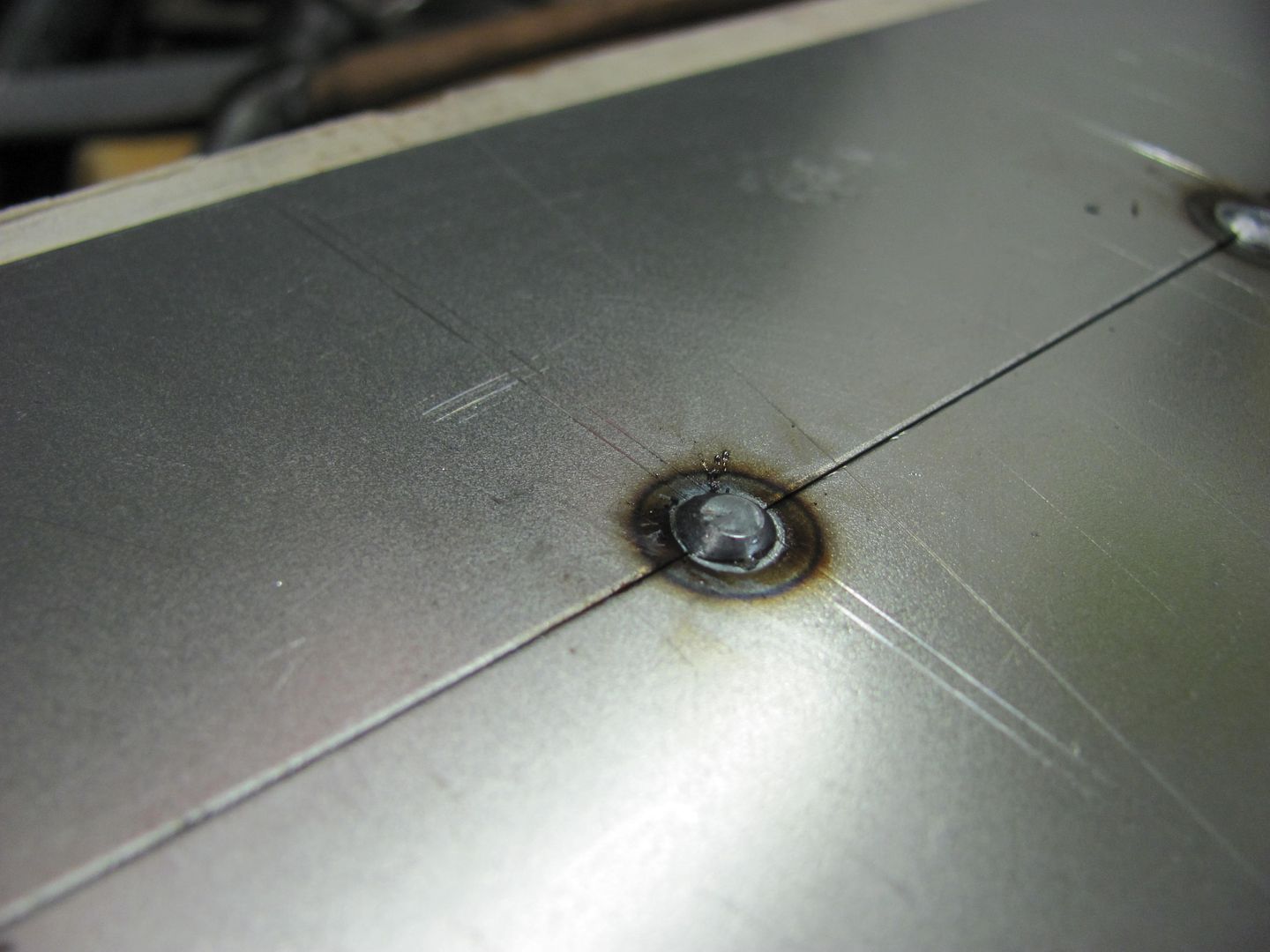
DO NOT PLANISH at this point. Go another 1/2" and add another tack. Is there any change in panels positioning? Go another 1/2" and add another tack. What we are trying to do with this process is to monitor how much shrink is occurring. The first tack should "anchor" the two panels together at the end. With the panels tight together, each subsequent weld tack will start to shrink in both pulling the panels together and also shrinking in overall length along the weld. In effect, this will start to manipulate the panels where the individual pieces on the un-welded end try to overlap each other. So If you haven't seen this happen, keep welding dots at 1/2" spacing until it does happen.
Now that you see these panels overlapping, the next phase is to see how much planishing it takes to "undo" the overlap. Start at your anchor tack, and hammer and dolly once.

Picture105-1.jpg


Go to each subsequent dot and apply the same hammer and dolly in the same approximate force. The flat should be similar in size, but I'd gauge your effort more on hammer force than size of the flats. When you get to the end, check the overlap to see if it still interferes with adjacent panel fitment at the un-tacked end. If it still overlaps, start at the beginning, repeat the planishing of one dot at a time with only one hit per weld, monitoring overlap. When your panel overlap issue has been resolved, your weld dot planishing effort should be the number of hammer strikes per weld dot that it took to resolve the overlap, using approximately same striking force. This assumes your weld dots don't mysteriously grow in size to add the need for more planishing, so again the importance of OCD consistency. This planishing effort will not be the end of the metal bumping to your panel ie: once you get welding in your patch panel/hood scoop/etc. It is the initial needed to help relieve the shrinking effects so the differing forces will relax a bit. What we did in striking one dot once and then move to the next is only for test purposes to identify the number of strikes you needed per weld dot. After this initial planishing, any remaining planishing needed will be based on what the panel looks and feels like, high spots, low spots, etc after welding, initial planishing, weld dot grinding, and panel reading is completed.

Now that you have completed this, just for the heck of it, go to the first anchor dot, and start planishing it and it alone. Keep repeating until you see the adjacent ends start to separate as the weld dot is being stretched. Look at how wide the gap is. This shows the extra effort needed to overcome the shrinking and panel movement that happens when you leave a gap that size in the panel. It also demonstrates the differing planishing efforts that will be needed for inaccurate and inconsistent gaps. For any inconsistencies in your weld seam (gap size, weld dot size, etc), keeping track of what, where, and how much is the tricky part, and adds to the challenge of sorting out the panel where it can be finished with minimal filler. Some may be OK in using thick filler, but it doesn't take that much effort to become more consistent in your processes to eliminate such a need for excess filler. This importance of consistency is in all the processes, starting with tight gaps at fit up. Everything that you can do to keep consistency throughout from start to finish only makes the planishing efforts more consistent throughout, lessening the need to keep track of the errant what, where, and how much.
 

iajonesy

Well-known member
Joined
Feb 8, 2009
Messages
2,467
Location
Iowa
Wow that really explains it very clearly.I always thought that a small gap was the way to go when welding patches,but see now that I was very wrong. Thanks,Robert. I'll keep watching your posts for new and good information. Your photos are top quality,too,so that makes your posts that much more interesting.
The shirts are just right for me as I am color blind. My wife says she can pick me out of the crowds of grey haired old men very easily when I'm in one of your shirts.

Mike
 

lilcraigford

Well-known member
Joined
Oct 19, 2014
Messages
348
Location
Portland, ME
This is an awesome thread! I not only admire the skill and craftsmanship that goes into sheet metal work, but the creativity behind the modified tools is what really stands out to me.
 

cspcrx

Well-known member
Joined
May 2, 2014
Messages
608
Location
Phoenix, AZ
I have to say this is amazing! I am super novice at welding and I am just impressed at what you guys do. I have an 86 CRX with a sunroof that does not work and want to plug it with sheet metal. Looking through this thread makes me realize that if I know what I was doing I could do it and not get a roof that looks like a ruffle potato chip. LOL
 

bwingate

Member
Joined
Sep 27, 2014
Messages
16
So, last weekend I welded in some patch panels into the floor of my car. This method is a lot more work and a lot harder than I expected. Slower too. But I think my results came out ok. No pix because this was my first time EVER welding anything for real.


I have a few questions tho:

I would place a few tack welds, planish them a bit and then grind them down until they were just proud of the surrounding metal. After the panel is fully welded in, what's the best way to finish the welds to be even?


What's the recommended way to remove paint, especially the factory coating on the patch panels? I used a flap disk and ended up taking of so much metal in the process that the panel was ruined - paper thin edges. Do I just need more patience and practice or am I using the wrong tool.


Thanks all!
 

MP&C

Well-known member
Joined
Oct 21, 2009
Messages
4,396
Location
Leonardtown, MD
IMO, wrong tool. If you are building trailers and cleaning up the frames, then flap wheels work well. On sheet metal, I have always said that cleaning up welds with a flap wheel gives you an obstructed view of what is being sanded away which will in many cases result in thin panel to either side of the weld, just as you have now validated. I prefer to use the cutoff wheel to get most of the weld to just above panel surface as you have done. Once all the weld "dots" have been overlapped, ground after each one, and you are "done" with that stage, then if there are any variances between adjoining weld dots, it may be more helpful to continue with the cut off wheel in grinding them to a consistent height, yet still slightly above panel surface. Finish off with a small 3" sanding disc (about 80 grit) to blend the weld into the adjacent panels. Patience is key, and as I've been telling my apprentice, if you're going to use a Mig to weld sheet metal, you're going to get good and grinding.

Hopefully this following video will shed some light, where this is grinding a plug weld (one dot) the premise is the same.. You've likely already viewed this, but this time, take particular note that any use of the cutoff wheel also includes having the other hand braced/stabilized to help guide the tool for more accuracy, less errant misses/gouges in the parent metal.. This will help to give you better results.


.
 
Last edited:

theoldwizard1

Well-known member
Joined
Feb 22, 2011
Messages
43,073
Location
SE MI
Simple question from someone who has ZERO experience in "bump and paint".

How do you prime the back side of a weld ? Many times these are in inaccessible areas. Without some priming, won't they rust through quickly ?
 

54stude

Well-known member
Joined
Jul 12, 2007
Messages
95
Location
Twin Cities MN
Simple question from someone who has ZERO experience in "bump and paint".

How do you prime the back side of a weld ? Many times these are in inaccessible areas. Without some priming, won't they rust through quickly ?


Google weld through primer, I cannot steer you to an exact brand but Napa carries one. After welding you can use cold galvanizing compound in a spray can if you can get some access.
 

MP&C

Well-known member
Joined
Oct 21, 2009
Messages
4,396
Location
Leonardtown, MD
Simple question from someone who has ZERO experience in "bump and paint".

How do you prime the back side of a weld ? Many times these are in inaccessible areas. Without some priming, won't they rust through quickly ?


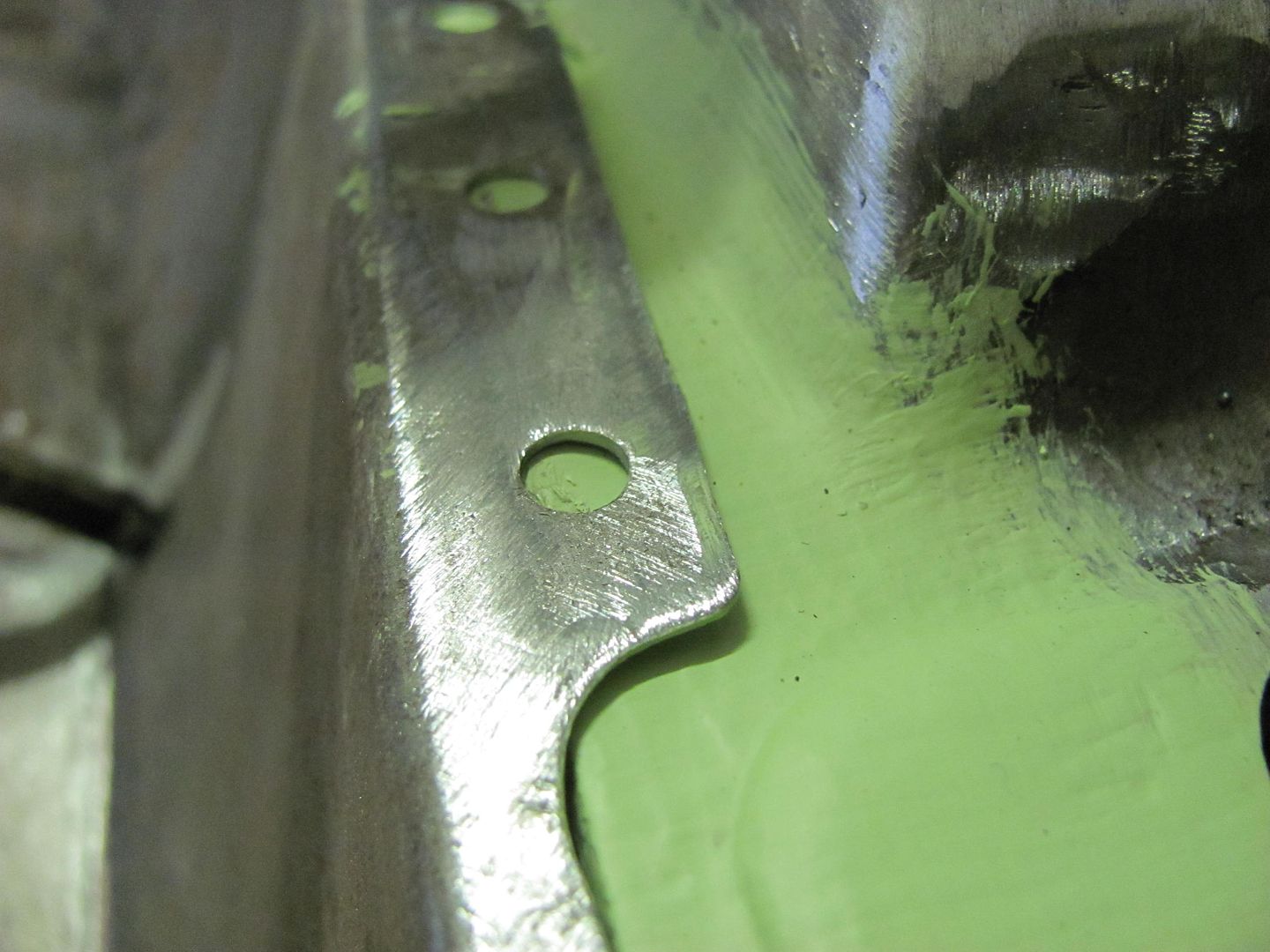
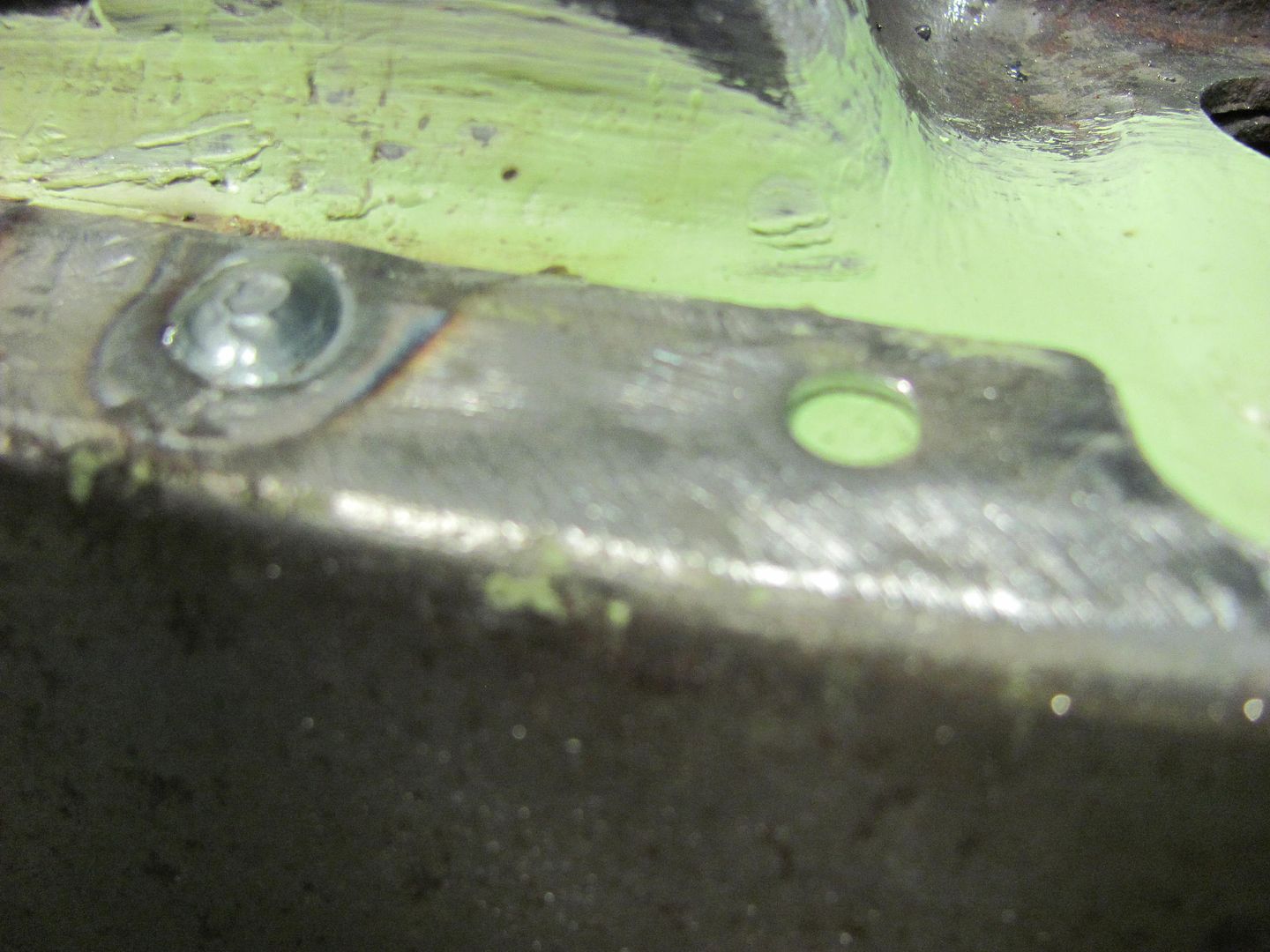
When assembling adjacent panels I'll typically just use epoxy between the two, as shown here, painted on the rear tailgate opening, and also on the underside of the tailpan. This provides rust protection where in many cases the factory process does not add any paint until after assembly. In cars like this 55, in many cases the inner voids such as in the rockers or floor crossmembers never receive any paint finish inside, making them prone to moisture and rust issues.
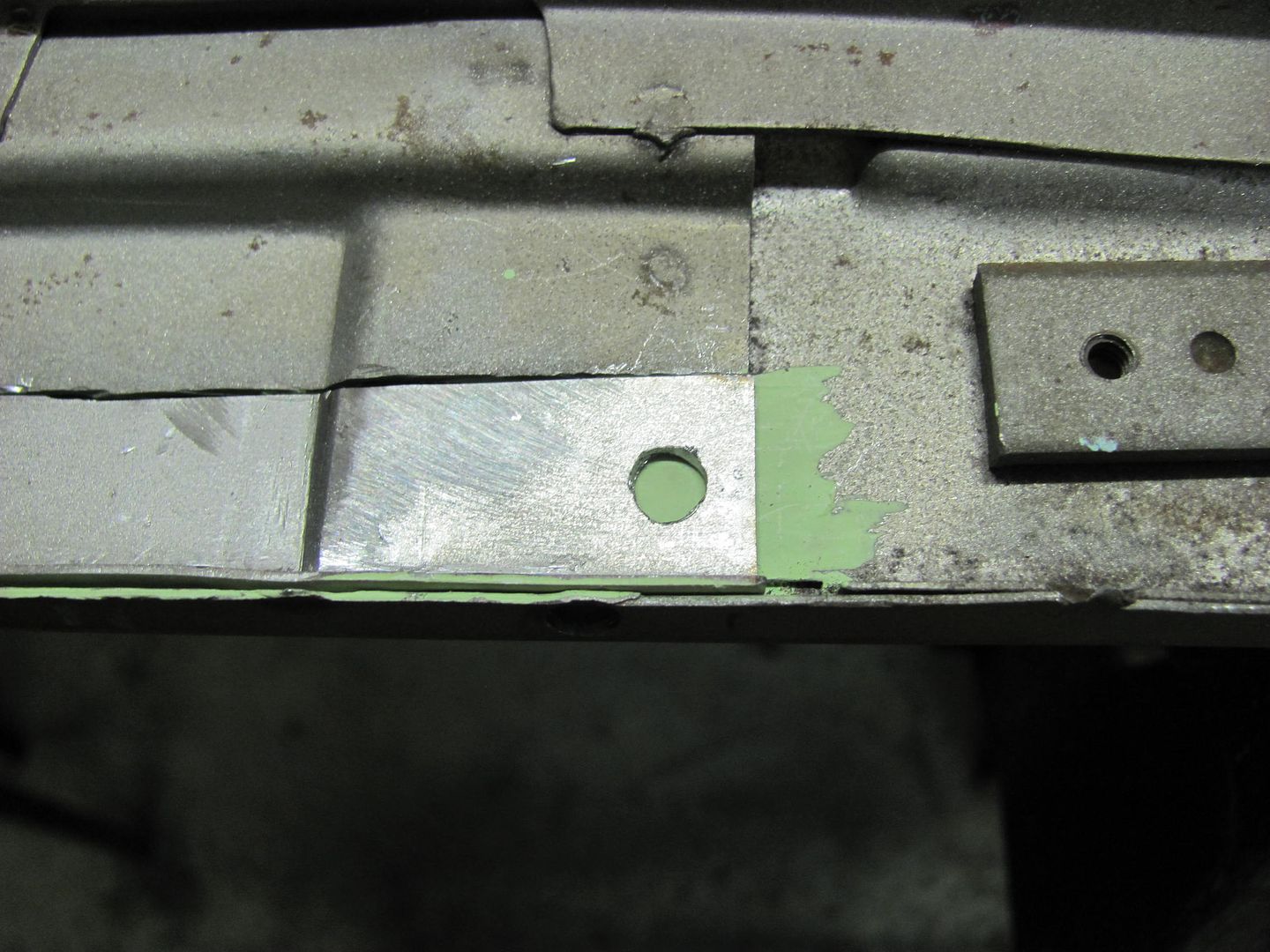
Where this epoxy will not allow welding, you will need to clean the paint off the adjacent panel within the drilled plug weld hole.

Picture314.jpg


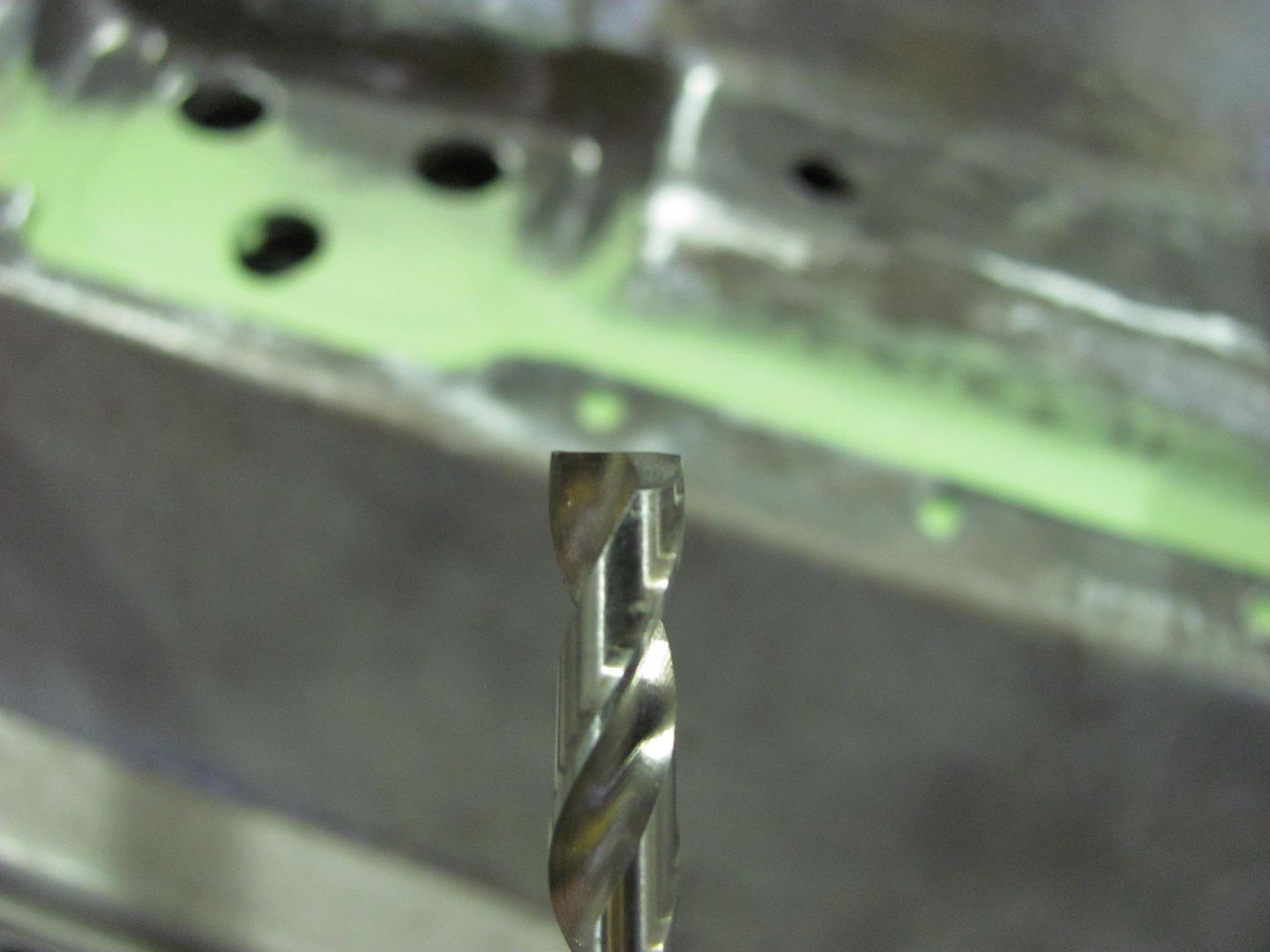
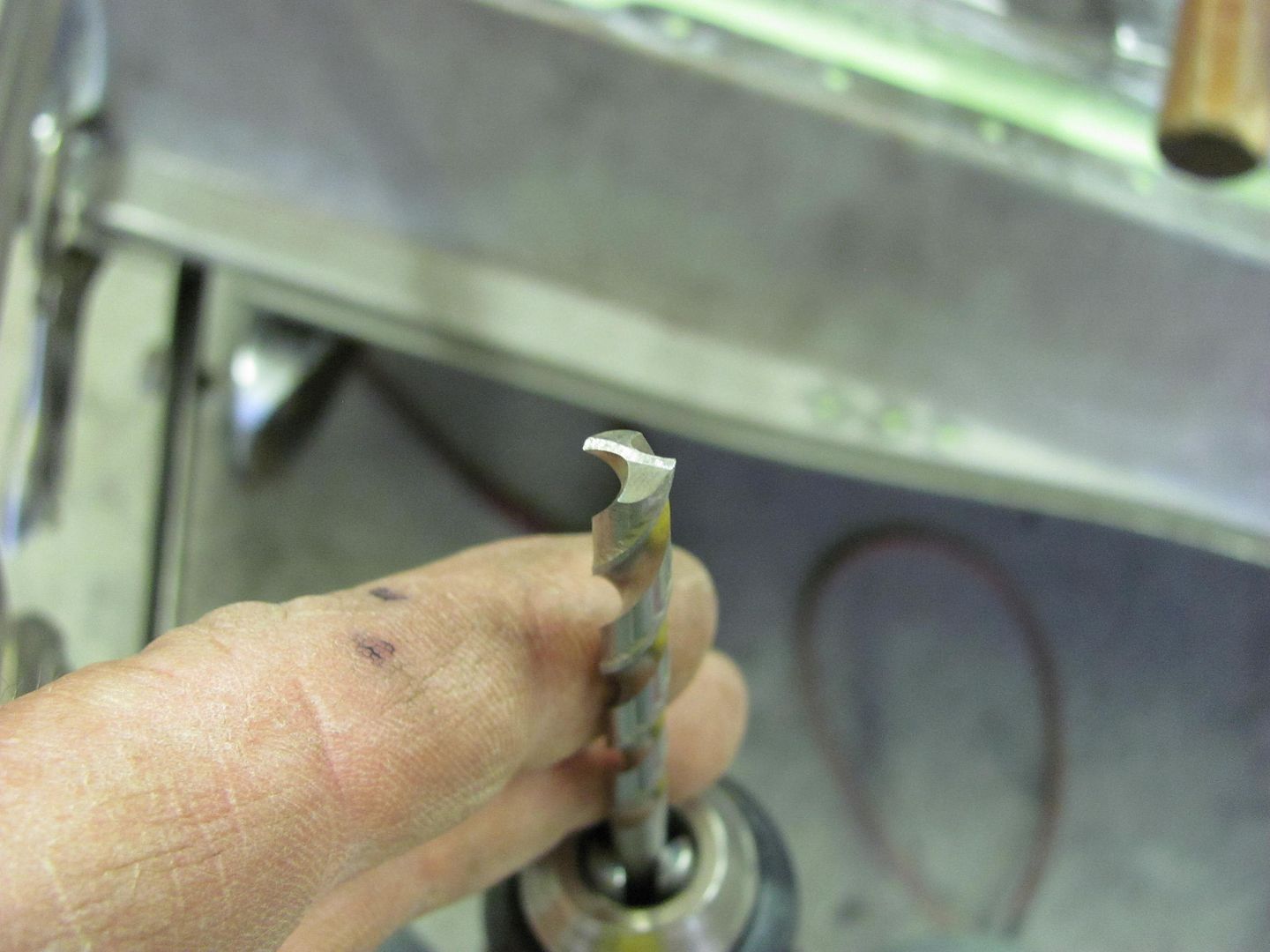
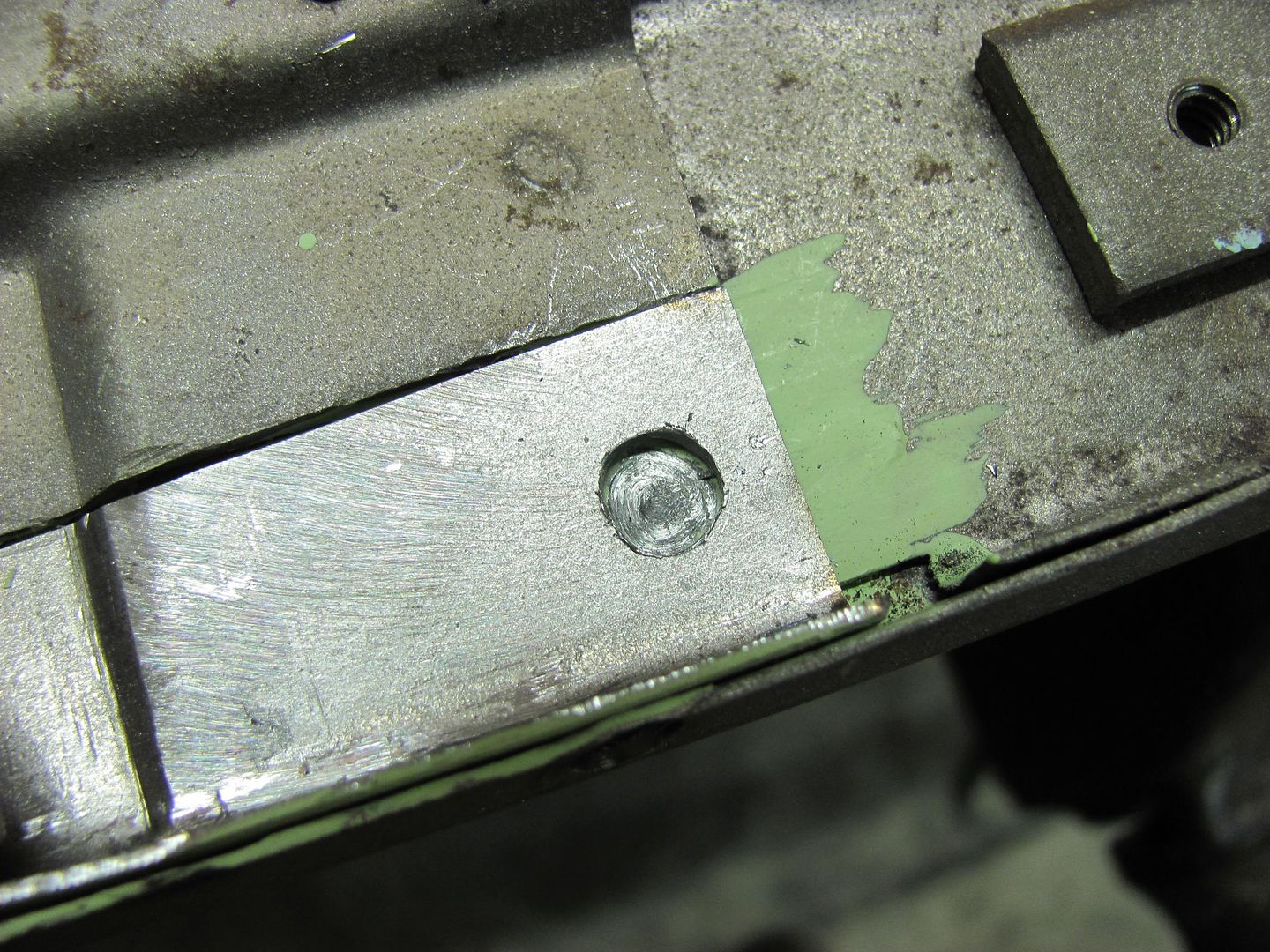
Which is what brought about the need for this tool, the same size drill bit I used for plug weld holes is flattened and backfaced to resemble an end mill cutter.

Picture315.jpg


Picture316.jpg


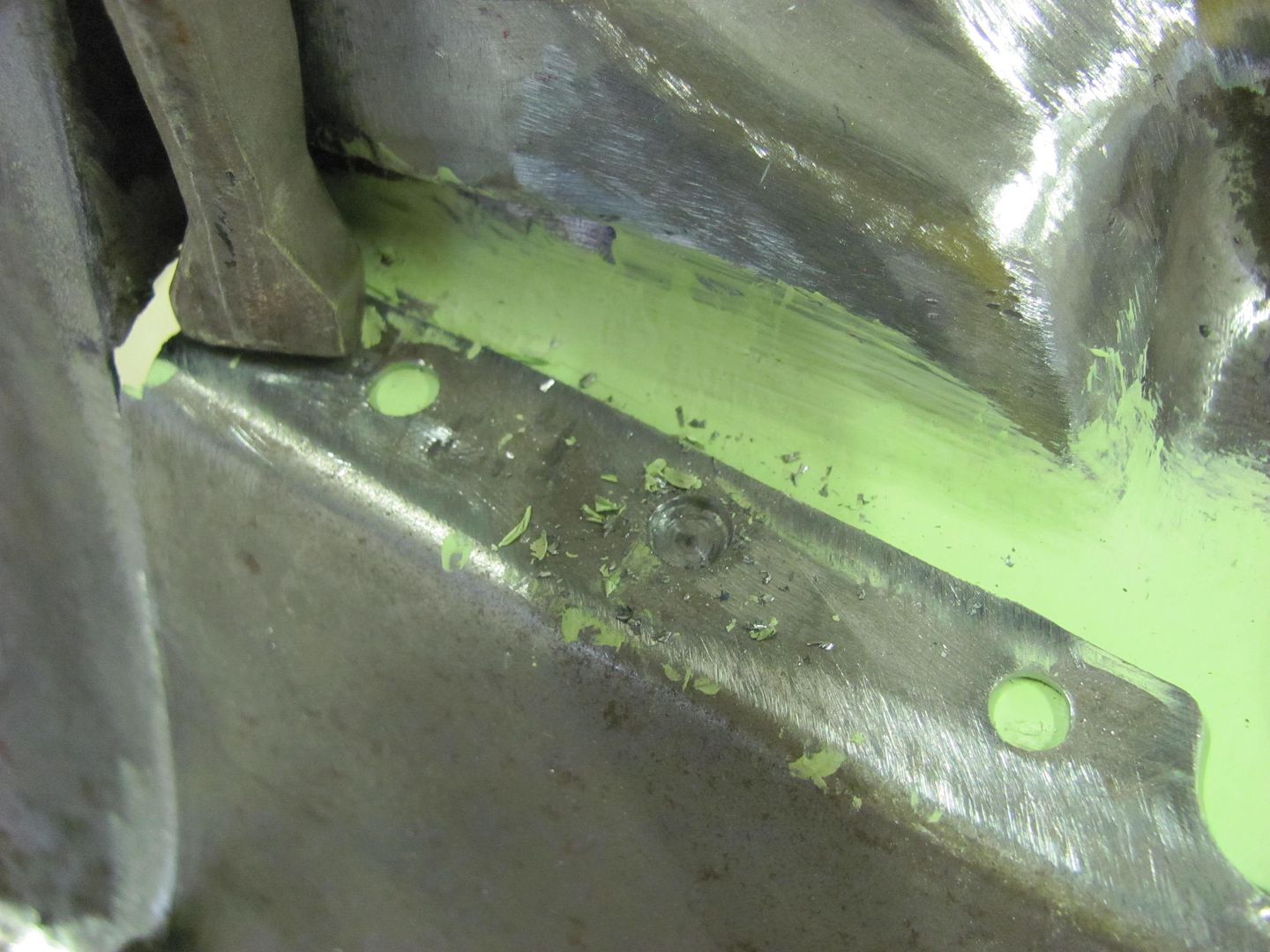
This shows how it works, cleans the paint from the metal surface, but having a flat face on the cutter, it doesn't affect the metal as a regular drill bit would. Notice most of the "chips" are paint....

Picture318.jpg


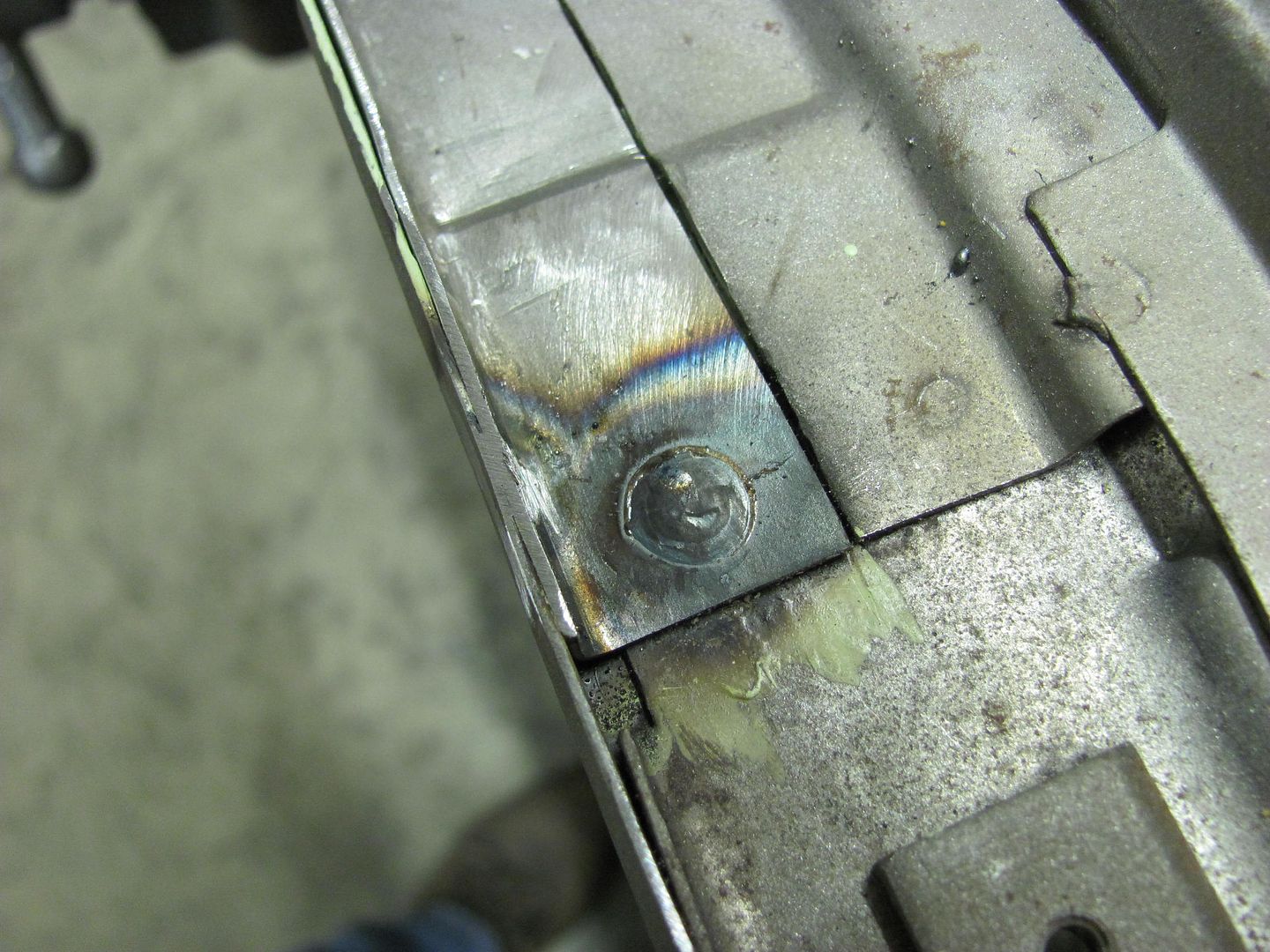
And welded......

Picture321.jpg


Some guys will use a weld through primer to accomplish this same process, and I would suggest to remove any weld through primer out of the plug weld hole (despite it's name) as you may get a contaminated weld otherwise. I prefer the epoxy as I read an issue of Auto Restorer magazine quite a few years back that a study showed epoxy offered better long term protection from rust. Most of your weld through primers are fresh out of a spray can, so you're not dealing with a urethane or any type of catalyzed product, so I can see where perhaps the epoxy would be better. I'd say no matter whether you choose weld through or epoxy, it will be better than nothing at all.

For application, I spray inside my paint booth. For a small application like you see here, I'll mix up some epoxy and brush it on. (note brush strokes in first pic above) Again, the application process won't matter much as any exposed epoxy will be sanded and re-applied later, but now that we have some epoxy between the two panels, there is better rust protection regardless of how it got there. For cavities, there are wand type sprayers that would get inside rockers, etc. rather easily, for any newly installed panels I would say to epoxy prior to welding on the vehicle to get the best protection while you have access to spray.
 

gelierb

Well-known member
Joined
Nov 16, 2010
Messages
52
Location
Redwood City, CA
When assembling adjacent panels I'll typically just use epoxy between the two, as shown here...

Wow - this thread is still alive! Nice to see that green epoxy "weld primer" in action again. Hope all is well with you Robert.

I'm getting ready to buy a gas torch, to play at welding a bit (and for all the other misc uses). People are telling me to buy Victor, more established on the west coast I guess. was going to buy a "medium" size set but after looking at the handles I'm thinking "heavy duty" is not that much larger. Can't I just use a small welding tip on the larger handle? Victor also still makes a set with old style gauges (Journeyman 450). Thanks for any opinions.

looking at:
http://store.cyberweld.com/vijowecuou.html

or the older style gauges:
http://store.cyberweld.com/vijo450wecuo.html
 

Widowson2

New member
Joined
Jul 8, 2015
Messages
4
Location
Shartlesville Pa
I just spent the last hour plus reading this thread all I can say is outstanding! I see last post was in May I hope it's not over. Thank you Robert and everyone else for your input I have learned so much. Getting ready to fix rust on my 99 f-250 Super Duty, wheel arches and cab corners, never done this type of work before but very mechanically inclined. Can't wait to get started. Thanks again!:thumbup:
 

JonBoehman

Well-known member
Joined
Oct 7, 2011
Messages
364
Location
Philpot, Ky
I am so glad you showed this. Once again, you continue to put wrinkles in my brain. I look forward to reading this thread every night.
 

Widowson2

New member
Joined
Jul 8, 2015
Messages
4
Location
Shartlesville Pa
I'm glad I found this site and thread getting ready to do rust repair on my F-250, haven't welded in 20 hrs and that was stick. This thread taught me more in 1 hr then 4 weeks of researching the project. Also just purchased a Eastwood 135 mig they had special for $199 couldn't pass it up, it's all I need since all I need it for is sheet metal and garage only has 120. Hopefully we can get it cranked up again!
 
Last edited:

Crusarius

Well-known member
Joined
Aug 22, 2013
Messages
383
Location
Upstate NY
This thread is great. unfortunately I ran out of lunch break so I stopped at page 4. I do not know if anyone has mentioned anything about non weldable backer. For example when I have gaps that are to large or holes that need to be filled I will clamp a piece of copper or aluminum to the back side of the panel then fill the gap or hole with weld. Weld will not stick to copper or aluminum making it very easy to fill large holes.

I typically work with 3/16" to 1/4" material doing custom suspensions and equipment repairs.
 

SteveH-CO

Well-known member
Joined
Aug 29, 2014
Messages
283
Location
Southern Colorado
How do you prime the back side of a weld ? Many times these are in inaccessible areas. Without some priming, won't they rust through quickly ?

When you're all done, you really need to bury the backside in grease. Especially if you live in Michigan. I'm surprised when I see people do all-metal repairs, and then do nothing on the back side, and use the vehicle as a daily driver - they rust out again in 2 years or less. Be sure your welds are all solid and tight and that ALL paint and body work is done before you apply grease (aerosol Lithium or axle grease) to the back side.
 

Justanoldguy

Well-known member
Joined
Jun 1, 2008
Messages
3,673
Location
Atiamuri. Central North Island. New Zealand
This thread is great. unfortunately I ran out of lunch break so I stopped at page 4. I do not know if anyone has mentioned anything about non weldable backer. For example when I have gaps that are to large or holes that need to be filled I will clamp a piece of copper or aluminum to the back side of the panel then fill the gap or hole with weld. Weld will not stick to copper or aluminum making it very easy to fill large holes.

I typically work with 3/16" to 1/4" material doing custom suspensions and equipment repairs.

Cool but I just read a lot of reasons not to fill holes etc with weld.
Main one being the extra heat involved.
 

User_Name

Well-known member
Joined
Jul 30, 2008
Messages
281
Location
Teegeeack
Hey Robert, lots of great stuff here but I've got to ask about what happens to the underlying epoxy that surrounds a plug weld. Doesn't the heat burn the epoxy back around the circumference of the plug and leave an area that is unprotected? Or is the epoxy stable enough that there's no significant burn-back?

I know you used HOK epoxy at one point but are doing more stuff with SPI. Have you noticed any difference as far as plug welds are concerned?

Finally, I know that Fuzor makes a seam sealer that's heat-stable for resistance welding. Have you ever given it a shot or heard anything about it when used for plug welds?
 
To avoid these ads, REGISTER NOW!

MP&C

Well-known member
Joined
Oct 21, 2009
Messages
4,396
Location
Leonardtown, MD
I have yet to use the SPI in conjunction with plug welding, so I can't give a comparison at this point.. Here are some results of using the H/K...


Cleaned spots for the plug welds...


Picture345-1.jpg


Picture346-1.jpg


Picture348-1.jpg


Note the discoloration of the epoxy next to the weld above, where it turned brown from the heat. It was allowed to cool off, then attempted the highly technical fingernail scrape of the paint. I thought the paint may scrape off, but it held tight, not so much as a scratch.

I haven't used the Fusor seam sealer..
 

User_Name

Well-known member
Joined
Jul 30, 2008
Messages
281
Location
Teegeeack
Thanks, Robert.

I've been meaning to do the patches in my floor pan for months now but reality keeps getting in the way. Hopefully I'll be able to get to them in the next week or so.

If I can get my hands on the Fuzor stuff I'll try and do some testing on some coupons to see how it holds up to MIG heat. Hopefully the SPI epoxy works as well as the HOK.
 

gelierb

Well-known member
Joined
Nov 16, 2010
Messages
52
Location
Redwood City, CA
Would be interesting to top coat a few of these samples and bury them outside for 6 months and see if the weld-baked EP prevents/impedes corrosion.
 

woodturner9

Well-known member
Joined
Feb 16, 2007
Messages
576
Location
Indiana(ish)
Also just purchased a Eastwood 135 mig they had special for $199 couldn't pass it up, it's all I need since all I need it for is sheet metal and garage only has 120.

How did you get the $199 price? Do you know if that is still available? I have been looking at that welder, but did not see a $199 price in any of the emails from Eastwood, best I can find is $269.

Have you tried the welder? What do you think?

Thanks.
 

Widowson2

New member
Joined
Jul 8, 2015
Messages
4
Location
Shartlesville Pa
I was doing a Google search one afternoon and it was a pop up that came up, I click it and it was legit. Pulled out the credit card and the rest is history. Yes I tried it just practicing now haven't welded in years. Not sure if it's still available at that price. Love it for sheet metal so far
 

chevouier

Member
Joined
Aug 28, 2015
Messages
10
So, there is one niggling problem with my practice welds. In my earlier attempts I thought I had messed up the grinding, and I did, but the reason was that I was trying to get out these small depressions just to the side of some of the tacks. They are the dark spots shown in the pics of different attempts below. I'm assuming that these would be no problem with filler, but am wondering if anyone can tell me why this is happening and how to prevent it. I'd like my finished product to look more like Roberts, but realize that this might take years of practice. As instructed, I carefully grind and planish both sides but these depressions still appear. Also, on a few of the pieces I tried different heat settings. I can imagine that these depressions are shrinkage from the heat of the tack, but they will not planish out (and they really aren't visible until all of the grinding and sanding is done. However, these depressions appeared even on the recommended settings for this gauge (20) of steel....
so is this undercut around the weld i have the same problem thanx mark
 

MP&C

Well-known member
Joined
Oct 21, 2009
Messages
4,396
Location
Leonardtown, MD
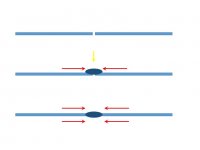
IMO that is not an undercut weld. The undercut defect is typically a much sharper valley adjacent to the weld edge. If I had to guess, I'd say you have little if any weld penetration. Here's why: (gap shown for clarity of two panels only, would ideally be butted tightly)


Middle view shows a weld with insufficient weld penetration. As the weld shrinks (red arrows), with the majority of the shrinking occurring above the panel, the top line of the panel moves together, the bottom with less shrinking does not. This forces the panel in the area of the weld downward (yellow arrow)

In the bottom view of the panels with better weld penetration, the shrink pulls more equally on the top and bottom line of the panel for less of this deformity.


attachment.php


Now, in looking at the welds and comparing the panel thickness to the mass/thickness of the weld, you can see how leaving the welds there will affect the weld penetration by acting as a heat sink. This is why I suggest to planish each weld dot individually, and grind both front and back sides to just above panel thickness before moving on to the next weld. This gets rid of this "heat sink" for more consistency in the welds, from start to finish.
 

Attachments

  • **** weld deformity.jpg
    **** weld deformity.jpg
    24 KB · Views: 1,552
Last edited:

chevouier

Member
Joined
Aug 28, 2015
Messages
10
Thank you for your time I'll crank the heat up and plansh at after each dot thank you mark

Sent from my SM-G900I using Tapatalk
 

MP&C

Well-known member
Joined
Oct 21, 2009
Messages
4,396
Location
Leonardtown, MD
That does show some with good weld penetration and some areas that still shows the seam. I think this is a combination of minimal weld penetration in areas and lack of planishing/grinding during the process. Try adding the planishing and grinding in the mix, see if it doesn't help out... in both less panel deformation and better weld penetration. Hopefully it gets you to better consistency where heat required remains the same so your weld time (trigger pull) can also become more consistent.
 

chevouier

Member
Joined
Aug 28, 2015
Messages
10
That does show some with good weld penetration and some areas that still shows the seam. I think this is a combination of minimal weld penetration in areas and lack of planishing/grinding during the process. Try adding the planishing and grinding in the mix, see if it doesn't help out... in both less panel deformation and better weld penetration. Hopefully it gets you to better consistency where heat required remains the same so your weld time (trigger pull) can also become more consistent.
Thanks again for your help I'll keep practicing and will post my results enjoy your work amazing

Sent from my SM-G900I using Tapatalk
 

toplessHO

Well-known member
Joined
Oct 20, 2014
Messages
14,005
Location
central florida
this doesnt apply to the welding but does apply if youre trying to duplicate a factory spot weld in the area you plug welded
In the areas you ve plug welded grind them flat and coat with some high build primer.
While the primer is still wet put a pencil eraser over the plug welds and give a slight twist.
Pull pencil straight up without dragging it. Do this at slightly different angles and maybe a little off center as all welds werent perfect and youre trying to duplicate that.
 

MP&C

Well-known member
Joined
Oct 21, 2009
Messages
4,396
Location
Leonardtown, MD
Looks to still have some "depression" adjacent to a few welds in areas, but does look better. Still see some weld penetration hanging on the back side. Weld, planish, grind, repeat. The grind part refers to the back side as well (given adequate access). Leaving any excess adds a heat sink..
 

chevouier

Member
Joined
Aug 28, 2015
Messages
10
Thanks I'll keep practicing good luck with ya shop wish I was over your side of the world haven't found anything like that in new Zealand cheers mark

Sent from my SM-G900I using Tapatalk
 

Justanoldguy

Well-known member
Joined
Jun 1, 2008
Messages
3,673
Location
Atiamuri. Central North Island. New Zealand
Thanks I'll keep practicing good luck with ya shop wish I was over your side of the world haven't found anything like that in new Zealand cheers mark

Sent from my SM-G900I using Tapatalk

There are plenty of excellent shops in NZ.
Every bit as good as the best in America.
Kiwis are renown for their meticulous work.
Maybe you have just been looking in the wrong place.

Reminds me of " the grass is greener over the fence" :beer:
 
To avoid these ads, REGISTER NOW!
Top Bottom