To avoid these ads, REGISTER NOW!

Welding in patch panels

stricht8

Well-known member
Joined
Apr 20, 2008
Messages
1,714
146d4d8e.jpg


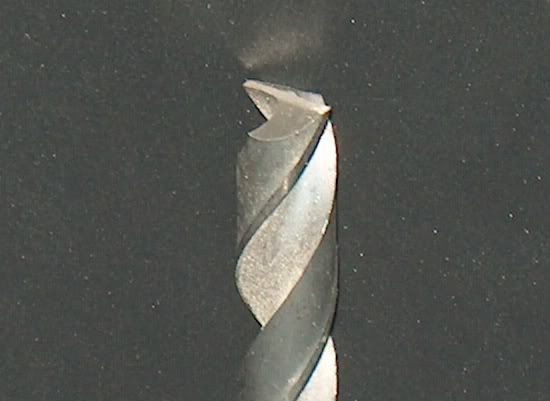
I use about a 120 or so grit 3" sanding disc to completely flatten the end of the drill bit (I use a letter A for all my plug welds, works good with the heat setting I am at), You end up with what looks somewhat like a figure 8. With all that flat surface, it would be more difficult to remove paint, so on the back side of the leading edge of the cut, using the sanding disc again, and angled "relief" is formed in each side. This now leaves about a 1/16" wide flat straight across, as you can see above, which works much better to remove the paint. The EP I'm using is KP-2CF from House of Kolor.

Thanks Robert. I'll try that.
 
To avoid these ads, REGISTER NOW!

sberry

Banned
Joined
Jun 18, 2005
Messages
35,747
Location
Brethren, Michigan
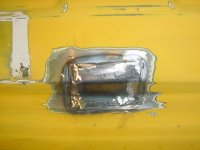
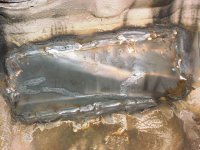
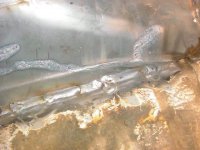
I don't fit them the exact same way, the one in the pic here isn't a super example as this was in an obscure place not visible when finished but the top and right side show somewhat. I rarely **** weld, I put the patch behind, just a little, 1/16 to 1/8 and consume the lap. No holes, very well sealed. Skim it with putty when finished. With butts as you can see they just cant get a quality weld as easily. Done right there is no place for water to collect.
I keep 030 wire in the machine, if I was doing a steady diet of auto body it would be 023.
 

Attachments

  • Mack back patch.JPG
    Mack back patch.JPG
    27.8 KB · Views: 1,273
  • Mack floor patch.JPG
    Mack floor patch.JPG
    46.4 KB · Views: 1,209
  • Mack floor weld.JPG
    Mack floor weld.JPG
    34.4 KB · Views: 1,133

balthasarbal

New member
Joined
Jan 27, 2010
Messages
3
Hello,
When welding a patch panel or fender flare on a car, I use either oxy-acetylene (gas welding) or wire-feed (mig welding), in that order of preference. Tig welding is great, but few do-it-yourselfers have a tig welder, so we'll stick with the first two. Gas welding is my first choice because the metal stays fairly soft and workable, and metal-finishing is easier (and more quiet). Mig welding work-hardens the metal and seems to shrink the weld area excessively. Gas welding also shrinks (heat shrinks); however, the metal is still workable with hammer & dolly, whereas a mig-welded panel is too stiff to work effectively.
 

Flathead Red

Well-known member
Joined
Jul 25, 2009
Messages
648
Location
Gulf Coast of Florida
Thanks for all the cool tech. This one of the most informative threads I have read as I am trying my hand at Mig welding some patch panels into my 40 Fords running boards.

Flathead Red
 

sicklyscott

Well-known member
Joined
Dec 29, 2009
Messages
131
I'm new to welding and would like to fix some rust spots on my project Miata. When doing a **** weld, what is the correct technique for the weld? Using a MIG, do you do a circle pattern for the tack weld? I've tried a few times but everytime I pull the trigger it seems to just feed into the gap and not actually tack the piece together. Any suggestions?
 

mktbully

Well-known member
Joined
Dec 8, 2008
Messages
73
I'm new to welding and would like to fix some rust spots on my project Miata. When doing a **** weld, what is the correct technique for the weld? Using a MIG, do you do a circle pattern for the tack weld? I've tried a few times but everytime I pull the trigger it seems to just feed into the gap and not actually tack the piece together. Any suggestions?

i'm sure someone will correct me since i don't do the body panel welding much...but...

how big is the gap that you're trying to fill? i mean it should be fairly tight with almost no gap where your weld is just really a tack.

w/ the right setting the weld will penetrate the panel. you don't want to hold it there for too long. that's where you get in trouble with heat.

outside of body work welding i start from one side and build it up so it hits the other side of the gap...but that's more exhaust welding and not too critical like a body panel.
 

t100

Well-known member
Joined
Sep 3, 2009
Messages
6,101
X2. I looked when originally posted about them and then again today. No luck. I'm planning on doing some patch work on my jeep next week.

I bought a pack of 6 for $8 couple weeks ago. you can find them in the welding supply section.
 

Rory Bellows

Well-known member
Joined
Jan 14, 2006
Messages
1,083
Location
Ohio
I bought a pack of 6 for $8 couple weeks ago. you can find them in the welding supply section.

I was there this afternoon. Got 8 for $5.99 - 20% off coupon = $5.10 out the door. They are in the welding section. Item # 44751 they are not on their website though. You can buy 40 from HF for the price of 4 at Eastwoods. I bet they are both packed by Ping Pong at the same factory.
 

projectPONY

Well-known member
Joined
Sep 25, 2008
Messages
83
Location
Dallas, TX
this is some great information guys. I am ASE and iCAR certified in collision repair and refinishing and in MIG welding and it doesn't cease to amaze me that in this industry we never stop learning. I've been doing restorations since I got out of school and I can honestly say that I have learned more from talking to other bodymen and painters at resto shops than I ever did in school. I will also say that every bodyman has his own technique and the trick to quality work is finding what works and making work for YOU, IMO.

as for migging, IMO it's a finesse game. set your welder up according to what the machine calls for and then dial it in as you run some beads on some scrap coupons. believe it or not, the most common mistake that people make when migging is that they hold the gun too close to the material.

MP&C, great work buddy. that looks awesome.
 

69supercj

Well-known member
Joined
Jan 26, 2010
Messages
555
When I did quarter panels I would weld inside the car as much as possible. That way I wouldn't have to grind as much

I like this idea, almost sounds like a no brainer but I'd never thought of it. Anybody else out there weld from the backside when possible to reduce surface grinding?
 

MP&C

Well-known member
Joined
Oct 21, 2009
Messages
4,396
Location
Leonardtown, MD
Thanks for the comments guys.


When I did quarter panels I would weld inside the car as much as possible. That way I wouldn't have to grind as much


Depending on how much/little metal finishing one cares to do, yes this is an option. The weld will shrink, causing a slight valley that one could use filler in to smooth out the panel. If you intend to hammer and dolly to metal finish the seam, it may require grinding on both sides regardless, in which case you would want the majority of the weld on the outside, more accessible.
 
Last edited:

MP&C

Well-known member
Joined
Oct 21, 2009
Messages
4,396
Location
Leonardtown, MD
I'm new to welding and would like to fix some rust spots on my project Miata. When doing a **** weld, what is the correct technique for the weld? Using a MIG, do you do a circle pattern for the tack weld? I've tried a few times but everytime I pull the trigger it seems to just feed into the gap and not actually tack the piece together. Any suggestions?


Scott, none of the following statements are intended to pick on anyone's technique or profess something to be the only way it can be done. (my disclaimer) If anyone has something that works for you, by all means use it. But this is the method I follow, and seems to work now that I have the hang of it. There are always exceptions you run into that will require deviating from your "norm" to tackle an oddball situation.


Most hobbyists only have a MIG welder in their shop to work with. Where you will hear from many professional sheetmetalists (I aspire to be in that category one day) that TIG or O/A gives you a better weld, a softer weld, a this or that, I am not at that stage yet in my abilities to be able to confirm it as gospel. I have a TIG to go along with my MIG, but the TIG is a lower end machine that does not have as precise control on the lower amperage scale as some of the bigger machines. Thus, for me it does not play nicely with auto sheet metal, and I find it relegated to use when welding up something on the welding table. So, like most other guys out there, I work primarily with my MIG when it comes to actually welding on the car. So the following will be based primarily on using the MIG, and applications will likely differ if you are using O/A or TIG. (my second disclaimer) Now, if you have ever welded thicker steel, let's say 1/8" or thicker, you have seen that this metal will tolerate heat fairly well and permits you to weld in one continuous pass. Automotive sheet metal on the other hand, typically in the neighborhood of 19 ga, is too thin to provide these exact same results. If you were to have your welder heat and wire feed set up for doing a pass on 19 ga steel, you will notice that the initial start is likely a cold weld, with lack of panel penetration. Looking at the back side, you would still see two separate panels.....until the metal starts to heat up, and then you will see the weld penetration as you would expect, and contining, the metal heats up further, until you blow out a hole. Point being, sheet metal is not as friendly to continuous weld passes as you would see with the thicker metals.

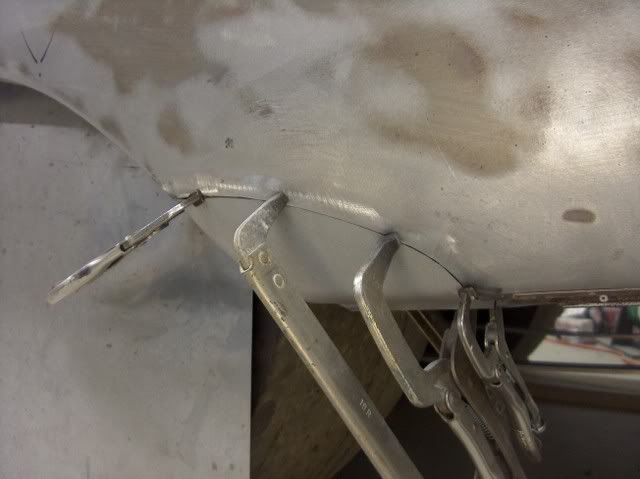
So before we get into actual welding, let's talk about your panel preparation. Clean, rust free, no paint, oil, etc, that's a given. I typically cut out any rust damage until you get to good metal. Sometimes that involves going three or so layers deep to get to good metal, but while you are welding, do it right or you'll be doing it again in a year or so. Welding is cheap compared to paint products. ;) For the typical repair panel I am fabricating, I will cut it out about 3 times (hopefully all on the same panel). Tool of choice is offset snips, you'll need left and right handed. Initial cut is a rough cut, a good 1/2" or so oversized. Now it will fit against the adjacent panel a little better without all the extra metal in the way. Trace an outline from your hole/opening to make another cut. Here I'll use a sharpie or similar device, and trim again, leaving about 1/8 extra this time. Fit and trace once more, this time marking with a scribe, ice pick, or similar sharp device, and trim just to the outside edge of the scribe. Test fit again, using your 3" sander to touch up any areas that aren't fitting tightly together. Oh yeah, in case you just missed that, NO GAPS. Any weld is going to cause some shrinking. The wider the gap, the more filler, the more heat, the more shrinking, the more your panel just moved from where you intended the edge to be. And as you have seen, hard to fill and weld a gap with about .023 wire. So here's where we work in the welding scenario. I hope no body gets offended, by my personal view is people set gaps (and use backer plates) because they can't get a full penetration weld otherwise, because the machine is not set hot enough and the panels aren't tight together. Think of the weld pass we discussed earlier. The initial part of the weld does not produce a full penetration weld. So to fix that, let's turn up the heat. We want full panel penetration, the first time, every time. But wait, you say. If I keep welding, it will blow a hole in the panel. So true, That is why in welding sheetmetal, the process I use is more heat (I normally set my machine for the next thicker metal....18 ga, set the heat for a 16 ga panel, etc), but only weld one dot at a time. If the panels are tight together, the feed wire can "feel" the joint even if you're blindfolded! Now, one zap and the panel is tacked. I know this may be different for some, others may have tried it and still found themselves blowing holes due to the "excessive heat". Before giving up hope, first try increasing the wire feed speed a bit more. Think of it this way.....there is enough heat to cause the weld, but not enough filler material going in, so somethings gonna give, hence the blowout. So more heat, more feed, single dots only, and no gaps. I'll follow this post with a small patch I did on a quarter panel to hopefully show the process a little better.
 
Last edited:

MP&C

Well-known member
Joined
Oct 21, 2009
Messages
4,396
Location
Leonardtown, MD
(continued)

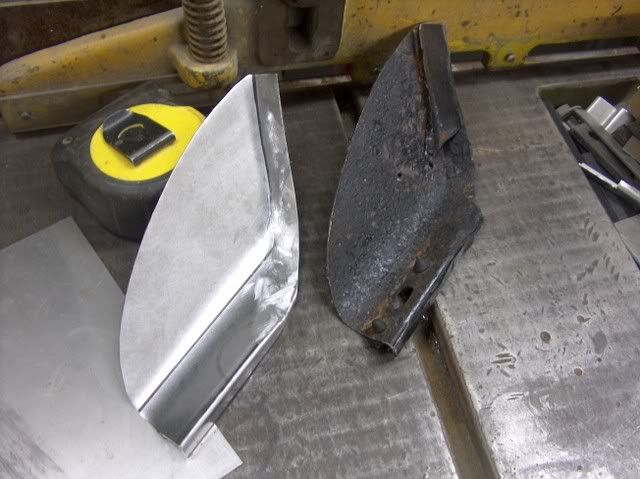
Here we have typical rust damage due to dirt and water collection in the nooks and crannies.


Picture227.jpg


Here I have forced the issue. We need to make a repair panel..


Picture228.jpg


Rough layout and forming the repair


Picture229.jpg


Picture231.jpg


Slight bends, shrink the corner, repeat


Picture234.jpg


Picture236.jpg


Picture237.jpg


Picture238.jpg


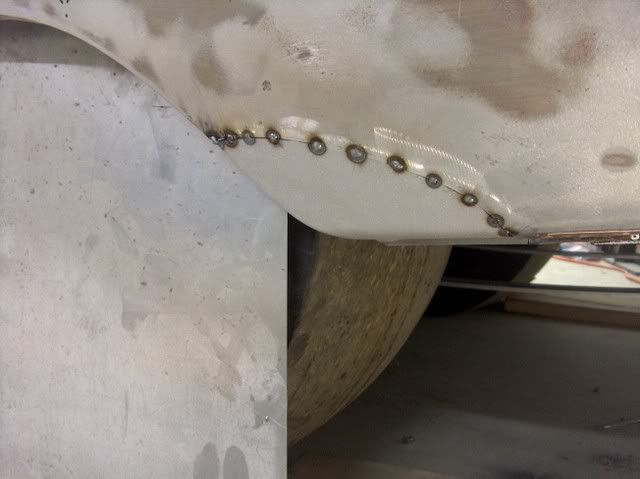
Fitment and tack welding


Picture240.jpg


Picture242.jpg


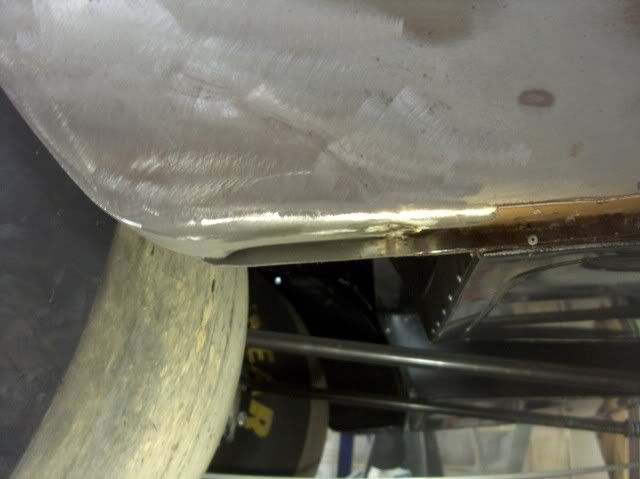
Here I would stop and planish the weld dots with a hammer and dolly, just like the post I did on page one, lower fender. This helps to negate the effects of shrinking from the welding process. Then grind down these dots to just above panel surface, so they will be out of the way for planishing the next set of dots. (use 1/16 wide cut off wheel to grind as described in previous post about grinding welds) Now weld the next dots, overlapping the originals by about 1/3 to 1/2 diameter of the dots. Continue the dot welding, planishing, and grinding, and repeat until finished. Then clean up the remainder with about a 60 or 80 grit sanding disc in your 3" sander.

Picture243.jpg


Picture246.jpg


I hope this helps, good luck on the Miata!
 
Last edited:

chevyboy91188

Well-known member
Joined
Feb 23, 2010
Messages
346
Location
Tampa, Fl
this thread is better than anything I have ever seen on bodywork, I'm doing my 66 gto and this has helped alot as I have to replace the tail panel, rear wheel wells lower rear quarter patches. great work MP&C
 

pistolpete

Member
Joined
Feb 17, 2010
Messages
24
Location
StRatford, Ontario
MP&C I just want to say thanks for taking the time you have in this thread, it is greatly appreciated to be able to obtain knowledge as such. Seems most people will tell you how you are doing it wrong, but few will take the time to give amazing examples and back it up.

Just one quick question though, and just more so clarification then anything. You will do your tack's for the entire panel 1-2" apart, then planish hammer the tacks and then grind down to just above the panel. Do a second set of tack welds and repeat the hammering and grinding?
 

MP&C

Well-known member
Joined
Oct 21, 2009
Messages
4,396
Location
Leonardtown, MD
Pete, yes to your question. Part of the "MIG welds are harder" comes into play when you have this nice big weld going from one end to the other. It can be up to four times the thickness of the sheet metal in places, depending on technique, so naturally it should be harder. By welding and planishing one dot at a time, you keep the mass of weld to a minimum, so it becomes easier to planish out the welds. And by planishing as you go, you can keep the shrinking issue at bay. A bit more time consuming, but it also help to spread out the welding so the panel can cool off in between.
 
Last edited:
To avoid these ads, REGISTER NOW!

jeepnut24

Well-known member
Joined
Aug 23, 2006
Messages
797
Location
Morrison CO
HF has them for MUCH cheaper. I bought my set there as well and got 8 for less than 4 at eastwood. For chunks of steel that probably came from the same place it was worth going to HF.

That said, I found them to give too much of a gap for my liking. Im probably going to modify mine to create a thinner gap. They would probably work well on old US metal though, Im working on newer panels.
 

rogsmart

Well-known member
Joined
Aug 22, 2009
Messages
240
Location
It's the part that's gonna fall in the ocean when
MP&C,

Just wanted to say that your technical writing is first rate. Clear, detailed, and to the point with photos that nicely support the writing. Having done a little tech writing myself I know it takes time and effort to make it like that. So thanks for that.
RogSmart

P.S. The metal working ain't too shabby either.
 

MP&C

Well-known member
Joined
Oct 21, 2009
Messages
4,396
Location
Leonardtown, MD
Thanks RS!

Pete, I had one other project that showed planishing and it's effects a bit better, so I thought I would add that for you.


We recently worked on an NOS quarter that the owner wanted to shave the gas door, so here my metalsmith apprentice nephew Chris had started to cut out the gas door opening so it could be shaved. Large holes used in the corners to minimize the shrinking and buckle effect you see when welding in sharp corners. The cutoff wheel had got away from him (guess we need that lazer guide from Sears!) and he thought the next best thing was to cut out some more. Two more mis-cuts and we would have a three door wagon on our hands......


Picture154-1.jpg


Picture155-1.jpg


Picture156-1.jpg


Picture157-1.jpg


Still had old door skins off the same car laying around, this seemed the perfect candidate to make the patch with. Cut it oversize, marked the hole, trimmed that oversized, scribe the opening, trimmed some more, some slight work with the sanding disc, and Viola! A nice, tight fit.


Picture158-1.jpg


Picture159-1.jpg


Now I needed a nice bench to weld on, and still have access for planishing the weld dots. Good thing these paint stands were in the way, I probably wouldn't have given them thought.


Picture160-1.jpg


Aligned as we went, dot welded, planished, ground down the weld, repeat.


Picture161-1.jpg


Nice tight fit


Picture162-1.jpg


Picture163-1.jpg


Picture165-1.jpg


Picture166-1.jpg


Picture167-1.jpg


Got some more weld dots in and decided to not planish for a few of them, should be a good demonstration to show the deformation that occurs. I usually run my hand outside along the perimeter of the patch to check for any deformation to know where you need to planish a bit more. Normally you will start to see a buckle depression in between some of the welds. As this is a small patch within the middle of a large panel, the shrinking effect will tend to draw everything in toward the patch, so much of the buckling you see will be on the main panel on the outside perimeter of the patch. This should also clue you in that the stretching that needs to occur is not the buckle, but just inside that buckle, at the weld and heat affected zone of the weld. Once that area is stretched a bit, the buckle should lay flat once again.

Here is the back side of the quarter, first we'll show the full weld penetration we're looking for, then the deformed metal.


Picture168-1.jpg


Due to our "experiment" to show the deformation we have more than one dot next to each other. Here you see some of the weld dots next to each other are of differring heights. If I were to planish these as they are, the hammer and dolly may have a tendancy to deflect the metal causing a wave in the metal. One dot at a time with the hammer and dolly flat will insure you keep your panel flat, here I ground down the two to about 1/16 above the surface, consistantly flat, and then planished.


Picture169-1.jpg


The buckle caused by the shrinking....


Picture170-1.jpg


With only planishing the three weld dots adjacent to the buckle, here are the results.


Picture171-1.jpg


This is why I find it important to planish as you go, to keep the panel as straight as you can, while it is fairly easy to "read" the buckles as they appear and take care of them then and there. After a few more passes of weld dots, planishing, and grinding, I'll start to mark the areas left to be welded, sometimes they're hard to see in the welding helmet. Of course, maybe that's a sign of the eyes starting to go....or a dirty welding helmet. :D


Picture177-1.jpg


Picture178-1.jpg


.....and I think that was the last of those pictures until we got the quarter installed, but this shows the importance of keeping up on planishing the welds, and getting those planished ones ground down and out of your way for the next ones that get welded in.
 
Last edited:

stricht8

Well-known member
Joined
Apr 20, 2008
Messages
1,714
Looks to me like a metalmeet demonstration. Nice work! Did you mig or tig those tacks? The gap seems awfully tight for mig so you have me wondering.
 

stricht8

Well-known member
Joined
Apr 20, 2008
Messages
1,714
HF has them for MUCH cheaper. I bought my set there as well and got 8 for less than 4 at eastwood. For chunks of steel that probably came from the same place it was worth going to HF.

That said, I found them to give too much of a gap for my liking. Im probably going to modify mine to create a thinner gap. They would probably work well on old US metal though, Im working on newer panels.

I agree. I also find the gap they leave to be too wide.
 

MP&C

Well-known member
Joined
Oct 21, 2009
Messages
4,396
Location
Leonardtown, MD
Thanks, used a MIG welder for all of it. Those pics were posted on MM before the big crash...
 
Last edited:

rktolds

Well-known member
Joined
Jan 20, 2008
Messages
156
Location
Tuttle,OK
How is your MIG set up? I have a Lincoln 135 MIG with .030 wire (I think) and need to practice my **** welds for my '72 Cutlass project. My first attempt at a fender patch was terrible. This thread is giving me more confidence to get out there and practice.

Matt
 
Last edited:

MP&C

Well-known member
Joined
Oct 21, 2009
Messages
4,396
Location
Leonardtown, MD
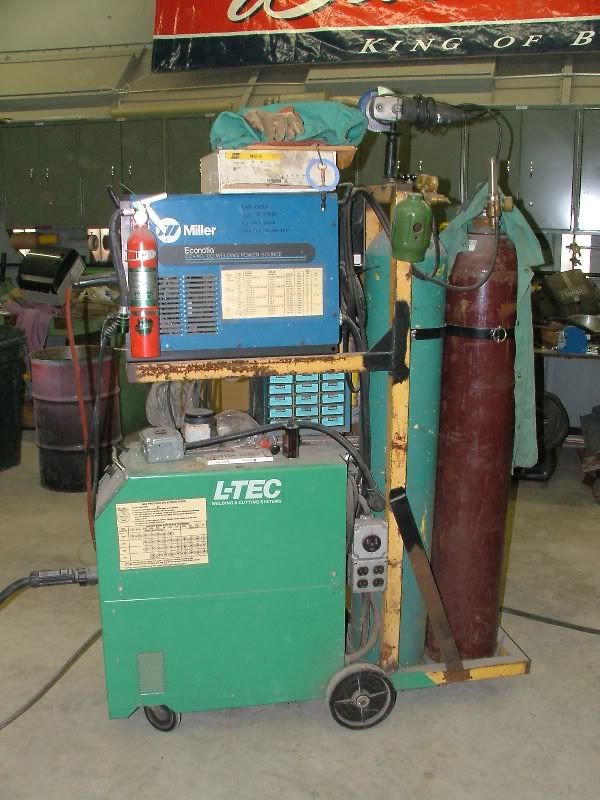
Matt, I have an L-Tec migmaster 250, predecessor to Esab before they bought them out. The chart you see on the sides of the welders is the "suggested" settings that came in the manual per metal thickness. I use this as a guide and tweak from there. Typically when I **** weld / dot weld as seen in above posts, it is set up for 16 ga metal and speed set just high enough to prevent blow outs when dot welding. That is how I get the full weld penetration.


Picture179.jpg


If you'd like to post some pictures of your welds you are having problems with (front and back both) on this thread, I think you'd get some good feedback on corrections to make, and it would be a good learning tool for other novice welders. ;)
 

stricht8

Well-known member
Joined
Apr 20, 2008
Messages
1,714
How is your MIG set up? I have a Lincoln 135 MIG with .030 wire (I think) and need to practice my **** welds for my '72 Cutlass project. My first attempt at a fender patch was terrible. This thread is giving me more confidence to get out there and practice.

Matt

Hi Matt. Here are some tips for welding in patch panels that I posted a while back on another forum. It might be of use to you.

First, make sure that the gauge of both pieces of metal is the same. 19-20 gauge seems about right for many older cars. Both ends need to be clean and free of rust, oil, paint. Actually both sides of what you are welding need to be clean. Some people go as far as to wipe it down with acetone. The pieces need to be positioned close to each other but not touching. About 1/32'' gap. If too close then the gap will shift and you might get some overlapping further down. This happens because the area that is getting welded shrinks, which causes other parts of the panel to move in response. If the gap is too big then you will blow holes in the metal. Once the panels are positioned and clamped in place, make small tack welds. Jump around so as not to get one area too hot. As you tack, the panel and gap may shift. Readjust as necessary to keep the gap the same. If there is any heat distortion then you might want to grind down the tack on both sides (if possible) and use the hammer and dolly at the weld. Use the hammer on dolly technique to stretch the weld. Do not hammer metal that appears to be distorted too far around the weld. This distorted metal will naturally correct itself once you stretch the weld area or area immediately around the weld (maybe 1/2 ''on either side) This area is called the HAZ or heat affected zone. Once the panel is tacked in place with tacks every 3/4'' apart or closer, you can weld between tacks. Don't weld more than 3/4'' to 1'' at a time and make sure you jump around and wait awhile for the panel to cool if too hot. If you don't do that you will get too much distortion and burn through. Also you should grind and stretch the weld as you go. Trying to correct the panel distortion once it's all welded up will be more difficult. Grind/ sand the weld down and you are done. Flap disks work nicely and won't cause too much gouging of the metal surrounding the weld. 3'' roloc disks on a small angled air die grinder or a 2 inch air grinder also works nicely. That's it. www.metalmeet.com is full of info about weld finishing.
 

rktolds

Well-known member
Joined
Jan 20, 2008
Messages
156
Location
Tuttle,OK
Thanks for the help. I'll try and dig out some scrap and practice this weekend. My problem is getting the gap right and my setting maybe off. I think the HF/Eastwood holders mentioned earlier are the ticket for me.


Matt
 

Lippyp

Well-known member
Joined
Jun 26, 2006
Messages
6,720
Location
Shropshire, UK
I used the panel clamps when I was repairing my '67 Chevy C10, great when you have access to both sides of the panel. For those that you don't then a good assortment of welding clamps of variuous sizes and shapes and some sheet metal screws are a good idea.

Heres some pics of the floor repairs and rocker replacement.

Befores:


new metal


Clamps


Bolted in place before welding


To avoid these ads, REGISTER NOW!
Top Bottom