
You are using an out of date browser. It may not display this or other websites correctly.
You should upgrade or use an alternative browser.
You should upgrade or use an alternative browser.
Welding in patch panels
- Thread starter jteck75
- Start date
MP&C
Well-known member
I would weld the crack you noticed first as you’re going to get some shrinkage out of that. Then, if heat is used I like to start with a heating tip on a dent puller. Again, a slower approach. If you want to use a torch, I would use the smallest tip you have on an O/A torch setup and heat up only about a dime sized circle at a time. Keep in mind, you don’t need to get things red hot in order to shrink. A golden tan (pre-blue) or blue is plenty of heat to yield shrinkage. Red hot and glowing does a good job of making mill scale and all the cleanup needed from that. So I’d shy away from too much heat.
MP&C
Well-known member
Follow the same methods in using the laid over ruler and profile templates to keep track of where the high spots are…
I would weld the crack you noticed first as you’re going to get some shrinkage out of that. Then, if heat is used I like to start with a heating tip on a dent puller. Again, a slower approach. If you want to use a torch, I would use the smallest tip you have on an O/A torch setup and heat up only about a dime sized circle at a time. Keep in mind, you don’t need to get things red hot in order to shrink. A golden tan (pre-blue) or blue is plenty of heat to yield shrinkage. Red hot and glowing does a good job of making mill scale and all the cleanup needed from that. So I’d shy away from too much heat.
Thanks Robert.Follow the same methods in using the laid over ruler and profile templates to keep track of where the high spots are…
I really hate giving up on the donut dolly BUT I need to move forward. (maybe as a perfectionist, that's why restoring this car is taking way to long)
I don't have a dent puller but do have the O/A torch with the small tip. And as per your instructions will keep it from getting red hot.
Do you simply heat it then quench the high spots?
Or do you hammer dolly it, then quench? I'm sure there are many methods.
I came across a video where he hits the hot spot with a hammer, then quickly off-dolly hammers in a circular motion around the hot spot, then quenches it.
He explains it pretty well at about the 2:00 minute mark. I really compare everything I see and read to what Robert teaches and this guy seems pretty good.
Last edited:
wiskydelta
New member
- Joined
- Jan 2, 2017
- Messages
- 3
If I have easy access to the backside of the repair panel should it be welded there to minimize grinding on the front?
MP&C
Well-known member
What welding process are you using, MIG? For best results you should planish the welds to stretch and overcome the shrinking that occurred as the weld cooled, then grind any weld proud down to flush (both front AND back side) so that the parent metal’s thickness is observed throughout. This will help to prevent ghost lines from appearing in the paint finish.
Last edited:
wiskydelta
New member
- Joined
- Jan 2, 2017
- Messages
- 3
I'm using MIG, removing cancer rust on hinge pockets, running boards and cab corners on a 59 GMC truck being restored for a daily driver, no car shows.
MP&C
Well-known member
Daily driver or otherwise, I’ve always suggested that people use those “hidden areas” to practice and hone your skills for when you need to make a repair that counts, one that’s in your face visible. Using a method that yields a nicer repair, regardless of location, it becomes second nature and soon you’re able to tackle anything with ease.
Here’s a video to show the hazards of not having single panel thickness throughout a repair. Note the horizontal ghost line towards the bottom of this tailgate, shows EXACTLY where the repair occurred. It would have been no more cost in materials and perhaps only slightly more labor to have done this repair correctly to help prevent this from occurring, a blemish to an otherwise flawless restoration.
At the end of the day, your vehicle, your choice of repair methods. With the high cost of paint materials, just some food for thought to help get the best job done that you can. Rework comes out of my pocket, so I strive for the same high quality in the repair regardless of location.
Here’s a video to show the hazards of not having single panel thickness throughout a repair. Note the horizontal ghost line towards the bottom of this tailgate, shows EXACTLY where the repair occurred. It would have been no more cost in materials and perhaps only slightly more labor to have done this repair correctly to help prevent this from occurring, a blemish to an otherwise flawless restoration.
At the end of the day, your vehicle, your choice of repair methods. With the high cost of paint materials, just some food for thought to help get the best job done that you can. Rework comes out of my pocket, so I strive for the same high quality in the repair regardless of location.
Last edited:
wiskydelta
New member
- Joined
- Jan 2, 2017
- Messages
- 3
"Using a method that yields a nicer repair, regardless of location, it becomes second nature and soon you’re able to tackle anything with ease."
Good point, I agree.
Thanks
Good point, I agree.
Thanks
logixjock
Well-known member
Wait, so that ghost line was from an overlap of the two panels? Or was it a **** weld with a mig vs a tig?Daily driver or otherwise, I’ve always suggested that people use those “hidden areas” to practice and hone your skills for when you need to make a repair that counts, one that’s in your face visible. Using a method that yields a nicer repair, regardless of location, it becomes second nature and soon you’re able to tackle anything with ease.
Here’s a video to show the hazards of not having single panel thickness throughout a repair. Note the horizontal ghost line towards the bottom of this tailgate, shows EXACTLY where the repair occurred. It would have been no more cost in materials and perhaps only slightly more labor to have done this repair correctly to help prevent this from occurring, a blemish to an otherwise flawless restoration.
At the end of the day, your vehicle, your choice of repair methods. With the high cost of paint materials, just some food for thought to help get the best job done that you can. Rework comes out of my pocket, so I strive for the same high quality in the repair regardless of location.
K13
Well-known member
That's what happens when you overlap two panels. Especially on a dark vehicle. The double layer of metal doesn't expand and contract at the same rate as the surrounding single layers and unless you have about 1/2" of filler on there to hide it the line at the top of the overlap maps through the paint. See it often when guys use adhesives and do overlap repairs that should have been welded in.Wait, so that ghost line was from an overlap of the two panels? Or was it a **** weld with a mig vs a tig?
MP&C
Well-known member
The ghost line was from an overlap that was fully welded. Thicker material (two layers) takes longer to expand in a heating cycle and longer to contract in a cooling cycle than the single layer next to it. Give it about a year or two of these differing cycles (think car show) and the ghost line magically appears and shows where the seam is located. Weld proud left untouched can be 4 (or more??) times the thickness of the parent metal, and given the extra bulk (4 layers thick equivalent), would react in a similar fashion as two layers vs one layer where it would pose more risk of a ghost line. I am assuming here, but a question to put the weld on the back side to limit grinding on outside leads me to interpret that zero grinding was going to occur on the backside. I've heard this exact question asked many times over the years, and the intent has always been to eliminate the need for grinding, and leave the weld on the back side, untouched. Perhaps this one is different, perhaps not. But not planishing a weld will also leave deformity where shrink of the weld has occurred in the form of an up and down (sinusoidal wave) just outside the weld. So additional challenges exist with that method...
Last edited:
APEowner
Well-known member
One of our members (ellisjuan) sent me an IM asking about my experience with weld through primer. I thought my answer might be of interest to all so I'm posting it here instead of in an IM.
His IM read, in part "I.... saw that you TIG'd through weld thru primer? Was wondering what you used, did you have any issues with weld spattering? I tried it with some stuff from o'reilly's, and it ended up ruining my gas lens. How long did you wait for it to dry?"
I use weld through primer in lapped joints that are plug or spot welded. In a restoration I only use lap joints where the factory did and I **** weld and metal finish if I'm creating a joint where there wasn't a factory one. I'd prefer to use a spot weld everywhere the factory did but I don't own a spot welder and the ones that I can sometimes borrow don't always reach to where the weld needs to be so I plug weld.
Here's an example of one such repair. As I was looking for pictures for this I realized that there's another application where I use a lap joint and weld through primer. That's when I add fish plates to a seam that doesn't exist from the factory.
This rear frame rail on a '68 Mustang convertible is but welded to the factory rail and has a fish plate on the inside. I sprayed both sides of the fish plate joint with 3M weld through primer, let it dry and then scraped the primer off the weld path before I MIG welded it in place. At some point before the it was closed up I coated the rest of the inside of the original rail with POR-15. I either MIGed or TIGed the outside **** weld, I don't know which. I probably MIGed just because it's easier in this very out of position weld.
I sprayed the top flanges where the trunk floor sits with the 3M weld through primer and painted the inside of the rail with Rust-Oleum and did a similar treatment to the bottom of the trunk floor.

I then put the trunk floor in place, scraped the primer off through the plug weld holes and plug welded it in place.
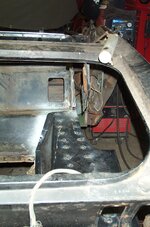
This was MIGed. I can tell by the welds, the fact that the welder is in the picture and because when I TIG plug welds I sand the e-coat back from the holes so I don't ruin the gas cup on the TIG welder.
So, to answer ellisjuan's question. If I'm TIGing a plug welded lap joint I scrape the primer out of the hole and sand the e-coat back from the edge of the hole before I weld. I use 3M weld through primer in a rattle can. It only takes 5-10 minutes to dry. I mostly MIG joints like this however. It's just faster and they're less sensitive to contamination. I'll typically only TIG them if the welder is already right there.
Here's the completed floor seam sealed and primed and ready to go to the body shop. I only did the structural rust repair on this project.
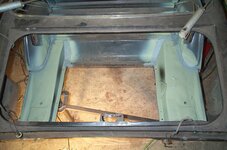
His IM read, in part "I.... saw that you TIG'd through weld thru primer? Was wondering what you used, did you have any issues with weld spattering? I tried it with some stuff from o'reilly's, and it ended up ruining my gas lens. How long did you wait for it to dry?"
I use weld through primer in lapped joints that are plug or spot welded. In a restoration I only use lap joints where the factory did and I **** weld and metal finish if I'm creating a joint where there wasn't a factory one. I'd prefer to use a spot weld everywhere the factory did but I don't own a spot welder and the ones that I can sometimes borrow don't always reach to where the weld needs to be so I plug weld.
Here's an example of one such repair. As I was looking for pictures for this I realized that there's another application where I use a lap joint and weld through primer. That's when I add fish plates to a seam that doesn't exist from the factory.
This rear frame rail on a '68 Mustang convertible is but welded to the factory rail and has a fish plate on the inside. I sprayed both sides of the fish plate joint with 3M weld through primer, let it dry and then scraped the primer off the weld path before I MIG welded it in place. At some point before the it was closed up I coated the rest of the inside of the original rail with POR-15. I either MIGed or TIGed the outside **** weld, I don't know which. I probably MIGed just because it's easier in this very out of position weld.
I sprayed the top flanges where the trunk floor sits with the 3M weld through primer and painted the inside of the rail with Rust-Oleum and did a similar treatment to the bottom of the trunk floor.
I then put the trunk floor in place, scraped the primer off through the plug weld holes and plug welded it in place.
This was MIGed. I can tell by the welds, the fact that the welder is in the picture and because when I TIG plug welds I sand the e-coat back from the holes so I don't ruin the gas cup on the TIG welder.
So, to answer ellisjuan's question. If I'm TIGing a plug welded lap joint I scrape the primer out of the hole and sand the e-coat back from the edge of the hole before I weld. I use 3M weld through primer in a rattle can. It only takes 5-10 minutes to dry. I mostly MIG joints like this however. It's just faster and they're less sensitive to contamination. I'll typically only TIG them if the welder is already right there.
Here's the completed floor seam sealed and primed and ready to go to the body shop. I only did the structural rust repair on this project.
MP&C
Well-known member
Plug weld cleaning bit that might help out:
APEowner
Well-known member
That's a great idea. Thanks. I'm sure it's quicker than the dental pick I've been using.Plug weld cleaning bit that might help out:
I've seen the drill bit trick before but never tried it. Looks like it works well. I used to just scratch the plug weld hole out with a scratch awl but recently purchased these small brushes which also make quick work of removing epoxy or weld thru primer:Plug weld cleaning bit that might help out:
And of course, no weld thru primer discussion would be complete without the debate of /copper vs. Zinc

Good comments except the cooling/cracking. When steel is under 0.2% carbon it is pretty much immune to hardening by quenching. That said, some MIG wires can be up around 0.25% so possible the HAZ could be a bit hard and quenchable so nothing to lose by just letting it cool slowly in still air. I would not lose any sleep doing it either way (but knowing my wire's metallurgy and behaviour).With sheet metal the gap is not necessary, I try to have little to no gap when doing patches. The clamps work great when you need them but that is pretty rare. The trick is to do tacks, alternate around the panel and give plenty of time to cool, let them air cool and NEVER accelerate the process with water, damp rag, compressed air. Accelerating the cooling process will create brittle and weak welds that can crack later in time. As shown above you should occasionally grind down your tacks to see where you are at. Make sure the metal is clean, no paint, oils, etc., this will keep the weld clean. One thing that I will point out is in the pictures above the metal has epoxy primer on it, this will be debated but this is generally a bad idea. If it is absolutely necessary then make sure it is ground off about 1" away from the weld area, not only will it dirty the weld but it ends up needing to be ground off later anyways. As for wire size, .023 is pretty much standard, .035 can be used on the thicker metal but not all cars have 18ga. sheet metal. Clecos are a bad idea, this is not their intended use and flanged patches are a huge no no, they will retain moisture in the flange and fail in short order due to corrosion.