To avoid these ads, REGISTER NOW!

Welding nut to broken stud

woody367

Well-known member
Joined
Sep 22, 2014
Messages
114
Location
Denver, NC
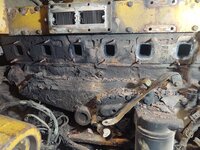
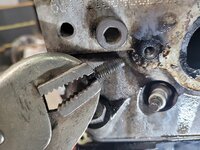
I am replacing the exhaust manifold on my truck that is leaking. Got the manifold off and there were 5 broken studs. Been spraying with KROIL for a week and got 1 remained. The others broke off inside about 2-3 threads Been watching videos of guys welding nts on to remove the. I am wondering why some weld the nut on and others put a flat washer on first and then the nut? All I have a a small MAP gas torch and was told I will not get it hot enough to break corrosion bond seeing it is a aluminum head. Any suggestions?
 
To avoid these ads, REGISTER NOW!

Zeke

Well-known member
Joined
Aug 13, 2009
Messages
17,176
Location
Long Beach CA, the sewer by the sea.
I am replacing the exhaust manifold on my truck that is leaking. Got the manifold off and there were 5 broken studs. Been spraying with KROIL for a week and got 1 remained. The others broke off inside about 2-3 threads Been watching videos of guys welding nts on to remove the. I am wondering why some weld the nut on and others put a flat washer on first and then the nut? All I have a a small MAP gas torch and was told I will not get it hot enough to break corrosion bond seeing it is a aluminum head. Any suggestions?
2-3 thread down in the hole? You need to take that head to a shop.

You can't weld with MAP gas. Who told you that?

The washer could be copper. If you don't know about that, let someone do this for you.
 

Buckgnarly

Well-known member
Joined
Oct 8, 2010
Messages
7,651
Location
VT
The washer makes it easier to get more meat for welding, I do it lots of times on broken brake bleeders. It builds up and out the area to weld, especially when it's recessed.
No way you are doing anything useful in this case with MAPP gas. Mig is best bet in this scenario.
 
Last edited:

Wrench97

Well-known member
Joined
Jun 23, 2018
Messages
12,060
Location
Southeastern Pa
Some guys use the washer method which enables them to weld a larger nut to the washer then they could to just the stud.
You need a mig welder to even attempt it on a pickup, I've successfully used a stick on larger engines and 7/16" or 1/2"-12mm size studs but never on a 8mm stud.
 
OP
W

woody367

Well-known member
Joined
Sep 22, 2014
Messages
114
Location
Denver, NC
I am using a gas mg set up. The mapp gas was going to use to heat the stud. I will need to build the stud up to weld the nut on. I just watched a guy hold jumper cables on the stud to heat it. That's just CRAZY. My torch set up is still in storage and can not set it up to heat the studs up. This is the pass side on my 04 F250 5.4 2V. Pulling the head will be my very last resort.
 

BillK

Well-known member
Joined
Aug 24, 2006
Messages
9,314
Location
Beautiful Southern Maryland
Woody, I have a method that works a lot of times if they arent stuck too bad. If the others came out just soaking them it might work. I drill a hole right in the center with either a 1/8" or 9h/32 drill, I can tell you for sure in the morning when I get to to the shop. Only has to go in about 1/4" or so. Then I use a 1/4" drive Torx socket as an easy out. I tap the socket ino the hole pretty good and the stud will either come out or it wont :) I dont remember which Torx I use but again I can tell you in the morning. I probably do at least 10 every week and it works about 80% of the time. You do have to have a very good Torx bit. Mine are all snap on. The Torx bit works way better than an ez out.
 
OP
W

woody367

Well-known member
Joined
Sep 22, 2014
Messages
114
Location
Denver, NC
The stud that came out I was lucky, I think the others are in ther good. I have straight and spiral ez-outs. I also bought the LISLE drill out template if need be. Do induction heaters work? This was repaired by FORD years ago and did the F it up. 4 bolts were left the OE steel, bet it was they could not get them out. The other 3 were upgraded to the new stainless stud. And 1 hole was reamed and a 3/8 bolt forced in. Nothing had anti-seize on them. I already fix the hole that was reamed with solid insert SS.
 

jonesg

Well-known member
Joined
Mar 15, 2010
Messages
1,698
Location
northern Maine/
I am using a gas mg set up. The mapp gas was going to use to heat the stud. I will need to build the stud up to weld the nut on. I just watched a guy hold jumper cables on the stud to heat it. That's just CRAZY. My torch set up is still in storage and can not set it up to heat the studs up. This is the pass side on my 04 F250 5.4 2V. Pulling the head will be my very last resort.
the welder alone will make the stud near white hot.

build it up slowly bit by bit, i had to keep dressing the weld with my dremel to ensure good weld.
it took 5 tries before I got it , the weld kept breaking off the stud so I drilled a hole in the stud and started the weld in the hole.
the reason for a washer is to allow a much bigger nut , thats good for leverage.

I've done it with stick but mig is probably the best way.
sometimes they come out easy once welded up but I've had them fight me all the way out and had to use a big ratchet.
heres one I removed from a volvo steering knuckle, it didn't go quietly.


iagsxr

Well-known member
Joined
Jan 10, 2010
Messages
1,499
Location
Vinton, Iowa
Your MIG wire's not going to stick to the aluminum head, you just don't want to wreck the exposed threads.

Clean the end of the bolt as best your can. Build the weld up as fast as you can to keep heat in it. Like leave your helmet down and as soon as your last zap changes color zap it again. If you don't know what I mean forget that and go slowly.

Once your weld's built up past the head your can weld a washer on it to have more surface area to weld a nut to if you want but where the weld attaches to the bolt will likely be the fail point.
 

ZRX61

Well-known member
Joined
Aug 15, 2006
Messages
28,716
Location
Solar Blight Valley, SoCal
For studs broken off below the surface, one trick is to make a copper sleeve from an old piece of pipe to line the hole down to the stud to prevent damaging the threads when you put the hurt on it with the welder. Not sure that would work on an 8mm hole though.
 
OP
W

woody367

Well-known member
Joined
Sep 22, 2014
Messages
114
Location
Denver, NC
My son has had great success using TIG with a short back-cap. He said you can put much more heat into the stud without the added filler deposit using MIG. He has young hands and eyes (20’s) and that is also a factor. I watched him remove several broken studs on a 5.4 Ford in very little time.
Your son want to come do it? Lol
 
To avoid these ads, REGISTER NOW!

dogdog

Well-known member
Joined
Nov 15, 2011
Messages
12,711
The washer is just there to prevent the nut from accidentally sticking to the work piece. or your welding splatter stuck onto the thread making it worse... if you have enough room to gas MIG. it is fine... the heat from the welding should heat it enough... did that to my VW before... except the space is tight and I have to use fluxcore on highest setting( D or E on the lincoln SP-135T with 0.30 flux core wire) ....

Tig is fine if you can fit the torch (I cant fit the torch under there). Have tried TS8000 torch, it works but the heat flares all over the place... scares me (you can try it with one of those Oatey soldering heat shield) . since engine still on the car. Have used one of those small oxy and map torches.... it have good precision, but flame was too week, spend about a whole bottle of oxygen before it heat the nut... so...
 

BillK

Well-known member
Joined
Aug 24, 2006
Messages
9,314
Location
Beautiful Southern Maryland
Woody,

The drill I use is 9/32 with a T20 Torx bit. If you have the straight e-z outs they should work the same.

The induction heater will only work on studs that are sticking out enough to get the coil around the stud.

To the guys that are commenting on the washer use when welding a nut on . . . . you use a steel washer. Weld the washer to the stud first which is a lot easier than welding down through the middle of a nut. Then you weld the nut to the washer. To be honest with you I think the heat is really what does the job with this method. When you weld the washer and nut on it expands the stud. Then you let it cool off and it will generally come out almost by hand.
I very rarely have to resort to welding.


Just about every manufacturer uses the 8MM exhaust and intake studs. Almost every single LS or Late Hemi head that I get has at least one broken off. Almost always an end one. Pretty sure it is because of the intakes expanding so much.

If you end up pulling the head off see if there is a shop near you with a metal disintegrator. That is by far the best way to get them out if you have more than one or two.
 

jonesg

Well-known member
Joined
Mar 15, 2010
Messages
1,698
Location
northern Maine/
the video I posted was done with a stick welder, threads broke below the surface , lots of spatter but it did not foul the threads.
I wouldn't go near it with ez outs unless it broke going in.
 

PWC Repair

Well-known member
Joined
Dec 27, 2012
Messages
3,172
Location
Arkansas
I have this happen regularly on the jet skis I work on........even a few threads deep. Clean it out with some propane heat and (non flammable) brake cleaner. I use my HF flux wire welder and stab it in and just start welding right to the stud. I just blob it up past the surface and knock off the flux. Then place a nut over the blob and weld inside the nut. Smack it a few times with a small ball pein hammer and unscrew it. Works for me 95% of the time. I've never had it booger up the threads of the aluminum.
 

alfadan

Well-known member
Joined
Mar 9, 2007
Messages
2,106
Location
Augusta, ks
Non flammable brake cleaner and welding heat can create phosgene gas. I know it evaporates away quickly, but any in crack or down in bolt holes can still vaporize. Not critiquing, but be careful.
 

csp

Well-known member
Joined
Mar 23, 2010
Messages
5,719
Location
Franktown, CO
The washer is just there to prevent the nut from accidentally sticking to the work piece.
It also allows you to more accurately weld to the broken bolt/stud and focus the heat on it as well as give more surface area to weld the nut to, which also means more heat.
 

Biginch

Member
Joined
Jul 13, 2015
Messages
5
i build up the broken bolt proud of the surface, then hold a nut NEXT to the blob and weld it to the blob. welding through the nut, the nut soaks up most of the heat, making it harder to get penetration on the blob/bolt. welding to the side of the nut, you can control where the heat goes and get a good weld nearly every time. just make sure there is room to turn the broken bolt out with the nut welded on this way.
 

dwk000

Member
Joined
Nov 20, 2017
Messages
17
This is a common issue with the RAM pickups, just weld a nut onto the bolt with a MIG and it backs out. I used an old nut with a collar on it just to get more area protected. Hit it with the MIG in the center a few times. The heat from the weld free's up the stud, there are a ton of you tube videos on this.
 

3rdgendslmech

Well-known member
Joined
Mar 12, 2017
Messages
499
Location
Maryland
I work for the Port of Baltimore as a mechanic where we stock pile de-icing salt. I've become somewhat of a pro at getting broken, rusted, bolts and nuts out.
The washer trick, definitely do that one. Even if you have to build up your stud and put a little ****** on it. Here's another tip, try to find self locking nuts, the ones that are tapered on one side of the nut. If you can't find any, put a little bevel on one side of the nut all the way around. It'll give you a little more meat to weld to.
A mapp gas torch is all I use most of the time. The best tool you can use here is PATIENCE. Once you get your washers and nut welded to the stud, don't hulk the **** out of it as soon as you put your wrench of vice grips to the nut! You wanna rock it back and forth, with some force, but not so much that you rip your weld off. Once you feel that first little crack, you've got it! Use PB blast, WD40 or any other kind of lube and keep working at it. Still....don't get ambitious and think because its moving you can run it right out. Take your time, heat it up a few times with the torch and let it cool a little. The heating and cooling will expand the stud and push against the corrosion, and when the stud cools and shrinks the corrosion doesn't because its not metal anymore.
These are from a 3116 Cat motor 2 years ago. I tried to cut off most of the heads of the bolts so I could have a little meat to grab to.
 

Attachments

  • 3116 broken exh stud.jpg
    3116 broken exh stud.jpg
    293.3 KB · Views: 63
  • 3116 studs removed.jpg
    3116 studs removed.jpg
    140 KB · Views: 62

ATC

Well-known member
Joined
May 12, 2012
Messages
8,268
Location
VA
Best of luck to you. I was lucky with mine...they all came out:


97F150_2.JPG
 

StormcrowAz

Well-known member
Joined
Nov 3, 2011
Messages
750
Location
Phoenix, AZ
I just went through this. LS motor, several bolts broke off just below the surface. Aluminum heads. Soaked in penetrating oil for a week or so and then just straight mig welded to the top of the stud. Built up a little bead and removed with vise grips.
53147176077_07f7560658_b.jpg

53147960029_a1d14d03b3_b.jpg
 

Jazz1

Well-known member
Joined
Jan 3, 2016
Messages
4,184
Location
Thunder Bay On.
Welding the nut on creates enough heat to break the stud free, IMO. Had to do some couple years ago fortunately only 8 bolts to remove front clip for easy access to heads.
 
To avoid these ads, REGISTER NOW!
Top Bottom