To avoid these ads, REGISTER NOW!

Welding Small Metal Dowels to Plate

Zewnten

Well-known member
Joined
Jun 11, 2017
Messages
1,841
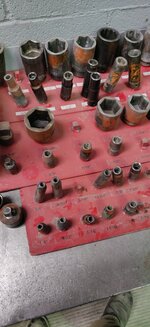
Not much of a fabricator but I need a heavier duty version of the Hanson socket trays for my custom socket sets.

I'm thinking of making them from 1/4" dowel welded to 1/8" plate. Whats the fastest but secure way to weld the dowels? I need to make a lot of them. Could I spot weld the dowels or would I need to mig each one? Appreciate your time and help.
 
To avoid these ads, REGISTER NOW!

Kev In

Well-known member
Joined
Nov 19, 2016
Messages
87
Location
Lethbridge, Alberta, Canada
Just an idea.
You could drill 1/4” holes into the plate, insert the 1/4” steel rod 75% into the hole and weld them from the back. Grind off any protruding weld if required. It would be a nice clean look from the top.

You could also drill the holes, then tap all the holes and thread in a rod into each hole. Think of a rod like a mig tip to thread in. No welding, but lots of tapping lol.
 

MushCreek

Well-known member
Joined
Jan 14, 2015
Messages
9,826
Location
Upstate South Carolina
It depends upon the equipment you have. I'd make the dowels on a lathe, drill and tap for a small screw, and drill and countersink the plate for a flat head screw.
 

Graham08

Well-known member
Joined
Dec 10, 2007
Messages
713
Location
Iron Station, NC
I'd drill, mig from the bottom, grind flat. Anything done up top is just going to leave weld bead you can't grind off and odds are you won't get the spacing perfect trying to hold them in spot and tacking without the hole.

Another vote for this. An added bonus is you'll have less weld trying to pull your dowels off square.
 

laser3kw

Well-known member
Joined
Nov 17, 2012
Messages
7,276
Location
northen IL
multiple welded pins most likely will make the plate curl, unless it is clamped throughout until cold.
 

mogandave

Well-known member
Joined
Nov 4, 2021
Messages
3,052
Location
Bangkok
If the OP has access to a decent spot-welder that would be what I would do, but not with dowel pins. I'd cut and chamfer bar, stainless is you have it.

Stainless spot-welds really nice. You could fixture the pins using a holes in a piece of wood.

1/4" stainless key-stock chamfered on one end spot-welded to burnished stainless would be the sh*t...
 

APEowner

Well-known member
Joined
Oct 2, 2009
Messages
4,166
Location
Sunny, New Mexico
How many is "a lot of them"? What's the material? If I were making thousands of them and they were steel I'd spot weld. If I were making a couple hundred I'd probably do a press fit of some kind.
 
To avoid these ads, REGISTER NOW!

Monza Harry

Well-known member
Joined
Dec 29, 2018
Messages
1,433
Location
Windsor ON
My vote is to drill and C'sink from the back for the screw that fits the "pull dowel" of choice, no welding, warping and easily kept in the desired spacing. You can use 1/4, 3/8, and 1/2" dowels for your different drive sizes (yes even 3/4, & 1" too) Harry
Edit to correct the D@mn Autocorrect
 
Last edited:

Monza Harry

Well-known member
Joined
Dec 29, 2018
Messages
1,433
Location
Windsor ON
Sorry, corrected above, sorry posting on my phone with the auto incorrect and my touch screen resistant fingers, when my lunch was just about done. [C'Sink = Countersink] Harry:oops:
 

speed bump

Well-known member
Joined
May 28, 2008
Messages
6,317
Location
Butte Montana
For our socket boards at work we just mig on the appropriate size square stock. I don't have any pictures handy but I'll take some on Monday.

Personally unless I had an ironworker or punch I wouldn't spend putting holes in the plate.
 

speed bump

Well-known member
Joined
May 28, 2008
Messages
6,317
Location
Butte Montana
Here's what we have at work. Just make sure your posts are welded on opposite sides of the sockets or they will be tippy. Not a perfect solution but it's quick and holds sockets.
 

Attachments

  • IMG_20211213_122255.jpg
    IMG_20211213_122255.jpg
    241.2 KB · Views: 73
  • IMG_20211213_122306.jpg
    IMG_20211213_122306.jpg
    249.5 KB · Views: 70

engineer2

Well-known member
Joined
Dec 13, 2009
Messages
11,824
Location
Chicago burbs
I once made some out of wood and dowels. Two observations:
It takes experimentation to get the spacing right.
You may need to re-arrange pins if you add more socket(s).

If I were making them out of steel, I would drill spring pin holes close together to give you spacing flexibility.
 

BD1

Well-known member
Joined
Mar 18, 2007
Messages
4,602
Location
north side
As mentioned, 1/4'' plate at the minimum, drill through, ream bottom, and plug weld . Clean, neat, and it wont warp.
 

shawhite

Well-known member
Joined
May 28, 2014
Messages
1,519
Why not just buy the westling machine trays they come in 2 row and 3 row 1/4, 3/8, and 1/2


JohnathanSchroeder

New member
Joined
Oct 22, 2022
Messages
1
Welding thin-walled structures is a real challenge for the novice welder. A gap in knowledge leaves annoying holes in the metal. Thin-walled structures are best welded with thin electrodes - 1.6-2 mm. For thin metal, you need to lower the welding current. Electrodes with a large diameter will not work here - they will quench the arc at a low current. And suppose you increase the current to the required value on the same electrode with a diameter of 3 mm. In that case, the thin-walled metalwork will immediately begin to burn. So it is better to use electrodes 1.6-2 mm in diameter. Good luck with your work.
 
Last edited:
To avoid these ads, REGISTER NOW!
Top Bottom