To avoid these ads, REGISTER NOW!

Welding Table Build

tufffordtruck

Member
Joined
Jul 21, 2008
Messages
14
Location
Charleston, WV
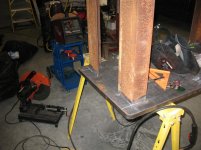
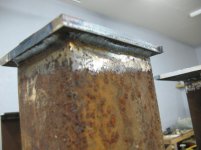
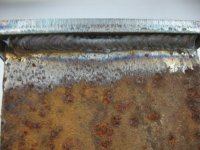
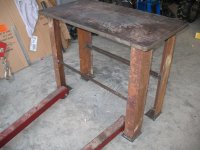
I started building a welding table for my garage. The top is approximately 23"x48" and 1" thick. The legs are made of 3"x5" angle that I had laying around. I have welded 3/8" thick pads on the bottom of the legs. The legs are tacked into place and I hope to finish the welding this evening. I am using a 110v Lincoln Pro Mig 140 with 0.035 HF solid wire.

I think I will mount a hitch reciever on the bottom to slide the grinder and vise into. Any opinions or suggestions before I flip this heavy thing over and set it into place.
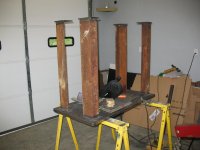
 

Attachments

  • IMG_2619.jpg
    IMG_2619.jpg
    139.4 KB · Views: 187
  • IMG_2620.jpg
    IMG_2620.jpg
    142.8 KB · Views: 187
  • IMG_2626.jpg
    IMG_2626.jpg
    132.4 KB · Views: 209
  • IMG_2627.jpg
    IMG_2627.jpg
    142.6 KB · Views: 218
  • IMG_2628.jpg
    IMG_2628.jpg
    135.3 KB · Views: 193
To avoid these ads, REGISTER NOW!

Jack Olsen

Super Moderator
Staff member
Joined
Mar 22, 2009
Messages
6,678
Location
Los Angeles
I still consider myself a novice welder -- so take the following opinions accordingly.

My immediate concern is how you're getting enough heat into metal that thick with a 110v welder so that you get the kind of penetration you need to save you from that heavy table top snapping loose from the legs under heavy use -- leaving you with some seriously broken foot and ankle bones.

Your welds look great. But that doesn't mean you're doing much more than floating a beautiful bead on the surface of that steel. Did you pre-heat it with a torch?

Again, I'm a beginner, so if I'm wrong about being concerned, my apologies. Hopefully some more-experienced welders will give their opinions.

But in your shoes, I think I'd put together a frame for the table top made of thicknesses your welder can handle -- then have the inch-thick plate sit on top of that -- maybe with some welds to hold it in position, but nothing where you need the weld to hold for the table to remain structurally sound.
 

bimmer1980

Well-known member
Joined
Feb 5, 2009
Messages
2,105
Location
York, PA
I agree with Jack. I've made a few welding tables and usually it is easier to build a complete frame and then bolt the top to the frame.

Another though, make the frame much larger than your current top. Then add a steel grate to the other half. THen you have a torching or grinding area. you could even add a pan with sand under it to catch the torch droppings. adding a draw thru fan would also help to catch the grinding dust.

With a tube frame, you could also incorporate a receiver hitch for grinders, vices, a stand for the chop saw, etc.

one last point, bit would be easier to weld up the frame by itself, as you can control the weld warpage. No way to correct for weld warpage after it is welded to the steel plate.

Plus, if you ever want to drill some holes in the plate, you might sometime want to remove it.

I would also drill a hole in the cap you used for the leg and put a leveling bolt in it.

I have also found that a wire cup brush in a grinder is helpful for removing the rust and scale before a weld. Makes the welds even better.

regardless, do what works for you and enjoy what you are doing!
 

larry_g

Well-known member
Joined
Apr 28, 2007
Messages
16,893
Location
oregon
Do yourself a favor and wail sideways on the foot pad of one of the legs with a heavy sledge or a chunk of timber. If you can't break it off then Jack can sleep better. If you do break it then you know what you have to do. I also agree with the need for adjustable feet.

lg
no neat sig line
 

ironheadtom

Well-known member
Joined
Dec 28, 2009
Messages
1,119
Location
Kentucky
I agree with these guys. That's one helluva piece of plate you've got there and you're welding it with a real small machine. If nothing else run some angle or box tube between all the legs to make them one unit, even if you do it after everything else. and then stand back when you flip that monster!
 

msnow

Well-known member
Joined
Nov 16, 2009
Messages
192
If it was me with that small welder I would be running multi-pass fillets on the inside and outsides of the angle. Run a real slow and hot root pass and then start stacking them up. You can also do tricks like turning down the wire speed at the beginning of the weld and make your travel time longer so that as you progress you have a good chance of getting the plate a lot hotter. A frame might be nice but if you are careful I think you have a good chance of attaching the legs to the top alright for your purposes. Might clamps some braces in when you flip it though to keep them from going out of plumb.
 

msnow

Well-known member
Joined
Nov 16, 2009
Messages
192
One more thought if you have any flux core wire now would be the time to use it. You can burn a lot hotter with that on those smaller machines. Make sure you clean your passes really well though before you start the next one or you will have impurities in the weld.
 
To avoid these ads, REGISTER NOW!

Professur

Well-known member
Joined
Apr 7, 2010
Messages
3,911
Location
Mo-Ray-Al, K-bec, Ka-Na-Da
I gotta agree with these guys. Beauty work, but you're way outta that machine's league. Personally I'd have used a stick welder for metal that heavy, nothing less. A lower bracing/shelf support is a must for lateral stability too.


Advice .... locking casters under those footpads. I saw a table one guy had from another site where he had a foot pedal that would push down the casters when he wanted to move it. Some form of cam action as I recall. That way when the casters were up, the weight was square on the footpads. I think that table was about 8' long tho, set up as bimmer mentioned. He'd recessed the grill a touch so that he could lay a maple butcher block over it for a non-marring surface.
 
OP
T

tufffordtruck

Member
Joined
Jul 21, 2008
Messages
14
Location
Charleston, WV
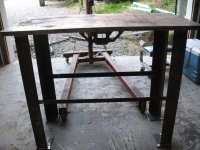
Thanks guys for all the advice. I realize it is big metal for my machine, but I dont have a bigger machine or a stick welder and am trying to make do with what I have. I took my time on the welds and I think I got them burned in pretty well, welded both sides of the channel, single passes. I welded a bumper hitch to the underside of the front for sliding my vise into.

We flipped it over with my engine hoist and a friend got on top of table and "danced" around for awhile so we could check for any signs of instability. Seems pretty solid, so I guess we'll see how it goes.
 

Attachments

  • IMG_2631.jpg
    IMG_2631.jpg
    145.5 KB · Views: 109
  • IMG_2635.jpg
    IMG_2635.jpg
    142.4 KB · Views: 111
OP
T

tufffordtruck

Member
Joined
Jul 21, 2008
Messages
14
Location
Charleston, WV
A neighbor of my dad has a machine/fab shop. He had it laying around as leftovers from another project. He cut it out and radiused the corners with his torch table. It was around $130 for the top.
 

csp

Well-known member
Joined
Mar 23, 2010
Messages
5,720
Location
Franktown, CO
Another reason for a frame is to keep the top from sagging. Yes, even 1" plate can sag, especially if you put something heavy on it for a long period of time.
 

ironheadtom

Well-known member
Joined
Dec 28, 2009
Messages
1,119
Location
Kentucky
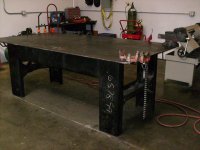
Looks really nice. That's a great welding table. Here's my old one. It would've been cool to have thicker plate but the half inch was all I could afford
 

Attachments

  • weldtable.jpg
    weldtable.jpg
    145.2 KB · Views: 178

Falcon67

Well-known member
Joined
Jun 11, 2009
Messages
18,371
Location
Merkel, TX
Having done a .125 wall roll bar install with a new Hobart 140 welder and .035 wire, I can pretty much GUARANTEE you do not have the necessary penetration to hold that top. To get even close you would have had to cut some grooves at the mating line, and heat the two pieces up a bunch and make multiple passes. I don't care how nice the welds look. Install bolts.

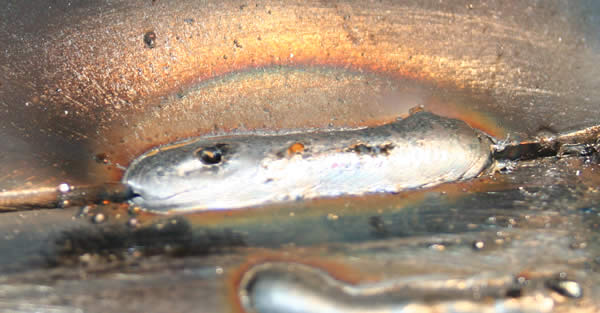
Here's a but weld with .035 wire and the heat turned up full with as much wire speed as it would handle. Material is CRS tube .125 thick. No bevel and no pre-heat.

The weld
weldtest2.jpg

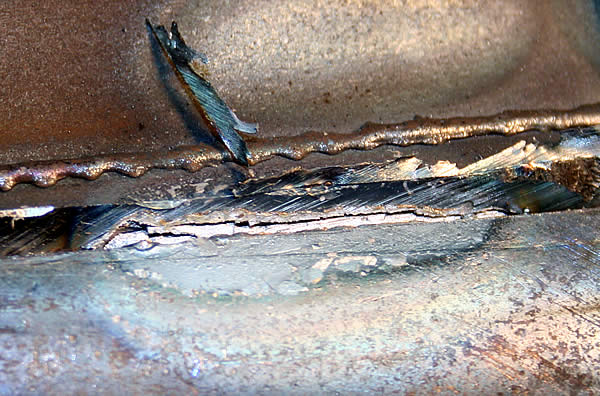
The penetration
weldtest3.jpg

Note how easily it tore open. With bevels and heat, penetration went way up. I did lots of tests, welding scraps and beating them apart with a sledge hammer until I got what I wanted. If I get to where I would be doing more chassis work like this, I will go to a 220V 180 model for more cushion in the process.
 
Last edited:

LoneGunman

Well-known member
Joined
Mar 27, 2007
Messages
2,081
Location
The Gunshine state
Looks really nice. That's a great welding table. Here's my old one. It would've been cool to have thicker plate but the half inch was all I could afford

Your OLD one? What's your new one look like? That old one is beyond awesome when compared to my little crappy welding table.
 
To avoid these ads, REGISTER NOW!
Top Bottom