To avoid these ads, REGISTER NOW!

well water pressure problem

kbeefy

Well-known member
Joined
Sep 14, 2013
Messages
3,450
Location
Harington, Eastern Washington
An 80 gallon water pressure tank in a residential home?!... That's one massive house!

You are again making assumptions on what is normal. My normal is a farm with animals, orchards and gardens.

Not that my house is normal, it's an old farm homestead.
Our Pressure tank is outside, underground in the well house. By rough estimations it's about 400 gallons.
It will run 10 sprinkler heads about 10 minutes before the pump kicks on.
 
To avoid these ads, REGISTER NOW!
OP
B

billconner

Well-known member
Joined
Jul 20, 2021
Messages
6,962
Location
Thousand Islands NYS
Is this a deep well with a submersible pump or shallow well that has a jet pump?

I would definitely check the operation of the pressure switch.
Some are wired to not run if the well is dry to prevent burning up the pump.
Once the water underground has recharged it will work again.
I think deep with submersible, but really am not positive. First house not on city water. Had water quality tested as part of inspection for purchase.

Pump will run even if dry. Discussed that with plumber. Talked about adding a device or panel that would prevent pump sucking air.
 

Bad Habit

Well-known member
Joined
Mar 19, 2014
Messages
1,991
Location
Chumstick WA
Somewhere in your closing documents there should be info on the well, depth, flow, etc, if not you can get from the county. Good info to keep on hand. Just had to deal with well problems last year.
 

Firebrick43

Well-known member
Joined
May 12, 2015
Messages
14,022
Location
West central Indiana
Have you taken the cap of the well casing and dropped a piece of steel with enough flotation (foam or wood) to make it float when it hits the water; on a string to sound the level? How does this compare to the drilled depth of the well and the depth that the pump is setting at? If you don't know those you can usually figure those out with a small steel weight on a string.

I have seen pump switches with a contact badly burned act similarly. One time with it comes together it runs fine but the next time one leg of the 240 doesn't make or only allows partial current and the pump runs erratically. To much of that and it will destroy the pump. I would shut the breaker off, pull the cover off the switch, and test for incoming voltage. Then you can look at the contacts conditions and even run water till the switch contacts drop and measure resistance across the contacts.
 

larry_g

Well-known member
Joined
Apr 28, 2007
Messages
16,875
Location
oregon
Well, totally mystified. Water ran fine. In maybe ainute or a little more pressure gauge hit 40 and then started to climb to 60. Again, not knowing much at all about this stuff, it seems to indicate the pump and switch is fine. Make sense?

Now going to look for leaks elsewhere - hose bibs first.
Shut off all the water spigots and watch the pressure gauge. Is it dropping? That will tell you if you have any appreciable leaks. But I suspect that you have no leaks that are causing problems.

Your running water for a minute before the pump starts to refill at 40 seems normal. Can you time the refill rate. If it is near a minute then your OK. If a few seconds then not good, but with a minute drawdown it says to me your not waterlogged. If you were the drawdown time would also be real short.

I assume that you were testing by running water in the laundry sink in the picture. Can you repeat the test with running a sink or bathtub in the house? If it doesn't repeat with another sink then that lends a lot of credence to the poster that brought up filters. My brother was having a flow problem in a new to him house and finally found the filters hidden behind a panel in the kitchen.

lg
no neat sig line
 

larry_g

Well-known member
Joined
Apr 28, 2007
Messages
16,875
Location
oregon
I have seen pump switches with a contact badly burned act similarly. One time with it comes together it runs fine but the next time one leg of the 240 doesn't make or only allows partial current and the pump runs erratically. To much of that and it will destroy the pump. I would shut the breaker off, pull the cover off the switch, and test for incoming voltage. Then you can look at the contacts conditions and even run water till the switch contacts drop and measure resistance across the contacts.
Agree with the above. I don't even mess with pressure switches anymore. If I suspect the switch and I can't remember when it was last replaced I replace it. I keep one on the shelf as well as the capacitors as they also seem to fail at the least opportune times. The pressure switch is less that $50 and also the caps. Part of life on the farm.

lg
 

PCustoms

Well-known member
Joined
Jul 23, 2011
Messages
22,608
Location
VT
Agree with the above. I don't even mess with pressure switches anymore. If I suspect the switch and I can't remember when it was last replaced I replace it. I keep one on the shelf as well as the capacitors as they also seem to fail at the least opportune times. The pressure switch is less that $50 and also the caps. Part of life on the farm.

lg

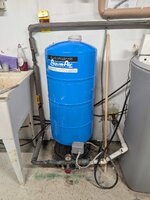
Can you point me to where the cap goes in the OP pic?

1761496381061.jpeg
 
To avoid these ads, REGISTER NOW!
OP
B

billconner

Well-known member
Joined
Jul 20, 2021
Messages
6,962
Location
Thousand Islands NYS
Shut off all the water spigots and watch the pressure gauge. Is it dropping? That will tell you if you have any appreciable leaks. But I suspect that you have no leaks that are causing problems.

Your running water for a minute before the pump starts to refill at 40 seems normal. Can you time the refill rate. If it is near a minute then your OK. If a few seconds then not good, but with a minute drawdown it says to me your not waterlogged. If you were the drawdown time would also be real short.

I assume that you were testing by running water in the laundry sink in the picture. Can you repeat the test with running a sink or bathtub in the house? If it doesn't repeat with another sink then that lends a lot of credence to the poster that brought up filters. My brother was having a flow problem in a new to him house and finally found the filters hidden behind a panel in the kitchen.

lg
no neat sig line
With all outlets closed pressure gauge doesn't drop watching it for a few minutes. Unless it was outside really no place for leaks we wouldn't be aware of very quickly. I checked outside and not even drips under hose bibs.

I'd say from when it hits 40 and kicks on you when it hits 60 and shuts off is a little over a minute.

Low well is a real possibility. I'll ask plumber - really the only one around here. When after lawn sprinkler drained well and I called, practically got a list of who else was having same problem.
 

djbmw

Well-known member
Joined
Jun 20, 2013
Messages
1,129
Location
Ottawa, Ontario, Canada
I think the capacitors are on the pump. This is mid-90s. There's no sign of anything between panel and wire to pump other than the pressure switch.
That armoure cable going from the pressure switch goes right into your breaker panel? If so then yes, the cap is on the pump. For older ones, the pressure switch will connect to a well control box with cap inside (example image attached.
 

Attachments

  • images.jpeg
    images.jpeg
    21.8 KB · Views: 13
OP
B

billconner

Well-known member
Joined
Jul 20, 2021
Messages
6,962
Location
Thousand Islands NYS
That armoure cable going from the pressure switch goes right into your breaker panel? If so then yes, the cap is on the pump. For older ones, the pressure switch will connect to a well control box with cap inside (example image attached.
Yes BX to panel. Nothing like that starter around.
 

JOE.G

Well-known member
Joined
Feb 4, 2013
Messages
765
Location
Eastern ( Catskills ) NY
Pressure tanks do not hold the amount of water that they are called ( At least bladder style tanks ) A 40 Gallon only holds about 12 Gals of water a 20 Gallon holds about 6 . The pump will kick on at 40 and turn off at 60 and the pressure tank holds the water that goes to your fixtures ( 20/40,30/50,40/60 are typical pump switch settings ) The larger the pressure tank the less the pump cycles on and off, you are better off with the biggest tank your system will support, if you go to big the pump can **** well dry if it can't recover fast enough to small of a tank and you cycle your pump more and cause undo wear.

I would drain tank so there is no water, check pressure and set it 2 pounds less than pump kick on pressure. Turn pump back on and with all fixtures closed see if pressure gauge drops. If all looks good I would start with replacing pressure switch ( First clean the tube below the gauge as it tends to collect sediment and give you false readings )
 
Last edited:

pcmeiners

Well-known member
Joined
Aug 13, 2009
Messages
7,890
Location
In the only town in Pennsylvania, Bloomsburg.
Pump will run even if dry. Discussed that with plumber. Talked about adding a device or panel that would prevent pump sucking air.

This or similar device....it works, mine is working right now as the water hit bottom last night. Once you run dry the device turns of power and requires a manual reset.


While you are at it, get a surge protector connected on the load side of your pressure switch, it is useless to connect on the power supply side when the pump is not running.
 
Last edited:

racecougar

Well-known member
Joined
Jan 26, 2021
Messages
5,028
Location
Missouri
Thats a crazy big pressure tank. My hot water tank for my 2400 sq ft home is 60 gallons...
I just looked up images of 80 gallon pressure tanks and they are massive! Like 5 feet tall. Crazy stuff.
Consider that tank sizing generalities could possibly be regional.

120 gallon tank w/bladder in pump house, well drilled just over 500', 1800' sq ft house, Missouri.
 

BombShelter

Well-known member
Joined
Nov 16, 2015
Messages
543
Location
State of Hockey
Mine does the same thing every couple years. I have to unscrew the pressure gauge and clean out the 1/4" pipe it's attached to. Dirt gets stuck up there making the pressure look fine (it's stuck with limited movement). The system thinks it has water pressure but there's no water in it.
 
To avoid these ads, REGISTER NOW!
Top Bottom