Steinmetz
Well-known member
i ******* hate those solder guns! soldering iron all the way!
I'm with you on that.


i ******* hate those solder guns! soldering iron all the way!
A 50 year old soldering gun cannot hold a candle to a proper soldering iron when it comes to working with delicate SMD components.
Sure I'll give you an example. I use to work on Instrument Landing Systems built in the 1950s. No removable PC boards existed until the 1970s or so. Most stuff could be soldered with a soldering iron but occasionally a gun was necessary just due to the amount of wattage necessary to heat up the wiring and solder to make a solid electrical connection.
Try changing out an electrolytic (tin can) capacitor with a soldering iron.
Steve
what is one worth to you? I have some. Nobody around here is smart enough to use electric. They still use a blow torch and copper head wand. Mostly for making stills.
 "I have a little list; they will never be missed..."
Sure I'll give you an example. I use to work on Instrument Landing Systems built in the 1950s. No removable PC boards existed until the 1970s or so. Most stuff could be soldered with a soldering iron but occasionally a gun was necessary just due to the amount of wattage necessary to heat up the wiring and solder to make a solid electrical connection.
Try changing out an electrolytic (tin can) capacitor with a soldering iron.
Steve
I've done it many times.
Anyone can do it, . . . but you'll likely have a COLD SOLDER JOINT. That separates the amateurs from the professionals. I'm talking about the beer can sized capacitors that locked the sides of the capacitor to the frame of equipment for a ground. It is difficult to do even with the largest wattage soldering guns.
You guys do not know all the equipment that exists out there so for you to say the gun has no place is showing ignorance of the facts. Or maybe Outlaw is right, you guys just want to flame people and argue.
Sheeesh!
Steve
Again, I've done it many times. And I know what a cold-soldered joint is. Moreover, you're in no position to question my expertise.
I wouldn't have expected that soldering guns would be such a contentious topic. But, given the threads about Sears, Snapon, etc, I shouldn't be surprised.
The level of animosity does surprise me though.


 .
.
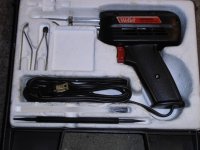
If you want to uncurl that cord, just find a piece of 2" PVC, wrap the cord tightly around it, laid flat as you want it to be.
Then just leave it in a hot sunny place for a few days.
It should uncurl and lay flat again.
We used to do that with microphone cords that people had wound
"around the elbow", which is about the worst thing you can possibly do for a wire that carries a low voltage signal.
I know audio engineers who can tell the sound difference between an XLR microphone cord that's been wound around someone's elbow repeatedly, and one that's been
wound up correctly. I've watched one of them do it blind folded, and get it every time.
Hard to believe, but it really does cause serious problems with the wrap of the internal wires, the individual strands in the conductirs, all of which changes the impedance,
and causes noticeable frequency shifts, believe it or not.
It's one of the classic ways to get yourself kicked off a road crew for a major tour - get caught elbow wrapping a microphone cord.
What is the correct way to wind a cord?
 Guess I need to start buying them - and maybe even learn to solder.