To avoid these ads, REGISTER NOW!

Wet kraft insulation on roof

cpelletier7

Member
Joined
Jun 14, 2017
Messages
6
I have a detached extended one car garage and last year I insulated the whole thing with kraft faced batt insulation. Once in a while when I go out to the garage the paper on the insulation is all wet but the insulation itself is dry. I've been told it's from my floor but I've never seen wet spots on my concrete. Would sealing the concrete solve this problem and if so the floor is old and all pitted what would I be able to use product wise in order to seal it?
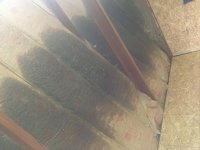
 

Attachments

  • IMG_3417.jpg
    IMG_3417.jpg
    138.7 KB · Views: 54
To avoid these ads, REGISTER NOW!
OP
C

cpelletier7

Member
Joined
Jun 14, 2017
Messages
6
Is the insulation directly on the roof? As in, no air gap?

No it's r13 insulation on 2x6 rafters so there's a couple inches in between for air flow. I have holes in the soffets but I don't have a ridge vent yet. I would think if it was from not having a ridge vent though the insulation would also be wet not just the paper.
 

mm08822

Well-known member
Joined
Jan 13, 2012
Messages
6,034
Location
NJ
I used to work for the Pink Panther Insulation company at one of their building insulation mfg plants.
The kraft paper is adhered to the wool with asphalt. It is actually the asphalt that is the vapor barrier and the kraft paper is just a place to apply a thin uniform coat of asphalt, also provides some air flow reduction and finally provides stapling flanges to the assembly to attach it to the joists/rafters.

Condensation occurs when moist warm air hits a cold surface.
Reducing the moisture entering the space is one method - sealing your floor can help. Eliminate any drafts.
Getting soffit and ridge vents fully functioning helps moderate the delta T.
Providing air circulation in the "living space" is another.
Finally reducing the delta "T" amounts at each surface interface lowers the potential amount of condensation at each interface.
Have you also considered sheetrocking the ceiling (after the above items confirmed)?
 

yeldogt

Well-known member
Joined
Jan 2, 2012
Messages
18,184
The humidity in the garage is too high ... did you VB the slab? Opening the doors on a humid day?

Warm air rises -- brings any moisture with it..
 
OP
C

cpelletier7

Member
Joined
Jun 14, 2017
Messages
6
I have considered sheetrocking but I really don't think it's worth that amount of time/money. So a couple things I hear that could be it is no I don't have a VB on the slab and the slab is from 48 so it's cracked pretty bad in the back and also pitted all over. Second the windows are like old garbage school bus style windows that aren't sealed or even stay shut for that matter. I could seal the floor and replace the windows and possibly put osb up on top of the insulation like I did with the walls but I'm guessing I have to throw out all of my insulation now and clean up the rafters due to the mold already growing.
 
To avoid these ads, REGISTER NOW!

mm08822

Well-known member
Joined
Jan 13, 2012
Messages
6,034
Location
NJ
I have considered sheetrocking but I really don't think it's worth that amount of time/money. So a couple things I hear that could be it is no I don't have a VB on the slab and the slab is from 48 so it's cracked pretty bad in the back and also pitted all over. Second the windows are like old garbage school bus style windows that aren't sealed or even stay shut for that matter. I could seal the floor and replace the windows and possibly put osb up on top of the insulation like I did with the walls but I'm guessing I have to throw out all of my insulation now and clean up the rafters due to the mold already growing.

If the floor has major cracks in it letting lots of moisture through and the windows are like screen doors, then you have to get both of those items corrected first. Sounds like you need new concrete and windows.
If you know there is mold growing on the rafters/sheathing, then yes you must get rid of all that first before new insulation and wall covering. Otherwise it will come back to haunt you.
And proper eave/ridge venting is needed.

The symptoms are not to blame.
 

yeldogt

Well-known member
Joined
Jan 2, 2012
Messages
18,184
Put a plastic square down on the floor -- tape around and see if moisture is under the slab. Concrete can hold a lot of moisture.

When you take an old garage and start to add insulation and VB's the structure can not dry on a dry day as it once did -- you start to trap moisture.

It's the same with a very tight building -- I like to spray foam. Spray foam buildings need to be ventilated -- with little air change ... moisture is not removed.
 

Marctrees

Well-known member
Joined
Mar 5, 2015
Messages
6,265
Location
TX/LA border - Toledo Bend
OMG... SO many armchair "solutions" w/o NOT knowing the climate situation.

cpellet - Maybe you could help me with something.....

PLEASE Folks list where you live, meaning your climatic conditions, when you post something that totally relates to that.

If you are asking about a vise, then I don't care where you are.

Marc
 
Last edited:

Marctrees

Well-known member
Joined
Mar 5, 2015
Messages
6,265
Location
TX/LA border - Toledo Bend
The damn paper is wet because as MM said..it is a laminate of "tar" so to speak working as a medium perm vapor barrier.

So, obviously, at least w the info we have so far....... your humidity is coming from the inside, and for some reason condensing on the inside barrier side of the barrier.

That's why the glass itself is basically dry.


We need to know WHERE you are, and if you are cooling or heating or nothing or what??

Marc
 
Last edited:

Marctrees

Well-known member
Joined
Mar 5, 2015
Messages
6,265
Location
TX/LA border - Toledo Bend
Sheetrocking or anything similar will not solve your problem

Doing that, WILL make a breeding house for mold.

AND, if the glass is not notably moldy, why would you replace it??

Don't be mold phobic, be mold logical.

We live in Mold everyday.

When you fix the problem and remove the moisture feeding the mold, it drops dead.

Just like fire needs fuel, ignition, and oxygen... Mold needs moisture. food, and sufficient warm temps.

Remove any one of those from either case, it drops dead... the mold, and the Fire.

And as long as it's not like in an active air duct or something, it's just like bad bird **** sealed up in the attic..... NO bigee.


This totally sounds like one of those "throw money at it" things w no logical investigation.

Some cracks in the floor will not make any diff compared to moisture infiltration through the slab otherwise, IF that is a problem anyway in this case.

Marc
 
Last edited:

Marctrees

Well-known member
Joined
Mar 5, 2015
Messages
6,265
Location
TX/LA border - Toledo Bend
Liquid pass quickly through fiber glass as does air so it drys out fast if it has airflow above it.

So right after a good rain, poke your finger in there and see if the glass is wet, or only always just the paper on the INSIDE side of the laminations.

WHERE are you located??

Is this problem over the entire ceiling relatively evenly??

I mean as in the photo .. whole ceiling looks like that?

Do you have extremely high water table?

Is this wetness 365??

Only certain times of year?

Only after rain??

Are you AC'ing or heating when this moisture shows?

You have absolutely No "Work to do" till you figure out the source of the moisture conclusively.

Marc
 
Last edited:
To avoid these ads, REGISTER NOW!
Top Bottom