To avoid these ads, REGISTER NOW!

What coating for spalling concrete?

1/4atatime

Well-known member
Joined
Jun 9, 2024
Messages
164
Location
VA
How and with what should I coat my concrete in? I have some spots where the concrete spalled due to it sitting in bad winter weather while waiting for the garage to be built and not covering it because vehicles were parking on it. My garage is going to be put up in about 2 weeks and I am trying to prep so I can coat the floor before moving all my stuff into the garage. My plan is to grind down the concrete and then coat in armorclad epoxy with a 2 part top coat and primer. But I've read some post that for damaged floors a grind and simple top coating like coval or maybe ghost shield will hold up better. I'm not looking for show room quality (although a nice bonus) but primarily focused on a high strength coating that last. Picture of one of the spots for reference
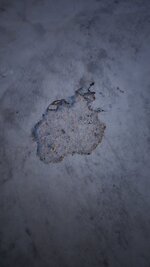
20250302_183642.jpg
 
Last edited:
To avoid these ads, REGISTER NOW!

ConCretin

Well-known member
Joined
Jan 20, 2011
Messages
3,378
Location
Central Maine
That looks like it might be de-lamination, which is caused by poor finishing techniques at placement and results in tiny voids between the finished surface layer and the underlying concrete. The smallest impact will break the surface layer and start it coming up. If I'm correct, you'll want to identify all of the delaminated areas and address them before investing time and money into a coating.

I'd start by tapping the concrete with a hammer around the 'spalled' areas. If the concrete surface continues to come off, it's a pretty good indication of de-lamination. Next you'll want to drag a steel chain across the floor and listen for a distinct change in the sound it makes. It's very noticeable when you pass over a de-laminated area. You'll need to remove the de-coupled surface wherever you find it and repair the surface.

I hope I'm wrong but better to find out now than when your new epoxy floor comes up.
 
OP
1

1/4atatime

Well-known member
Joined
Jun 9, 2024
Messages
164
Location
VA
That looks like it might be de-lamination, which is caused by poor finishing techniques at placement and results in tiny voids between the finished surface layer and the underlying concrete. The smallest impact will break the surface layer and start it coming up. If I'm correct, you'll want to identify all of the delaminated areas and address them before investing time and money into a coating.

I'd start by tapping the concrete with a hammer around the 'spalled' areas. If the concrete surface continues to come off, it's a pretty good indication of de-lamination. Next you'll want to drag a steel chain across the floor and listen for a distinct change in the sound it makes. It's very noticeable when you pass over a de-laminated area.

I hope I'm wrong but better to find out now than when your new epoxy floor comes up.
Thank you for the help I will check that. What would I need to do to fix it? Grind it off then coat?
 

mike93lx

ALLIANCE MEMBER
Joined
Dec 9, 2013
Messages
37,529
Location
Richmond, VA
Yeah, weather doesn't cause that and a coating wouldn't have helped. Unfortunately, I bet you are going to be in for a lot of grinding.

If you have a chance of a warranty, I'd bring back the guy that placed and finished the slab
 
OP
1

1/4atatime

Well-known member
Joined
Jun 9, 2024
Messages
164
Location
VA
Yeah, weather doesn't cause that and a coating wouldn't have helped. Unfortunately, I bet you are going to be in for a lot of grinding.

If you have a chance of a warranty, I'd bring back the guy that placed and finished the slab
Yikes ok guess I'll be grinding the thing down I'll see if I can get the guy back out to take a look if something else can be done. Would I be better off after I grind it down just doing something like ghost shield so I'm not risking it coming up after coating it or will it be ok to put a coating down?
 

PWC Repair

Well-known member
Joined
Dec 27, 2012
Messages
3,179
Location
Arkansas
I've seen similar as well. They worked the concrete to quickly and brought too much water up top.
 
OP
1

1/4atatime

Well-known member
Joined
Jun 9, 2024
Messages
164
Location
VA
I think luckily non of it is super deep probably barely an 1/8 an inch so hopefully I can just grind it all down and coat it and be good to go. The guy putting the concrete down waited a long time to finish it because we had a cold front come in that night (unlucky for me I guess) but I guess he didn't wait long enough for all the water to go away. It not terrible I haven't tapped it with a hammer or chain but so far I'm only seeing 4 or 5 spots like that the biggest being about 4 or 5 in wide and a foot long. The others are about the size of a silver dollar or so.
 

ConCretin

Well-known member
Joined
Jan 20, 2011
Messages
3,378
Location
Central Maine
I think luckily non of it is super deep probably barely an 1/8 an inch so hopefully I can just grind it all down and coat it and be good to go. The guy putting the concrete down waited a long time to finish it because we had a cold front come in that night (unlucky for me I guess) but I guess he didn't wait long enough for all the water to go away. It not terrible I haven't tapped it with a hammer or chain but so far I'm only seeing 4 or 5 spots like that the biggest being about 4 or 5 in wide and a foot long. The others are about the size of a silver dollar or so.
Hopefully it's not too widespread. De-lamination tends to be somewhat localized. It's generally caused by air and bleed water pooling under a surface that was sealed too quickly creating an actual void. The layer that comes up tends to be be fairly thin, maybe an 1/8" or slightly more.

You can grind it but I've generally found it's better to use an impact tool such as a bushing bit on a hammer drill or an air scrabbler, which makes easier to find the edges of the de-lamination and leaves a better surface for repairs. It doesn't take a lot of force to dislodge the bad surface and once you hit solid concrete you're done.

There are any number of products you can use. We've had good luck with Ardex products and Silpro TDQ. Make sure the substrate is saturated but with no standing water before applying a repair mortar.
 
OP
1

1/4atatime

Well-known member
Joined
Jun 9, 2024
Messages
164
Location
VA
Hopefully it's not too widespread. De-lamination tends to be somewhat localized. It's generally caused by air and bleed water pooling under a surface that was sealed too quickly creating an actual void. The layer that comes up tends to be be fairly thin, maybe an 1/8" or slightly more.

You can grind it but I've generally found it's better to use an impact tool such as a bushing bit on a hammer drill or an air scrabbler, which makes easier to find the edges of the de-lamination and leaves a better surface for repairs. It doesn't take a lot of force to dislodge the bad surface and once you hit solid concrete you're done.

There are any number of products you can use. We've had good luck with Ardex products and Silpro TDQ. Make sure the substrate is saturated but with no standing water before applying a repair mortar.
Thanks for all your help. I need to grind the rest of my concrete for the floor coating as well so should I grind and chip first then repare or chip and repair then grind? Which ardex product should I use?
 
Last edited:

mike93lx

ALLIANCE MEMBER
Joined
Dec 9, 2013
Messages
37,529
Location
Richmond, VA
I feel like I would chip out the bad material, patch and then grind, unless you find that a significant portion of the surface is compromised. But I'm no expert
 
To avoid these ads, REGISTER NOW!

FJ4FUN

Well-known member
Joined
Jul 28, 2014
Messages
624
Location
NorCal
If it were my floor.....
I'd locate/isolate any suspect concrete just as ConCretin suggested. If it appears to be isolated to a few areas tapping the area with a ball peen hammer will typically reveal any compromised concrete. Chip it all out then fill with our TrowelEase 1162PK, grind the floor and apply one of our fantastic 100% solids epoxy systems.
If it were my floor.... ;)
 
OP
1

1/4atatime

Well-known member
Joined
Jun 9, 2024
Messages
164
Location
VA
If it were my floor.....
I'd locate/isolate any suspect concrete just as ConCretin suggested. If it appears to be isolated to a few areas tapping the area with a ball peen hammer will typically reveal any compromised concrete. Chip it all out then fill with our TrowelEase 1162PK, grind the floor and apply one of our fantastic 100% solids epoxy systems.
If it were my floor.... ;)
Thank you! Once the garage is up I'll be grabbing some of your filler and a hammer and going to town. What's the min temp that I should do this 50F?
 

FJ4FUN

Well-known member
Joined
Jul 28, 2014
Messages
624
Location
NorCal
Thank you! Once the garage is up I'll be grabbing some of your filler and a hammer and going to town. What's the min temp that I should do this 50F?
Slab temp of 50F is the minimum but I'd suggest waiting until it warms up a bit more than that.
 

ConCretin

Well-known member
Joined
Jan 20, 2011
Messages
3,378
Location
Central Maine
Thanks for all your help. I need to grind the rest of my concrete for the floor coating as well so should I grind and chip first then repare or chip and repair then grind? Which ardex product should I use?
I think I'd try to locate all the delamination, chip it out and repair it before I ground the floor. That would allow you to smooth and blend the repairs while grinding.

If your coating system includes a repair product as suggested by FJ4UN, that's probably the best route to go.
 
OP
1

1/4atatime

Well-known member
Joined
Jun 9, 2024
Messages
164
Location
VA
I think I'd try to locate all the delamination, chip it out and repair it before I ground the floor. That would allow you to smooth and blend the repairs while grinding.

If your coating system includes a repair product as suggested by FJ4UN, that's probably the best route to go.
Sounds like a good order of process. I appreciate everyones help.
 
OP
1

1/4atatime

Well-known member
Joined
Jun 9, 2024
Messages
164
Location
VA
If it were my floor.....
I'd locate/isolate any suspect concrete just as ConCretin suggested. If it appears to be isolated to a few areas tapping the area with a ball peen hammer will typically reveal any compromised concrete. Chip it all out then fill with our TrowelEase 1162PK, grind the floor and apply one of our fantastic 100% solids epoxy systems.
If it were my floor.... ;)
Just ordered some of your TrowelEase to fix the floor. Any tips for applying? I've gone through and removed almost all the spots before the building was put up so I could easily clean the slab off and spray it down. I got 99% of it I think. I'm sure there are a few other tiny spots I couldn't find but plenty good enough. Also I'm still going back and forth on coatings but would I be able to spray something like ghost shield on the floor? Or does the TrowelEase need an actual coating put on top?
 
Last edited:
OP
1

1/4atatime

Well-known member
Joined
Jun 9, 2024
Messages
164
Location
VA
If it were my floor.....
I'd locate/isolate any suspect concrete just as ConCretin suggested. If it appears to be isolated to a few areas tapping the area with a ball peen hammer will typically reveal any compromised concrete. Chip it all out then fill with our TrowelEase 1162PK, grind the floor and apply one of our fantastic 100% solids epoxy systems.
If it were my floor.... ;)
Once I apply the trowelease how long does it need to cure before grinding on it with a floor grinder?
 

FJ4FUN

Well-known member
Joined
Jul 28, 2014
Messages
624
Location
NorCal
Just ordered some of your TrowelEase to fix the floor. Any tips for applying? I've gone through and removed almost all the spots before the building was put up so I could easily clean the slab off and spray it down. I got 99% of it I think. I'm sure there are a few other tiny spots I couldn't find but plenty good enough. Also I'm still going back and forth on coatings but would I be able to spray something like ghost shield on the floor? Or does the TrowelEase need an actual coating put on top?
The TrowelEase is a 3 component product Part A Resin, Part B Hardener, Part C aggregate. Once you've identified the areas to be filled/repaired, prepped and cleaned them and are ready to apply the TrowelEase, mix up a small batch comprised of just the Parts A&B and "prime" the areas to be patched. Let this cure a couple of hours (it does not need to be fully cured, it is actually better if it's not) then go ahead and mix the full 3 component batch to fill. Mix Parts A&B then add aggregate until you get a workable consistency. For spalled concrete I like it fairly loose like pancake batter so that you can pour it and not have to trowel it into the affected area. Slightly overfill so that it will be leveled off when grinding. For really shallow spots you may want to take an angle grinder and roughly grind a relief following the perimeter outline of the spot. This is called keying it in. The grinding creates more surface area to improve the filler anchoring. For more details on keying in check out Concrete Repair using TrowelEase. Note that this guide was based on a heavily used and abused worst case application.

I can't speak to compatibility with other manufacturer's products. TrowelEase is intended for use in 2K epoxy applications. It can be used as a stand alone product or coated with epoxy coatings.
 
OP
1

1/4atatime

Well-known member
Joined
Jun 9, 2024
Messages
164
Location
VA
The TrowelEase is a 3 component product Part A Resin, Part B Hardener, Part C aggregate. Once you've identified the areas to be filled/repaired, prepped and cleaned them and are ready to apply the TrowelEase, mix up a small batch comprised of just the Parts A&B and "prime" the areas to be patched. Let this cure a couple of hours (it does not need to be fully cured, it is actually better if it's not) then go ahead and mix the full 3 component batch to fill. Mix Parts A&B then add aggregate until you get a workable consistency. For spalled concrete I like it fairly loose like pancake batter so that you can pour it and not have to trowel it into the affected area. Slightly overfill so that it will be leveled off when grinding. For really shallow spots you may want to take an angle grinder and roughly grind a relief following the perimeter outline of the spot. This is called keying it in. The grinding creates more surface area to improve the filler anchoring. For more details on keying in check out Concrete Repair using TrowelEase. Note that this guide was based on a heavily used and abused worst case application.

I can't speak to compatibility with other manufacturer's products. TrowelEase is intended for use in 2K epoxy applications. It can be used as a stand alone product or coated with epoxy coatings.
Thank you I appreciate the detailed info
 
OP
1

1/4atatime

Well-known member
Joined
Jun 9, 2024
Messages
164
Location
VA
Thank you everyone for your help in this Thread I was able to get some TrowelEase applied in the spots and I'll go back and grind everything down and coat it with hellfire coating.

Here is an overview of the full process I did.

 
To avoid these ads, REGISTER NOW!
Top Bottom