To avoid these ads, REGISTER NOW!

What do I do now? New poster

supergnat

Member
Joined
Aug 24, 2011
Messages
11
Location
Palmyra, NJ
Hello all,
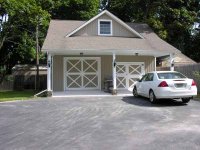
I have been what you might call lurking since I joined the forum two years ago. I finally decided to replace the original floor in my carriage house (garage). My contractor removed the old concrete and poured a new floor with 4000 PSI concrete. I wanted a smooth finish which he said was called a smooth trowel finish. The floor looked good when they left so I paid them in full. Once dry I saw lots of trowel swirl marks over most areas of the floor. When I complained he came back and said that is how a trowel finish looked and refused to fix anything. In desperation I used my 3 inch wide belt sander and sanded the ridges (1/8 inch) to get a relatively smooth surface. Now how do I get the fine powder residue off the floor surface? I vacuumed up as much as I could with my shop vac. I did wear a dust mask suitable for lead abatement. The floor is now a week old. When can I seal and coat the floor? What would you recommend I use? A photo of the building is below.
Thanks,
Supergnat
 

Attachments

  • .jpg
    .jpg
    71.5 KB · Views: 55
To avoid these ads, REGISTER NOW!

dandan111

Well-known member
Joined
May 2, 2012
Messages
1,623
Location
Indiana
You came to the right place. If you can get a picture of the floor in a few spots these guys will have ideas!
 

rsanter

Well-known member
Joined
Dec 22, 2007
Messages
18,503
Location
visalia ca
Use compressed air or a pressure washer to get all the dust and gunk out

Read the mfg spec, I think most want the concrete to be 30 or 60 days old before epoxy

Bob
 

Falcon67

Well-known member
Joined
Jun 11, 2009
Messages
18,371
Location
Merkel, TX
Pressure wash it and squeege, then let it cure for 30 days before you put anything on it coating wise. Your contractor did what he said, but you didn't really want any kind of "trowel" finish. You wanted a polished finish. You really have to convince them to not do that as many only think about leaving a tooth on the surface. My first shop was smooth - I had to convince them I really did want a power trowel polish finish because they didn't want to leave it like that. But they did, and it was like an ice rink when wet.

"Where a smooth, hard, dense surface is desired, floating should be followed by steel troweling. Troweling should not be done on a surface that has not been floated; troweling after only bullfloating is not an adequate finish procedure."
 
Last edited:
OP
S

supergnat

Member
Joined
Aug 24, 2011
Messages
11
Location
Palmyra, NJ
Thanks for the responses. I know nothing about concrete work. I figured a trowel finish would be smooth like my plaster walls. He never mentioned a polished finish to me.The floor is pretty smooth now as a result of my sanding with 50 grit belts. I will power wash it and use a big squeege. I think they just did a poor job of troweling. I tried to take some photos but nothing really useful shows-up. SHould I use any kind of cleaner or just use plain water? The one problem I will have is that the old carriage door rolls on a steel half moon track in the floor so pushing water out will be difficult. What about using a wet/dry vac with a squeege head to ****-up the dust filled water?
Thanks again for your help and advice.
Supergnat
 

dgeesaman

Member
Joined
Sep 28, 2008
Messages
21
It seems that you can go from rough to smooth but not easily the other way. Plus for liability reasons, if you slip on a wet polished floor they are out of business. Either reason could be why they would give the roughest surface they can.
 

spclk

Well-known member
Joined
Nov 14, 2011
Messages
145
It seems that you can go from rough to smooth but not easily the other way. Plus for liability reasons, if you slip on a wet polished floor they are out of business. Either reason could be why they would give the roughest surface they can.

Considering a bunch of us apply epoxy to our floors, a liability over a smooth concrete surface just seems silly. I'm not disagreeing about the possibility of a lawsuit, just saying that our epoxy coated floors are going to be SLIPPERY when wet.
 
To avoid these ads, REGISTER NOW!

Amanda

Member
Joined
Jul 22, 2013
Messages
7
Location
Troy, MI
A cleaner would help get all the dust off the floor better than just using water.

Wait at least 30 days to apply a coating.
 

rugerlady

Well-known member
Joined
Aug 15, 2008
Messages
1,378
Location
Michigan
Any Coating should be applied after at leasat a 30 day cure. let me know if I can answer any questions.
 
OP
S

supergnat

Member
Joined
Aug 24, 2011
Messages
11
Location
Palmyra, NJ
Hi All,
My new floor is now over 30 days old. I decided I could not stand all the trowel marks so I used my 3 in belt sander to sand the entire floor with 50 grit belts. I obviously used quite a few belts. Today I thoroughly vacuumed the floor with my shop vac. I used a wide stiff brush attachment and scrubbed the surface while vacuuming. I can now tough the floor surface and not end-up with a whit film on my hand so I think it is clean enough.

I have been reading about preparation and I'm now more confused than ever. Some say I can seal the floor in preparation for the epoxy coating once the concrete ages 30 days. But others say that it takes 30 days per inch for the concrete to cure. That would mean that I have to wait at least four months. This is the largest section of my garage (280 square feet) and it is totally clear right now. I would hate to have to wait four months.

What should I do and which products would be best for my small garage? I use the space for my Model A Ford and other small projects.
Thanks for you continued advice.
 
Last edited:

pauls_workshop

Well-known member
Joined
Mar 7, 2013
Messages
2,788
Location
Indiana, USA - Underappreciated Place to Live!
Gnat, do not put any sealer on the floor if you are going to go with epoxy. Epoxy must be put on a "virgin" surface floor, without any sealer or oil, etc fully removed from it. Preferred method is diamond wheel grinding to give it a rough profile it needs to stick, but you can also do acid etch. Not sure if the sanding will do this well enough. Any discontinuity in the floor will telegraph through epoxy and you will see it. This is why the above methods are used. Epoxy is like a sheet or two of paper thick when done, like a thick paint in depth. You only need to wait 30 days, not 4 months to do whatever.

There are many options you could choose for your floor. I put together a summary here a while back for newbies. See post #16:

http://www.garagejournal.com/forum/showthread.php?t=212567

Also, I'm happy to help anyone with any questions I could help with. People can always private message me if you prefer. I am checking the board about twice a week these days though due to other obligations I have to do so not an instant response. My area of help is hand grinding or epoxy mainly, since that is what I did (the very hard way, but also thus the way to learn the most about it to be able to help others with what I've learned). Others here can help with tile, racedeck, and sealers more than me. I am also just a homeowner, so not a manufacturer and have unbiased views on things. Sometimes we do have to keep our manufacturers in check on the forum (particularly when they go after each other and act like two year olds for awhile), but generally they are super knowledgable and helpful and we keep them all around for this reason! thx- Paul
 
Last edited:

dubber

Well-known member
Joined
Dec 31, 2012
Messages
5,326
Location
Canada's Capital
Great garage from the exterior for sure. For specific questions about your floor i think people may be able to provide you with more insight after you post a pic of the area your speaking to.
 
OP
S

supergnat

Member
Joined
Aug 24, 2011
Messages
11
Location
Palmyra, NJ
Paul, thanks for the link with all that great information. It will be very helpful in making my decision.

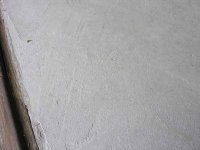
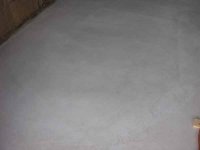
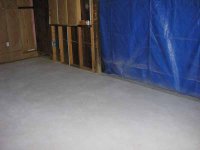
Dubber, I have attached a few photos of the interior and of the current floor surface. This is new concrete a little over thirty days old. As you may notice, I have a sheet of plastic on the floor and have no evidence of moisture. One odd think was that the contractor perforated the plastic vapor barrier after they installed it. They said that needed to be done to allow the water in the concrete to drain out. It seemed odd to me but I don’t know what is actually correct. Of course, it is too late to fix that if their action was wrong. This side of the building is about 15’ X 19’. The other side was concreted a number of years ago and is approximately 11’ X 19’. It was originally a carriage house/horse stall built around 1885 when the home was built. Palmyra, NJ is a small residential town just outside of Philadelphia, PA

The other portion of the building is

I hope to get this finished before the weather gets too cold.

Thanks,
Supergnat
 

Attachments

  • .jpg
    .jpg
    50.4 KB · Views: 19
  • 001.jpg
    001.jpg
    48.3 KB · Views: 19
  • 002.jpg
    002.jpg
    33 KB · Views: 15
  • 004.jpg
    004.jpg
    41.9 KB · Views: 17
  • 005.jpg
    005.jpg
    38.9 KB · Views: 15
  • 006.jpg
    006.jpg
    39.4 KB · Views: 14
To avoid these ads, REGISTER NOW!
Top Bottom