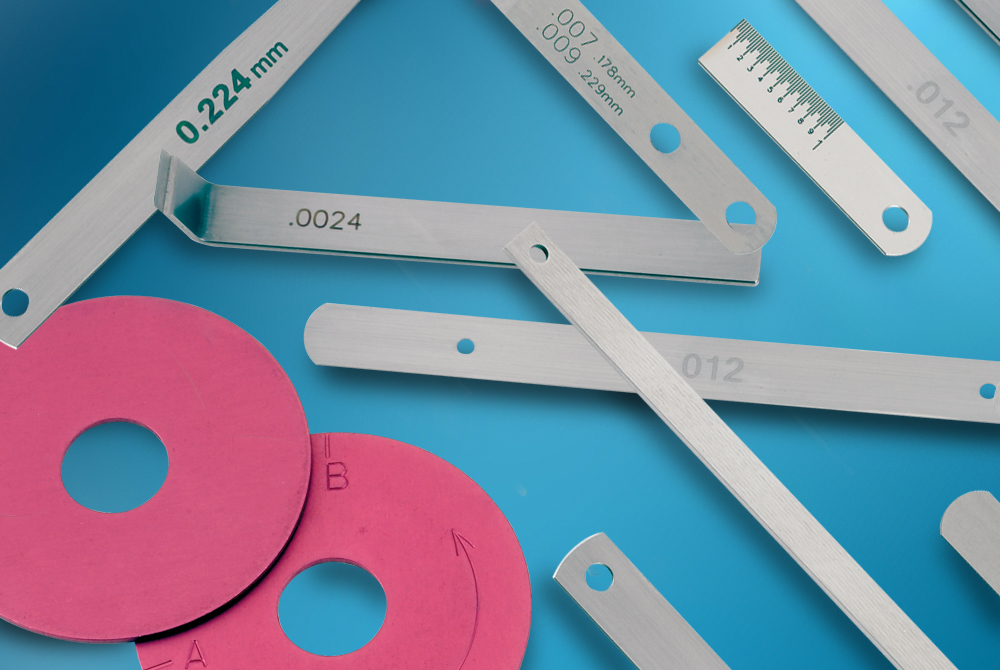
Just to add another digression to this discussion, here we are late in the year 2022, yet it's still remarkably difficult to find metric-only feeler gauges.
This matters mostly to those of us with metric motorcycles with shim adjustments, where the available shims and the specs are in millmeters, not barleycorns or bananas.
Inch gauges usually have metric equivalents marked on them. Better than nothing, but EXTREMELY error-prone.
Metric gauges are not too terribly hard to find, (powersports shoppes often stock nice quality sets under the "Bikemaster" brand name) but almost all are also crapped up with inch/barleycorn conversions, which only serve as added opportunities for error.
The only metric-only gauges I've found are in increments too course for many motorcycles.
One of my bikes, for example, has valve clearance specs of just .03mm - .08mm (no, that's not a typo or misunderstanding; the spec really is .0012" - .0031" for vintage 8-valve Suzukis), and shims are available in .05mm increments. Gauges thinner than .05mm are very hard to find, and ideally you would need .01mm increments up to about .15mm. The best I've been able to do is increments of .02 or .03mm. So you're left with the fine art of deducing actual clearance by whether the clearance feels loose or tight.
To give another example, my Yamaha FJ-09 specs are .26-.30mm (exhaust), and .11 - .20mm (intake), with shims available in .05mm increments. This is more typical for modern motorcycles, but note how the exhaust clearances are in a smaller range, and these are the clearances that change the most; it's good practice to set these near or at the upper spec where possible so that they'll stay in range as long as possible. (There's also the fine art of acquiring and saving factory shims, which are often found in very useful "in-between" sizes.)
A digital micrometer that reads directly in millimeters has really made life far easier as well; once in a while a shim is missing its faint markings, or I want to verify a shim.
Yes, it's certainly possible to do quality work in any measurement system available, including Klingon cubits. But sticking with millimeters throughout instead of farting around with conversions and constant math really does serve to reduce opportunities for errors.
What I would love, and would actually pay rather well for, is a service that could assemble custom feeler gauge sets, in clearly marked millimeter-only measurements in .01mm increments in the exact ranges I want. I'd happily sign up for a set specific for each bike.
There are industrial suppliers, but no one I've found selling onesie-twosies to ordinary slobs like me:
Rather than fumble trying to make do with “off the shelf” items, your employees will be more productive using a tool made specifically for your application

www.easterngage.com

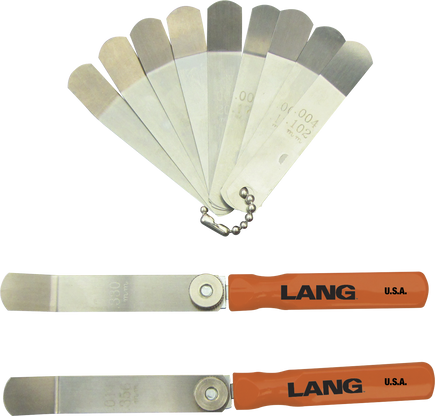
 www.langtools.com
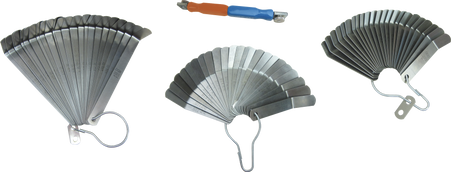


 . Since then, they have always been also in the on-board tool kits... not all of them are a classic version as this: