To avoid these ads, REGISTER NOW!

What is involved with testing existing concrete?

330Scott

Well-known member
Joined
Feb 6, 2005
Messages
195
Location
Skeeter Bite, Eyewa
I have been considering a four-post lift for a while now and the unit that I like is the Direct-Lift Pro Park 9 Plus. However, the specs state that the lift requires a minimum of 4” of concrete with 3000 psi. So how do I go about determining the strength of my concrete. Do I have to bore out a cylinder of concrete and take it to be analyzed?

I am totally clueless on this one.

Thanks,

Scott
 
To avoid these ads, REGISTER NOW!

sberry

Banned
Joined
Jun 18, 2005
Messages
35,747
Location
Brethren, Michigan
Almost all modern concrete is easily 3000 psi unless something drastic went wrong, if it looks nice its probably fine and with 4 post hoist common concrete in a garage is fine.
 

sjsfire

Well-known member
Joined
Feb 21, 2006
Messages
371
Location
illinois
330Scott said:
Wow, that was quick. Thank's for your input. Fwiw, the concrete was poured in 1984. It does look to be in fine shape though.


Thats probably better yet, maybe they used real wire mesh or rebar in the concrete when they poured it back in "84". Now days they use the fiberglass re-enforced concrete.
 

W-Cummins

Well-known member
Joined
Jan 9, 2006
Messages
1,640
Location
Iowa
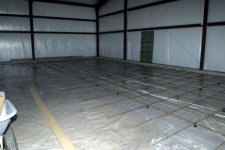
Damm What the hell was I thinking I could have just put some fuzzy stuff in and not tied all that bar??
 

Attachments

  • Echo Slab - 1 .jpg
    Echo Slab - 1 .jpg
    64.4 KB · Views: 28

bobbyd

Well-known member
Joined
Mar 17, 2006
Messages
137
Location
Kansas
Not so quick on the "most modern concrete is 3000 psi". There are a lot of factors that go into the ultimate strength of the concrete. Only some of which are attributable to the mix design of the concrete. Who actually poured the slab will make a huge difference. Among other things, water to cement ratio plays a vital role in the strength. 3000 psi mud will typically have a W/C ratio of between 0.45 and 0.55.

Now, let's say it's a hot day and the crew placing the concrete gets a little behind and adds a bunch of water to the mud to try and stay out of trouble towards the end of a truck. Lets say, there is only two yards of concrete left on the truck and the crew adds 10 gallons of water (not uncommon). Well, those two yards only had 60 gallons of water to begin with. Without boring you with the numbers, the new W/C ratio for the remaining two yards is 0.60 which is way out of spec and will impact the ultimate strength and durability of the concrete greatly.

Also consider that some contractors will save money wherever possible, including ordering 2500 psi mud, pouring thin slabs, etc. Trust me, I've seen it all.

Unless I was there when the slab was poured, I would err on the side of caution. Having a lift leg punch through a slab (I've seen similar things happen with shoring on a slab) while you're under it, won't make for a good day.

There are two readily common ways to test the existing concrete. The best, and most realiable is coring as you suggested. This also lets you know how thick the slab is and take a look at the subgrade, but leaves a hole in your floor. The second is called a "Swiss Hammer Test". It is non-destructive (no hole) and is used extensively in the testing industry. It's basically a machine that bounces a known weight off the surface of the concrete and by measuring rebound distance, etc and a little math, can give a pretty close approximation of the strength (not the thickness). Relatively inexpensive to have done and can add piece of mind.

Sorry for the long post, I can get long winded. Just don't want anyone "assuming" something when it comes to their safety.
 
To avoid these ads, REGISTER NOW!
OP
3

330Scott

Well-known member
Joined
Feb 6, 2005
Messages
195
Location
Skeeter Bite, Eyewa
Thank you, bobbyd. Appreciate your info a lot. Since my shop is a rental, I'll talk to the landlord about getting the concrete tested. And since said landlord is my brother, I'm sure that he will be receptive to my request.;) He has mentioned that the guy who built the building appears to have taken a few short cuts. So yes, I really shouldn't be assuming anything with this.

Thanks again.
 

bmwpower

Super Moderator
Staff member
Joined
Apr 24, 2005
Messages
12,578
Location
NJ
Who would perform a Swiss Hammer Test? I wouldn't even know where to look in the phonebook. Sounds like something we all should do prior to putting in a lift.
 

bobbyd

Well-known member
Joined
Mar 17, 2006
Messages
137
Location
Kansas
The easiest way is to call the local concrete ready-mix company. They'll be able to tell you who the local testing companies are. Terracon is a large nation wide testing agency that may exist in your neck of the woods. Local code office will also have that information.

Otherwise, check the yellow pages under "Laboratories - Material Testing" or something similar.

It's just not the conctractors that will take shortcuts. Ready-mix companies will too, particularly in residential construction when they can assume that ACI testing will not be done. Portland cement continues to rise in cost and availability in some areas. Ready-mix companies will reduce the amount of portland in the mix and/or replace with fly-ash to save cost. Since fly-ash is included in the W/C ratio, it doesn't change. However, fly-ash will not develop the strength like portland cement.

My advice for anyone that is planning on building a shop (especially if you plan on a lift) is to contact a testing company prior to concrete placement and have them do the proper testing on it during placement. This includes slump testing and compressive strength testing. They take samples in molds in a specific manner, cure them for up to 56 days and put them in a big press and crush them until failure. Only then can you be sure what you've got. The whole process probably costs around $200 - $250. Factored into the overall cost of even a modest $15,000 garage, it's cheap.
 

newgene

Member
Joined
Jan 23, 2006
Messages
9
Location
Waveland, MS
I may be able to share what I have learned. I am a mechanical engineer, so of course, I overanalyze everything. I too am about to build a garage that will need to meet the requirements for a lift (2-post Rotary brand). They also spec out 3,000 psi concrete. Yes, the most common concrete is 3,000, but that is just nominal.

So, I spoke to Rotary, as well as local installers. For liability reasons, they will not tell you to use anything else. However, in talking to their engineers, for example, they design for a factor of safety of 3:1 on their lifts. That puts their capacity for a 10,000 lb lift at 30,000 lb. Well, I'm buying a 10,000 lift for 4,000 to 6,500 lb vehicles. Although that is not the safety factor for compressive loads on concrete, if gives you an idea that they are overdesigning their products. I also spoke with the lift installers, and I asked them realistically if the spec can fluctuate. He said the biggest concern they have is not in the concrete strength, but thickness. For example, they require a 4.25" minimum thickness, so I am specifying a 5" minimum pad throughout the garage. I could have just poured footers around the posts, but it's probably just as easy to pour the whole slab. It takes more concrete, but it's still only about $83/cubic yard.

By the way, you can do some simple feel good calculations on the posts. For example, I am installing a 2-post, and they require 3,000 psi. If the post sizes are similar, and there are twice as many, you know your load is more distributed. I know that's not a definite answer, but IMHO, I wouldn't worry too much with whether you have 3,000 psi. I would bet the 3,000 psi is a spec carried over from a 2-post spec. They can have cantilever loads, and would present a different torque than a 4-post. BTW, I thought about bumping up the psi rating, but even just for the garage I didn't want to manage getting multiple types of mix from concrete trucks. I can just see someone goofing it up.

I think you're fine.
 
Last edited:

bmwpower

Super Moderator
Staff member
Joined
Apr 24, 2005
Messages
12,578
Location
NJ
I hope so. I installed what I think is 4000 psi concrete, 8" thick. The concrete contractor thought I was crazy. I didn't care. I think he was worried about being able to trowel things so he may have added some water.

I hope your info regarding thickness is correct.
 

Ramblur

Well-known member
Joined
Apr 4, 2006
Messages
449
Location
Central FLA
I've got the same 10K Rotary 2-post and can verify those specs,
4 1/4" and 3000 psi.:) They also had a spec on how close it can
be to the edge of a slab, mine wasn't even close so I don't recall
that measurement.
 
To avoid these ads, REGISTER NOW!
Top Bottom