To avoid these ads, REGISTER NOW!

What is it? (air compressor starter?)

RaysnCayne

Well-known member
Joined
Apr 12, 2011
Messages
194
Location
Richmond, VA
Hey all,

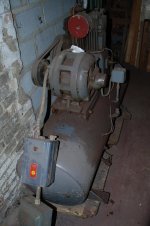
I found an ancient air compressor a few weeks back (Full story here: http://www.garagejournal.com/forum/showthread.php?t=195939 and it had these two boxes attached to it.

Can you tell me what they are, what they do? A starter of some sort? The motor was a 3-phase unit so I'm wondering if this is a 3-phase-only set up? Or, could I wire it so it runs my new single-phase motor? If so, would it be any better (gentler on start-up??) than me simply flipping the breaker at the panel the way I do now?

Assuming it's a 3-phase-only deal, is it worth anything? (thinking of craigslisting it)
 

Attachments

  • DSC_0287.jpg
    DSC_0287.jpg
    141.6 KB · Views: 117
  • DSC_0316.jpg
    DSC_0316.jpg
    142.7 KB · Views: 93
  • DSC_0317.jpg
    DSC_0317.jpg
    140.4 KB · Views: 103
To avoid these ads, REGISTER NOW!

dbonne

Well-known member
Joined
Apr 18, 2013
Messages
305
Location
Southern Idaho
Unfortunately that is a 3 phase motor, you cannot (easily) run it on single phase. However, from what I can see in your first pic, that is one great compressor. Those compressors are almost bullet proof. If it turns by hand and has compression, I would most certainly spend the money on a single phase motor for it and use it!
 

OccupantRJ

Well-known member
Joined
May 15, 2009
Messages
11,218
Location
Eastern North Carolina
In the last pic, the upper unit is a 3 phase disconnect. It can also be physically used as a single phase disconnect. The lower unit is a 3 phase motor starter, and depending on the coil voltage, may also be used for single phase by using only two of the three connections, along with the proper protective overload heaters for the motor application. Starters are sized for the intended load to be able to handle the amperage. Size 1, size 2, etc. Note that I referred to PHYSICALLY can be used. Code may dictate otherwise.
 
OP
R

RaysnCayne

Well-known member
Joined
Apr 12, 2011
Messages
194
Location
Richmond, VA
So it's a 3-phase disconnect and a 3 phase starter. Thanks guys.

Now, is there any reason I'd want to make those work on a single phase motor? Or should I just stick with my breaker-flipping start-up method? I can't see any benefit to making all this work on my system, but if there is, then I'd be willing to give it a shot.

Is there any market value to these pieces? I can't imagine old 3-phase parts get picked up for much since most commercial shops use new stuff.

Since I'm guessing I'd be lucky to get $20 for them, I may just convert them to some sort of cool "storage cabinets" for my drill bits or air hose attachments or something. They'd fit nicely into my vintage garage decor theme.

DBonne, check out the link in my first post for the full story behind this old girl. ;)
 

dbonne

Well-known member
Joined
Apr 18, 2013
Messages
305
Location
Southern Idaho
Just checked out original post, I was behind in the info chain. I am an air compressor nut (among alot of other things) and think she is a beaut! Good luck with that unit!
 
To avoid these ads, REGISTER NOW!

OccupantRJ

Well-known member
Joined
May 15, 2009
Messages
11,218
Location
Eastern North Carolina
The starter is a relay to take the amount of current during startup and running, and to give a means of control from the pressure switch, so it also does not have to handle the large amperage. It also protects the motor from an overload situation, such as a pump physically locking up. The starter allows the use of smaller switches for various control functions that may be desired, such as controlling the compressor to come on when the shop lights are turned on. The breaker likely will eventually fail due to excess usage if used as a power switch, and it has to handle the inrush current each time.
 

Grumpy365

Well-known member
Joined
Jan 21, 2010
Messages
623
Location
Brazoria County Texas
If it was me, I would go to Automationdirect.com . I would buy a contractor, a breaker, and a switch.

I would mount the breaker and contactor in a box, with a switch on the door.


I would wire the switch to energize the holding coil of the contactor.

My wires from my House breaker box or plug would come in to the top of the supplemental breaker I selected.

I would come out of the bottom of the breaker in to the top of the contactor.

And out of the bottom of the contactor to the motor.


SO, you hit the switch, the contactor engages, motor starts.

If it draws to many amps, the supplemental breaker above the contactor protects your stuff .
 

Charles (in GA)

Well-known member
Joined
Jan 11, 2006
Messages
12,489
Location
50 mi south of Atlanta
There are two main reasons for using the motor starter.

1) The motor needs thermal protection.... Many motors have a thermal "breaker" inside the motor. They are the motors that have a red reset button on the back end of the motor. It will trip and shut the motor down if it overheats. However, many larger motors do not have thermal protection built in. If they do not have the thermal protection internal in them, then the motor starter can be used to provide that protection. Most motor starters have a heater element in them. This element has to be accurately sized to the motor's normal full load amperage, so that if the amp draw increases above normal FLA, the heater will get too hot and a thermal switch will open the circuit that controls the coil of the starter, shutting the motor down.

2) Motors draw a lot of current, pressure switches that can handle that current are expensive, and still subject to their contacts burning due to the heavy loads of the motor. With a motor starter, you can route the coil circuit from one of the incoming hots, thru the thermal overload, then to the pressure switch, and from the pressure switch back to the coil and from the other side of the coil to the other incoming hot in the motor starter.

The same effect can be achieved by running from one incoming hot thru the thermal switch and back to a coil terminal, and from the other coil terminal thru the pressure switch and back to the other incoming hot of the motor starter.

What all of this does, is make the pressure switch last practically forever, as the pressure switch will only be carrying the current that operates the coil in the motor starter, probably less than an amp.

If your motor is over 3 hp, and does not have thermal protection internal in it, you need to be using a motor starter.

Motor starter, and magnetic starter are interchangeable terms.

You will probably need a new heater for that old motor starter to work properly with your new motor, and you may not be able to find what you need. The old three phase starter will have two heaters, one of them can be bypassed or removed, it will not be needed, you only need one on single phase.

You will need to look at your coil voltage for the starter, it will need to be 220v to 240v.

The disconnect switch can be used if it is capable of handling the amperage you intend to pull thru it, you will only be using two of the three contacts in it.

Charles
 
OP
R

RaysnCayne

Well-known member
Joined
Apr 12, 2011
Messages
194
Location
Richmond, VA
Enlightening.

Guess I won't try turning them into a cute, craft project, but instead I'll see if I can work them into the system when I get to the final installation.

Thanks guys.
 

RedBKM

Well-known member
Joined
Dec 2, 2012
Messages
236
Location
Central Virginia
I came across a bunch of these old electric boxes and they have many uses. I especially like the old ones with jewel type light lenses.

I used one for first aid supplies but be sure to label it in case you're on the floor and your buddy is looking for bandaids etc.

They also make a nice TP holder. Threaded rod and some wing nuts and the door keeps it clean. Mine started in the master bath but the wife got mad.

As for the magnetic starter... The newer style starters have an adjustment dial instead of the plug in modules. If your current draw changes in the future just turn the dial.
 
To avoid these ads, REGISTER NOW!
Top Bottom