abstamaria
Well-known member
What is the ideal position for mounting a vise on a bench? Many thanks in advance,
Andy
Andy
Last edited:


Rear, fixed jaw lined up with the edge of bench. Err on the side of this jaw overhanging the edge. If it is too far back you can't clamp long pieces that want to hang down vertically toward the floor or they will hit the bench.
If it's a swivel vise, I like it on the corner. Ideally placed where the fixed jaw will clear either the front edge or the side edge, depending on which way it's swiveled.
(Nice answer, Zeke...)


On the front and side edge so you can do this on both the front and side... [see his post]
I usually like to mount mine over the leg so I can bang or pull down on it with no give. The top of my bench is 2x4s, but my vise is mounted on a 2x10 that is also anchored to the wall so that I can pull on it without it flexing as well.
I've heard the left vs right hand thing on what end of the bench to mount to. I'm left handed and never saw a real disadvantage at either end.
Chris
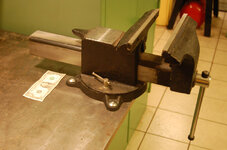
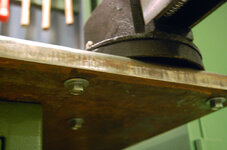
. . . . My best vise will clear the side but not the front of my workbench. . . .
I'm glad to hear that my vise isn't the only one incapable of overhanging two sides of a corner. I have a swivel-base Columbian 3-1/2" that can't be bolted down on a corner in a way that will allow the fixed jaw to overhang both edges. I can get one, but not both.
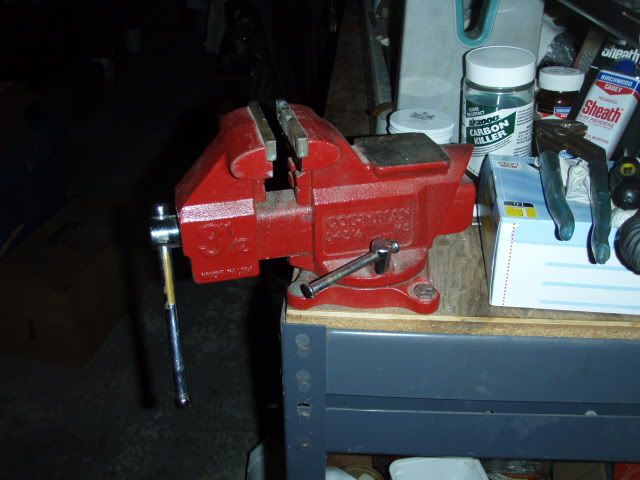
Also -- take a close look at the base before you drill your holes. I'd put in a few vises over my lifespan and had never given it a thought. Then I had to drill holes in an inch-thick bench top for a very big vise. I lined up everything very carefully, thinking (wrongly) that the base would be symmetrical. In fact, the holes are usually along a D shape, so that the jaws can overhang the base more on the side that lines up with the edge of the bench.
I mounted the new vise and never gave a thought to the fact that the base had to overhang in order to have the inside jaw line up properly with the edge of the work surface. It was only when I was mounting the next vise that I realized that there's a cutaway portion that avoids any overhang being necessary. Of course, I'm not re-drilling holes in the inch-thick bench to correct my mistake. But a part of me wishes I could.
I'm glad to hear that my vise isn't the only one incapable of overhanging two sides of a corner. I have a swivel-base Columbian 3-1/2" that can't be bolted down on a corner in a way that will allow the fixed jaw to overhang both edges. I can get one, but not both.
One more addition to Shadowdog's pictures is, if possible on your bench, you might round off the corner so you can swivel the vise without removing the object in the vise.
Mine is on a post mount so it doesn't matter.
Charles
 :
:One more addition to Shadowdog's pictures is, if possible on your bench, you might round off the corner so you can swivel the vise without removing the object in the vise.
Mine is on a post mount so it doesn't matter.
Charles
Rear, fixed jaw lined up with the edge of bench. Err on the side of this jaw overhanging the edge. If it is too far back you can't clamp long pieces that want to hang down vertically toward the floor or they will hit the bench.

To digress a bit, here is my dream vise. Ettore Bugatti was an obsessive-compulsive perfectionist; if I won the lottery, the first thing I would buy will be one of his 1930s Type 35Bs. When he could not stand the erratic electricity supplied by the local utility, he built his own power plant with polished wood plank floors. When he couldn’t find a vise whose jaws were parallel enough for him, he built his own.
At closing, he would check each of the vises in the factory; woe be to the workman whose file had scratched one!
Pur Sang, a small company in Argentina that builds credible replicas of the Type 35, builds replicas of these vises. Even these replicas are too expensive for me. If I did get one, I would paint it French Racing Blue. And mount it properly on a bench with a rounded-off corner.