To avoid these ads, REGISTER NOW!

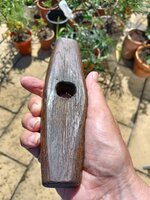
What is this hand-made handle (?) for please?

IainP

Active member
Joined
Sep 7, 2017
Messages
42
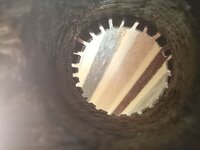
Hi all. I saw this at an antiques fair in Lincolnshire UK, yesterday, and wondered what it was. It was a bargain at £1.50 ($1.80) and I bought it knowing that someone here would be able to tell me what it was for! I'm assuming it was some kind of handle, but it's so crudely made, I can't see how the "teeth" could engage with the whatever it was supposed to connect to.
Iain
 

Attachments

  • 20220613_220524.jpg
    20220613_220524.jpg
    186.6 KB · Views: 104
  • 20220613_220603.jpg
    20220613_220603.jpg
    413.7 KB · Views: 98
  • 20220613_220631.jpg
    20220613_220631.jpg
    215.1 KB · Views: 84
  • 20220613_220649.jpg
    20220613_220649.jpg
    197.6 KB · Views: 84
To avoid these ads, REGISTER NOW!
OP
I

IainP

Active member
Joined
Sep 7, 2017
Messages
42
Interesting idea! The edges are quite blunt though:
 

Attachments

  • spokes.jpg
    spokes.jpg
    316 KB · Views: 88

Farmer J.

Well-known member
Joined
Sep 18, 2016
Messages
1,995
Location
UK, Cornwall/Hertfordshire.
It looks familiar to me, I'm sure I have seen someone using one somewhere..!

I don't think it's necessarily a handle, it could be to retain a roll of twine on a shaft or something like that.

The iron ring looks like it has had hacksaw cuts made around the inside of it for some reason, I don't think those are original.
 
Last edited:
OP
I

IainP

Active member
Joined
Sep 7, 2017
Messages
42
It looks familiar to me, I'm sure I have seen someone using one somewhere..!
Yes, I feel that way too! I'm imagining some kind of rural/ farming use now, but no closer to a solution. The 15 minutes I just spent looking at "antique rope making machines" on Google images was fun though.
 

Farmer J.

Well-known member
Joined
Sep 18, 2016
Messages
1,995
Location
UK, Cornwall/Hertfordshire.
Yes, I feel that way too! I'm imagining some kind of rural/ farming use now, but no closer to a solution. The 15 minutes I just spent looking at "antique rope making machines" on Google images was fun though.
Ha ha, yea, those rope machines are great fun! I was thinking along the lines of an object like this maybe sliding along and separating the strands as a cable is twisted..
Coming from Lincolnshire it could likely be something rural or to do with farming. Will keep my eye out.
Does it have any wear marks at all, like grooves or scratches, that may give a clue to how it was used?
 
OP
I

IainP

Active member
Joined
Sep 7, 2017
Messages
42
Ok. some more information and pictures!
Does it have any wear marks at all, like grooves or scratches, that may give a clue to how it was used?
Yes, on the side away from the metal, the wood appears more damaged than the top side, though whether this is just how it was made is hard to tell.

There's no obvious sign of wear on it, not even in the hole, but I hadn't noticed before that the metal ring is off centre, so the teeth are nearly flush with the wood on one side and sticking well out on the other side.
This seems very odd, as either the teeth perform a function which involves them sticking out away from the wood, or flush with the wood, but it's hard to imagine what function it could perform doing both.

The 2 nails go all the way through the wood, and have had the points flattened off, as you can see in the photo. This suggests that the ring had to be held very firmly in place to perform its job.

The item was on a table along side other very old and "rustic" looking tools such as saws, and other wooden tools.
 

Attachments

  • 20220614_151449.jpg
    20220614_151449.jpg
    332.1 KB · Views: 47
  • 20220614_151331.jpg
    20220614_151331.jpg
    466.6 KB · Views: 40
  • 20220614_151222.jpg
    20220614_151222.jpg
    435.3 KB · Views: 37
  • 20220614_151152.jpg
    20220614_151152.jpg
    427.7 KB · Views: 39
  • 20220614_151058.jpg
    20220614_151058.jpg
    394.9 KB · Views: 36
  • 20220614_151052.jpg
    20220614_151052.jpg
    393.7 KB · Views: 41

RTM

Well-known member
Joined
May 13, 2019
Messages
13,134
Location
SF Bay Area
One thought, though this looks kinda bit. There are tools to "groove" dowels to improve glue adhesion. You can buy pre grooved dowels, or you can groove your own, crudely. Unless someone had tiny hands, this seems too big.

Other uses where adding grooves to something might be useful. Since they aren't symmetric, consistent, or anything like that, an "out of sight" application?
 

Farmer J.

Well-known member
Joined
Sep 18, 2016
Messages
1,995
Location
UK, Cornwall/Hertfordshire.
Yes, on the side away from the metal, the wood appears more damaged than the top side, though whether this is just how it was made is hard to tell.
The 2 nails go all the way through the wood, and have had the points flattened off, as you can see in the photo. This suggests that the ring had to be held very firmly in place to perform its job.
A couple more questions, to at lest try and guess the age of this object.
Are the nails wire nails, cut nails, or hand forged ones? The use of clinched over nails suggests it was made before around 1800 when machine made screws came in to common use, (invented in 1760) but if they are machine made wire nails the same as modern ones, then it was made after around 1860 and the maker just preferred using nails to screws.
Any idea what species of wood it is? I don't immediately recognise it, it looks rather splintery. If it's a non native species, some tropical hardwood, it may be that it was made somewhere far away from Lincolnshire.
 

Marsim

Well-known member
Joined
Feb 9, 2022
Messages
496
Could it be something along the lines of this cheese press handle?
 
To avoid these ads, REGISTER NOW!

Thesian

Well-known member
Joined
May 26, 2022
Messages
47
Maybe a stretch, but just a wooden mallet, and the teeth were a way to hold the handle in place with pressure?
I am along this same line. The teeth are too irregular to be any kind of effective drive mechanism. I would then assume they either cut, or hold a position. My guess is also that it’s some sort of mallet head with the metal piece being part of the fixation, albeit a sad one alone. My 2 cents….
 
OP
I

IainP

Active member
Joined
Sep 7, 2017
Messages
42
Are the nails wire nails, cut nails, or hand forged ones? The use of clinched over nails suggests it was made before around 1800 when machine made screws came in to common use, (invented in 1760) but if they are machine made wire nails the same as modern ones, then it was made after around 1860 and the maker just preferred using nails to screws.
Any idea what species of wood it is? I don't immediately recognise it, it looks rather splintery. If it's a non native species, some tropical hardwood, it may be that it was made somewhere far away from Lincolnshire.
Interesting ideas here! I'm trying to get one of the nails out now, so will post result here. Yes, the wood looks splintery at first glance but actually is rock solid, and very dark, so I'd guess it's non-native.
IT reminds me of a bore auger handle.
I see what you mean:
 

Attachments

  • wood.jpg
    wood.jpg
    469 KB · Views: 39

Nevadablue

Member
Joined
May 29, 2022
Messages
12
I think it was made to encourage conversation. A “conversation piece”. Put it in a place of pride and wait…

what fun, watching for more ideas!
 
OP
I

IainP

Active member
Joined
Sep 7, 2017
Messages
42
I think it was made to encourage conversation. A “conversation piece”. Put it in a place of pride and wait…

what fun, watching for more ideas!
Ha you could be right. I'd love to know what it is of course, but also rather happy that it's not embarrassingly obvious either, and has generated some great discussion. And I've learned about old nails too ;-)
Iain
 

RTM

Well-known member
Joined
May 13, 2019
Messages
13,134
Location
SF Bay Area
In the hammer camp questions: does it look like the ends have hit anything? MY plane adjuster hammer has small indentation from hitting wooden planes. A non native hardwood may not show much damage.

In the other questions camp: are the end tapered evenly? Does it show sliding damage on the cheeks vs on the striking faces? Maybe to push something open, or to form leather or….?
 

Farmer J.

Well-known member
Joined
Sep 18, 2016
Messages
1,995
Location
UK, Cornwall/Hertfordshire.
Ha you could be right. I'd love to know what it is of course, but also rather happy that it's not embarrassingly obvious either, and has generated some great discussion. And I've learned about old nails too ;-)
Iain
This is one of those times when the saying 'It's about the journey, not just the destination' probably applies!
If you haven't already found it Stumpy Nubs did a very good little video about old nails:
 
OP
I

IainP

Active member
Joined
Sep 7, 2017
Messages
42
Stumpy Nubs did a very good little video about old nails:
That was very interesting, thanks!
In the hammer camp questions: does it look like the ends have hit anything? MY plane adjuster hammer has small indentation from hitting wooden planes. A non native hardwood may not show much damage.

In the other questions camp: are the end tapered evenly? Does it show sliding damage on the cheeks vs on the striking faces? Maybe to push something open, or to form leather or….?
No wear or damage that I can see. Here's a close up of the ends.
I tried to remove one of the nails but it didn't go well.. It looks like a normal wire nail though:
 

Attachments

  • Job1.jpg
    Job1.jpg
    278.5 KB · Views: 19
  • Job2.jpg
    Job2.jpg
    312.9 KB · Views: 17
  • Job3.jpg
    Job3.jpg
    282.4 KB · Views: 27

Farmer J.

Well-known member
Joined
Sep 18, 2016
Messages
1,995
Location
UK, Cornwall/Hertfordshire.
I wouldn’t think it is for twisting, because there’s only two nails holding that metal piece on.

Going off on a wild tangent. How about for a spinning wheel or yarn winder?
Yea, I agree, it looks like something like that. It could fit over a shaft and retain a coil or spool of yarn, thread, string, rope whatever. The metal washer would prevent the retaining pin or wingnut on the end of the shaft from chewing in to the wood. Used like this the nails holding the metal washer wouldn't be under any significant strain, they just retain the washer in place.
 

CN Spots

Well-known member
Joined
Apr 21, 2016
Messages
3,067
Location
NW Mississippi
Had to google the yarn winder. Most have straight or concave ends. Seems like this thing's taper would encourage the yarn to fall off?

This is a good one. I have no idea. It'll probably end up being a clammerbob for a bevelling tacklasher.

and don't bother googling that.
 

Leviton

Well-known member
Joined
Feb 25, 2019
Messages
903
Location
Oregon
I'll throw out a wild a** guess. Could it be a homemade tenon cutter? First cut the end of a leg or spoke to roughly the right size, than spin this on to clean it up and make it round and the correct diameter?

What doesn't fit about this theory is that usually tenon cutters have only a single blade, whereas this has multiple "blades". I think the only way to know would be to try it.

However, my speculation is pretty much closing the barn door after the horse has bolted. I think CN Spots has correctly identified it - it has to be a bevelling tacklasher.
 
To avoid these ads, REGISTER NOW!
Top Bottom