To avoid these ads, REGISTER NOW!

What is this tool?

Snappy Rob

New member
Joined
May 19, 2016
Messages
1
Location
Los Angeles, CA
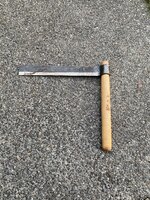
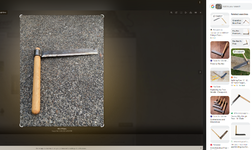
I got this tool in a lot of tools I purchased. The blade looks new, and the handle seems to have been added later. The handle seems non-functional, and the blade shows no sign of use. My guess is to remove bark from logs, but have no idea.
 

Attachments

  • IMG_5075.jpeg
    IMG_5075.jpeg
    2.2 MB · Views: 121
  • IMG_5077.jpeg
    IMG_5077.jpeg
    2.2 MB · Views: 113
  • IMG_5078.jpeg
    IMG_5078.jpeg
    1.9 MB · Views: 98
  • IMG_5074.jpeg
    IMG_5074.jpeg
    2.4 MB · Views: 103
To avoid these ads, REGISTER NOW!

Ohio Andy

Well-known member
Joined
Jul 31, 2024
Messages
2,244
Location
Columbus, Ohio
It is a shingle froe, and you're right it doesn't look like it has been used much. Probably because the blade was attached to the handle upside down.
I had to zoom in really close to see it was upside down. Was using mine just last week. Mine works really well. Highly recommended.

Then again if you'll never use it...
 

RTM

Well-known member
Joined
May 13, 2019
Messages
13,053
Location
SF Bay Area
. Probably because the blade was attached to the handle upside down.
When you put it into use, don’t hit it with anything metal. A big @$$ branch or branch section will work well.


And the handle is made to slide out towards the sorta sharp edge. It is easier to store that way. It’s not a sharp edge, you use the handle to steer the spiitting if the grain.
 
Last edited:

Ohio Andy

Well-known member
Joined
Jul 31, 2024
Messages
2,244
Location
Columbus, Ohio
When you put it into use, don’t hit it with anything metal. A big @$$ branch or branch section will work well.


And the handle is made to slide out towards the sorta sharp edge. It is easier to store that way. It’s not a sharp edge, you use the handle to steer the spiitting if the grain.
So think about a log with straight grain and you want to split it in a very controlled way because maybe you want to make handles for an ax or a hammer or spoons or spokes... The wood will split along the grain and you have a lot of control where that occurs.

Last time I used mine like grabbed a log that was 4 to 6 in thick and then I took a hatchet and I cut cut a handle out that I could easily grab on the bottom and then I beat the back of it into the log. Once it gets in a little bit it splits it and then you can use the handle as leverage.
 
  • Like
Reactions: RTM

2oolhound

Well-known member
Joined
Dec 18, 2010
Messages
5,918
Location
BC Canada
Along the west coast we call them shake froes. Cedar shakes are just long thick shingles usually about 18" long. You cut the cedar tree into 18" long rounds which are split into large squares called bolts that one man can handle (you have to flip them often to control the taper). Shakes are split from the bolts. Shakes are about 3/4" on one end and they taper slightly along the grain as they split so they are about 1/2 to 3/8" thick at the opposite end. They can be 8" wide or more. Cedar shake roofs last 40 years or more, up to 100 years. Because of the heavy taper they are sometimes shipped to a shingle mill where the shake is run through a band saw where they become 2 shakes from sawing down their length. These shakes are known as re-saws and they are not as highly regarded. Lower quality cedar can be cut in much shorter lengths and sawed, not split, into shingles.

This is how it was done in the 70's but I don't think it continues today other than a few folks doing their own.
 
To avoid these ads, REGISTER NOW!

Beerhippie

Well-known member
Joined
Oct 13, 2023
Messages
9,606
Location
Far NE Oregon
Along the west coast we call them shake froes. Cedar shakes are just long thick shingles usually about 18" long. You cut the cedar tree into 18" long rounds which are split into large squares called bolts that one man can handle (you have to flip them often to control the taper). Shakes are split from the bolts. Shakes are about 3/4" on one end and they taper slightly along the grain as they split so they are about 1/2 to 3/8" thick at the opposite end. They can be 8" wide or more. Cedar shake roofs last 40 years or more, up to 100 years. Because of the heavy taper they are sometimes shipped to a shingle mill where the shake is run through a band saw where they become 2 shakes from sawing down their length. These shakes are known as re-saws and they are not as highly regarded. Lower quality cedar can be cut in much shorter lengths and sawed, not split, into shingles.

This is how it was done in the 70's but I don't think it continues today other than a few folks doing their own.
I've hung a few genuine split-cedar shake roofs as late as the late '00s. Not cheap at all. Be sure you use stringers under the shakes or your $100K roof will last at most a few decades. Cedar shakes need air flow on both sides and, with it, can last for a century in our semi-arid clime.

Last time I used a froe and mallet we bucked, split and installed a new roof on a hundred-odd-year-old guard station (Bear Creek) in the Wallowas. The wood was Western Larch (Tamarack hereabouts) and we were splitting 4'-long shakes! This had a rafter and purlin roof, so you could actually see light through the finished roof, but nary a drop of water ever got through!
 

four.cycle

Well-known member
Joined
Oct 19, 2015
Messages
28,429
Location
Tacoma, Washington
Along the west coast we call them shake froes.
^ This. Always called it a "shake froe". Mine is in the garage and was originally equipped with the same, useless, upside-down handle as the OP's. NEVER bang on the back of the blade with steel - always use wood.

I hiked upstream about half a mile, found an 8-foot diameter Western Red Cedar (Thuja plicata) in a log jam, and after about a bazillion crazy plunge cuts (standing waist deep in the river) managed to pirate enough bolts to re-cover the front of the cabin after the Inaugural Day storm in 1994 - had to practically overhaul the entire structure.
Once you start working a bolt and you get the hang of it, you can get tricky.

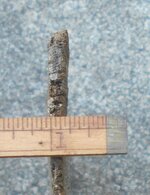
Below is an example of the work of a master. This shake was salvaged from a collapsed homestead structure on the Olympic Peninsula
originally built in the 1890s. It has a bit of lichen growing on the back side, but that's only because it was laying on the ground. Hard to imagine living in a structure where this was all that was between you and the outdoors. (This example is from an exterior wall, not the roof.)

The cedar shake and shingle industry is alive and well on the Peninsula. Cedar pirates are still pillaging anything they can get to so they can get enough money to buy another dime bag of meth. The last photo in the string was taken along one of my favorite trails - it leads through a grove of ancient Western Red Cedars - many of which well exceed 8 foot DBH.
 

Attachments

  • 1890s cedar shake Geo. Anderson homestead 01.jpg
    1890s cedar shake Geo. Anderson homestead 01.jpg
    591.6 KB · Views: 34
  • 1890s cedar shake Geo. Anderson homestead 02.jpg
    1890s cedar shake Geo. Anderson homestead 02.jpg
    139.7 KB · Views: 28
  • Cedar Grove Trail 082022 01.jpg
    Cedar Grove Trail 082022 01.jpg
    1.7 MB · Views: 36
Last edited:
To avoid these ads, REGISTER NOW!
Top Bottom