

You are using an out of date browser. It may not display this or other websites correctly.
You should upgrade or use an alternative browser.
You should upgrade or use an alternative browser.
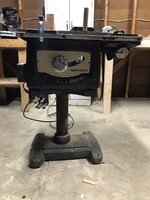
What is this vintage table saw worth?
- Thread starter monster1
- Start date
Craig Bernhardt
Member
How "vintage" is it, like Mark Twain vintage?
isb cornbinder
Well-known member
craftsman/Sears is dead in Canada. So, that saw is worth scrap weight, around here. Anyway, the base looks bent. Check for damage if you are going to buy it. The saw appears to be a tilting arbor, so, it is not all that vintage.
Kscardsfan
Well-known member
I see the saws going for 50-150 depending on condition. The base is what people go crazy over in this area.How much is this table saw worth? I'm just debating on if I should sell it or keep it and take it with me when I move cross country on a few years.
Ok. Old? Hell, IDK. It was the saw I grew up using when my family owned an RV dealership. Repaired a sh@t ton of dry rotted trailers using it. Doesn't really have any sentimental value for me and it's heavy as hell. Maybe I'll just donate it. I'm not into tool restoration other than watching YouTube videos about it.
Kscardsfan
Well-known member
If you were close I’d take it and give it a good home amongst all the other stupid things I’ve picked up lolOk. Old? Hell, IDK. It was the saw I grew up using when my family owned an RV dealership. Repaired a sh@t ton of dry rotted trailers using it. Doesn't really have any sentimental value for me and it's heavy as hell. Maybe I'll just donate it. I'm not into tool restoration other than watching YouTube videos about it.
crguy
Well-known member
I never understood the attraction to those bases. Too small of a footprint to be stable.I see the saws going for 50-150 depending on condition. The base is what people go crazy over in this area.
The base is worth as much, or more, than the saw.I never understood the attraction to those bases. Too small of a footprint to be stable.
neophyte
Well-known member
The value of “stationary” equipment, that cannot be easily shipped thru UPS/USPS/Fedex etc. is highly regional.
If you live near a major urban area with lots of “makers” the prices might be fairly high.
If you live in some rural or suburban area, were almost everybody had a home shop, then the prices aren’t going to be great, especially if there are condition issues.
The vintage column Craftsman equipment like that sort of looks “cool” so there might be more interest just because of that with the right audience.
For crguy;
The reason for that style of base was likely modularity, and maybe compactness for shipping.
Those bases were used for a variety of equipment, sometimes with more than one column.
Since a column system is already used for Drill Presses, which are and were a fairly standard tool. Most of the same equipment and setup could be used for machining the post mount in the base castings for a tablesaw or whatever, as would be used for machining the column mount in the base casting for a drill press.
The same tubular steel used for the drill press column could also be used for the base column on the saw making supply logistics easier.
Most equipment that used this type of column base, was essentially old school “Benchtop” sized machinery, although usually made with heavier castings than current benchtop machinery.
If a machine was slightly talker or shorter, using the equipment on a benchtop might be slightly harder for some people depending on height.
Witha column system like this, the column height could be made shorter or taller easily by the manufacturer to get whatever they considered the “proper” height, and I presume an owner could purchase the appropriate sized steel to make the stand taller or shorter if the were handy, to customize the height if necessary.
Were tablesaws routinely being used for breaking down large sheet material when these saw were being made?, Or was that mistly left for a handheld circular saw, or a Radio Arm Saw with a shop built table?
If you live near a major urban area with lots of “makers” the prices might be fairly high.
If you live in some rural or suburban area, were almost everybody had a home shop, then the prices aren’t going to be great, especially if there are condition issues.
The vintage column Craftsman equipment like that sort of looks “cool” so there might be more interest just because of that with the right audience.
For crguy;
The reason for that style of base was likely modularity, and maybe compactness for shipping.
Those bases were used for a variety of equipment, sometimes with more than one column.
Since a column system is already used for Drill Presses, which are and were a fairly standard tool. Most of the same equipment and setup could be used for machining the post mount in the base castings for a tablesaw or whatever, as would be used for machining the column mount in the base casting for a drill press.
The same tubular steel used for the drill press column could also be used for the base column on the saw making supply logistics easier.
Most equipment that used this type of column base, was essentially old school “Benchtop” sized machinery, although usually made with heavier castings than current benchtop machinery.
If a machine was slightly talker or shorter, using the equipment on a benchtop might be slightly harder for some people depending on height.
Witha column system like this, the column height could be made shorter or taller easily by the manufacturer to get whatever they considered the “proper” height, and I presume an owner could purchase the appropriate sized steel to make the stand taller or shorter if the were handy, to customize the height if necessary.
Were tablesaws routinely being used for breaking down large sheet material when these saw were being made?, Or was that mistly left for a handheld circular saw, or a Radio Arm Saw with a shop built table?
I built many subwoofer boxes on that table when I was younger. 4 x 8 sheets of MDF were challenging to say the least.I never understood the attraction to those bases. Too small of a footprint to be stable.
