Hey guys I recently found this and was wondering what it's used for and about how old it is. It appears to be some kind of sheet metal crimping shears. It was made by Champion and has a patent number stamped on it.

You are using an out of date browser. It may not display this or other websites correctly.
You should upgrade or use an alternative browser.
You should upgrade or use an alternative browser.
What is this?
- Thread starter RickV78
- Start date
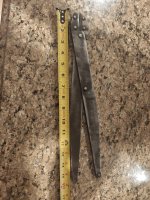
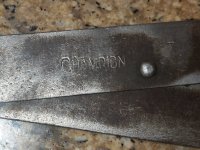
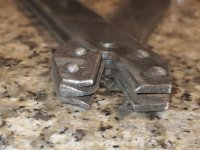

larry4406
Well-known member
Duct crimper?
Oh yeah that makes sense. It probably would crimp an end of a round pipe to turn that end into a male so it would fit into another pipe of the same size. Probably one of the first ones ever made.Duct crimper?
micromind
Well-known member
Yep, duct crimper.
Crimped many a duct with them over the years.
Crimped many a duct with them over the years.
Duct crimper?
Ed in Virginia
Well-known member
I showed ChatGPT your photos and got this back:Hey guys I recently found this and was wondering what it's used for and about how old it is. It appears to be some kind of sheet metal crimping shears. It was made by Champion and has a patent number stamped on it.
- Maker: Champion (sold under the Champion brand; often simply stamped, not logoed)
- Era: circa 1910s–1930s
- Trade: Tinsmith / stove & flue work
- Manufacture: Forged steel, riveted construction (typical pre-WWII)
Champion was a well-known American tool brand that produced hand tools for tradesmen—especially sheet-metal workers—before modern HVAC specialization. Tools were commonly marked only with the brand name, exactly like yours.
Why this is clearly an early Champion
Key period details visible in your photo:- Plain block-letter stamp (no logo, no model number)
- Forged handles with hand-finished surfaces
- Peened rivets, not bolts or screws
- Narrow, tapered jaw profile for stovepipe rather than duct seams
Typical use (historically accurate)
A tinsmith or homeowner would:- Insert the jaws ~½–¾″ into the pipe end
- Squeeze to form a deep crimp
- Rotate the pipe
- Repeat around the circumference
Wow that's impressive. Thanks for that. That's crazy they're 100 years old. The stove pipe use makes sense as well. I honestly can't seem to find another one like it online.I showed ChatGPT your photos and got this back:
- Maker: Champion (sold under the Champion brand; often simply stamped, not logoed)
- Era: circa 1910s–1930s
- Trade: Tinsmith / stove & flue work
- Manufacture: Forged steel, riveted construction (typical pre-WWII)
Champion was a well-known American tool brand that produced hand tools for tradesmen—especially sheet-metal workers—before modern HVAC specialization. Tools were commonly marked only with the brand name, exactly like yours.
Why this is clearly an early Champion
Key period details visible in your photo:
This style predates the familiar 5-blade HVAC crimpers and was intended to make fewer but deeper crimps, ideal for black stovepipe used with coal and wood stoves.
- Plain block-letter stamp (no logo, no model number)
- Forged handles with hand-finished surfaces
- Peened rivets, not bolts or screws
- Narrow, tapered jaw profile for stovepipe rather than duct seams
Typical use (historically accurate)
A tinsmith or homeowner would:
Exactly the same principle as today—just slower and more manual.
- Insert the jaws ~½–¾″ into the pipe end
- Squeeze to form a deep crimp
- Rotate the pipe
- Repeat around the circumference
RTM
Well-known member
What the patent number? There are tools for looking up patents online.has a patent number stamped on it
What the patent number? There are tools for looking up patents online.
Attachments

d42jeep
Well-known member
Here is a different brand I posted in January ‘25. These are Pioneer brand 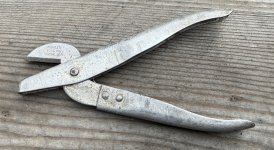


-Don
-Don
micromind
Well-known member
Here is a different brand I posted in January ‘25. These are Pioneer brand
-Don
I have that exact one. It's seen a lot of use and still works well.
RTM
Well-known member
Here is your patent, from google patents. Since the last number is missing, I just started from one, fortunately 3 was the winner, so it saved me guessing 7 more times.

This patent is not in DATAMP.
This patent is not in DATAMP.
Last edited:
Wow. Excuse my ignorance, did you somehow show ChatGPT all of the photos and then it output all of that data?I showed ChatGPT your photos and got this back:
- Maker: Champion (sold under the Champion brand; often simply stamped, not logoed)
- Era: circa 1910s–1930s
- Trade: Tinsmith / stove & flue work
- Manufacture: Forged steel, riveted construction (typical pre-WWII)
Champion was a well-known American tool brand that produced hand tools for tradesmen—especially sheet-metal workers—before modern HVAC specialization. Tools were commonly marked only with the brand name, exactly like yours.
Why this is clearly an early Champion
Key period details visible in your photo:
This style predates the familiar 5-blade HVAC crimpers and was intended to make fewer but deeper crimps, ideal for black stovepipe used with coal and wood stoves.
- Plain block-letter stamp (no logo, no model number)
- Forged handles with hand-finished surfaces
- Peened rivets, not bolts or screws
- Narrow, tapered jaw profile for stovepipe rather than duct seams
Typical use (historically accurate)
A tinsmith or homeowner would:
Exactly the same principle as today—just slower and more manual.
- Insert the jaws ~½–¾″ into the pipe end
- Squeeze to form a deep crimp
- Rotate the pipe
- Repeat around the circumference
Oh man that's great! Thanks so much for researching that! I can't believe all the help I just got from this forum. Well now that we know what it is I'm now wondering what I should do with it. I don't collect old tools and these seem pretty rare so should I put them on eBay or is there an old tool museum that would want them? They're definitely cool but I'm sure there's a better place for them then in my garage. LolHere is your patent, from google patents. Since the last number is missing, I just started from one, fortunately 3 was the winner, so it saved me guessing 7 more times.
This patent is not in DATAMP.
Yeah I guess there is a "3" hiding in there.Here is your patent, from google patents. Since the last number is missing, I just started from one, fortunately 3 was the winner, so it saved me guessing 7 more times.
This patent is not in DATAMP.
Attachments

crguy
Well-known member
Neither a valuable collectible or a museum piece.Oh man that's great! Thanks so much for researching that! I can't believe all the help I just got from this forum. Well now that we know what it is I'm now wondering what I should do with it. I don't collect old tools and these seem pretty rare so should I put them on eBay or is there an old tool museum that would want them? They're definitely cool but I'm sure there's a better place for them then in my garage. Lol