
To avoid these ads, REGISTER NOW!

What metal is this

Dosstramp

Member
Joined
May 14, 2020
Messages
6
Location
England
I've got this old ratchet wrench which looks like aluminum.
I was convinced it was aluminum.
But it's not.
I tried a magnet on it the other day and it was strongly magnetic.
That rules out aluminum.
I found it in a box of old tools which I'd had for years, and all had some amount of rust, but this did not.
It is clearly non ferrous and I haven't cleaned it. It came out of the box just as shown in the pictures.
So what is it made from?
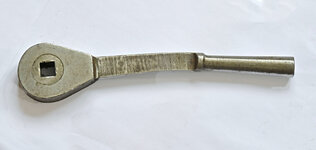
DSC_3288.JPG
 
To avoid these ads, REGISTER NOW!

Steve_P

Well-known member
Joined
Sep 15, 2010
Messages
5,181
Why is it "clearly nonferrous" if it's "strongly magnetic"? I would bet it's steel of some alloy if it's magnetic. It may be something as simple as nickel plated steel.
 
To avoid these ads, REGISTER NOW!

F-22

Well-known member
Joined
Jan 23, 2022
Messages
1,830
None of them 'strongly' though right?
I think some can be (especially with such a massive object). I have some 70's Italian bikes with stainless mudgards that seem to be as magnetic as normal steel. Stainless bolts and screws are typically very poorly magnetic.
 

GeoBruin

Well-known member
Joined
May 5, 2018
Messages
3,733
I think some can be (especially with such a massive object). I have some 70's Italian bikes with stainless mudgards that seem to be as magnetic as normal steel. Stainless bolts and screws are typically very poorly magnetic.
Ferritic and Martensitic stainless steels are magnetic, with the extent varying based on whether they are anealed or tempered to some degree. Among the various stainless steels, 420 has been a popular choice for tools. It is Martensitic and magnetic.
 
Last edited:

matthew

Well-known member
Joined
Dec 4, 2009
Messages
1,345
The magnetic properties of stainless depend on its crystal structure.

304 and 316 are two common alloys, and have around 18% chromium and 8% nickel. They typically have a grain structure called ‘austenite’ which is non-magnetic, but in practice they are very mildly magnetic because the crystal structure has imperfections from when it is formed and from machining and bending. (Example - have you ever noticed your cutlery seems slightly magnetic, but some pieces more than others? Likely they are an 18/8 alloy.)

410 and other alloys have other crystal structures, such as martensite or ferrite, and are magnetic similar to mild steel. I think someone once told me 410 or 430 were more common in heat exchangers, not sure what other applications.
 
Last edited:

Old Man Roger

Well-known member
Joined
Apr 6, 2017
Messages
17,409
Location
Palm Coast Florida
The magnetic properties of stainless depend on its crystal structure.

304 and 316 are two common alloys, and have around 18% chromium and 8% nickel. They typically have a grain structure called ‘austenite’ which is non-magnetic, but in practice they are very mildly magnetic because the crystal structure has imperfections from when it is formed and from machining and bending. (Example - have you ever noticed your cutlery seems slightly magnetic, but some pieces more than others? Likely they are an 18/8 alloy.)

410 and other alloys have other crystal structures, such as martensite or ferrite, and are magnetic similar to mild steel. I think someone once told me 410 or 430 were more common in heat exchangers, not sure what other applications.
And then there’s Chinese stainless steel, which just has cast iron in it..lol Ya, the house I just bought came with new “SS“ appliances, the fridge already has a tiny rust spot.
 

malacti

Member
Joined
Jun 12, 2023
Messages
18
And then there’s Chinese stainless steel, which just has cast iron in it..lol Ya, the house I just bought came with new “SS“ appliances, the fridge already has a tiny rust spot.
All stainless can rust. Even the good stuff depending on what it’s exposed to.
 

matthew

Well-known member
Joined
Dec 4, 2009
Messages
1,345
All stainless can rust. Even the good stuff depending on what it’s exposed to.
Yes. And even how it has been processed. If there is a spot weld, sometimes a rust mark is left that needs to be cleaned because of iron coming out of solution.

In seriousness - stainless has a reputation for corrosion and non-magnetic properties that has often led to it being misapplied. It is prone to pitting corrosion when exposed to chlorides, for example.

While there’s a good chance this case is on the low side of the chromium spec, the fact it’s a spot and not across the whole surface does beg the question - how was it processed and what was it exposed to? Clean it, and see what happens…
 
To avoid these ads, REGISTER NOW!
Top Bottom