To avoid these ads, REGISTER NOW!

What size wire do I need?

Corbin5754

Well-known member
Joined
Sep 11, 2016
Messages
47
Location
Indiana
I think I know what wire size I need but I just want to make sure. I'm running power to my steel building about 65 feet away from my 200 amp house breaker panel. I want to install a 60 amp sub panel out there and need to know for sure what size wire I need before I order it. I'm going with direct bury wire and the size I plan on going with is uf-b 6/3 with ground is that right? And is there a certain kind of sub panel box I need to buy? Is a 60 amp sub panel and a 60 amp breaker panel the same thing? Thanks for your help.
 
To avoid these ads, REGISTER NOW!

ishiboo

Well-known member
Joined
Oct 27, 2010
Messages
9,481
Location
Oshkosh, WI
There's a forum for lighting/electrical :)

I would personally run 2-2-2-4 mobile home feeder, it's going to be a lot cheaper and give you 90 amps.
 

readhead

Well-known member
Joined
Dec 8, 2012
Messages
6,175
Location
Durango, Co.
You are digging a trench anyway. Why wouldn't you put conduit in it? Over the years I have had to dig up poorly buried direct bury cables to find and repair damaged spots that short to ground. Conduit is cheap insurance.
 

coljar

Well-known member
Joined
Sep 26, 2010
Messages
6,243
Location
Belpre, Ohio
You are digging a trench anyway. Why wouldn't you put conduit in it? Over the years I have had to dig up poorly buried direct bury cables to find and repair damaged spots that short to ground. Conduit is cheap insurance.

This. I won't try to answer whether the size is right because I run that by my electrical inspector friend, but putting it in conduit is the right thing to do. Conduit is very cheap.
 

ishiboo

Well-known member
Joined
Oct 27, 2010
Messages
9,481
Location
Oshkosh, WI
The only reason I want to run direct bury is so I won't have to deal with running conduit.

You don't need conduit, except above ground. But I would recommend it, especially being such a short run. If not, I'd bury it in sand. MHF is a lot more pleasant to strip than UF too :thumbup:
 

jp828108

Well-known member
Joined
Jun 28, 2011
Messages
484
Location
Ohio
I'm no electrician, but as long as you can shut power off to it then i don't see either of them being a bad option. I like the idea of conduit, and keeping track of where and how deep you bury it. Gives you a little cushion if you ever have to dig close to it. I know there are at least several thousand feet of direct bury at my parents place. It feeds to a remote natural gas well on their farm. I know of one place when drains were being installed that it was gotten into. the patches were expensive and probably better than what the gas company would have used, but to my knowledge it has never just failed, some type of interaction like digging caused the issue, not just sitting undisturbed in the ground.

Ultimately I would call a local electrical supply house and see what they recommend. I would compare it to the answers from the guys on here who frequent the electrical forums. I think a few of them are electricians too. Me personally I would use wire that is rated to be in conduit and run it in conduit for the piece of mind, unless someone can tell me why direct burial would be better other than cost.
 

readhead

Well-known member
Joined
Dec 8, 2012
Messages
6,175
Location
Durango, Co.
Direct bury failures are usually caused by poor installation. Someone gets lazy and decides that the dirt removed from the trench "isn't that bad" and doesn't have the proper sand delivered. They skip the most important step in the direct bury process. During the backfill a sharp rock lands on the wire. I think this is more of a problem in cold country because of freezing but that rock eventually cuts the insulation and now one leg is shorting to ground somewhere.

Direct bury was popular around here until about ten years ago and now the supply houses don't even keep it in stock. Conduit provides a better finished product and piece of mind.
 

cj7jeep81

Well-known member
Joined
Jul 11, 2006
Messages
463
Location
S.E. Indiana
I also vote for MHF 2-2-2-4 (can get at any box store), and conduit. As for the breaker, you could breaker at the house with 60amp or 90amp. If 60amp, make sure the breaker can accept 2 gauge wire, it will say on the side.
For the panel in your shop, I would go with a 100amp panel with a main breaker. It doesn't matter if the amperage of the panel is greater than the amperage of the feeder breaker, and it will give you more room. Also, the box stores normally have starter kits of a 100amp panel and a handful of breakers for a very reasonable price.
 

John in OH

Well-known member
Joined
Jun 2, 2007
Messages
2,444
Location
SE Ohio & Eastern Virginia
I also vote for using conduit. Yeah, you don't need it, but 65 ft. of 2" conduit is cheap and gives you added protection, so, "why not"? You might want to add a second run of 1-1/2" conduit adjacent to the primary conduit with a pull rope through it for any future, unforeseen need. Again, once you've dug a trench, why not take advantage of it to the max?
 

Radix2

Well-known member
Joined
May 28, 2014
Messages
1,853
Location
the thumb!, MI
Maybe it is a local problem, but I don't see the value of conduit for properly sized feeds.

Millions of homes with underground feed are direct burried. Failure rate is nothing. I'd put a conduit in for future "stuff". But for main feeds? Nah.

2-2-2 MHF is not going to go bad or need to be upsized...
 

Radix2

Well-known member
Joined
May 28, 2014
Messages
1,853
Location
the thumb!, MI
The quality/thickness of insulation doesn't even compare. Part of that of course is due to the insulation requirements for the much higher voltage.

https://psc.wi.gov/thelibrary/publications/electric/electric11.pdf

Direct bury failures are usually caused by poor installation. Someone gets lazy and decides that the dirt removed from the trench "isn't that bad" and doesn't have the proper sand delivered. They skip the most important step in the direct bury process. During the backfill a sharp rock lands on the wire. I think this is more of a problem in cold country because of freezing but that rock eventually cuts the insulation and now one leg is shorting to ground somewhere.

Direct bury was popular around here until about ten years ago and now the supply houses don't even keep it in stock. Conduit provides a better finished product and piece of mind.

Sberry is talking about regular 240 feeds to homes. New construction in many areas is underground feed only. They just drop the wire in a trench and go.

Are you guys saying the poco in your areas are doing conduit to houses from the transformers?

I just converted from overhead. They said if I wanted to do the work I would have to do conduit to the pole. Or pay them to do the whole thing. The cost for me to do it was as much as letting them do it... so I let em.... dig it and drop the wire right in.
 

ishiboo

Well-known member
Joined
Oct 27, 2010
Messages
9,481
Location
Oshkosh, WI
Maybe it is a local problem, but I don't see the value of conduit for properly sized feeds.

Millions of homes with underground feed are direct burried. Failure rate is nothing. I'd put a conduit in for future "stuff". But for main feeds? Nah.

2-2-2 MHF is not going to go bad or need to be upsized...

Except he needs a ground.

Conduit is so cheap and easy to work with, I don't understand why it's a big deal. 65' run is 7 sticks, at $6 a piece for 2". $42. I guess you need an expansion joint or two as well. I think you can sneak by with 1-1/2" and save $10. The money he saved going from UF to MHF already paid for conduit.

If this was a long run and there were substantial savings to be had, maybe it'd be a different story. When I dig and bury I run everything I can. My Internet antenna pole has 3 Cat6 direct burial, two 14-2 UF, and a 1" poly water pipe in case I need to pull something in the future. I'd rather spend an extra few bucks now than deal with digging up the yard again in the future.
 
OP
C

Corbin5754

Well-known member
Joined
Sep 11, 2016
Messages
47
Location
Indiana
Thanks for the input guys. I'll look into the conduit. So what sub panel and breakers should I go with if I get the 2-2-2-4 mhf wire
 
To avoid these ads, REGISTER NOW!

mburrus

Well-known member
Joined
Nov 15, 2014
Messages
235
Location
Miami, Fl
i would do a run of 2" PVC along with it. i work for the power company. direct burial cable WILL fail... much easier to have a conduit to pull a new cable in to...!!! the labor is in opening the trench, PVC is fairly cheap and very easy to install
 

ishiboo

Well-known member
Joined
Oct 27, 2010
Messages
9,481
Location
Oshkosh, WI
Thanks for the input guys. I'll look into the conduit. So what sub panel and breakers should I go with if I get the 2-2-2-4 mhf wire

I'd breaker it for 90A in your house for the full capability. Doesn't matter if you go with a 100A, 125A, 150A or 200A sub-panel/main breaker in the outbuilding... just get the number of spaces you'll need plus room to grow. The breaker in the outbuilding is just a shutoff.
 
OP
C

Corbin5754

Well-known member
Joined
Sep 11, 2016
Messages
47
Location
Indiana
Ok so I'll probably go with the 2-2-2-4 wire.
Now do I have to use a 90 amp breaker in the house panel? If so I'll go with a 90 amp breaker and a 100 amp sub panel in the out building.
Is there a certain type of 90 amp breaker I need to get?
 
OP
C

Corbin5754

Well-known member
Joined
Sep 11, 2016
Messages
47
Location
Indiana
This pic is takin right next to where my main panel is.
 

Attachments

  • IMG_3827.jpg
    IMG_3827.jpg
    152.9 KB · Views: 51

ishiboo

Well-known member
Joined
Oct 27, 2010
Messages
9,481
Location
Oshkosh, WI
Ok so I'll probably go with the 2-2-2-4 wire.
Now do I have to use a 90 amp breaker in the house panel? If so I'll go with a 90 amp breaker and a 100 amp sub panel in the out building.
Is there a certain type of 90 amp breaker I need to get?

No, you could use an 80, 70, 60, 50, 40, 30, 20, 15, 10... :) You might find a 50A is much much cheaper and available at your local big box store, whereas a 90A is not... you're fine going with a 50A, but then the #2 may not fit in the lugs.

You need whatever type of breaker your panel requires.
 
OP
C

Corbin5754

Well-known member
Joined
Sep 11, 2016
Messages
47
Location
Indiana
Ok so whatever size breaker I install in the house panel is what will be the available power in the out building? I only have room for a single pole breaker in my house panel. If I put a 30 amp single pole in the house panel will that be like having 60 since the house is a 200 amp service. And if I go with a 30 amp breaker will the wire from the 2-2-2-4 mhf fit into a 30 breaker?
 
OP
C

Corbin5754

Well-known member
Joined
Sep 11, 2016
Messages
47
Location
Indiana
And honestly I really don't need anymore then 60 amps out there so what size mhf wire is good for a 60 amp feed 70 feet away?
 

Attachments

  • IMG_3954.jpg
    IMG_3954.jpg
    134.4 KB · Views: 26

cj7jeep81

Well-known member
Joined
Jul 11, 2006
Messages
463
Location
S.E. Indiana
Ok so whatever size breaker I install in the house panel is what will be the available power in the out building? I only have room for a single pole breaker in my house panel. If I put a 30 amp single pole in the house panel will that be like having 60 since the house is a 200 amp service. And if I go with a 30 amp breaker will the wire from the 2-2-2-4 mhf fit into a 30 breaker?

A single pole breaker will only give you 30 amps of 120v service. I highly doubt a 2 gauge wire would fit in a 30amp breaker, but it should be listed on the side of the breaker what size wires will fit. I would recommend checking to see if you can get the tandem breakers for your panel, and free up space. To run a subpanel, you'll need to feed it with a double pole breaker.
 
OP
C

Corbin5754

Well-known member
Joined
Sep 11, 2016
Messages
47
Location
Indiana
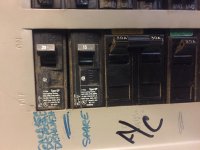
In pic I uploaded there's 2 spares on my panel not being used,one towards top and one in middle can I pull them both and move the 2 breakers in between them down so there will be room for a double pole breaker
 

Attachments

  • IMG_3956.jpg
    IMG_3956.jpg
    8.7 KB · Views: 31

ishiboo

Well-known member
Joined
Oct 27, 2010
Messages
9,481
Location
Oshkosh, WI
In pic I uploaded there's 2 spares on my panel not being used,one towards top and one in middle can I pull them both and move the 2 breakers in between them down so there will be room for a double pole breaker

This is Canada? I have no idea if anything I said is correct for Canada. Please put your location in your profile.
 
OP
C

Corbin5754

Well-known member
Joined
Sep 11, 2016
Messages
47
Location
Indiana
Ok I can use a tandem breaker to free up space. So should I plan on getting a double pole 30 amp breaker to feed into a 60 amp panel in out building? And I'm still confused on which wire I need to get so I can buy conduit and wire, run it and let a electrician connect the wiring.
 

pattenp

Well-known member
Joined
Jun 4, 2008
Messages
10,175
Location
Virginia - USA
If using 2-2-2-4 you should be using a double pole breaker. And in most cases a 50A is the smallest breaker that #2 will fit in.
 

pattenp

Well-known member
Joined
Jun 4, 2008
Messages
10,175
Location
Virginia - USA
Mhf doesn't require conduit, except above groung, just like uf-b

MHF is not just like UF-b when it comes to installation. MHF has to be in conduit where above ground and inside the structure. UF-b only needs to be in conduit where subject to possible damage.
 

mike93lx

ALLIANCE MEMBER
Joined
Dec 9, 2013
Messages
37,406
Location
Richmond, VA
MHF is not just like UF-b when it comes to installation. MHF has to be in conduit where above ground and inside the structure. UF-b only needs to be in conduit where subject to possible damage.

Sorry, yes. I was thinking about installation outside of a structure and should have qualified my statement. Thanks for the correction.
 
OP
C

Corbin5754

Well-known member
Joined
Sep 11, 2016
Messages
47
Location
Indiana
I don't know why but I just don't feel comfortable putting in a 90 amp breaker in the main panel. If I use 2-2-2-4 wire in conduit and want 60 amp service in my detached building what double pole breaker do I get for the main panel?
Sorry for all the questions but I just want to get everything ran before I get a electrician to wire it up.
 

cj7jeep81

Well-known member
Joined
Jul 11, 2006
Messages
463
Location
S.E. Indiana
You would use a 60amp double pole breaker in the house if that's what you want in the shop. You could then install a 100 amp (or 200 amp, or anything 60amp or greater) panel in the shop with no problem. The 100 amp breaker in the shop panel would just serve as a disconnect, as you would be limited to the 60amp supplied from the house.
 
To avoid these ads, REGISTER NOW!
Top Bottom