To avoid these ads, REGISTER NOW!

What to put under tile in bathroom? New stuff? Hardi?

Itsjustdirt

Well-known member
Joined
May 15, 2013
Messages
531
Location
San Diego, California
I haven't tiled anything for a decade or two. I'm renovating our bathroom and will be doing the floor and tub surround. What do you guys like to use as a under-tile surface/waterproofer?

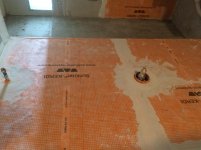
Hardibacker on the floor and tar paper/hardibacker for tub surround? I've seen new products (some orange plastic stuff with a bunch of small blocks) on renovation shows. Is there anything new/better?

Thanks!
 
To avoid these ads, REGISTER NOW!

kd3pc

Well-known member
Joined
Aug 10, 2013
Messages
3,630
Location
Northern Neck
backer/hardi board and ditra

make sure to glue, screw the backer board to the flooring as tight as you can with no movement
 

larry4406

Well-known member
Joined
Jan 27, 2006
Messages
19,578
Location
Northern Virginia
What is the flooring in the adjacent room?

Whatever you add to the bathroom subfloor as a substrate will raise the finished elevation. You may then end up with a threshold/transition/ aka trip hazard.

In my case my bathroom was adjacent 3/4" sand on site hardwood. Thus I chose 3/8" AC plywood glued and screwed to the subfloor. After thinset and tile, it planes out perfect with the hardwood.

In my shower I used concrete board, fiber mesh tape, and sealed all 100% with Red Guard.

At work, on our bathrooms we use 1" mud set floors. Then a threshold. Creates a nice trip hazard which I hate. I do love the mudset floor, never have had a cracked bathroom tile in 15 years+.

In our first floor kitchens, we use concrete board (1/2") which still results in an elevation difference to the hardwood which I detest and thus a trip hazard reducer is needed.
 
Last edited:

hefnerconstructionlc

Well-known member
Joined
Nov 1, 2016
Messages
665
Location
Kansas
For the tub surround you could use the Schluter Kerdi product. This is a waterproofing membrane that is applied on the tub surround. You can use moisture resistant drywall for your tub surround and follow it with the Kerdi product. The key to a good bond is to get your thin set quite wet. That allows it to wick into the fleece binder of the Kerdi product and Bondwell to the Drywall substrate. You can go to their website and explains the process quite well. The other option is to use cement backer board and coat the seams with alkali resistant mesh tape. And then follow up with two coats of red guard on the seams and preferably the whole surround. The red guard method is slightly cheaper and faster but certainly not as good a process as the Kerdi.

For your floor you could use quarter inch cement backer board set in quarter inch modified thin set mud bed. Or you could use the Schluter Ditra System which allows for a waterproof seal and uncoupling membrane. What the uncoupling membrane does is allows subfloor below to move independently of the tile and this helps prevent cracking of the tile. It's the very same system the Romans used by setting tile in a sand base. It allowed the tile to move in the and bass independent of the ground movement and to thus not crack the tile. As a disclaimer I have no interest in the Schluter products I am just a general contractor and we find ourselves doing tile extensively for customers.

Nine times out of 10 for floors,I find cement backer board set in a thin set mudbed is the most cost-effective way to install tile on the floor. Basically you'll use a quarter inch trowel and coat the sub floor with the modified thin set. Then you just use galvanized roofing nails and nail the cement backer board down. This makes the floor more flush then using backer board screws. Also avoids the problem of over driving the back board screws through the thin quarter inch cement backer board problem. Make sure to coat your backer board seems with alkaline resistant mesh tape. Then coat the seams with a light coat of thin set prior to setting your tile. This will avoid your grout from popping later down the road.

I attached a few photos of the Kerdi product in action. Good luck.
 

Attachments

  • IMG_9952.jpg
    IMG_9952.jpg
    141.8 KB · Views: 48
  • IMG_9922.jpg
    IMG_9922.jpg
    140.1 KB · Views: 51
OP
I

Itsjustdirt

Well-known member
Joined
May 15, 2013
Messages
531
Location
San Diego, California
Thanks guys! I think I like the Kerdi stuff! Looks like a good product. I forgot to mention, this is going to be done upstairs in an older wooden house. I've reinforced the **** out of the floor joists and blocked them as well. Obviously, there will still be more vibrations than on a concrete slab. Is this more of a reason to use the Kerdi product on the floor?


I noticed no one mentioned roofing paper behind the cement board if using that option for tub surround. Is that because its implied or do you just screw the cement board to the wall and tape the seams?
 
To avoid these ads, REGISTER NOW!

memphisnate

Well-known member
Joined
Jan 8, 2010
Messages
398
Location
Memphis, TN
The reason for tar paper or plastic behind the cement board is the paper/plastic is the water barrier. If you use one of the systems or Redgard, thats the waterproofing on the "Frontline".

Sent from my XT1650 using Tapatalk
 

hefnerconstructionlc

Well-known member
Joined
Nov 1, 2016
Messages
665
Location
Kansas
Really the Kerdi des not need to go on your floor unless you're trying to make a waterproof liner in the bathroom floor. The Kerdi product is a waterproofing membrane, they make a floor product which is called Ditra. If you're not too worried about major water leak's then just fill up your floor well with concrete board and put your tile down.. If you're worried about water leaks then you can take the next step. But properly installed concrete board with mud and tape seems, a tile and mop board tile should keep 95% of the water right where it should be.
 

ford33

Well-known member
Joined
Feb 26, 2011
Messages
2,118
Location
Chicago, IL. USA
I am doing a bathroom floor right now. The initial bathroom floor lasted 30 years and was exterior plywood subfloor with vinyl stick on tile. No rot found. I am placing ceramic tile on 1/4" thick concrete backer boards. I expect it to last another 30 years. Consider the millions of tile floors that are properly installed with backer board and tile and you will understand that it works fine.
 

38 Dodge Coupe

ALLIANCE MEMBER
Joined
Mar 19, 2013
Messages
419
Location
Delaware Ohio
I use the same method as kd3pc. Removed existing floor covering and then put 1/4" hardi backer 3' x ' board with gray thinset underneath and then attach the board with screws to the sub floor designed for the cement board. It will provide an outstanding base and will further stiffen the floor for minimal movement which is critical for a tile floor.
 

rustyjames

Well-known member
Joined
Dec 28, 2008
Messages
1,077
Location
central nj
Just a heads up: Cement board applied to the floor shouldn't be glued down, it's supposed to be set in a bed of thinset, using the proper notched trowel.

For detailed tile installations the John Bridge website is highly recommended.
 

Jon_E

Well-known member
Joined
Aug 19, 2015
Messages
575
Location
Southwestern Vermont
For my floors I did 1/4" Hardibacker over thinset on the subfloor, screwed down. For the shower walls I did 1/2" Durock screwed right to the studs, then some kind of thick waterproofing (equivalent to RedGuard but it was blue or black) and then thinset tile on the surface. I also referred to the John Bridge website heavily when doing my tile work.
 
To avoid these ads, REGISTER NOW!
Top Bottom