To avoid these ads, REGISTER NOW!

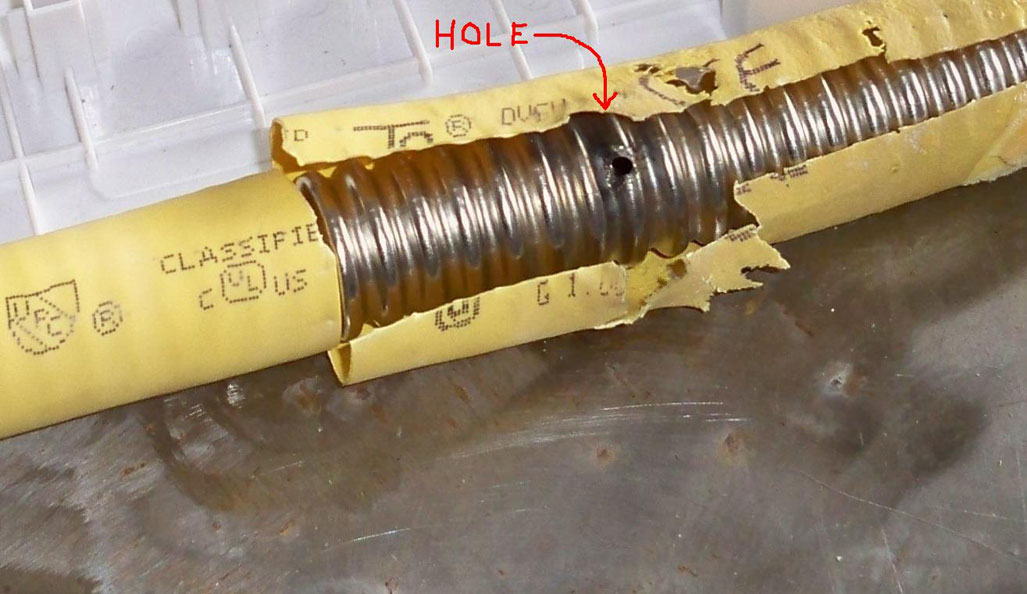
What was found after the gas explosion

HoosierBuddy

Well-known member
Joined
May 9, 2006
Messages
2,919
Location
Southern Indiana
This picture was taken following a gas explosion on a pool heater. The water dripping off of it is from the sprinkler system, which put the fire out. Significant structural damage to the building the pool heater was in but thankfully no one was hurt.

At this time it is not certain if the split in the pipe was the cause of or the result of the explosion.

Those of you that think CSST is the answer to all your gas piping needs....I don't think I agree. In fact, I would avoid it unless there were no other way to do the job. But that's just me. It is allowed by code if installed by a qualified person to the proper specifications including protection from hazards and bonding.

Good Luck.

Phil
 

Attachments
  • csst line.jpg
    csst line.jpg
    114.1 KB · Views: 661
Last edited:
To avoid these ads, REGISTER NOW!

Zick

Well-known member
Joined
May 13, 2009
Messages
418
Location
WI
Did this CSST pipe have any possible movement were it would cause it to crack like that?

I've got a couple gas fireplaces that were installed using CSST, but I can't image why they would break like that unless there was continous movement going on.
 
OP
H

HoosierBuddy

Well-known member
Joined
May 9, 2006
Messages
2,919
Location
Southern Indiana
Did this CSST pipe have any possible movement were it would cause it to crack like that?

I've got a couple gas fireplaces that were installed using CSST, but I can't image why they would break like that unless there was continous movement going on.

Zick,

Like I said...It could be that the explosion rocked the pool heater so bad it broke the CSST. That being said, until the gas got shut off that split was bleeding live gas...so even if it wasn't the cause (and it may have been...the fire marshal is investigating that) but even if you're right...???? It still ain't no good to have a split like that.

I mean...have you ever seen black pipe split? I haven't.

Phil
 

Zick

Well-known member
Joined
May 13, 2009
Messages
418
Location
WI
It will be interesting to find out if that split caused the exposion and if so, why did it split?

Thanks
 

zmaxmotorsports

Well-known member
Joined
Jan 11, 2013
Messages
11,948
Location
South of omaha
Im a retired electrical/hvac/plumbing contractor.
Ive been fighting the use of that trash since the first time I layed eyes on it.
But what can I say everbody wants cheap/fast,thats what you get with cheap fast!
I didn't notice if that piece was bonded/grounded or not.:(
Nope not bonded on that end anyway
 

message

New member
Joined
Sep 25, 2012
Messages
2
Location
Sioux Falls, SD
I'm no expert but I have run a couple lines of CSST and proper fitting installation should not leave any metal exposed.
Unless you cut the yellow insulation off the pipe to display the leak?
 

welder4956

Well-known member
Joined
Apr 8, 2010
Messages
3,066
Location
Birmingham, AL USA
This picture was taken following a gas explosion on a pool heater. The water dripping off of it is from the sprinkler system, which put the fire out. Significant structural damage to the building the pool heater was in but thankfully no one was hurt.

At this time it is not certain if the split in the pipe was the cause of or the result of the explosion.

Those of you that think CSST is the answer to all your gas piping needs....I don't think I agree. In fact, I would avoid it unless there were no other way to do the job. But that's just me. It is allowed by code if installed by a qualified person to the proper specifications including protection from hazards and bonding.

Good Luck.

Phil

A metallurgical evaluation would be needed for the fracture surface and adjacent material to determine if it was due to a single rapid overload event, or if it may have been another mechanism. Being near pool chemicals would make me suspect chloride stress corrosion cracking if the pipe is made from a 300 series stainless steel. There does appear to be some corrosion in the bottom of the convolution that contains the fracture and the 2 to the left of it. The amount of cold work needed to form the convolutions on the pipe would provide enough residual stress and sensitivity of the material to stress corrosion. All it would need is a source of chlorides, which would be the pool chemicals from wetting or spillage on the pipe. But that would just be a wild *** guess unless it was confirmed by a thorough metallurgical examination.
 
Last edited:

Highbeam

Well-known member
Joined
Feb 15, 2011
Messages
2,292
Location
Mt Rainier foothills, WA
In a pool mechanical room, there are plenty of corrosive gasses being oozed so no actual liquid spillage or wetting is required. Terrible environment for bare metals.
 

Kevin C

Well-known member
Joined
Aug 4, 2011
Messages
1,653
Location
Portland OR
http://www.cleveland.com/nation/index.ssf/2011/12/nearby_lightning_strike_can_tu.html

hole-gas-line.jpg


http://www.classiclightningprotection.com/damage.html

Another version of the same issue.
 

ishiboo

Well-known member
Joined
Oct 27, 2010
Messages
9,481
Location
Oshkosh, WI
Interestingly, being RIGHT NEXT to an appliance, CSST may have been used there even if black pipe were used for the rest of it. Even if that install was all black pipe, a gas stove or dryer would have been connected via CSST... and many furnaces/water heaters/etc. now are as well.

Kevin - NOT the same issue... lightning strike issues with CSST are well known and bonding requirements have changed.
 

Kevin C

Well-known member
Joined
Aug 4, 2011
Messages
1,653
Location
Portland OR
l.

Kevin - NOT the same issue... lightning strike issues with CSST are well known and bonding requirements have changed.

Believe it or not... I knew that. I still posted because problems with that style of material seemed relevant.

Edit: By issue I meant that type of piping developing a leak because the walls are quite thin.
 
Last edited:
OP
H

HoosierBuddy

Well-known member
Joined
May 9, 2006
Messages
2,919
Location
Southern Indiana
Believe it or not... I knew that. I still posted because problems with that style of material seemed relevant.

The lightning strikes are still a concern in my book because:

1. These changes were made relatively recently and there has not been enough in-field evaluation to say definitively that bonding, by the new standards, protects CSST from lightning damage in all cases.

2. The changing standards have caused some confusion among qualified HVAC contractors (and even among a few code inspectors) about the proper method to bond CSST...so I am concerned that installers are just now becoming aware of changes to requirements and some installations may not be up to code.

3. To my knowledge (I might be wrong...check me on this, please) No one is going out and retrofitting old CSST installations with bonding wires.

3. THE HUGE problem is anyone can buy CSST from many stores and begin installing it without understanding the code requirements, and many of these installations will never be inspected by someone that knows what they should be looking for.

I'm not saying here that people that don't know how to plumb should be plumbing natural gas with black steel pipe either. But, normally a job of any size requires threading equipment (which 99% of homeowners don't have) so it sort of naturally prevents them from doing anything too terribly wrong with it, most of the time.

FINAL POINT...I will say one other (good) thing about CSST. For the homeowner that is bound and determined to run a gas line themselves and has no access to threading equipment...THEY CAN use CSST themselves and meet code. They need to read and study the manufacturer's qualification material (look online under the manufacturer's name or check with the store) and if they follow that code to the letter, they may well end up with a code compliant installation...which beats the HELL out of those I've seen glue up PVC and run gas down it because they didn't have threading equipment.

sigh.

Phil

p.s. Just in case anyone reads above and thinks I just said "you can use PVC for natural gas". No. You. Can't. Ever.
 
Last edited:
OP
H

HoosierBuddy

Well-known member
Joined
May 9, 2006
Messages
2,919
Location
Southern Indiana
Phil, or others,
Can someone expand on the new (?) bonding, or the new standards, protects CSST piping!

Thanks!

Read=>http://www.tracpipe.com/Customer-Content/WWW/CMS/files/152565_OmegaFlex_DIGuide_9.11.pdf

Looks like bonding is covered beginning page 52.

This is the 100 page manual that you must read and understand completely before you can legally install the 1st foot of trac-pipe.

If you were using Wardflex, they have a different manual. You'd have to read and understand it to legally install Wardflex per the U.S. national fuel code.

Every manufacturer has a different book and the fuel code says the installer has to be qualified to the manufacturer's procedures and install any of their product according to those procedures.

Phil
 
Last edited:
To avoid these ads, REGISTER NOW!

cj7365

Well-known member
Joined
Feb 13, 2012
Messages
816
Location
New Mexico
Im a retired electrical/hvac/plumbing contractor.
Ive been fighting the use of that trash since the first time I layed eyes on it.
But what can I say everbody wants cheap/fast,thats what you get with cheap fast!
I didn't notice if that piece was bonded/grounded or not.:(
Nope not bonded on that end anyway

so if you do not use csst to connect to your oven, dryer etc... what do you use? I am not a plumber/HVAC person, I grew up with this kind of connector.

What other options are there????
 

volaredon

Well-known member
Joined
Oct 7, 2012
Messages
1,618
Location
IL
I was wondering about that; I am hooking up a ventless heater in my attached garage (yeah I know but it's what I have--we'll see how it does the rest of this winter) It's one of the smaller ones10 or 15K BTU... I have a roll of 1/2" CSST given to me by a neighbor. I am gonna use about 5' of it in the crawlspace to the sill in the garage then a dryer/stove connector hose from the sill to the heater I don't know if this is gonna be "permanent" yet out there, man the fittings are stupid expensive.
I was planning on running the line underground to the detached garage in this material within a PVC "conduit" to power my Modine hanging heater; but now I don't know about that idea any more.... I was all gung ho on this idea but not so sure any more..
Is the lightning strike thing a "chance encounter" or does this material somehow "draw" lightning to it??? Is it more likely to have a strike in an area with CSST than if I plumb my gas thru something else? I only have 10' to go underground; well itll be about 14' because itll be 2' down.
 
OP
H

HoosierBuddy

Well-known member
Joined
May 9, 2006
Messages
2,919
Location
Southern Indiana
I was wondering about that; I am hooking up a ventless heater in my attached garage (yeah I know but it's what I have--we'll see how it does the rest of this winter) It's one of the smaller ones10 or 15K BTU... I have a roll of 1/2" CSST given to me by a neighbor. I am gonna use about 5' of it in the crawlspace to the sill in the garage then a dryer/stove connector hose from the sill to the heater I don't know if this is gonna be "permanent" yet out there, man the fittings are stupid expensive.
I was planning on running the line underground to the detached garage in this material within a PVC "conduit" to power my Modine hanging heater; but now I don't know about that idea any more.... I was all gung ho on this idea but not so sure any more..
Is the lightning strike thing a "chance encounter" or does this material somehow "draw" lightning to it??? Is it more likely to have a strike in an area with CSST than if I plumb my gas thru something else? I only have 10' to go underground; well itll be about 14' because itll be 2' down.

I would highly recommend you just go to the store and buy the proper sized and rated flexible appliance connector. The last couple I've bought have included an excess flow valve on the inlet of the coated-tubing. It acts as a circuit breaker to stop the flow of gas if the connector breaks.

Phil
 

SeanM

Well-known member
Joined
Mar 6, 2011
Messages
92
Interestingly enough I used a flexible appliance line from my supply line to my hanging heater when I did my gas install. The inspector came out and told me he wanted to see black pipe up to the heater. He also was the one that said even though my county permits the use of the CSST he would like to see that I used black pipe in the building as well.

He was very much against the use of the flexible piping. He said in his experience he has been trying to get the county not to allow it except for ranges. He also said that most all internal structure leaks / issues have been caused by flex pipe leaks or people piercing copper lines with screws/nails.
 

brewchief

Well-known member
Joined
Sep 20, 2008
Messages
2,370
Location
Michigan
I would bet that the split was from corrosion, in the tracpipe manual there is a requirement to wrap any exposed pipe to prevent corrosion when installed in a pool equipment room.

CSST has it's pros and cons, like any other product a lot of the reported problems are due to improper installation or application. I've installed thousands of feet of wardflex and tracpipe over the last ten years and it has been trouble free. We have had more problems with black pipe leaking in recent years since the majority of the fittings now come from china and other countrys that the words "quality control" must not translate to.

Several years ago we had a service call for gas leaks due to a lightning strike, there were leaks at many of the black pipe connections as well as damage at two appliance connectors.
 

darkk

Well-known member
Joined
Dec 24, 2009
Messages
3,361
Location
Willimantic, Ct.
GREAT! Now I have to worry :scared:about blowing up my new addition! I ran 65 feet of it inside the walls from upstairs down through the garage, through the laundry room into the basement. Christ! If mine goes, it'll take the whole house and new garage addition with it...:sad:
 

NUTTSGT

Super Moderator
Staff member
Joined
Sep 14, 2009
Messages
50,896
Location
Northern Central Ohio
I'd actually like to see more pictures of the entire area and a picture before the insulation was cut back.

Seeing the bluish-green oxidation on the fitting would lead to believe that it's possible that something could have been leaking. Typical NG leaks in black pipe at the joints usually yield some rusting of the pipe due to the moisture in NG.

If you have a NG leak in the service to your home, chances are there's a dead spot in the grass.
 

BadgerBoilerMN

Well-known member
Joined
Aug 4, 2011
Messages
837
Location
Minneapolis
We use CSST in Minneapolis every day. I have a couple hundred feet in my house.

A pool heater is not a very good example of any component failure. Have you tried to buy a pool heater. We are licensed in the city and the state of Minnesota for gas piping and find the vast majority of appliance and component failures are due to the illiteracy of the installer.

I am certified for all the CSST products, but yes, you can buy it at the local big box stores. Personal responsibility is the real issue.

http://publicecodes.cyberregs.com/icod/ifgc/2009/index.htm
 

CNGsaves

Well-known member
Joined
Sep 26, 2012
Messages
13,233
Location
KS and OK
CSST has it's place when PROPERLY INSTALLED . . . . but if environment where the gas line is going might be HARSH . . . ie wet / chemicals / etc then I would sure opt for black pipe steel for Natural Gas run (ie much safer). Why take a chance with CSST just to save a few bucks??

I've got CNG friends who are having problems with their GasCo pipeline NG supply being TOO wet . . . thus lots of water in the NG even though it comes from the gas company. One guy is in OH.

Personally, I would ONLY use CSST in totally protected space like open space in floor trusses if you were adding a NG run over to a NG stove or clothes dryer, and ONLY then if I was convinced that I was getting DRY natural gas from the GasCo.
 

BadgerBoilerMN

Well-known member
Joined
Aug 4, 2011
Messages
837
Location
Minneapolis
The CSST pictured was not installed to current standard...the SS would not be exposed. If the gas is "wet" I would not want ferrous pipe in my system. It would be CSST.
 

volaredon

Well-known member
Joined
Oct 7, 2012
Messages
1,618
Location
IL
I would highly recommend you just go to the store and buy the proper sized and rated flexible appliance connector. The last couple I've bought have included an excess flow valve on the inlet of the coated-tubing. It acts as a circuit breaker to stop the flow of gas if the connector breaks.

Phil

I have used a 'flexible appliance connector' on the heater. The CSST used comes off of a black iron pipe and wound up being about a 6' run to the sill in the crawlspace; with a "termination plate". From there, I went with a 1/2" NPT "close" ******, iron 90* fitting and a shutoff valve and then the "flexible appliance connector" and lastly of course teh heater.
 

CNGsaves

Well-known member
Joined
Sep 26, 2012
Messages
13,233
Location
KS and OK
The CSST pictured was not installed to current standard...the SS would not be exposed. If the gas is "wet" I would not want ferrous pipe in my system. It would be CSST.

We now understand you like/love CSST and will only install it.

However, NUTTSGT is a Fireman . . . he wrote:
NuttsGT said:
Seeing the bluish-green oxidation on the fitting would lead to believe that it's possible that something could have been leaking. Typical NG leaks in black pipe at the joints usually yield some rusting of the pipe due to the moisture in NG.

Since CSST is thin-wall . . . it definitely would fare WORSE in wet environment than black pipe steel. It would take a long time for black pipe steel to totally rust through!

I'll go with Fireman recommendation and limit my exposure of CSST to only those situations where it makes sense. NUTTSGT also said leaks in black pipe would show some rust . . . he didn't say pipe FAILURES. Minor leak in NG would hopefully be caught by the mercaptan smell emitted from the NG leak. I feel natural gas supply lines should be installed in the safest way possible.
 
OP
H

HoosierBuddy

Well-known member
Joined
May 9, 2006
Messages
2,919
Location
Southern Indiana
We're wandering rather far afield here but:

1. Natural gas liquids are not typically water. They are heavy hydrocarbons entrained in the natural gas stream. They cause no-end of problems (clogged pilot regulators, etc.) but corrosion is not one of the problems they cause. Corrosion inside a gas line is typically due to sulphides, which can combine with other elements to form acidic compounds in the gas stream. Sulphides are not normally present in natural gas...but it is something gas companies are probably cognizant of and would react to if they got into their systems.

2. Dead vegetation over gas leaks is quite common. In fact dead vegetation is one of the signs the public is asked to watch for to make them think "possible gas leak" (others being a 'rotten egg' odor, a hissing noise, bubbles appearing in puddles, or blowing dirt or soil). It is caused by the gas leak stripping oxygen from the soil, as it rises (60% of the weight of air) from the leaking underground line. The oxygen-less soil can't support vegetation and the grass dies over the leak.

Phil

p.s. Just to be clear, gas leaks on underground gas lines are not "normal". If you note the signs listed under 2., call your gas provider or 911 to report and leave the area. Your gas company must survey all of it's gas lines for leaks on a regular basis to meet code requirements.
 
Last edited:

brewchief

Well-known member
Joined
Sep 20, 2008
Messages
2,370
Location
Michigan
We now understand you like/love CSST and will only install it.

However, NUTTSGT is a Fireman . . . he wrote:


Since CSST is thin-wall . . . it definitely would fare WORSE in wet environment than black pipe steel. It would take a long time for black pipe steel to totally rust through!

I'll go with Fireman recommendation and limit my exposure of CSST to only those situations where it makes sense. NUTTSGT also said leaks in black pipe would show some rust . . . he didn't say pipe FAILURES. Minor leak in NG would hopefully be caught by the mercaptan smell emitted from the NG leak. I feel natural gas supply lines should be installed in the safest way possible.


I would rather have CSST in a wet environment then black pipe, I've seen CSST outdoors with nothing protecting it for years and it looks like new, on the other hand I've replaced black pipe that was installed low to the ground and got covered with mulch that has rusted out in a few years.

The chemicals in a pool room can cause all sorts of problems, combine them with a humid environment and you have a recipe for disaster.


Around here the gas is plenty dry, I've fixed plenty of gas leaks and never seen rust around them except when it's outside and was never properly painted.

I've installed lots of both black pipe and CSST, thousands of feet of both, in an area subject to physical damage I prefer black steel, a long run that will be buried above a drywall ceiling give me the no hidden leaking fittings CSST.

Like anything else it boils down to using the right materiel for the job and installing it properly.
 
To avoid these ads, REGISTER NOW!
Top Bottom