To avoid these ads, REGISTER NOW!

What would a shop have been like in World War 2?

William Payne

Well-known member
Joined
Mar 15, 2010
Messages
7,813
Location
Wanganui, New Zealand
Something made me wonder recently what would shops and tools have been like around the world during world war 2? Whether it be a machine shop, mechanics, all trades. Not just in the allied nations but axis as well. What would have been a top set of tools during the war?
 
To avoid these ads, REGISTER NOW!

Dave455

Well-known member
Joined
Mar 19, 2013
Messages
5,830
Location
Sussex, England
Well, I can help you to a degree, as my Grandmothers family ran a haulage company throughout the second world war, and my Grandfather helped my Great Uncle maintain the vehicles.

Obviously, I never saw the workshop “back in the day”, but it was described to me. They had space to get two or three vehicles in at a time, and plenty of room to work. They had an “inspection pit” to access the underside which was lit.

Grandfather and Great Uncle each had their own bench and their own tools (hand tools). Specialist tools were provided.

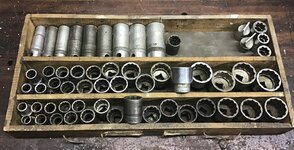
Grandfather owned a mixture of British and American tools. The latter were slightly less common in the U.K. back then, but Grandfather felt that the quality was first class, and some items (such as his Blackhawk sockets and accessories) were perfectly suited to his work. He had many Blackhawk, Armstrong and Billings wrenches too

Prior to the war he only really needed tools in British Standard sizes, but when American trucks became available he acquired tools in SAE sizes.

Back then, vehicles were easier to work on. There was more space, and fasteners were more generously sized so didn’t need to be torqued up like today. But, mechanics did much more, and parts would be rebuilt rather than replaced, hence the benches!

I still have all my Grandfathers tools from that era. He stored sockets and accessories in a surplus ammunition box fitted with drawers of his own making. Here are a couple.66542516-DEDD-4C4A-821B-9CC1AA1FC368.jpegCA76EAD5-4FB8-4A57-A602-B45BABBAC54E.jpeg
 

Farmer J.

Well-known member
Joined
Sep 18, 2016
Messages
1,995
Location
UK, Cornwall/Hertfordshire.
Pretty much what Dave said, and I reckon they were similar all over the world except maybe some hot countries they were just under a shady tree.
My late Mother, born 1922, grew up in Grandfather's Garage and told me the same as Dave says.
Personal property of the employee mechanics was only basic hand tools, usually in a wooden home made box or carry tote. Some special tools like bearing pullers were owned by the business and hung on boards or on the walls of the building.
The building itself was an uninsulated corrugated iron shed at ambient temperature, roasting hot in summer and freezing in winter with condensation dripping in between!
The facilities for workers were very basic. They ate packed lunch in the workshop. Toilet was a shed out the back. Cold running water was considered a luxury, but they did have that. Everyone was covered with oil, filth and grime and just lived with it. My Grandmother said doing the laundry was a nightmare as Grandfathers hands were always covered in waste oil and this contaminated his underwear every time he went for a pee. She said cancer growths on the scrotum was common because of this, but Grandfather survived that and 2 world wars but died of bowel cancer anyway.
The cars and trucks of that era required a lot of maintenance compared to vehicles of today, valve seat grinding every 30,00 miles, but as Dave says this was all basic stuff and done on benches in the workshop.
Whilst WW2 was going on of course they were all terrified of air raids and bombing and listened out for enemy aircraft all the time. The gasoline storage tanks underneath the forecourt would have blown them all sky high had they ignited. The nazis did aim an incendary bomb at the Garage, but it missed and landed in Great Uncles haystack nearby , shame, it burned all his hay. They spent the next decade joking about it, saying things like: "What is hidden in your haystacks, to make them a strategic target"?
Fuel was rationed of course (I still have some coupons) so in desperately short supply. Used lubricating oil was saved up from use in cars and re used in our farm tractors it was so difficult to get, and straining it through a cloth stretched over a funnel was a messy job.
That's what they said it was like.
 

Private Lugnutz

Well-known member
Joined
Mar 30, 2012
Messages
30,679
Location
The Authentic Jersey Shore
What would have been a top set of tools during the war?
I started a whole thread explicitly addressing this part of your query, linked here...


RTM

Well-known member
Joined
May 13, 2019
Messages
13,241
Location
SF Bay Area
My Grampa was a WW2 military mechanic, and had a home shop later in life. He died when I was 16 or so, and we only met once or twice, as he and Gramma divorced early, when Dad was young. A very thin set of tools got him by in his home shop, but he supposedly kept every bit of anything which may have been useful later. Was a bear to clean out.

I’ve since bought a few 1940s boxes, and some had so much scrap material which may have been useful later, following the frugal and reusing that FarmerJ and Dave mentioned above.

No first or second hand information tho.
 

Aaron_W

Well-known member
Joined
Feb 6, 2018
Messages
2,936
Location
Northern California
I suspect not as different as you might think with the exception of electronics and power hand tools. Of course all manual machines in machine shops, no CNC. Some of the most desirable machines for home shops today date back to the 1930s and 40s.

Electronics and CNC are obvious differences, but power tools stand out, not just the move to cordless, but corded handheld power tools were larger, and expensive so fairly rare.

I can remember helping my Dad with projects in the early 70s. He had some power tools, but he still used a lot of hand tools, hand saws, Yankee push drill, bit and brace, and the eggbeater style of drill. He didn't use the hand tools to be old school, they were just handier in many cases than the heavy, and kind of clumsy power tools. Most that he had were older and bought used so probably from the 1960s.

In auto shops as mentioned there was a lot more adjustment necessary requiring brake lathes, valve grinders etc, but you still see a lot of this equipment in shops today, they are just pushed in a corner covered with dust and cobwebs.

Truly portable chainsaws like we have today didn't come along until the late 1950s, so logging looked a lot different. Large 2 man chainsaws were around but there was still a lot of use of large one and two man hand saws (misery whip).

Older shops (older in the 1940s) were probably still using line shafts to power a lot of their equipment.
 
Last edited:
OP
W

William Payne

Well-known member
Joined
Mar 15, 2010
Messages
7,813
Location
Wanganui, New Zealand
I suspect not as different as you might think with the exception of electronics and power hand tools. Of course all manual machines in machine shops, no CNC. Some of the most desirable machines for home shops today date back to the 1930s and 40s.

Electronics and CNC are obvious differences, but power tools stand out, not just the move to cordless, but corded handheld power tools were larger, and expensive so fairly rare.

I can remember helping my Dad with projects in the early 70s. He had some power tools, but he still used a lot of hand tools, hand saws, Yankee push drill, bit and brace, and the eggbeater style of drill. He didn't use the hand tools to be old school, they were just handier in many cases than the heavy, and kind of clumsy power tools. Most that he had were older and bought used so probably from the 1960s.

In auto shops as mentioned there was a lot more adjustment necessary requiring brake lathes, valve grinders etc, but you still see a lot of this equipment in shops today, they are just pushed in a corner covered with dust and cobwebs.

Truly portable chainsaws like we have today didn't come along until the late 1950s, so logging looked a lot different. Large 2 man chainsaws were around but there was still a lot of use of large one and two man hand saws (misery whip).

Older shops (older in the 1940s) were probably still using line shafts to power a lot of their equipment.
Since you brought up CNC If you want some interesting reading on the history of CNC it dates from that era. Really fascinating reading on the early automated machines.

As someone who works in a tool and die shop and has spend his entire working life in shops I can imagine what it would have been like but I really wish it was possible to see it. Hopefully people may post pictures to go along with the awesome ones posted so far.
 
To avoid these ads, REGISTER NOW!

Farmer J.

Well-known member
Joined
Sep 18, 2016
Messages
1,995
Location
UK, Cornwall/Hertfordshire.
I suppose the only 'power tool' in Grandfathers Garage workshop would have been an air compressor for tyre inflation. He had a hand crank pillar drill and a blacksmith's leg vice, which my Son has now.
My Mother often said that there just wasn't many tools at all, they had so few because everything was so simple. They had access to a Blacksmith forge nearby and made use of it for chassis and body repairs, such as they were.
Once the Americans joined in to WW2 things became much improved, and the tool kits they brought with them (like in Don's pics in the post above) were the stuff of legend, considered so marvellous that people were still talking about them in the 1960's when I was growing up. Actually one of the things that led me to GJ was to find out about them.
Of course, these guys never threw anything away that may be useful, as RTM says, because they had just lived through the early 1930's depression and then war happened.
Oh, and they said they were very hungry almost all of the time, as well as scared, which made it difficult to work hard. My family was less hungry than most because of the farm but still, they were often hungry.
 

MShaw

Well-known member
Joined
Mar 2, 2015
Messages
1,014
Location
York, Pa.
I remember when when I started in a machine shop in 1963. I worked for the Chandler Evans co in West Hartford Ct.. They started making the carburetors for the Pratt & Whitney radial engines. Chandler Evans was in a back section of the other Pratt & Whitney that made machine tools, small tools, and gages. This Pratt & Whitney had been around since the 1850's and a lot of the shop area was like a dungeon. I remember the story of a group of employees getting reprimanded for "congregating" The truth was they were congregating around the only light at shop level bright enough to read a blueprint by.
 

driftpin

Well-known member
Joined
Dec 22, 2016
Messages
11,304
Location
Miami-Dade/Broward Co. Florida
A Delta DP220 with a casting date for the table of November 8, 1944, five weeks before the Battle of the Bulge. The underside of the table shows a DP200 casting. I've seen vintage pictures of what appear to be this model mounted side-by-side, on a manifold (not sure of the exact name) to drill simultaneous holes in stock.

Delta drill press.01.pngDelta drill press.02.pngDelta drill press.03.pngDelta drill press.04.jpg
 
Last edited:

Nevadablue

Member
Joined
May 29, 2022
Messages
12
My Dad was a Machinists Mate on a minesweeper in WWII. He didn’t talk a lot about the tools, and I’m sure they were specific to what they had to work on. He did say they had a small machine shop onboard and that the machinist could “make anything”.
One story was that they dropped a wrench, the only one they had for the job, into the crankcase of one of the two engines. They lowered a volunteer down into the oil, was up to his chest, and he picked up the wrench with his toes.
 

Steve from Socal

Well-known member
Joined
Jan 27, 2009
Messages
3,510
Location
Hutchinson Ks.
As for machine tools and metrology things were not as primitive as you may expect. Look at the hydro-tels and profilers, engine lines had all kinds of purpose built machinery. B&S made ten millionth reading mics.

The 1930's was the start of modern machine tool era and it adopted at a fast pace. Think of what Packard did to serial produce Merlin engines or Pratt & Whitney with R2800's Wright with the 3350 in the US. Mercedes and Jumo along with many others in Germany, RR and Bristol and on and on. The American and British machine tool industry always had German, Swiss and, French competition. At the start of the war there was some impressive machines by the end of the war a couple decades of progress was had in 6 years.

Steve
 

Provincial

Well-known member
Joined
Sep 21, 2011
Messages
6,874
Location
Near Salem, OR
Plenty of progress in machine tools during the war, but also consider the thousands of Atlas lathes that produced small items, often of aluminum, brass, bronze, zinc, or plastic, in venues as small as bedrooms and as large as real factories. These were not "state-of-the -art" but merely "good enough." It was all about meeting tolerances and using the right material and tooling. They were the other end of the spectrum, and did their job!
 

MarkH

Well-known member
Joined
Dec 19, 2005
Messages
1,353
Location
Kansas
Much smaller and with much less tools than we are used to now. Growing up the main shop filled that role from the 1930's to the mid 1970s. It was a a two story building with a storage attic and about the size of a large 1 1/2 car garage. We could fit in 1 tractor or 1 car or pickup. The trucks of the time could be nosed in. All other work was done outside on a large concrete slab next to the shop. It had a lean to attached to it to hold parts and other required storage such as tractor duals. We had to take the exhaust off most tractors when bringing them in and and of course a cab would not fit. Tractors and combines with cabs were the main driver for the new shops. We did and still keep an old International M with a cut off exhaust and a farmhand loader on it for snow removal in the winter in the old shop. It is an easy building to heat and makes it easy to start the tractor for snow removal.

We had a homebuilt workbench at the far end of the building. Next to it a Jungers stove and manual storage. On the other side storage for hardware built on the wall. You could find any bolt, nut, nail, etc hardware would have on hand so we did not have to go to town for it. We also salvaged items from teardowns and stored them here. Then we had two other wall parts storage areas for common parts for equipment and vehicle repair. Again no trips to town. We also had wood and metal storage areas.

Tools we had in the 1940s. I did an inventory in the late 60s and was told it had not changed for 20 years except the screwdrivers, wrenches and sockets had been replaced with Craftsman as my grandfather got better stuff as his kids learned more about repairs. The list did not include items like knives, drill bits, extension cords, etc and a few things my dad bought in the 60's. Of course everything was SAE.
1. One 15 gallon air compressor.
1 Air gauge
1 Air blow tool to clean grain drills.
1. Arc Welder they had to get special permission to get this during the war.
1. Ox Acetylene torch.
1 Manual drill press converted to electric
1 Power Hacksaw
1 Power Grinder
1 Anvil
1 Vise
1 1/4 in power drill
1 set open end wrenches 1/4 to 1 1/4
1 set box end wrenches 3/8 to 1 1/4
1 1/2 inch socket set with about 44 pieces
10 piece screwdriver set
1 Allen set
1 ignition set
4 adjustable wrenches
2 pipe wrenches
2 ford wrenches
4 various sized pliers
2 cutting pliers
1 end cutter
2 vise grips
1 tap and die set
4 hammers 1 claw, 1 ball peen, 1 cross peen, 1 blacksmith
1 sledge or BFH Hammer
2 wood saws
1 swede saw
1 coping saw
1 hacksaw
1 timing light
1 vacuum gauge
1 feeler gauge
1 gasket scraper
5 file and rasps
1 welding slag chipper
2 sanding blocks
2 pry bars
1 repair tool for sickles to replace the knives and remove and set rivets.
1 chain cutter
1 flat chain cutter
1 punch set
1 chisel set
1 wood chisel set
2 Deere wheel/axle adjusting wrenches.
2 grease guns
1 trouble light
1 suction pump
1 canvas/leather repair kit for swather canvases. Horses were gone by 1940.
2 bottle jacks
2 jack stands

That was it and there was very little we could not fix with the above. It was amazing most of it would fit in one portable tool chest. I almost doubled the number of tools we had when the 14 year old me bought my first set of tools from Sears with a 3 drawer tool chest in the early 70's. It also was more than most of the neighbors had too. It could be frustrating as multiple people were fixing things at the same time and having to share tools.

My home shop has about 100 times what granddad had. I do not know how he would respond if he saw it and how the tools are used.
 
Last edited:
To avoid these ads, REGISTER NOW!
Top Bottom