To avoid these ads, REGISTER NOW!

What would you do before you drywall?

Toddyus

Member
Joined
May 3, 2011
Messages
23
I am in the process of building a new 2-car garage. I've finally convinced myself to insulate and drywall before I move everything back in and want to get experienced opinions on what I should run in the walls before I finish them.

For reference, it's a 24wx20d garage.

Electrical:
How many outlets would you run in each wall? All at standard height? Any in ceiling? Would you wire everything for 15 amp? 20 amp? Mostly 15 with some 20? (Will have a 50 amp subpanel)

Lighting:
How many fixtures would you put in that space? I'm planning on fluorescent ceiling shop lights -- would you use 4' or 8'? Would you direct wire or run switched outlets?

Air lines:
Is it practical to run these in the walls or would it be better/safer to run them on the surface (in case of air leaks)?

Data:
I'm having the builder install a separate 2" conduit for low-voltage wire. Right now I plan to run several cat5/6 lines, a phone line, an RG6, some garage opener cable and some 4-wire speaker cable. I don't have immediate use for some of these, but figure it'll be cheap enough and quicker to do it in one pull. What else, if anything would you run in there?

What am I not thinking of?

Thanks for any insight.
 
To avoid these ads, REGISTER NOW!

sachapan

Active member
Joined
Jul 23, 2009
Messages
32
Location
Ontario, Canada
Congratulations on the build.

I am in the process of building a new 2-car garage. I've finally convinced myself to insulate and drywall before I move everything back in and want to get experienced opinions on what I should run in the walls before I finish them.

For reference, it's a 24wx20d garage.

Electrical:
How many outlets would you run in each wall? All at standard height? Any in ceiling? Would you wire everything for 15 amp? 20 amp? Mostly 15 with some 20? (Will have a 50 amp subpanel)

I like to run outlets every 4-5 feet at about 40" from the floor. Maybe add outlets in the ceiling for your garage door openers and maybe a hanging trouble light or two.

15 or 20 amp boils down to a couple of thoughts: are you likely to run multiple large amperage devices at the same time, e.g. a router and a table saw? If so, lean towards the 20 amp. 20 amp circuits also allow more outlets to be run per circuit although I don't see this being a big issue. In my (smallish) double garage, I added a few 15 amp circuits to the existing one, which is sufficient for my needs.

So my recommendation is 20 amp circuits if you think there is some advantage for your use otherwise a few 15 amp circuits and just one or two 20 amp ones (perhaps closest to the panel if the cost of wiring is an issue in your budget).

Lighting:
How many fixtures would you put in that space? I'm planning on fluorescent ceiling shop lights -- would you use 4' or 8'? Would you direct wire or run switched outlets?

Again, some personal choice here but I prefer switched 4' lights although there's nothing wrong with the 8 footers. I wired mine up with three rows of three lights each row on its own switch. Just doing a little something in the garage maybe with the doors opened? Just turn on the center row. Doing some detailed work? Light up all three rows and grab the sunglasses, especially if you're planning to paint the walls a gloss white.

Air lines:
Is it practical to run these in the walls or would it be better/safer to run them on the surface (in case of air leaks)?

Many here I think would recommend running the air lines in wall. Personally, I like the look of on wall mounting with proper stand offs. Just please, please, please don't ask for opinions on running air in PVC lines.
:shocking:

Data:
I'm having the builder install a separate 2" conduit for low-voltage wire. Right now I plan to run several cat5/6 lines, a phone line, an RG6, some garage opener cable and some 4-wire speaker cable. I don't have immediate use for some of these, but figure it'll be cheap enough and quicker to do it in one pull. What else, if anything would you run in there?

What am I not thinking of?

Thanks for any insight.

Sounds like you have your bases covered with that collection of wires. Definitely have an extra pull cord (or two or three) added to the bundle for the future you.
 

apexit1

Well-known member
Joined
Jan 25, 2011
Messages
336
Make sure you always have a snake in the conduit. It'll make running cables in the future much easier.
 

Cobra5150

Well-known member
Joined
Feb 2, 2008
Messages
1,953
Location
GA
Make sure you always have a snake in the conduit. It'll make running cables in the future much easier.
What do you feed the snake? And do you tie the cables to his tail then he pulls it through?:lol_hitti
Definitely put the outlets higher in the garage. How about wiring for speakers/TV?
 

bobemmerich

Well-known member
Joined
Aug 23, 2009
Messages
1,611
Location
Middletown, Ct.
Electrical, definitely run 20 amp outlets and GFI protect them. As far as height/amount, I would go by what local code suggests. I have a 16x20. All mine are at 48" from the floor, 3 on each wall.(had to be spaced at least 30" from each other) I also have one 15 amp circuit feeding a ceiling receptacle for a drop light, my lighting (4 T-40 4' flourescents and a single incandescent) and 2 wall outlets.
Lighting, for your size I would say go with the 8 footers, spaced about 4' apart. that should be plenty.
Air lines, personal preference is to have them run outside the walls with proper hangers. The reason is 2 fold: You can spot leaks/issues and you can tap into it if necessary.
Data sounds like you've got that covered fairly well.
Of course this is only my opinion, and should be taken with a grain of salt...LOL
 

RivennHewn

Well-known member
Joined
Jun 4, 2011
Messages
10,370
Location
PNW
Outlets are cheap. Put more in than you think you'll ever need.

Same for lighting. Add some lights that are switched separately so you can control light level. Also, have some for general lighting, and some task lighting above your work bench.
 

Olyar15

Well-known member
Joined
Oct 2, 2009
Messages
207
Location
Bowser, BC
What about a 240V outlet, in case you might want to power something like a compressor or a lift?
 

70redbee

Well-known member
Joined
Dec 31, 2008
Messages
494
Location
Knoxville,Md
Put outlets every 4' at 40" above the floor. Run 220 for future air compressor or and welder. Run your air lines to what you would like,really doesn't affect them either way. Run your cable,computer lines,tv cable and speaker wires to your chosen locations. I ran all my outlets on 20 amp. I would put my lights in 3 rows switched with 3 switches so you can turn on only the ones you need. Also put extra lighting above any work benches. Make sure to put outlets for garage door openers and outlets for a future ceiling fan. If you want reels mouted to the ceiling make sure you put in those outlets also. Put in extra conduits from the panel to the attic for future wiring, I would put in several extra conduits. Frame in for an access panel above the elec. panel for future wiring so you can remove it easily without cutting drywall. There are most likely many more things that I didn't mention but all the other guys will chime in for those things. Good info here on the board.
 
OP
T

Toddyus

Member
Joined
May 3, 2011
Messages
23
Wow, I knew this forum was good!

Great ideas on running additional conduit to the attic. I will be building with storage trusses and will need to light and power that space. I like the idea of running 20 amp outlets everywhere. The cost of wire and outlet's aren't enough to take a chance on needing it later.

On the lights, a couple people mentioned running three banks. I assume you would run those lengthwise from front of the garage to back?

I was thinking I would put my compressor in a back corner, then run an air line across the back wall with fittings near the compressor, near the middle of the garage and near the other corner. I'd also like to hang a reel from the ceiling. Is that overkill? Previously, I just had a reel near the compressor and pulled it all over the garage. Kind of a pain when you just want a little air for a quick project.
 

dreamingmuscle

Well-known member
Joined
Dec 4, 2005
Messages
3,472
Location
Tryon Oklahoma
Outlets should be 50 inches from the floor to the bottom of the box.

That way any plywood that might get leaned against it won't cover them up.


Put blocking between the studs where ever you think you might want to hang anything. Nothing is more frustrating then trying to hang something and not being able to find enough studs. That or take good notes and photo's of the stud locations so they can be found when it's time to hang those cabinets.
 

TooTall

Active member
Joined
Mar 24, 2006
Messages
34
Location
So. Cal.
And..... before you close it up take photographs for reference. Then you'll have a record of how your wires were routed and how the studs are arranged, etc etc.

Kurt O.
 

Jeff Ivers

Well-known member
Joined
Apr 9, 2010
Messages
2,556
Location
Oklahoma
Run 12/2 w/G and 20 amp breakers for all 115 v outlets.

Make sure each wall has at least 2 separate circuits.

Wire 1 30 amp 115 v outlet and at least 1 20 amp 220 v for air compressor and small MIG welder if you may go that way in the future.

All switches and outlets 50-52" off the ground.

Install a switch on the opener circuit so you can turn off the opener when out of town for security reasons.

Lights down each side and across the front of the shop where your workbench / open hood is likely to be. I find the 8' lights are much more reliable than the 4'.

Pictures of all walls before closing up.
 

Thruxton

Well-known member
Joined
Dec 30, 2010
Messages
767
Location
Virginia
Use 20A outlets and you won't have trouble with the plastic breaking off underneath the ground, also, by spec they have a greater grip than the 15A. I run mine 48" above the floor, but the suggestion of 50" to clear 48" panels is really good.

Also, I backed my drywall with plywood to give screws purchase for LIGHT loads- heavy stuff still gets attached to studs, of course.

As you can see, you have come to the right place- I have learned a ton here!
 
To avoid these ads, REGISTER NOW!

Racecarl

Well-known member
Joined
Oct 25, 2008
Messages
474
Location
McCook, NE
Ditto on the outlets 50" from the floor. Also do not use anything but commercial 20A outlets, they grip the cord prongs SO much better.
 

ddawg16

Well-known member
Joined
Jul 11, 2008
Messages
21,005
Location
S. California
Run speaker wires if you even 'think' you might want speakers at a later date.

Install a couple of outlets in the ceiling.

Put an outlet next to the garage door.....just in case you decide to install a Liftmaster....I wish I had.....
 

sheslostcontrol

Well-known member
Joined
Nov 22, 2009
Messages
250
Location
Decatur, GA
Definately go with 20a circuits and 20a receptacles. Lighting can still be 15a. Find where your desk or workbench will be and add a low-voltage box there. Pull an ethernet and coax line to the box, making sure to use shielded versions of both cable and do NOT run parallel to high voltage (you may need to get creative on cable placement).

You may also want to make a station where your ethernet/coax/speaker wire enters the garage.. a platform or something where you can mount a switch/router and other electronic goodies. Be sure to have a 2-gang high voltage box and receptacles to power the electronics.

I have 3 ethernet ports in the shop area, and 7 more in the office/studio above. Each has a coax jack too.. in case I need one in the future. All the cable runs to one spot (12 total ethernet including 2 runs from the house.. one is for backup if the other fails) and go into wall jacks for easy management.
 

sheslostcontrol

Well-known member
Joined
Nov 22, 2009
Messages
250
Location
Decatur, GA
Be sure to pull security wire for motion detectors, sirens, keypads and control panels.

I also installed a 30a and 40a breaker for future use. Good idea about taking pictures before you seal everything up.
 

east_tn_emc

Well-known member
Joined
Aug 30, 2008
Messages
426
Location
East Tennessee
Are you planning to put in A/C (maybe a mini-split ductless) later down the road? Might want to run a power feed and also think about running the copper and wiring for it before closing in the drywall.....

Ask me how I know to NOT FORGET about this one (as he heads out to get his Roto-zip and cut into his drywall) :eyecrazy:
 
OP
T

Toddyus

Member
Joined
May 3, 2011
Messages
23
Excellent suggestions. I would not have put the outlets at 50" from the floor and would have kicked myself for it later.

So, and I have not searched on this yet, but will, is the prevailing wisdom for permanent air lines to use gas piping?
 

Falcon67

Well-known member
Joined
Jun 11, 2009
Messages
18,371
Location
Merkel, TX
From my 20x24 experience:

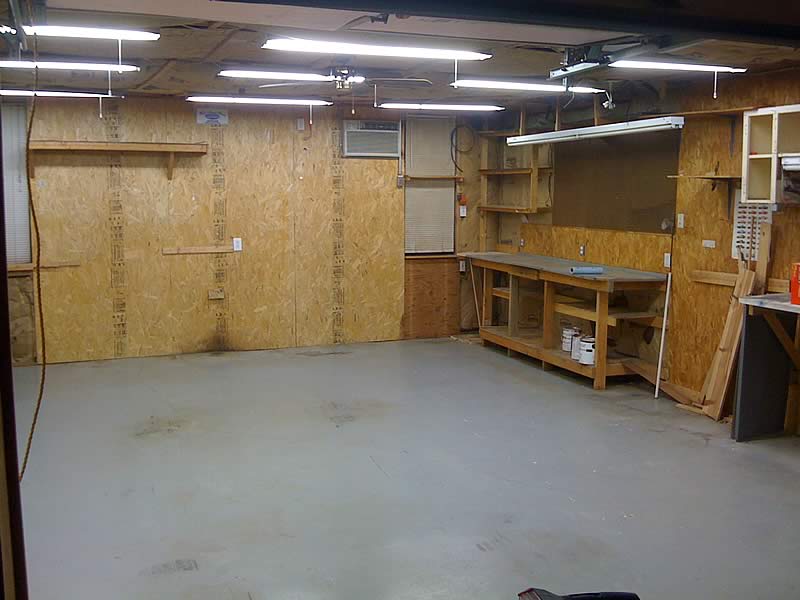
If you really want to see, then 4 rows of 3 each 4' shop lights across the 20' width will make it bright. That works out to 2' space, 4' light, 2' space, 4' light, 2' space, 4' light, 2' space. Wire them in banks of two (6 lights) at least. I set my long dimension row light spacing at 4' - 6' - 4' - 6' - 4'. Hang and switch/wire a separate set of lights for work benches.

Wire everything with 12-2 w/g. It's $80 for 250', $60 for 100' of MC. You will not use enough 14-2 to really justify the $60 for a 250' roll.

Plugs - depends on your machinery. General outlets I'd run 3-4 circuits. Buy a big enough breaker box for additions. At least 20 circuits. Really. Put them at whatever height you like, 40~50". Just be consistent and it'll make cutting the sheetrock a little easier. If you lay the sheets instead of standing the sheets on end, put them 48 1/2" below the ceiling (48" if drywall is already on the ceiling) then you only have to notch the bottom sheet. ALL OUTLETS must be either GFCI or on the load side of a GFCI. Plan your wiring routes accordingly. Yes, GFCIs are cheaper than a GFCI breaker. About 5 to 1 or so, depending.

Air - I used 1/2" black iron and ran it surface mount around the shop. Go to the TIP site and look at their recommended layout - it's a good model to follow. I would not try to bury it in the walls. Use several unions in the pipe runs. If you re-arrange (you will) or find leaks (you will), you will taking things apart.

Light layout:
ShopEmpty.jpg
 
Last edited:

larry_g

Well-known member
Joined
Apr 28, 2007
Messages
16,875
Location
oregon
If your panel is in the shop consider using a screw on panel to cover the stud bay above the box so if you need to rewire or add a circuit you can remove the panel to get from the box to the attic easily. Also consider an outlet on the outside of the building for use in the driveway and/or on the side for electric yard tools.

lg
no neat sig line
 

qdvuu

Well-known member
Joined
Feb 8, 2008
Messages
611
Location
Norcal
A couple more thoughts:

- Put outlets (or junction boxes) in the ceiling in case you want to add ceiling fans in the future. Also include the ability to control them via a wall switch (dimmer style) because pull strings may not be accessible due to a project car parked in the way.

- Since the trend in technology is for more and more electronic devices, add extra outlets in a convenient place for cell phone rechargers, a computer/network center, etc.

- Put a couple outlets up high in case you want to mount a TV close to the ceiling.

- Don't forget an outlet for the mini fridge! And the neon beer lights!
 

Steevo

Well-known member
Joined
Aug 18, 2009
Messages
8,738
Location
43.49600, -112.04300
I thought I had covered all the bases. I have lights, lots and lots of lights on multiple switches and zones. I have twenty-two 120v/20a receptacles, I have six 240v/30a and four 240v/50a receptacles, I have a 240v water heater connection, I have outside receptacles and lights and a motion light. I have a box in the ceiling and one on a wall for Ethernet, so I can hang a wireless access point and have a wired location, too. I have garage door opener receptacles up high on the sides for the Liftmaster 3800 type openers. I ran thermostat wire from the hanging furnace location (also has a 120v ceiling outlet for it) to a back wall for the thermostat. I even wired three light sockets in the attic with a switch just above the access door, so it is well lit if I need to do any work up there. I thought I had covered it all.

After the drywall was done, and I was out there for days on end painting the ceiling and walls, listening to music from a little radio, I suddenly realized that I hadn't run any speaker wire. Now I have to fish it down a wall from the attic, and I am so glad I haven't blown in the ceiling insulation yet, because I am going to use ceiling speakers.

There's always something, Roseann Roseannadanna . . .
 
Last edited:
OP
T

Toddyus

Member
Joined
May 3, 2011
Messages
23
From my 20x24 experience:

If you really want to see, then 4 rows of 3 each 4' shop lights across the 20' width will make it bright.

Air - I used 1/2" black iron and ran it surface mount around the shop. Go to the TIP site and look at their recommended layout - it's a good model to follow. I would not try to bury it in the walls. Use several unions in the pipe runs. If you re-arrange (you will) or find leaks (you will), you will taking things apart.

Light layout:
ShopEmpty.jpg

Falcon67 - thanks for the pic. I'll also check out the TIP site. Possibly dumb question, does the black iron pipe accept standard NPT fittings, or do you have to adapt it somehow? Also when you join sections of pipe, do you just use teflon tape or something different?

I thought I had covered all the bases. I have lights, lots and lots of lights on multiple switches and zones. I have twenty-two 120v/20a receptacles, I have six 240v/30a and four 240v/50a receptacles, I have a 240v water heater connection, I have outside receptacles and lights and a motion light. I have a box in the ceiling and one on a wall for Ethernet, so I can hang a wireless access point and have a wired location, too. I have garage door opener receptacles up high on the sides for the Liftmaster 3800 type openers. I ran thermostat wire from the hanging furnace location (also has a 120v ceiling outlet for it) to a back wall for the thermostat. I even wired three light sockets in the attic with a switch just above the access door, so it is well lit if I need to do any work up there. I thought I had covered it all.

After the drywall was done, and I was out there for days on end painting the ceiling and walls, listening to music from a little radio, I suddenly realized that I hadn't run any speaker wire. Now I have to fish it down a wall from the attic, and I am so glad I haven't blown in the ceiling insulation yet, because I am going to use ceiling speakers.

There's always something, Roseann Roseannadanna . . .

Steevo, First of all, I love the way you tell this story. Great buildup to the lesson. Second, I definitely plan to run speaker wire. Just debating on whether I run a couple stereo speakers, in-wall/in-ceiling speakers, satellites in the corners with a sub or even just a soundbar with sub below the TV... Decisions, decisions.
 

Thruxton

Well-known member
Joined
Dec 30, 2010
Messages
767
Location
Virginia
Falcon67 - thanks for the pic. I'll also check out the TIP site. Possibly dumb question, does the black iron pipe accept standard NPT fittings, or do you have to adapt it somehow? Also when you join sections of pipe, do you just use teflon tape or something different?


Steevo, First of all, I love the way you tell this story. Great buildup to the lesson. Second, I definitely plan to run speaker wire. Just debating on whether I run a couple stereo speakers, in-wall/in-ceiling speakers, satellites in the corners with a sub or even just a soundbar with sub below the TV... Decisions, decisions.

Good stuff! I've learned a few things here. Re: speakers: if you go with in-ceiling, dust will not be a problem on the grills (and that is a BIG problem if you are interested in good sound!).
 
To avoid these ads, REGISTER NOW!
Top Bottom