
To avoid these ads, REGISTER NOW!

What's in TruFuel

dwasifar

Well-known member
Joined
May 28, 2017
Messages
2,089
I use canned pre-mix in my chainsaws. The saws get used relatively infrequently, so I don't need much fuel, and it's nice to have something stable in storage for long periods, plus I don't have a local source for ethanol-free gas.

But I have been wondering what this stuff is made of. TruFuel (and competing companies) are careful not to call it gasoline. They call it "engineered fuel and oil." And it definitely does not smell like gasoline.

So I tracked down a MDS and here is what TruFuel contains:

TruFuel 50:1 Mix
  • Naphtha (petroleum), full-range alkylate, butane-contg. 50% - 60%
  • isopentane 10% - 20%
  • pentane 10% - 20%
  • toluene 5% - 10%
  • xylene 5% - 10%
  • ethylbenzene 1% - 5%

Those all look like solvents to me, so I'm wondering where the oil comes into it. But clearly there is no gasoline in TruFuel. It has more in common with Coleman fuel.

I actually kind of like how it smells compared to gasoline, to be honest. Not like I'm going to sit around huffing it or anything, but it lacks gasoline's pervasive stink.
 
To avoid these ads, REGISTER NOW!

bob15

Well-known member
Joined
Dec 8, 2011
Messages
6,863
Location
Northeasten, CT
You are over thinking it. Go to a race track and smell race fuel (Cam2, Sunoco, VP, etc) and compare it to your Tru-Fuel smell. What you are smelling is the Toluene which is an octane booster. And "pump" gasoline will also have slightly different amount of detergents. Ever notice Mobil gas stations have a slightly different smell to them compared to other stations? It is whatever is in their detergent package.

Looking at your numbers, that is percentage by weight, so the amounts are tiny....5-10% of 128 ounces isn't much in the general scheme of things.

Also, you might want to view the SDS for your oil question: https://images.homedepot-static.com/catalog/pdfImages/60/603cba8a-05f7-4896-bc21-8172526a8f6c.pdf

And here is the msds for coleman fuel. Not as close as you might believe. http://ferris.msdssoftware.com/ImageDir/i011DA2E.pdf

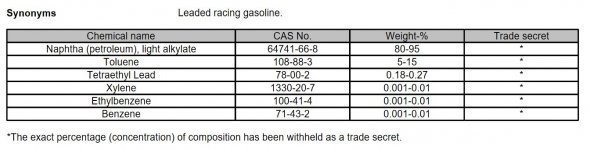
The picture I attached shows the MSDS numbers for Sunoco Leaded 110 octane race gas. Do they look the same as the Trufuel? pretty close, except for the lead.....
 

Attachments

  • sunoco leaded 110.JPG
    sunoco leaded 110.JPG
    84.2 KB · Views: 112

Showkey

"MEMBER EMERITUS"
Joined
Aug 9, 2014
Messages
8,638
Location
Wausau WI
The comment :
There are no additional ingredients present which, within the current knowledge of the supplier and in the concentrations applicable, especially in 32oz container.

Might mean in 50/1 mix the oil is a very very small that it not required to be reported ???
Or it might mean they use the same MSDS for 4 cycle version and did not add the oil ???


Back in the day lead gas days..... “white gas”....... was naphtha plus the other stuff minus the lead
 

Davefr

Well-known member
Joined
Jan 7, 2010
Messages
11,822
Location
OR
This begs the question. Can you blend your own TruFuel equivalent by starting with Coleman Fuel, adding some octane booster and 2 cycle oil?

There's always Coleman fuel at garage sales for about $1/gallon.
 

bob15

Well-known member
Joined
Dec 8, 2011
Messages
6,863
Location
Northeasten, CT
This begs the question. Can you blend your own TruFuel equivalent by starting with Coleman Fuel, adding some octane booster and 2 cycle oil?

There's always Coleman fuel at garage sales for about $1/gallon.

Short answer: no

Long answer:

Here is the sds for Coleman Fuel(cas # 68410-97-9) :http://www.deep-south-chemical.com/PDF%27s/SDS/Lactane%20SDS.pdf

Now, what are you going to add to make this the same as trufuel because octane booster 104 and 2 cycle oil isn't going to be everything needed? Plus, now you must re-jet your carbs because this concoction isn't going to burn the same as the Trufuel or VP SEF or even gasoline with 2 cycle oil. Will you be able to adjust the carb enough to not melt the engine down?

For me, I buy my pre-mixed VP SEF for $60-70 for 5 gallons at the local saw shop. For the lawn mower and other equipment, I buy my ethanol-free gas when I go to NY in multiple 5 gallon containers.
 

Robbie B

Well-known member
Joined
Jun 24, 2014
Messages
1,320
Location
Sunny side of hell
I can’t pay what they ask for trufuel. I have access to ethanol free but even if I didn’t I wouldn’t pay it. I’d replace the carb every couple years first. That stuff is 20 bucks for roughly a gallon vs. 3 bucks for ethanol free or 2.50 for the cheap stuff.
 

bob15

Well-known member
Joined
Dec 8, 2011
Messages
6,863
Location
Northeasten, CT
I can’t pay what they ask for trufuel. I have access to ethanol free but even if I didn’t I wouldn’t pay it. I’d replace the carb every couple years first. That stuff is 20 bucks for roughly a gallon vs. 3 bucks for ethanol free or 2.50 for the cheap stuff.

Why can't you pay the 50 cents more a gallon for ethanol-free gas? You spend more in replacing than saving. What is the labor cost replace the carb (plus the cost of the carb itself)?

And if you going to a small engine shop, you can get VP pre-mix at $12-13 a gallon, if you buy by the pail.

https://vpracingfuels.com/product-category/outdoor/small-engine-fuels/
 

Robbie B

Well-known member
Joined
Jun 24, 2014
Messages
1,320
Location
Sunny side of hell
Why can't you pay the 50 cents more a gallon for ethanol-free gas? You spend more in replacing than saving. What is the labor cost replace the carb (plus the cost of the carb itself)?

And if you going to a small engine shop, you can get VP pre-mix at $12-13 a gallon, if you buy by the pail.

https://vpracingfuels.com/product-category/outdoor/small-engine-fuels/


I do use the ethanol free fuel but even is I didn’t I’m replacing the carb myself. No way I’m paying to do 45 mins worth of work replacing a carb when I can do it myself. As far as the VP fuels idk if any of the small engine shops around me carry fuel by the gallon or anything. I very seldom go in them. I research online, go in and tell them what I need and walk out. I buy parts online. Never had a dire need to cut my grass that couldn’t wait on parts.
 

joe_padavano

Well-known member
Joined
Feb 26, 2011
Messages
1,788
Location
Northern VA
I can’t pay what they ask for trufuel. I have access to ethanol free but even if I didn’t I wouldn’t pay it. I’d replace the carb every couple years first. That stuff is 20 bucks for roughly a gallon vs. 3 bucks for ethanol free or 2.50 for the cheap stuff.

^^^THIS. The first time I saw TruFuel at my local NAPA, and asked the price (which they cleverly did not post), I was on the floor laughing. Of course, I have no problem with people who separate idiots from their money.
 
OP
D

dwasifar

Well-known member
Joined
May 28, 2017
Messages
2,089
Naphtha is raw gasoline.

The rest are mostly just acting as anti-knock agents Raising the octane.

You are over thinking it. Go to a race track and smell race fuel (Cam2, Sunoco, VP, etc) and compare it to your Tru-Fuel smell. What you are smelling is the Toluene which is an octane booster....The picture I attached shows the MSDS numbers for Sunoco Leaded 110 octane race gas. Do they look the same as the Trufuel? pretty close, except for the lead.....

Interesting. I didn't know gasoline and naphtha were that closely related. I always thought of naphtha as more like mineral spirits.

When I was a kid, I worked at an ink factory, where there were giant drums of various industrial solvents, including naphtha. (And ether, which was tightly secured, but I digress.) The guys in the plant who were smokers used to use the naphtha in their Zippo lighters. Maybe that's where I got the association. It was funny watching them fill their Zippos by carefully dribbling naphtha from the spouts of 55 gallon drums.

I can’t pay what they ask for trufuel. I have access to ethanol free but even if I didn’t I wouldn’t pay it. I’d replace the carb every couple years first. That stuff is 20 bucks for roughly a gallon vs. 3 bucks for ethanol free or 2.50 for the cheap stuff.

Sure, and I'd do the same if I was burning gallons and gallons of chainsaw fuel. But I don't need much. A quart of pre-mix costs about $5. Or for the same $5 I could mix oil and Sta-bil with a gallon of E-10 gas. But even if the Sta-bil keeps water out of the fuel, the ethanol is still in it and doing the things ethanol does to fuel systems. And for as little as I use the saws, I'd still wind up not using that full gallon before it went bad. So the extra cost, for me, is slight. If I was using the saws more, pre-mix would be too expensive.

I still use pump gas in my lawnmower and snowthrower. I run them dry at the end of the season. After 14 years in service, I've replaced the carbs on each of them once.
 
OP
D

dwasifar

Well-known member
Joined
May 28, 2017
Messages
2,089
^^^THIS. The first time I saw TruFuel at my local NAPA, and asked the price (which they cleverly did not post), I was on the floor laughing. Of course, I have no problem with people who separate idiots from their money.

Well, gee, thanks, Joe. I don't suppose my cost analysis above will make you rethink that.
 

Gunfixr

Well-known member
Joined
Feb 9, 2021
Messages
677
Location
behind the house
I can get ethanol free gas, but it's a 60 mile round trip.
Despite closely following mixing directions, and yes, I can measure, there was always issues with fuel I mixed. I lost an expensive chainsaw to an imperfect fuel mix.
Yes, the pre-mix is more, but we don't use a lot. If that makes me an idiot, so be it.

The mower uses diesel, same as the tractor.
 

nafterclifen

Well-known member
Joined
Nov 22, 2014
Messages
525
Location
Poconos, PA
Lucky for me, I can get 89 octane ethanol free gas locally (30 mile round trip). Current price is $3.76/gallon. Standard 89 octane (with ethanol) is currently $3.51/gallon.

I have (8) 5-gallon containers so I keep about 40 gallons of it on hand at any given time. I use it in my snow blower, leaf blower, weed wacker, tractor, go-kart and portable generator. I typically use it all within 6 months so I only have to make 2 trips a year to restock my supply.
 

joe_padavano

Well-known member
Joined
Feb 26, 2011
Messages
1,788
Location
Northern VA
Well, gee, thanks, Joe. I don't suppose my cost analysis above will make you rethink that.

I use E10 from the corner gas station and two stroke oil. It costs me a fraction of the cost per gallon of TruFuel. Run the carb dry (or empty the float bowl) before you put the tool away and you don't have carb issues. If ethanol-free were available locally, I'd pay the minor extra, but the nearest station is a 90 min round trip. I've had no issues.
 

Robbie B

Well-known member
Joined
Jun 24, 2014
Messages
1,320
Location
Sunny side of hell
Interesting. I didn't know gasoline and naphtha were that closely related. I always thought of naphtha as more like mineral spirits.

When I was a kid, I worked at an ink factory, where there were giant drums of various industrial solvents, including naphtha. (And ether, which was tightly secured, but I digress.) The guys in the plant who were smokers used to use the naphtha in their Zippo lighters. Maybe that's where I got the association. It was funny watching them fill their Zippos by carefully dribbling naphtha from the spouts of 55 gallon drums.


Sure, and I'd do the same if I was burning gallons and gallons of chainsaw fuel. But I don't need much. A quart of pre-mix costs about $5. Or for the same $5 I could mix oil and Sta-bil with a gallon of E-10 gas. But even if the Sta-bil keeps water out of the fuel, the ethanol is still in it and doing the things ethanol does to fuel systems. And for as little as I use the saws, I'd still wind up not using that full gallon before it went bad. So the extra cost, for me, is slight. If I was using the saws more, pre-mix would be too expensive.

I still use pump gas in my lawnmower and snowthrower. I run them dry at the end of the season. After 14 years in service, I've replaced the carbs on each of them once.


I fill up the can for the riding mower and pour a couple gallons out of that. It covers my saw and my blower, my weed whacker is 40-1. I can fill my cans at the first of the season, throw in some stabil and they last the summer and fall, and just refill the mower can as needed. I’m cutting about 2&1/2 acres between mine and my in-laws.
 

M6erfan

Well-known member
Joined
Dec 6, 2014
Messages
10,170
Location
'Merica!
Is there any real objective evidence that Sta-bil and such products actually do anything against the effects of ethanol?

E0, in a sealed metal container will last at least 6 mos. Why is Sta-bil needed?
 
Last edited:

Leaflessshadetree

Well-known member
Joined
Aug 1, 2013
Messages
7,148
Location
Don't ask.
We've been using brand name gas substitute in equipment at our fire department for about a year now. We check (and start) every piece of equipment at least once a month.
IMO we've had more issues with starting them since switching fuel. Guy 1 tries to start it, after 10-20 pulls guy 2 steps up to show guy 1 how it's done. Eventually 3-4 guys agree it's broken and it's sent for service. A day or two later repair guy goes through normal start procedure, it starts easy runs fine.
I don't know if it's the fuel, the equipment or the guys trying to start them.

At home I still use gas from the local station (usually 87 octane, E10). I don't pay attention to how long it sits but I know that I've run gas that's been in equipment for 2-3 years without any issue. If I do have issues I drain and refill with fresh fuel.
If not cleaning a carb isn't a big deal.
 

bob15

Well-known member
Joined
Dec 8, 2011
Messages
6,863
Location
Northeasten, CT
I can get ethanol free gas, but it's a 60 mile round trip.
Despite closely following mixing directions, and yes, I can measure, there was always issues with fuel I mixed. I lost an expensive chainsaw to an imperfect fuel mix.
Yes, the pre-mix is more, but we don't use a lot. If that makes me an idiot, so be it.

The mower uses diesel, same as the tractor.

The answer is nope. Nothing wrong with using pre-mixed gas. Like I said a few times, I use the VP SEF gas for my saws and weed-wacker and have no complaints and no more rotten, disintegrating fuel lines and needle tips on expensive saws.
 
To avoid these ads, REGISTER NOW!

M6erfan

Well-known member
Joined
Dec 6, 2014
Messages
10,170
Location
'Merica!
We've been using brand name gas substitute in equipment at our fire department for about a year now. We check (and start) every piece of equipment at least once a month.
IMO we've had more issues with starting them since switching fuel. Guy 1 tries to start it, after 10-20 pulls guy 2 steps up to show guy 1 how it's done. Eventually 3-4 guys agree it's broken and it's sent for service. A day or two later repair guy goes through normal start procedure, it starts easy runs fine.
I don't know if it's the fuel, the equipment or the guys trying to start them.

At home I still use gas from the local station (usually 87 octane, E10). I don't pay attention to how long it sits but I know that I've run gas that's been in equipment for 2-3 years without any issue. If I do have issues I drain and refill with fresh fuel.
If not cleaning a carb isn't a big deal.

You've had no issue with 2-3 year old E10? I need the address of that fuel station.
 

Johnny Generic

Well-known member
Joined
Nov 24, 2015
Messages
601
Location
35 miles NE of Pittsburgh, Pa.
I was told by a small engine repair shop owner that at the end of the season or if device is going to be laid up just empty the gas or run till dry. Then add a small amount of true fuel to tank and let run till dry. Why use it on something that you use on a regular bases? Seems to make sense to me. Johnny Generic.
 

Robbie B

Well-known member
Joined
Jun 24, 2014
Messages
1,320
Location
Sunny side of hell
Is there any real objective evidence that Sta-bil and such products actually do anything against the effects of ethanol?

E0, in a sealed metal container will last at least 6 mos. Why is Sta-bil needed?


Stabil was never advertised to protect against ethanol. Stabil is used to prevent fuel from going bad in equipment and vehicles when they are stored for a long time.
 

unslow1

Well-known member
Joined
Mar 3, 2012
Messages
7,880
Location
Illinois
I use ethanol free that is 70 cents a gallon more. After having to rebuild multiple carbs and fuel systems. I'm glad someplace near sells it now. Several years it was a 100 mile round trip to get it. I still have a fuel system I have to take apart and not looking forward to it.
 
Last edited:
OP
D

dwasifar

Well-known member
Joined
May 28, 2017
Messages
2,089
I use E10 from the corner gas station and two stroke oil. It costs me a fraction of the cost per gallon of TruFuel. Run the carb dry (or empty the float bowl) before you put the tool away and you don't have carb issues. If ethanol-free were available locally, I'd pay the minor extra, but the nearest station is a 90 min round trip. I've had no issues.
I use maybe a quart of fuel a year in my saws, so $5/yr. To mix my own would cost about $5/gal including the cost of gas, Sta-bil, and oil, and at the end of two years I'd have to throw away the remaining stale half gallon. So my cost doing it that way is $2.50/yr.

Now, as I've said, if I were using the saws all the time, or even at least enough to burn up that gallon of home mix before it goes stale, I'd do what you do. But to save two and a half bucks once a year? Not worth the hassle. I can afford that just for the convenience alone.
 

Showkey

"MEMBER EMERITUS"
Joined
Aug 9, 2014
Messages
8,638
Location
Wausau WI
Stabil was never advertised to protect against ethanol. Stabil is used to prevent fuel from going bad in equipment and vehicles when they are stored for a long time.


After ethanol became on the market the issues started particularly in the with the marine crowd they came up with 360 so there are two versions:

STA-BIL 360 Marine Ethanol Treatment and Fuel Stabilizer - Prevents Corrosion - Helps Clean Fuel System For Improved In-Season Performance - Treats Up To 80 Gallons, 8 fl. oz. (22239)

C0D43A71-EDB5-47E4-B8BE-71D9F8736C02.jpg
 

Attachments

  • C0D43A71-EDB5-47E4-B8BE-71D9F8736C02.jpg
    C0D43A71-EDB5-47E4-B8BE-71D9F8736C02.jpg
    50 KB · Views: 20

Buster21

Well-known member
Joined
Aug 16, 2014
Messages
418
Location
Idaho
I know several people that own landscaping businesses including my brother in law, and all of them use some type of True Fuel, when asked about it everyone without question said it saved them money in the long run. Imagine 30 employees from different backgrounds trying to mix oil and fuel several times a day. He would always find half used bottles of oil mix in the trash at the end of the day, and try to find a clean way to measure it out on a landscaping truck. He said he used to always have to repair small engines because of to much or not enough oil in the mix or dirty fuel. This just takes the guess work out of it.
 

M6erfan

Well-known member
Joined
Dec 6, 2014
Messages
10,170
Location
'Merica!
Stabil was never advertised to protect against ethanol. Stabil is used to prevent fuel from going bad in equipment and vehicles when they are stored for a long time.

After ethanol became on the market the issues started particularly in the with the marine crowd they came up with 360 so there are two versions:

STA-BIL 360 Marine Ethanol Treatment and Fuel Stabilizer - Prevents Corrosion - Helps Clean Fuel System For Improved In-Season Performance - Treats Up To 80 Gallons, 8 fl. oz. (22239)

Uh huh. The question still stands. Is there any objective evidence that Sta-bil or other fuel
treatments that advertise as such, "protect" against ethanol. Or for that matter, "keeps fuel from going bad"?
 

American Locomotive

Well-known member
Joined
Jan 8, 2017
Messages
10,947
Location
Rhode Island
Gasoline isn't a singular thing. It's a mix of a huge variety of different distillates, and the composition of gasoline can differ wildly based on what refinery it came from and what kind of crude oil it was refined from. It seems with gasoline they care more about it meeting certain specifications (vapor pressure, viscosity, flash point, octane) rather than meeting specific chemical composition target.

I swear sometimes I must be the only one who has never had a real major issue with E10 fuel. My cheapo garbage Poulan Pro 2-stroke leafblower always starts up in the spring with the same fuel it had in the fall. My snowblower always starts with the same fuel it had in it from the winter prior, same with my generator. Really the only "special" thing I do on the Generator and Snowblower is turn the fuel off, and let them burn all the fuel out of the carb before shutting them down for the season.

Even my Honda CB750 started up just fine on gas that was at least 6 months old.

I know several people that own landscaping businesses including my brother in law, and all of them use some type of True Fuel, when asked about it everyone without question said it saved them money in the long run. Imagine 30 employees from different backgrounds trying to mix oil and fuel several times a day. He would always find half used bottles of oil mix in the trash at the end of the day, and try to find a clean way to measure it out on a landscaping truck. He said he used to always have to repair small engines because of to much or not enough oil in the mix or dirty fuel. This just takes the guess work out of it.
Sounds like your landscaping friends are using faulty math to justify them running their operation poorly.

Why are they needing to mix fuel several times a day? Why are there 30 different people mixing fuel? Load up two 5-gallon tanks of pre-mix for the day, and that should cover just about anything you would need. Entrust just 1 or 2 people to mix fuel, and take the guess work out of it by buying containers like this: https://www.amazon.com/dp/B009SO12I8/?tag=atomicindus08-20 - 1 entire 12.8oz bottle = 50:1 ratio in 5 gallons of gas. Just dump the bottle into a full fresh container of gas. No thinking required.

A Stihl BR600 uses 0.33 gallons of fuel per hour. You run that thing 8 hours a day during leaf blowing season and it will burn $52/day in TruFuel. In just 10 days of use, you'd spend enough money on fuel to buy another Stihl BR600. The cost of TrueFuel is absolutely obscene for commercial use, and your friends are almost certainly absolutely losing their shirts vs. just simplifying the mixing process and training their employees properly.
 
Last edited:

Robbie B

Well-known member
Joined
Jun 24, 2014
Messages
1,320
Location
Sunny side of hell
After ethanol became on the market the issues started particularly in the with the marine crowd they came up with 360 so there are two versions:

STA-BIL 360 Marine Ethanol Treatment and Fuel Stabilizer - Prevents Corrosion - Helps Clean Fuel System For Improved In-Season Performance - Treats Up To 80 Gallons, 8 fl. oz. (22239)

C0D43A71-EDB5-47E4-B8BE-71D9F8736C02.jpg


Yeah, I went back and read some more on the page and saw that. Looks like the marine is the ticket for small engine fuel.
 

Robbie B

Well-known member
Joined
Jun 24, 2014
Messages
1,320
Location
Sunny side of hell
Uh huh. The question still stands. Is there any objective evidence that Sta-bil or other fuel
treatments that advertise as such, "protect" against ethanol. Or for that matter, "keeps fuel from going bad"?


Quite honestly idk where you’d look to find the evidence. I only use it in the last can I mix of the season. I don’t see the point in using it year round. I use it faster than they say is necessary.
 

redmondjp

Well-known member
Joined
Nov 25, 2014
Messages
2,318
Location
Redmond, WA
Gasoline isn't a singular thing. It's a mix of a huge variety of different distillates, and the composition of gasoline can differ wildly based on what refinery it came from and what kind of crude oil it was refined from. It seems with gasoline they care more about it meeting certain specifications (vapor pressure, viscosity, flash point, octane) rather than meeting specific chemical composition target.

I swear sometimes I must be the only one who has never had a real major issue with E10 fuel. My cheapo garbage Poulan Pro 2-stroke leafblower always starts up in the spring with the same fuel it had in the fall. My snowblower always starts with the same fuel it had in it from the winter prior, same with my generator. Really the only "special" thing I do on the Generator and Snowblower is turn the fuel off, and let them burn all the fuel out of the carb before shutting them down for the season.

And I have had the exact opposite experience as you have. I have repeatedly had E10 gas go bad just from sitting in the mower tank between the end of June and the beginning of October - it goes flat (volatiles exit the tank) and the mower simply will not start. No such issues since switching to E0.

I suspect that this difference in experience largely has to do with your first paragraph above - the composition of gasoline must vary depending upon what part of the country you live in. Where I live (PNW), pump gas just destroys small engine carbs.

I have vintage Jerry cans that I use to store E0 fuel, and it keeps for years. My 2-cycle mix that I am using now is at least 3 years old - I "lost" the can somewhere in the shed (in a metal can, fully sealed) and just discovered it again last fall. It still works as it should. I buy E0 35-50 gallons at a time in the fall, so if we have an extended power outage (which has happened in years past) where gas stations cannot pump out of their tanks, I have gas for my generator, vehicles, and if I don't use the gas for that, it lasts long enough so I then use it for the next season's mowing/sawing/trimming.

I pay whatever the extra cost for E0 fuel because to me, it is completely worth in the saved time every year not having to clean out carburetors, replace fuel lines, and so on. This is especially frustrating when I have a very limited time to mow/trim, and I spend most of that time just trying to get the equipment to start and run.

And I was not the only one with the issue with E10 - all my neighbors had similar issues with their mowers which I got to fix for them. I flat out tell people now to use E0 fuel and if they ignore that I won't help them since they didn't take my advice.

Thank you for sharing your experience and if you can get pump gas to work for you, that's awesome and I fully support that decision from an economic and logistical standpoint.
 

65ranchero

Well-known member
Joined
Dec 16, 2020
Messages
5,077
Location
Danville, VT left NJ forever
All my equipment gets E-zero fuel
what ever size container I use I add Stabil in the correct amount of OZ. then fill the container.
It does 2 thing for me, it mixes the Stabil when filling and second give me a piece of mind when I forget to drain for the off season. ( which is all the time)

I had one bad experience one season with the rider mower when I had my knee replacement in Sept. of 2014 and forgot to add Stabil to the E10 for the season. In the spring went to start the mower and it would not start added fuel and finally got it started and it ran very poorly for 2 tanks.
Now that I use E-0 i don't even think about if its going to start.
But I also keep the mower on a trickle charge (HF cheapie) and start it once a month in the of season and it will start in -10F with enough choke
 

dr_clyde

Well-known member
Joined
Jan 7, 2009
Messages
6,438
Location
Holland, MI
On very rare occasions, I will need to clean a carb. But once in 10 years maybe. I run regular pump gas in everything, use the Stihl silver two stroke oil mix in the chain saw, weed wacker, leaf blower, and the concrete saw.

I never have had any issues, really. Not nearly enough to warrant the obscene price of premixed fuel.

I can afford to pay a small engine shop do a carb clean once every few years if it needs it. I can't be bothered, I have better things to do with my time.
 

toyotadriver

Well-known member
Joined
Dec 30, 2010
Messages
1,586
You've had no issue with 2-3 year old E10? I need the address of that fuel station.


I keep a lot of gasoline around the house. I have, at last count, 3 two cycle gas engines and 7 four cycle gas engines. I use ethanol in EVERYTHING I own (besides the diesel engines of course). I have stored E10 gas for as long as 4 years at a time. No issues whatsoever. Smells just as good 4 years later as the day it was filled and runs just fine. The main "secret" is to get good gas cans. You need gas cans that will not leak period. I use NATO cans. They aren't cheap but they seal completely and do NOT leak. EVER. That also means that volatile parts of gasoline don't evaporate....and that means the gas doesn't go bad.

I keep my 2 cycle gas in a 5 liter (1.3 gallon) NATO type can...again well sealed. I have been using a little more over the past year or two but prior to that, a gallon of 2 cycle gas lasted me for about 2 years. Now it lasts me a little more than a year. It lasts just fine and smells like fresh gas the entire time I'm using it.

Ethanol actually has some real benefits to engines. It's an excellent solvent (as a matter of fact alcohol is a key component in many fuel system cleaners) and will help keep your fuel system clean. The key is to keep it fresh by storing it in a gas can that will NOT leak gas vapors. Don't use the cheap gas cans from Walmart....buy real gas cans like NATO cans and stop worrying about your gas.
 

M6erfan

Well-known member
Joined
Dec 6, 2014
Messages
10,170
Location
'Merica!
I keep a lot of gasoline around the house. I have, at last count, 3 two cycle gas engines and 7 four cycle gas engines. I use ethanol in EVERYTHING I own (besides the diesel engines of course). I have stored E10 gas for as long as 4 years at a time. No issues whatsoever. Smells just as good 4 years later as the day it was filled and runs just fine. The main "secret" is to get good gas cans. You need gas cans that will not leak period. I use NATO cans. They aren't cheap but they seal completely and do NOT leak. EVER. That also means that volatile parts of gasoline don't evaporate....and that means the gas doesn't go bad.

I keep my 2 cycle gas in a 5 liter (1.3 gallon) NATO type can...again well sealed. I have been using a little more over the past year or two but prior to that, a gallon of 2 cycle gas lasted me for about 2 years. Now it lasts me a little more than a year. It lasts just fine and smells like fresh gas the entire time I'm using it.

Ethanol actually has some real benefits to engines. It's an excellent solvent (as a matter of fact alcohol is a key component in many fuel system cleaners) and will help keep your fuel system clean. The key is to keep it fresh by storing it in a gas can that will NOT leak gas vapors. Don't use the cheap gas cans from Walmart....buy real gas cans like NATO cans and stop worrying about your gas.

You bring up an important point. The storage container is key, I agree.

I saw the price creeping up on the goods cans about 10-12 years ago so I bought (2) 4 packs of 5ga NATO cans for around $100/4. Prices are through the roof now if one can find the good ones.
 

toyotadriver

Well-known member
Joined
Dec 30, 2010
Messages
1,586
Gasoline isn't a singular thing. It's a mix of a huge variety of different distillates, and the composition of gasoline can differ wildly based on what refinery it came from and what kind of crude oil it was refined from. It seems with gasoline they care more about it meeting certain specifications (vapor pressure, viscosity, flash point, octane) rather than meeting specific chemical composition target.

I swear sometimes I must be the only one who has never had a real major issue with E10 fuel. My cheapo garbage Poulan Pro 2-stroke leafblower always starts up in the spring with the same fuel it had in the fall. My snowblower always starts with the same fuel it had in it from the winter prior, same with my generator. Really the only "special" thing I do on the Generator and Snowblower is turn the fuel off, and let them burn all the fuel out of the carb before shutting them down for the season.

Even my Honda CB750 started up just fine on gas that was at least 6 months old.

Sounds like your landscaping friends are using faulty math to justify them running their operation poorly.

Why are they needing to mix fuel several times a day? Why are there 30 different people mixing fuel? Load up two 5-gallon tanks of pre-mix for the day, and that should cover just about anything you would need. Entrust just 1 or 2 people to mix fuel, and take the guess work out of it by buying containers like this: https://www.amazon.com/dp/B009SO12I8/?tag=atomicindus08-20 - 1 entire 12.8oz bottle = 50:1 ratio in 5 gallons of gas. Just dump the bottle into a full fresh container of gas. No thinking required.

A Stihl BR600 uses 0.33 gallons of fuel per hour. You run that thing 8 hours a day during leaf blowing season and it will burn $52/day in TruFuel. In just 10 days of use, you'd spend enough money on fuel to buy another Stihl BR600. The cost of TrueFuel is absolutely obscene for commercial use, and your friends are almost certainly absolutely losing their shirts vs. just simplifying the mixing process and training their employees properly.


Nicely stated. Sounds like a piss poor management problem. I know several people who run landscaping businesses and they don't have any of these problems. They would never run on Trufuel. It would cut into their bottom line too much.
 

M6erfan

Well-known member
Joined
Dec 6, 2014
Messages
10,170
Location
'Merica!
If you have a landscaping business burning fuel in the equipment everyday, your ethanol issues are way down compared to Joe Homeowner.
 

Buster21

Well-known member
Joined
Aug 16, 2014
Messages
418
Location
Idaho
Gasoline isn't a singular thing. It's a mix of a huge variety of different distillates, and the composition of gasoline can differ wildly based on what refinery it came from and what kind of crude oil it was refined from. It seems with gasoline they care more about it meeting certain specifications (vapor pressure, viscosity, flash point, octane) rather than meeting specific chemical composition target.

I swear sometimes I must be the only one who has never had a real major issue with E10 fuel. My cheapo garbage Poulan Pro 2-stroke leafblower always starts up in the spring with the same fuel it had in the fall. My snowblower always starts with the same fuel it had in it from the winter prior, same with my generator. Really the only "special" thing I do on the Generator and Snowblower is turn the fuel off, and let them burn all the fuel out of the carb before shutting them down for the season.

Even my Honda CB750 started up just fine on gas that was at least 6 months old.

Sounds like your landscaping friends are using faulty math to justify them running their operation poorly.

Why are they needing to mix fuel several times a day? Why are there 30 different people mixing fuel? Load up two 5-gallon tanks of pre-mix for the day, and that should cover just about anything you would need. Entrust just 1 or 2 people to mix fuel, and take the guess work out of it by buying containers like this: https://www.amazon.com/dp/B009SO12I8/?tag=atomicindus08-20 - 1 entire 12.8oz bottle = 50:1 ratio in 5 gallons of gas. Just dump the bottle into a full fresh container of gas. No thinking required.

A Stihl BR600 uses 0.33 gallons of fuel per hour. You run that thing 8 hours a day during leaf blowing season and it will burn $52/day in TruFuel. In just 10 days of use, you'd spend enough money on fuel to buy another Stihl BR600. The cost of TrueFuel is absolutely obscene for commercial use, and your friends are almost certainly absolutely losing their shirts vs. just simplifying the mixing process and training their employees properly.

I'll be sure to let him know that you don't approve of the way he runs his business or the fuel he uses.
First off you are basing cost on retail pricing, he said buying in bulk at wholesale is less than half the cost of the box store.
Second, you can't just mix it in bulk because those 30 people are strung out across town at different jobs each needing their own fuel..
Third, you mention training the workers better, depending on the workload he will pick up day laborer's that are standing in front of home depot that don't even speak English. But I will be sure to let him know you still don't approve.
 
To avoid these ads, REGISTER NOW!
Top Bottom