
You are using an out of date browser. It may not display this or other websites correctly.
You should upgrade or use an alternative browser.
You should upgrade or use an alternative browser.
What's This?
- Thread starter WaltEbie
- Start date

Larryjones
Well-known member
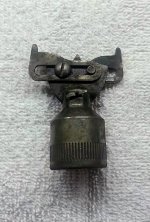
Adjustable spanner? Not the English kind.
ttpete
Well-known member
I'd agree with that. Back in the day, valves commonly had either 2 shallow holes or a screwdriver slot in the head to accommodate lapping tools.
four.cycle
Well-known member
is that what that widget is for? I see those frequently in older socket sets listed on Ebay. always wondered what the heck they were for.
now that I think about it... I've got a kit that's got one of those in it!
so.... is it for spinning the valve? I'm assuming the two divots those teeth fit into would be on the face of the valve which is toward the combustion chamber, correct?
now that I think about it... I've got a kit that's got one of those in it!
so.... is it for spinning the valve? I'm assuming the two divots those teeth fit into would be on the face of the valve which is toward the combustion chamber, correct?
Provincial
Well-known member
four.cycle, yes, the holes are in the valve head toward the combustion chamber. The pin spanner system is more positive than a suction cup, but the suction cup allows the operater to lift the valve and move it to a new position when lapping.
four.cycle
Well-known member
thanks.
who resurfaces valves anymore?
we always put all new ones in - wasn't worth fiddling around with. new seats too whether they needed them or not.
can't remember now what set I got those things in...!
who resurfaces valves anymore?
we always put all new ones in - wasn't worth fiddling around with. new seats too whether they needed them or not.
can't remember now what set I got those things in...!
Tony G
Well-known member
I still grind valves and seats when the metal there is sufficient. I'm old school.
ttpete
Well-known member
four.cycle, yes, the holes are in the valve head toward the combustion chamber. The pin spanner system is more positive than a suction cup, but the suction cup allows the operater to lift the valve and move it to a new position when lapping.
You put a light spring under the valve being lapped.
I still grind valves and seats when the metal there is sufficient. I'm old school.
Hum, I do it cause I'm cheap.
ttpete
Well-known member
thanks.
who resurfaces valves anymore?
we always put all new ones in - wasn't worth fiddling around with. new seats too whether they needed them or not.
can't remember now what set I got those things in...!
If you replace a seat, it has to be ground for concentricity with the guide and for seat contact width.
theoldwizard1
Well-known member
A guy on YouTube (motoYama82) did an "old school", low buck, in vehicle, engine rebuild on a Toyota 1.6L/1.8L. Pulled the head and cleaned the combustion chamber and valves with a wire brush on a drill. Pulled the pistons and gave them the same treatment and made sure the oil passages to the oil control ring was open. New rings, lapped the valves and reassembled.who resurfaces valves anymore?
Ran great !
ttpete
Well-known member
A guy on YouTube (motoYama82) did an "old school", low buck, in vehicle, engine rebuild on a Toyota 1.6L/1.8L. Pulled the head and cleaned the combustion chamber and valves with a wire brush on a drill. Pulled the pistons and gave them the same treatment and made sure the oil passages to the oil control ring was open. New rings, lapped the valves and reassembled.
Ran great !
That's not a rebuild, it's what we called a "ring & valve job" from a time when very few cars made it to 100K miles. Even then, the correct way to do it was to grind the valves and seats and replace the valve stem seals and knurl the guides.
Just lapping in valves is something that people did to Model T Fords 100 years ago.
That's not a rebuild, it's what we called a "ring & valve job" from a time when very few cars made it to 100K miles. Even then, the correct way to do it was to grind the valves and seats and replace the valve stem seals and knurl the guides.
Just lapping in valves is something that people did to Model T Fords 100 years ago.
Weeellll.....if one is to talk about 'the correct way', then one really should replace worn valve guides.
The 'Knurlizing' of valve guides became popular in the mid-1950's, when some of the then-new engines did not have replaceable valve guides, and the cost of a 'correct' repair, reaming the guide bores and fitting a new full set of valves with oversize stems was more than many car owners were willing to pay.
The tradition of lapping, as a 'final touch' to accurately ground valve seats, with the actual seat suitably narrowed with 'three angles' of seat stones, or with a Halls seat grinder using radius stones, was a way to be assured of the seat width, its location on the valve face, and full diametral contact of the valve on its seat.
Lapping with fine compound also improved the smooth finish of the seat, to some extent, at least in theory, to help the seat to work in to the smooth radius of contact with the valve, which would be established by 'work-hardening of the seat from its millions of forceful contacts by the valve, as the engine ran.
Lapping only, or re-contouring the seat with a 'reamer-type' of seat re-cutting tool, and then lapping, was the usual procedure for 'grinding-in' a valve, a common technique when the seats were soft cast iron, and valves were of a relatively softer grade of steel. This was pretty much obsoleted by the late '20's, as hard seat rings and a harder grade of valve steel were increasingly used by engine manufacturers.
cheers
Carla
Bobioz1
Well-known member
Carla gives great answers. Amazing to be able to pull that kind of info out so quick. Thank you.
ttpete
Well-known member
Weeellll.....if one is to talk about 'the correct way', then one really should replace worn valve guides.
The 'Knurlizing' of valve guides became popular in the mid-1950's, when some of the then-new engines did not have replaceable valve guides, and the cost of a 'correct' repair, reaming the guide bores and fitting a new full set of valves with oversize stems was more than many car owners were willing to pay.
The tradition of lapping, as a 'final touch' to accurately ground valve seats, with the actual seat suitably narrowed with 'three angles' of seat stones, or with a Halls seat grinder using radius stones, was a way to be assured of the seat width, its location on the valve face, and full diametral contact of the valve on its seat.
Lapping with fine compound also improved the smooth finish of the seat, to some extent, at least in theory, to help the seat to work in to the smooth radius of contact with the valve, which would be established by 'work-hardening of the seat from its millions of forceful contacts by the valve, as the engine ran.
Lapping only, or re-contouring the seat with a 'reamer-type' of seat re-cutting tool, and then lapping, was the usual procedure for 'grinding-in' a valve, a common technique when the seats were soft cast iron, and valves were of a relatively softer grade of steel. This was pretty much obsoleted by the late '20's, as hard seat rings and a harder grade of valve steel were increasingly used by engine manufacturers.
cheers
Carla
At the time I was working in an independent shop. Knurling integral guides that were basically part of the head was standard procedure. We were getting a few thousand more miles out of older cars at a lower cost. Valves and seats were done with Black & Decker equipment. I routinely did 3 angle seats and lightly lapped the valves in as a check.
There are hand seat cutters that will handle hard seats. They are made by Neway, and have been around for about 50 years. They have indexable carbide inserts that are easily replaceable. I did many VW heads with a set that I had, and they worked well.
Today, if I had a set of heads that I wanted a good job done, I'd use a shop that had a Serdi machine, a unit I assume you are aware of.